
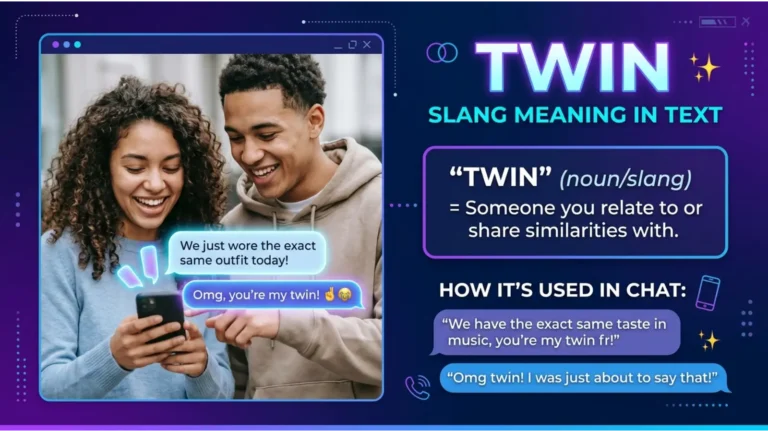
Twin slang meaning is a popular search for people who see the word “twin” in text messages, TikTok comments, Instagram posts, or everyday conversations. Traditionally, a twin is one of two children born during the same pregnancy.
However, in modern slang, the word has a different meaning. People often call their close friends, favorite people, or even strangers “twin” when they feel connected to them or share similar personalities, opinions, interests, or experiences.
You do not need to be related to someone to call them your twin. The term is usually friendly and informal, making it common among friends and younger social media users. However, its exact meaning can depend on the conversation, relationship, and tone. Understanding this slang can help you interpret messages correctly and respond naturally.
Quick Answer:
Twin slang means a person who feels similar to you, understands you, or shares your interests and personality. It is often used as a friendly nickname for a close friend or someone you relate to.
What Does Twin Mean in Text?
In texting, “twin” is an informal term people use for someone they feel connected to or have something in common with. It can describe a best friend, a person with similar tastes, or someone who seems to understand them perfectly.
For example, if your friend loves the same music, wears a similar outfit, or shares your opinion, you might say, “That’s my twin!”
The word can communicate friendship, excitement, familiarity, and a sense of belonging. It does not necessarily mean that two people look alike or are actual twins.
Twin Slang Full Form and Definition
Unlike abbreviations such as LOL or BRB, twin is not an acronym and has no special slang full form. It is an ordinary English word that has developed an additional informal meaning.
In slang, twin can mean:
- Close friend: Someone you feel comfortable around.
- Similar person: Someone who shares your interests or personality.
- Kindred spirit: Someone who understands your thoughts or feelings.
- Friendly nickname: A casual way to address someone you relate to.
Twin Meaning in Different Contexts
The meaning of twin can change slightly depending on where and how someone uses it.
1. Twin Meaning in Text Messages
In text messages, twin is often a friendly nickname. People use it to show that they relate to someone or feel close to them.
Example:
A: “I could eat pizza every day.”
B: “Twin, same!”
Here, the word shows that both people share the same preference.
2. Twin Meaning on TikTok
On TikTok, people may use “twin” in comments when they relate to a creator, agree with an opinion, or notice a similarity.
Example:
“Twin, you understand me!”
This means the commenter feels understood or shares a similar perspective.
3. Twin Meaning on Instagram
On Instagram, twin may appear in comments, captions, stories, or direct messages. Friends might use it when posting matching outfits, similar pictures, or shared memories.
Example:
“Out with my twin today.”
The person is probably referring to a close friend, not necessarily a biological sibling.
4. Twin Meaning in Real-Life Conversations
People also use twin in face-to-face conversations. Friends might call each other twin because they have similar habits, humor, or tastes.
Example:
“You ordered the same drink as me? You’re my twin!”
The speaker is expressing amusement and connection.
Is Twin Slang Rude, Offensive, or Neutral?
Twin is generally friendly, casual, and positive. People commonly use it to express closeness, agreement, or similarity.
However, context still matters. A nickname that feels natural between friends may sound overly familiar when used with a stranger or someone who prefers formal communication.
Consider these examples:
- Friendly: “Twin, I knew you’d understand!”
- Playful: “We bought the same shoes. We’re twins now.”
- Potentially awkward: Calling a coworker “twin” during a formal meeting when you do not know them well.
The word itself is not usually offensive. Still, avoid assuming that everyone likes informal nicknames.
Where Is Twin Slang Commonly Used?
Twin slang appears in several communication settings, especially informal conversations.
- Text messages: Chats between friends and family.
- TikTok: Comments, videos, and creator interactions.
- Instagram: Captions, comments, and direct messages.
- Snapchat: Casual conversations and messages between friends.
- Gaming communities: Friendly interactions between players.
- Everyday speech: Conversations among people who share interests or experiences.
Its popularity and exact use can vary by community, age group, and social setting.
Real-Life Conversation Examples of Twin Slang
The easiest way to understand twin slang is to see it in everyday conversations.
Friendly Examples
Example 1
A: “I always listen to music when I study.”
B: “Twin! I do that too.”
Meaning: Both people share the same habit.
Example 2
A: “You always know what I’m thinking.”
B: “That’s why we’re twins.”
Meaning: They understand each other very well.
Casual Examples
Example 3
A: “I got iced coffee again.”
B: “Twin, that’s my favorite!”
Meaning: They share a favorite drink.
Example 4
A: “We picked the same outfit.”
B: “Twin energy!”
Meaning: Their styles are similar.
Argumentative or Sarcastic Examples
Twin is usually positive, but people can use it sarcastically depending on their relationship and tone.
Example 5
A: “You copied my idea again.”
B: “Okay, twin, we clearly think alike.”
Meaning: The speaker may be joking or expressing mild annoyance.
Example 6
A: “You always say exactly what I say.”
B: “We’re twins, remember?”
Meaning: The response could be playful or defensive, depending on the situation.
These examples show why the surrounding conversation matters when interpreting slang.
Emotional and Psychological Meaning of Twin
Calling someone twin can express more than simple similarity. It can communicate an emotional connection or a feeling of being understood.
People may use the term to show:
- Belonging: They feel accepted by another person.
- Understanding: They believe someone shares their perspective.
- Affection: They want to express friendship or closeness.
- Shared identity: They feel connected through interests, humor, or experiences.
- Excitement: They are happy to discover a similarity.
For example, someone might say, “You’re my twin because nobody else gets my jokes.” This expresses a sense of connection, although the word alone does not prove how close two people actually are.
Origin and Background of Twin Slang
The word “twin” has long referred to one of two children born during the same pregnancy. Its informal use developed from the broader idea of two people being alike.
In everyday speech, people have often compared close friends or similar-looking people to twins. Online communication has helped spread this figurative use, especially in casual conversations and social media communities.
Today, someone can be called a twin because of matching clothes, similar opinions, shared habits, or a strong sense of friendship.
There is no single confirmed origin for every modern slang use of the word. Its meaning has evolved naturally through everyday language and online interactions.
Twin vs. Bestie vs. Bro vs. Soulmate
Twin is similar to several other slang terms, but each word emphasizes something slightly different.
| Slang term | Meaning | Common use |
|---|---|---|
| Twin | Someone similar to you or someone you relate to | Shared interests or experiences |
| Bestie | Best friend | Close friendship |
| Bro | Friend or brother-like person | Casual conversation |
| Soulmate | Someone with a deep emotional connection | Strong personal or romantic bond |
| BFF | Best friend forever | Close friendship, often playful |
For example, you might call someone your bestie because they are your closest friend, but call them your twin because you share the same humor, opinions, and interests.
These words can overlap, and their meanings depend on how people use them.
When Should You Use or Avoid Twin?
Twin works best in relaxed conversations where the other person understands your tone.
When to Use Twin
Use it when:
- Talking casually with friends.
- Discovering that someone shares your interests.
- Responding to a relatable social media post.
- Joking about similar outfits, habits, or opinions.
- Giving a friend an affectionate nickname.
When to Avoid Twin
Consider another expression when:
- Writing a formal email or business message.
- Speaking in a professional meeting.
- Addressing someone you do not know well.
- You are unsure whether the person welcomes informal nicknames.
In formal situations, expressions such as “I agree,” “We have similar interests,” or “I can relate to that” are often more appropriate.
Polite Alternatives to Twin
If you want to express the same idea without using slang, try these alternatives:
- We have a lot in common: Use when you share interests or experiences.
- I can relate to you: Use when someone describes a familiar feeling or situation.
- You understand me: Use when someone understands your perspective.
- We’re on the same wavelength: Use when you think similarly.
- You’re just like me: Use when you notice a strong similarity.
- My close friend: Use when describing the relationship to others.
These expressions work in both casual and more neutral conversations, depending on the wording.
Why Do People Use Twin Slang?
People use twin because it is short, expressive, and easy to understand in informal settings. A single word can communicate agreement, friendship, and similarity.
Common reasons include:
- Building connections: It helps people express a sense of closeness.
- Showing agreement: It can mean “I feel the same way.”
- Creating a playful tone: It makes a conversation feel relaxed.
- Expressing shared identity: It highlights common interests or habits.
- Joining online conversations: It is a convenient response to relatable posts.
For example, commenting “Twin!” under a post about a favorite movie quickly communicates that you share the same preference.
Impact of Twin Slang on Communication
Slang makes conversations feel more natural and personal, especially among friends. Words such as twin can help people communicate warmth and shared experiences without writing long explanations.
However, slang can also create confusion when someone is unfamiliar with the term. A person might interpret twin literally or assume it refers only to physical resemblance.
To communicate clearly, consider your audience and the situation. Informal slang is often effective in friendly chats, while standard English is usually preferable in professional writing.
Is Twin Slang Safe for Social Media?
Yes. Twin is generally harmless slang and is commonly used in friendly online interactions. It is not inherently offensive or inappropriate.
Still, remember a few basic online communication tips:
- Be respectful when commenting on other people’s posts.
- Do not use nicknames to pressure someone into a friendship.
- Avoid assuming that strangers want to be addressed informally.
- Consider the context before interpreting a comment.
The word itself is usually safe, but the way someone uses it can affect how a message is received.
Common Misunderstandings About Twin Slang
Some people misunderstand the word because it has both a literal and a figurative meaning.
Misunderstanding 1: Twin always means a biological sibling.
Correction: In slang, it can refer to a friend or anyone who shares similarities with you.
Misunderstanding 2: Twin means two people look identical.
Correction: People can use it even when they look completely different.
Misunderstanding 3: Calling someone twin means they are your best friend.
Correction: It can suggest closeness, but it may simply express agreement or a shared interest.
Misunderstanding 4: Twin is always romantic.
Correction: It is usually friendly and does not automatically suggest romantic interest.
Variations and Types of Twin Slang
People use several related expressions in casual conversation:
- Twin: A person you relate to or feel similar to.
- My twin: A more personal way to describe someone you feel connected to.
- Twin energy: A phrase for two people who act or think alike.
- Twin vibes: A way to describe a similar style, mood, or personality.
- Twin behavior: A playful comment about two people doing the same thing.
For example, “We both showed up wearing black. Twin behavior!” means that the two people independently made the same fashion choice.
These expressions are informal, and their meaning can vary with context.
How to Respond When Someone Calls You Twin
Your response depends on whether the person is a friend, an acquaintance, or someone online.
| Situation | Possible response |
|---|---|
| A friend calls you twin | “Always, twin!” |
| Someone shares your opinion | “Right? We think alike!” |
| Someone notices matching outfits | “Great minds think alike!” |
| A stranger comments “Twin!” | “Haha, I see the resemblance!” |
| You do not understand the context | “What do you mean by twin?” |
You do not need a special response. A simple, friendly reply is usually enough.
Regional and Cultural Usage
Twin slang is particularly visible in informal English-language online communities, including social media and texting. Its exact frequency and tone vary across regions and groups.
In the United States, it may be used as a casual term of address or to express similarity. Online, users in other English-speaking communities may also understand and use it through exposure to social media.
However, slang is not universal. Some people may be familiar with “twin” as a friendly nickname, while others may primarily associate it with biological siblings. When communicating across cultures, context helps avoid misunderstandings.
Frequently Asked Questions
1. What does twin mean in slang?
Twin means someone who shares your interests, personality, opinions, or experiences. It is often used as a friendly nickname.
2. What does twin mean in text messages?
In text messages, twin usually expresses agreement, friendship, or similarity. For example, “Twin, I love that song too!” means both people like the same song.
3. What does twin stand for?
Twin does not stand for a longer phrase. It is a regular English word with an additional informal slang meaning.
4. Is twin slang a compliment?
Usually, yes. Calling someone twin often communicates friendliness, affection, or a sense of connection. However, tone and context can change the meaning.
5. Does twin mean best friend?
Not necessarily. It can refer to a best friend, but it can also describe someone you have just met who shares your interests or opinions.
6. Can you call a stranger twin?
Yes, in some casual online conversations, but not everyone welcomes familiar nicknames from strangers. Consider the context and the other person’s comfort.
Conclusion
The twin slang meaning is simple: it describes someone you relate to, share similarities with, or feel connected to. In texts and social media, people commonly use it as a friendly nickname, an expression of agreement, or a playful way to celebrate shared interests.
Twin does not always mean a biological sibling, a best friend, or a romantic partner. Its meaning depends on the relationship and conversation. Use it naturally with friends and in casual online settings, and choose more neutral expressions in formal situations.
Understanding the context and tone will help you interpret twin correctly and use it confidently in everyday communication.

Ali Raza is an M.Phil. scholar and English language expert specializing in English grammar, slang meanings, vocabulary, and everyday expressions. He writes clear, practical, and easy-to-understand content that helps readers master confusing English words, phrases, spelling, and modern slang. His goal is to make English learning simple, useful, and accessible for students, beginners, and everyday readers.
1 thought on “Twin Meaning in Slang and How to Use It Correctly”