
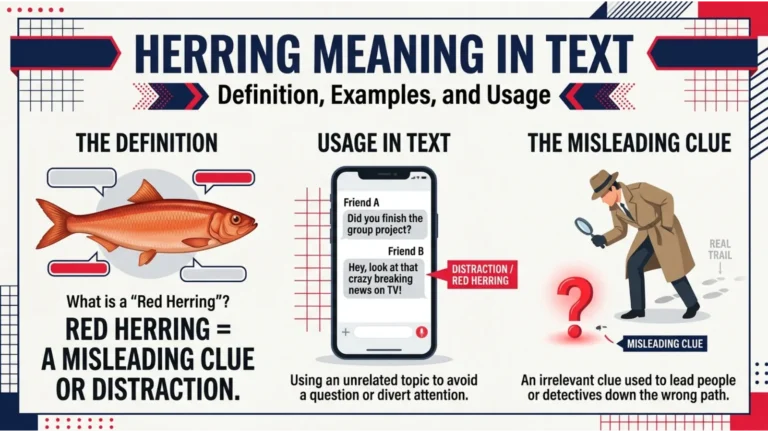
Herring meaning slang is a phrase people may search for when they encounter the word “herring” in online conversations, social media posts, comments, or discussions.
Unlike many modern texting abbreviations, herring is not widely recognized as a standalone slang term. However, it often appears in the expression “red herring,” which describes something that distracts people from the main issue or leads them toward the wrong conclusion.
Understanding this expression can help you follow online debates, jokes, mystery stories, and everyday conversations more easily.
The meaning also depends on how someone uses the word. In some situations, herring refers to a type of fish, while in others, it has a figurative meaning connected to misleading information or distractions.
Quick Answer:
Herring meaning slang is commonly associated with a “red herring,” meaning a misleading clue, distraction, or detail that takes attention away from the main point. Herring itself is not a widely established standalone texting abbreviation.
What Does Herring Mean in Text?
In text messages and online discussions, “herring” may refer to a distraction or misleading detail, particularly when someone uses the expression “red herring.”
A red herring is something that makes people focus on the wrong subject instead of addressing the real question or problem.
For example:
- “That argument is a red herring.”
- “Stop bringing up a red herring and answer the question.”
- “The detective followed a red herring before discovering the truth.”
In these examples, the expression describes information that distracts from the central issue.
However, if someone simply writes “herring,” they may literally mean the fish. You should consider the surrounding conversation before deciding what the word means.
Herring Full Form and Definition
People sometimes search for a “herring full form” because they expect unfamiliar internet words to be abbreviations. However, herring does not have a standard slang full form.
The word has two main meanings:
- Literal meaning: A herring is a small, oily fish commonly found in the Atlantic and Pacific oceans.
- Figurative meaning: In the expression “red herring,” it refers to something misleading that distracts from the main subject.
The figurative meaning is especially common in discussions about arguments, mysteries, news, and problem-solving.
Herring Meaning Slang in Different Contexts
The meaning of herring can change depending on the situation.
1. Herring in Text Messages
In texting, someone might use “red herring” when they believe another person is avoiding a question or changing the subject.
Example:
Person A: “Why didn’t you finish the project?”
Person B: “Well, the other team made mistakes too.”
Person A: “That’s a red herring. We’re talking about your project.”
Here, the phrase suggests that the response distracts from the original question.
2. Herring on Social Media
On social media, people may describe an unrelated argument or misleading detail as a red herring.
For example, during an online debate, someone might focus on a person’s appearance instead of responding to the person’s actual argument.
A commenter could say, “You’re using a red herring instead of addressing the issue.”
3. Herring in Movies and Mystery Stories
Mystery novels, detective shows, and crime films often use red herrings to mislead the audience.
A suspicious character may appear guilty, but later evidence reveals that the character had nothing to do with the crime.
The misleading clue is a red herring because it encourages viewers to suspect the wrong person.
4. Herring in Everyday Conversations
People can also use the expression in ordinary discussions about relationships, school, work, and personal disagreements.
For example, if someone changes the subject instead of answering a direct question, another person might describe that response as a red herring.
Is Herring Rude, Offensive, or Neutral?
The word “herring” is generally neutral when it refers to the fish. The expression “red herring” is also not inherently offensive.
However, calling someone’s argument a red herring may sound critical because it suggests that the person is avoiding the main issue or using a distraction.
Consider these examples:
- Neutral: “The author included a red herring in the mystery.”
- Friendly: “I think we’ve found a little red herring here.”
- Critical: “Your entire argument is a red herring.”
The tone depends on the situation, the relationship between the speakers, and how the expression is delivered.
Where Is Herring Commonly Used?
The literal word “herring” appears in conversations about food, fishing, cooking, and marine life.
The figurative expression “red herring” is commonly used in:
- Social media: To criticize distractions in online debates.
- Education: To explain reasoning errors and misleading clues.
- Workplaces: To identify discussions that move away from the main problem.
- News and politics: To describe arguments that shift attention away from an important issue.
- Books and movies: To describe clues that mislead readers or viewers.
- Everyday conversations: To point out when someone changes the subject.
Although the expression appears in informal conversations, it is also used in formal writing and critical analysis.
Real-Life Conversation Examples
Here are examples showing how the expression may appear in different situations.
Friendly Examples
Example 1
Friend A: “I think the neighbor stole the package.”
Friend B: “Maybe, but that could be a red herring.”
Example 2
Friend A: “This mystery is impossible to solve!”
Friend B: “The writer keeps giving us red herrings.”
Casual Examples
Example 3
Person A: “Why are we discussing my old mistake?”
Person B: “Fair point. That might be a red herring.”
Example 4
Comment: “Everyone is arguing about the headline instead of the actual report. Total red herring.”
Argumentative Examples
Example 5
Person A: “You didn’t answer my question.”
Person B: “I answered something related to it.”
Person A: “No, that’s a red herring. Please address the original question.”
Example 6
Commenter A: “Your point about the other company doesn’t prove anything.”
Commenter B: “How is that relevant?”
Commenter A: “It’s a red herring. We’re discussing this company’s decision.”
These examples demonstrate the figurative expression rather than an established standalone slang definition for “herring.”
Emotional and Psychological Meaning
A red herring can affect how people understand a discussion because attention naturally shifts toward information that seems interesting, surprising, or emotionally powerful.
For example, during a disagreement, someone might introduce an unrelated personal criticism. The conversation then becomes focused on that criticism instead of the original problem.
This can lead to:
- Confusion about the real issue.
- Frustration during disagreements.
- Difficulty evaluating evidence fairly.
- Unnecessary arguments.
- Delayed problem-solving.
However, not every change of subject is intentional deception. People sometimes introduce unrelated information because they misunderstand the question or believe another detail matters.
It is important to evaluate the situation before assuming someone’s motives.
Origin and Background of Herring
The word “herring” originally refers to a type of fish. The expression “red herring” developed as a figurative expression for something that distracts or misleads.
A traditional explanation connects the expression with the strong smell and appearance of smoked or cured herring, which could be used to distract animals during a chase. The precise historical development of the expression is more complicated than this popular explanation suggests.
Today, “red herring” has a well-established meaning in English. It is used in logic, storytelling, journalism, law, and everyday conversation to describe misleading information or an irrelevant distraction.
It is not a newly invented texting abbreviation, and there is no widely accepted slang full form for the word “herring.”
Herring vs. Similar Expressions
Several English expressions describe distractions or misleading information, but they do not all mean exactly the same thing.
| Term | Meaning | Example |
|---|---|---|
| Red herring | A misleading clue or distraction | “That detail is a red herring.” |
| Distraction | Something that takes attention away | “The noise was a distraction.” |
| Misdirection | Leading someone’s attention in the wrong direction | “The magician used misdirection.” |
| Smoke screen | Something that hides the real purpose or issue | “The announcement was a smoke screen.” |
| Change the subject | Move the conversation to another topic | “Don’t change the subject.” |
| False lead | Information that sends an investigation in the wrong direction | “The witness gave the police a false lead.” |
The main difference: A red herring is a specific kind of distraction, often involving misleading information. The other expressions describe related but not identical situations.
When Should You Use or Avoid Herring?
You can use “red herring” when you want to explain that a detail is distracting people from the main point.
When to Use It
- When discussing a misleading clue in a mystery.
- When analyzing an argument.
- When explaining a distraction in a debate.
- When identifying an unrelated point in a conversation.
- When discussing reasoning and critical thinking.
When to Avoid It
Avoid using the expression to accuse someone of deliberately misleading others unless you have good reason to believe that is happening.
Also, remember that “red herring” may sound overly formal or argumentative in a casual text message. Simpler alternatives can be more natural with friends.
For example, instead of saying, “That is a red herring,” you could say, “That’s not really related to the question.”
Polite Alternatives to Red Herring
If you want to point out a distraction without sounding rude, consider these alternatives:
- “I think we’re getting away from the main point.”
- “Could we return to the original question?”
- “That may be a separate issue.”
- “I’m not sure how that relates to what we’re discussing.”
- “Let’s focus on the main problem.”
- “I understand your point, but I’d like to address the original topic first.”
These expressions help keep a discussion focused without immediately accusing someone of misleading others.
Why Do People Use This Expression?
People use “red herring” because it provides a concise way to describe a misleading clue or an argument that distracts from the real issue.
The expression can be useful when explaining complicated discussions, analyzing stories, or identifying weak reasoning.
For example, a student might use it in an essay to explain how a mystery writer misleads readers. A worker might use it during a meeting to bring attention back to the main problem.
People also use the phrase online because it helps them criticize an argument without writing a lengthy explanation.
Still, the expression is most effective when the speaker can explain exactly how the detail distracts from the original subject.
Impact of Using Herring in Communication
Using “red herring” can make communication clearer when the expression accurately describes the situation.
It can help people recognize irrelevant information, improve discussions, and focus on evidence rather than distractions.
However, using it incorrectly can have the opposite effect. If you call every opposing argument a red herring, you may appear unwilling to consider another person’s point of view.
A better approach is to explain why the information is unrelated to the original question.
For example:
Instead of saying, “That’s a red herring,” try saying, “That may be true, but it doesn’t answer the question about the budget.”
The second response identifies the problem more clearly and encourages a more productive discussion.
Is Herring Safe to Use on Social Media?
Yes. The word “herring” and the expression “red herring” are generally safe for ordinary social media conversations. Neither is inherently vulgar or offensive.
You can use the expression in comments, captions, educational posts, and discussions.
However, tone matters. Calling someone’s argument a red herring can sound confrontational, particularly during a heated political or personal debate.
If you want to maintain a friendly conversation, explain the connection you see between the original question and the information being discussed.
Also, do not assume that every social media post using “herring” refers to slang. The writer may be discussing fish, food, or a literal topic.
Common Misunderstandings About Herring
People can misunderstand the word because they encounter it without knowing the expression “red herring.”
Here are some common mistakes:
1. Assuming herring is an abbreviation
Herring does not have a standard slang full form.
2. Believing herring always means a distraction
The word has a literal meaning as a type of fish. The figurative meaning is most clearly established in “red herring.”
3. Thinking red herring always means a lie
A red herring is a distraction or misleading clue. It does not necessarily mean that the information itself is false.
4. Assuming everyone uses it as internet slang
The expression is established English vocabulary, not a widely recognized modern texting abbreviation.
5. Treating every change of subject as deliberate manipulation
A person may change the subject unintentionally. Context and evidence matter when interpreting their behavior.
Variations and Types of Herring
The word can appear in several forms or expressions.
- Herring: The fish itself.
- Red herring: A misleading clue, detail, or distraction.
- Red herring fallacy: A reasoning error in which someone introduces an irrelevant point that distracts from the issue under discussion.
- Red herring clue: A misleading clue in a mystery, novel, film, or investigation.
These expressions are related, but they are not interchangeable in every situation.
How to Respond When Someone Uses Herring
Your response depends on what the other person means.
If they mean a distraction:
Person A: “That’s a red herring.”
You could reply: “Which part do you think is unrelated to the main point?”
If they use it during an argument:
You could say: “Let’s go back to the original question and address it directly.”
If you are discussing a mystery:
You could reply: “That makes sense. The clue was designed to mislead the audience.”
If the meaning is unclear:
Ask, “Do you mean a red herring, or are you talking about the fish?”
Asking for clarification is often the easiest way to avoid misunderstanding.
Regional and Cultural Usage
The expression “red herring” is established in English-speaking communities, including the United States, the United Kingdom, Canada, and Australia.
Its figurative meaning is generally consistent across these regions. People may encounter it in schools, workplaces, journalism, entertainment, and online discussions.
English speakers in other countries may also use the expression, particularly in educational or professional settings. However, familiarity can vary depending on a person’s English proficiency and exposure to the phrase.
There is no strong reason to treat “herring” as a separate regional texting abbreviation without additional context.
Frequently Asked Questions
1. What does herring mean in slang?
Herring is not widely recognized as standalone slang. It is commonly associated with “red herring,” meaning a misleading clue or distraction.
2. What does herring stand for in text?
Herring does not have a standard full form or acronym meaning in text messages. Its meaning depends on the context.
3. Is red herring an insult?
Not inherently. However, calling someone’s argument a red herring can sound critical because it suggests that the argument distracts from the main issue.
4. What is an example of a red herring?
If someone asks why a project failed and another person talks about an unrelated mistake from last year, that response may be a red herring if it distracts from the actual question.
5. Is herring a bad word?
No. Herring is an ordinary English word, and “red herring” is a common expression. Neither is inherently offensive.
6. Is herring the same as a false lead?
They are similar. A red herring is a misleading clue or distraction, while a false lead is information that sends someone in the wrong direction, especially during an investigation.
Conclusion
Herring meaning slang is most commonly connected to the expression “red herring,” which describes a misleading clue or distraction that takes attention away from the main issue. However, herring itself is not a widely established standalone slang term or texting abbreviation.
Understanding the context is essential. The word may refer to a fish, while “red herring” can describe an irrelevant argument, a misleading clue in a mystery, or information that distracts from an important question.
Use the expression when it accurately describes the situation, and explain your reasoning when discussing disagreements. This approach helps prevent misunderstandings and keeps conversations clear, respectful, and focused.

Ali Raza is an M.Phil. scholar and English language expert specializing in English grammar, slang meanings, vocabulary, and everyday expressions. He writes clear, practical, and easy-to-understand content that helps readers master confusing English words, phrases, spelling, and modern slang. His goal is to make English learning simple, useful, and accessible for students, beginners, and everyday readers.
3 thoughts on “Herring Meaning Slang in Text Explained With Examples”