

Inputted or Input often confuses writers because both forms can describe entering information. The confusion usually appears in past-tense sentences. Many writers expect “inputted” because most verbs take “-ed.” However, “input” can also work as a past-tense form. Major dictionaries recognize both forms. Cambridge lists both “input” and “inputted” as past forms. Merriam-Webster also lists “inputted or input” for the verb.
The best choice depends on your sentence and audience. “Input” often sounds concise and natural in technical writing. “Inputted” clearly marks the completed action. Both forms can be grammatically correct. This guide explains their meanings, differences, history, usage, and common mistakes. You will also learn which form works best in everyday and formal writing.
⭐ Quick Answer
Inputted or Input can both be correct past forms of the verb “input.” “Input” is concise and traditional, while “inputted” clearly shows the past action.
Example: I input the data yesterday. / I inputted the data yesterday.
📘 Meaning of Input
Input means to enter information, data, numbers, or commands into a computer or system. It can also mean advice, ideas, or information given to someone.
As a verb, “input” can have the same form in the present and past.
Examples:
- I input the customer details yesterday.
- She input the figures into the spreadsheet.
As a noun, “input” means information, advice, or something added to a system.
Example:
- Your input helped us improve the project.
Cambridge recognizes “input” as a past tense and past participle of the verb.
📘 Meaning of Inputted
Inputted is the regular past-tense and past-participle form of “input.” It means that someone entered information into a computer or system.
The word is accepted in standard English dictionaries. Cambridge directly lists “inputted” as the past simple and past participle of “input.”
Examples:
- She inputted the customer information yesterday.
- We have inputted all the survey results.
“Inputted” can sound clearer when you want to emphasize a completed action.
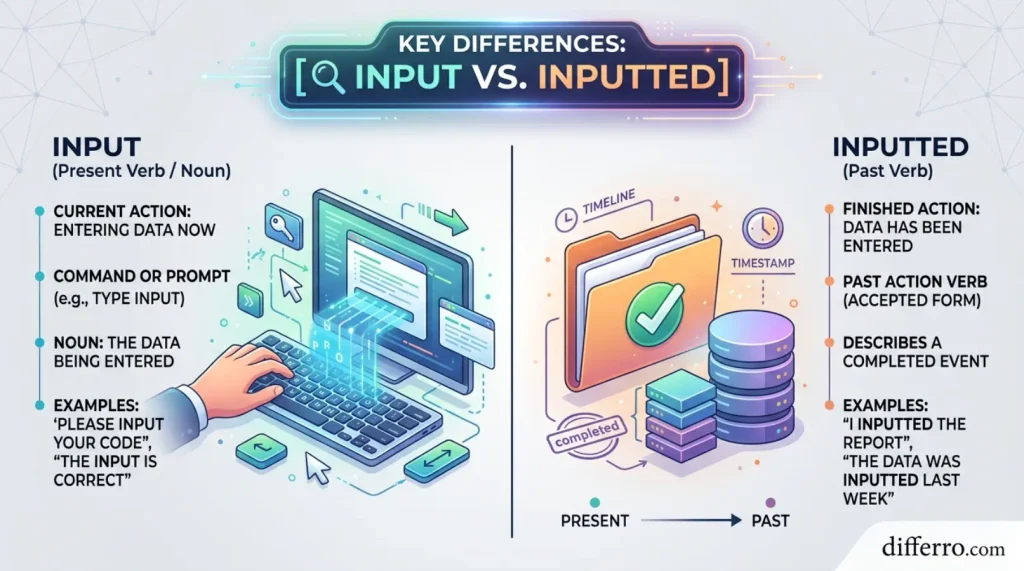
🔍 Key Differences: Inputted or Input
| Feature | Input | Inputted |
|---|---|---|
| Meaning | Entered information | Entered information |
| Tone | Concise and traditional | More explicit and regular |
| Usage | Common in technical writing | Common in technical and general writing |
| Popularity | Widely used | Widely recognized |
| Past tense | Correct | Correct |
| Past participle | Correct | Correct |
The main difference is form, not meaning. Both words can describe entering information into a system.
📚 Origin & History
The word input developed from the combination of “in” and “put.” It first worked mainly as a noun for something put into a system. Later, it became common as a computing verb.
Merriam-Webster records the noun “input” from the 17th century. It records the verb sense from the 20th century.
The verb follows an unusual pattern because “put” keeps the same form in several tenses. This helped establish input as a past form.
However, English speakers also created the regular form inputted. Dictionaries now recognize both forms.
Similar verb patterns include:
- Put → put
- Input → input or inputted
- Output → output or outputted
- Reset → reset or reset
- Set → set
There is no major spelling difference between British and American English for input or inputted.
Both varieties recognize inputted as a valid form.
Both also use input as a past and past-participle form.
| English Variety | Preferred Forms | Example |
|---|---|---|
| British English | input / inputted | I input the data yesterday. |
| American English | input / inputted | I inputted the data yesterday. |
| Canadian English | input / inputted | She input the information. |
| Australian English | input / inputted | They inputted the details. |
The choice usually depends more on style and context than national spelling rules.
✍️ When to Use Input
Use input when you want a concise past-tense form.
It works especially well in technical, business, and computing contexts.
Examples:
- I input the figures yesterday.
- She input the customer’s details correctly.
- We input all the records before lunch.
- They input the data into the system.
“Input” can sound especially natural when the surrounding sentence already makes the past meaning clear.
Use Input in Formal Writing
You can use “input” in professional writing without treating it as an error.
For example:
- The technician input the values manually.
- The employee input the information into the database.
- We input the results after checking each record.
However, some readers may find “inputted” more immediately clear.
✍️ When to Use Inputted
Use inputted when you want a clearly marked past form.
It can make the timing of an action easier to recognize.
Examples:
- I inputted the data yesterday.
- She inputted the wrong account number.
- The assistant inputted all the customer records.
- We inputted the results into the system.
“Inputted” is fully recognized by major dictionaries.
It can also work well when several regular past-tense verbs appear together.
Example:
- She checked, corrected, and inputted the information.
⚠️ Common Mistakes
1. Using “inputed”
Incorrect: I inputed the information yesterday.
Correct: I inputted the information yesterday.
The regular form needs two t’s before “-ed.”
2. Assuming “inputted” is always wrong
Incorrect idea: Inputted is never grammatically correct.
Correct: Inputted is a recognized past-tense and past-participle form.
Major dictionaries support this form.
3. Using “input” incorrectly with present meaning
Incorrect: Yesterday, I inputs the data.
Correct: Yesterday, I input the data.
The third-person present form is inputs, not “inputs” after “I.”
4. Confusing “input” with “inputted” in one sentence
Incorrect: Yesterday, I inputted the data and then input another file.
Better: Yesterday, I inputted the data and then inputted another file.
Consistency makes your writing easier to follow.
🧠 Easy Trick to Remember
Think about the word put.
“Put” stays unchanged in its past form.
Because input contains “put,” you can remember:
Present: I input the data.
Past: I input the data.
You can also remember the regular option:
Input → inputted
If you prefer a clearly marked past form, inputted works.
The key is simple: Never write “inputed.”
🌎 Everyday Life Examples
1. Entering Information Online
You may need to input personal details into an online form.
- I input my address yesterday.
- I inputted my address yesterday.
Both sentences can be correct.
2. Using a Spreadsheet
Office workers often input numbers into spreadsheets.
- She input the sales figures.
- She inputted the sales figures.
Both forms describe the same completed action.
3. Entering Customer Data
Businesses regularly input customer information into databases.
- The assistant input the customer details.
- The assistant inputted the customer details.
The meaning remains the same.
4. Using a Computer System
Employees may input information into workplace software.
- He input the report number.
- He inputted the report number.
Both forms work when describing a past action.
5. Completing an Online Application
Applicants often input information into digital forms.
- I input my information before submitting the form.
- I inputted my information before submitting the form.
Both versions communicate the same idea.
📈 Google Trends & Usage Insights
Search interest for inputted or input mainly comes from grammar and writing questions.
The two forms appear in dictionaries and established English usage, so neither should be treated as a spelling error.
Usage can vary by region, workplace style, and technical context.
For USA, UK, Australia, India, and Pakistan, writers can safely understand both forms.
| Country | Common Search Intent | Useful Form |
|---|---|---|
| USA | Grammar and workplace writing | Input / inputted |
| UK | Grammar and formal writing | Input / inputted |
| Australia | English usage and education | Input / inputted |
| India | Technical and academic writing | Input / inputted |
| Pakistan | Academic and workplace English | Input / inputted |
Google Trends does not provide reliable public country-by-country word-frequency counts for every grammatical form. Therefore, these insights should not be treated as exact search-volume figures.
📊 Keyword Variations Comparison
| Keyword Variation | Search Intent | Best Use |
|---|---|---|
| Inputted or Input | Comparison | Main SEO keyword |
| Input or Inputted | Comparison | Secondary variation |
| Past tense of input | Grammar | Educational search |
| Is inputted correct | Grammar | Question-based search |
| Is input a past tense | Grammar | Featured snippet |
| Inputted meaning | Definition | Informational search |
| Input grammar | Grammar | Supporting keyword |
⚖️ Final Verdict
Inputted or Input are both correct forms of the verb “input.”
Use input when you want a concise and traditional form.
Use inputted when you want to make the past action more obvious.
For example:
- I input the data yesterday.
- I inputted the data yesterday.
Both sentences are grammatically acceptable. Cambridge and Merriam-Webster both recognize the two forms.
If you write for a specific organization, follow its preferred style. Most importantly, avoid inputed, which is not the standard spelling.
❓ Frequently Asked Questions
Is “inputted” correct?
Yes. Inputted is a correct past-tense and past-participle form of “input.” Cambridge and Merriam-Webster both recognize it.
What is the difference between inputted and input?
Both can describe the completed action of entering information. “Input” is the unchanged form, while “inputted” uses the regular “-ed” ending.
Which is more common, input or inputted?
Both are established forms. “Input” is widely used in technical writing, while “inputted” is also common and clearly marks past tense.
Is “input” formal?
Yes. Input is appropriate in formal, technical, academic, and workplace writing when used correctly.
Why does the confusion between inputted and input exist?
The confusion comes from the unusual verb pattern. Many writers expect “inputted” because regular English verbs usually take “-ed.” The influence of “put” also makes “input” seem natural.
📝 Conclusion
Inputted or Input can both be correct when used as past forms of the verb “input.” The main difference is their grammatical form and style, not their basic meaning. “Input” offers a short and traditional option. “Inputted” provides a clear regular past form. Major dictionaries recognize both choices.
Use input when it fits naturally with your writing style. Choose inputted when you want the past action to stand out clearly. Both work well in technical and workplace contexts. Always remember that inputed is incorrect. If your organization follows a specific style guide, use its preferred form consistently. For most readers, either input or inputted communicates the intended meaning clearly.

Imran Lodhra is a comparison-focused content writer at Differro.com.
He specializes in creating clear, simple, and informative comparison articles.
His work helps readers understand key differences, pros and cons, and important details.
Imran focuses on accurate, practical, and easy-to-read content for everyday readers.
1 thought on “Inputted or Input: Meaning, Difference and Correct Usage”