
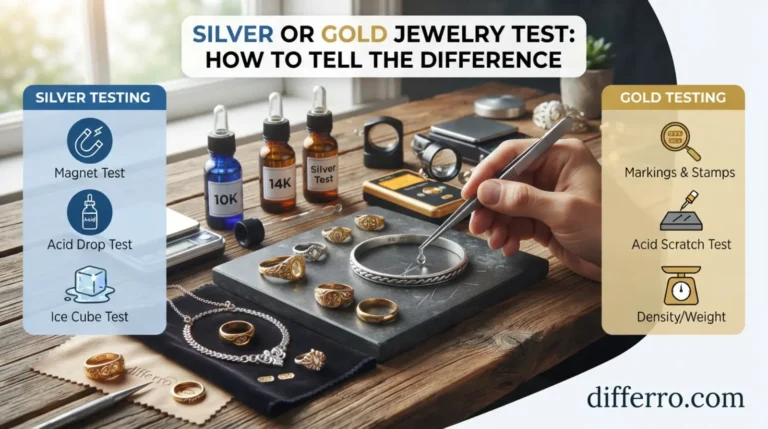
Silver or gold jewelry test methods help you identify a piece’s metal and understand its value. Many people struggle to tell silver from gold because jewelry can have similar shapes, finishes, and designs. Some pieces also use gold or silver plating over another metal.
Knowing the difference helps you avoid mistakes when buying, selling, or checking jewelry at home. Silver usually has a cool, white appearance, while gold comes in yellow, white, and rose shades. However, color alone cannot confirm a metal’s identity or purity.
Several tests can provide useful clues, including checking hallmarks, examining color, and using a magnet. Some methods require professional equipment for reliable results. This guide explains practical silver and gold jewelry tests, their limitations, and the safest ways to identify precious metals before making a purchase.
⭐ Quick Answer
The best way to distinguish silver from gold is to check the hallmark and have a jeweler perform an appropriate metal test. Silver is often marked 925 or 999, while gold may carry marks such as 375, 585, 750, or 999.
Example: A 925 stamp usually indicates sterling silver, while a 750 stamp usually indicates 18-karat gold. Hallmarks can be counterfeit, so confirm uncertain results professionally.
🥈 Meaning of Silver Jewelry
Silver jewelry contains silver as a main metal or as a surface coating. Pure silver is relatively soft, so jewelers often mix it with other metals to improve strength.
Sterling silver typically contains 92.5% silver and 7.5% other metals, often copper. Manufacturers may also plate other metals with silver to create a similar appearance.
Examples of Silver Jewelry
Example 1: A sterling silver ring carries a 925 hallmark, indicating a standard silver alloy containing 92.5% silver.
Example 2: A necklace has a silver-colored surface but a base-metal core. It may be silver-plated rather than solid silver.
Common Silver Hallmarks
- 999: Usually indicates 99.9% silver.
- 925: Usually indicates 92.5% silver.
- 800: Usually indicates 80% silver.
Hallmark systems vary by country and product. A stamp alone does not guarantee authenticity.
🥇 Meaning of Gold Jewelry
Gold jewelry contains gold mixed with other metals or, in some cases, a gold coating over another material. Jewelers use alloys to improve strength and create different colors.
Gold purity often appears in karats or fineness numbers. Pure gold is 24 karats, although jewelry marked 999 generally contains 99.9% gold.
Examples of Gold Jewelry
Example 1: An 18-karat gold ring contains approximately 75% gold and 25% other metals.
Example 2: A gold-plated bracelet has a thin gold layer over a different metal. Its appearance does not mean the entire bracelet contains gold.
Common Gold Hallmarks
- 999 or 24K: Usually indicates nearly pure gold.
- 750 or 18K: Usually indicates 75% gold.
- 585 or 14K: Usually indicates 58.5% gold.
- 375 or 9K: Usually indicates 37.5% gold.
These marks indicate claimed purity, not guaranteed authenticity. Counterfeit stamps and plated jewelry can mislead buyers.
🔍 Silver or Gold Jewelry Test: Key Differences
| Feature | Silver Jewelry | Gold Jewelry |
|---|---|---|
| Typical color | Silvery white | Yellow, white, or rose |
| Common purity mark | 925 or 999 | 375, 585, 750, or 999 |
| Common alloy | Silver mixed with other metals | Gold mixed with other metals |
| Tarnishing | Often develops tarnish over time | Pure gold resists tarnishing; alloys may change appearance |
| Magnet response | Pure silver is not magnetic | Pure gold is not magnetic |
| Density | Generally lower than gold | Generally higher than silver |
| Market value | Usually lower per gram than gold | Usually higher per gram than silver |
| Common uses | Rings, chains, earrings, decorative items | Rings, necklaces, bracelets, investment jewelry |
| Main identification methods | Hallmark checks and metal analysis | Hallmark checks and metal analysis |
Important: Appearance, weight, and magnet tests provide clues rather than proof. Other metals can imitate both silver and gold.
🧪 How to Test Silver or Gold Jewelry at Home
You can perform a few basic checks without damaging your jewelry. These methods help you gather clues, but none can confirm precious-metal purity on its own.
1. Check the Hallmark
Look for small numbers or letters stamped inside a ring or near a necklace clasp.
- Silver may carry marks such as 925 or 999.
- Gold may carry marks such as 585, 750, or 999.
- Plated jewelry may carry markings such as GP, GEP, or HGE, depending on the product.
Marking practices vary, and some pieces have no visible hallmark. Counterfeit marks also exist, so do not rely on a stamp alone.
2. Use a Magnet
Bring a small magnet close to the jewelry without scratching its surface.
Pure silver and pure gold are not magnetic. Strong attraction may suggest a magnetic base metal or component.
However, a lack of attraction does not prove authenticity. Many non-precious metals are also nonmagnetic, and some jewelry contains magnetic clasps or other components.
3. Examine the Surface
Inspect the jewelry under bright light. Look for areas where the surface color differs from the metal underneath.
- Silver-plated pieces may reveal a different-colored base metal where the coating wears away.
- Gold-plated pieces may show a different color around edges or frequently rubbed areas.
- Solid precious-metal alloys generally have consistent metal composition throughout, although solder and mixed components may differ.
Avoid scraping the jewelry to expose its core. Scratches can permanently damage the item and reduce its value.
4. Look for Tarnish or Discoloration
Silver often develops a dark tarnish after reacting with sulfur-containing compounds in the environment.
Gold resists ordinary tarnishing, especially at high purity. However, lower-karat gold alloys may discolor under certain conditions.
Tarnish alone cannot identify a metal. Silver-plated items can tarnish, and dirt or chemical exposure can affect many materials.
5. Compare Weight Carefully
Gold is much denser than silver. A gold piece of the same size and design may feel heavier than a silver piece.
However, hollow jewelry, different alloys, stones, and internal structures can change weight. Compare only pieces with similar dimensions and construction.
Do not judge authenticity by weight alone.
🏆 The Most Reliable Silver or Gold Jewelry Test
For valuable or uncertain jewelry, professional testing provides better evidence than home checks.
X-Ray Fluorescence (XRF) Testing
A jeweler or testing laboratory may use an XRF analyzer to estimate the metal composition of a piece.
The device can identify many elements without cutting or scratching the jewelry. However, surface plating can affect readings, and the method may not establish the composition of every layer.
Acid Testing
A trained jeweler may use specific testing acids to help identify gold or silver and estimate purity.
This method can damage the jewelry or leave marks, especially if the tester scratches the surface. Let a professional decide whether the test suits your item.
Laboratory Analysis
A qualified laboratory can use suitable analytical methods to assess precious-metal content. Some methods require a sample and may damage the item.
Ask about the testing method, limitations, fees, and whether the process affects the jewelry before agreeing.
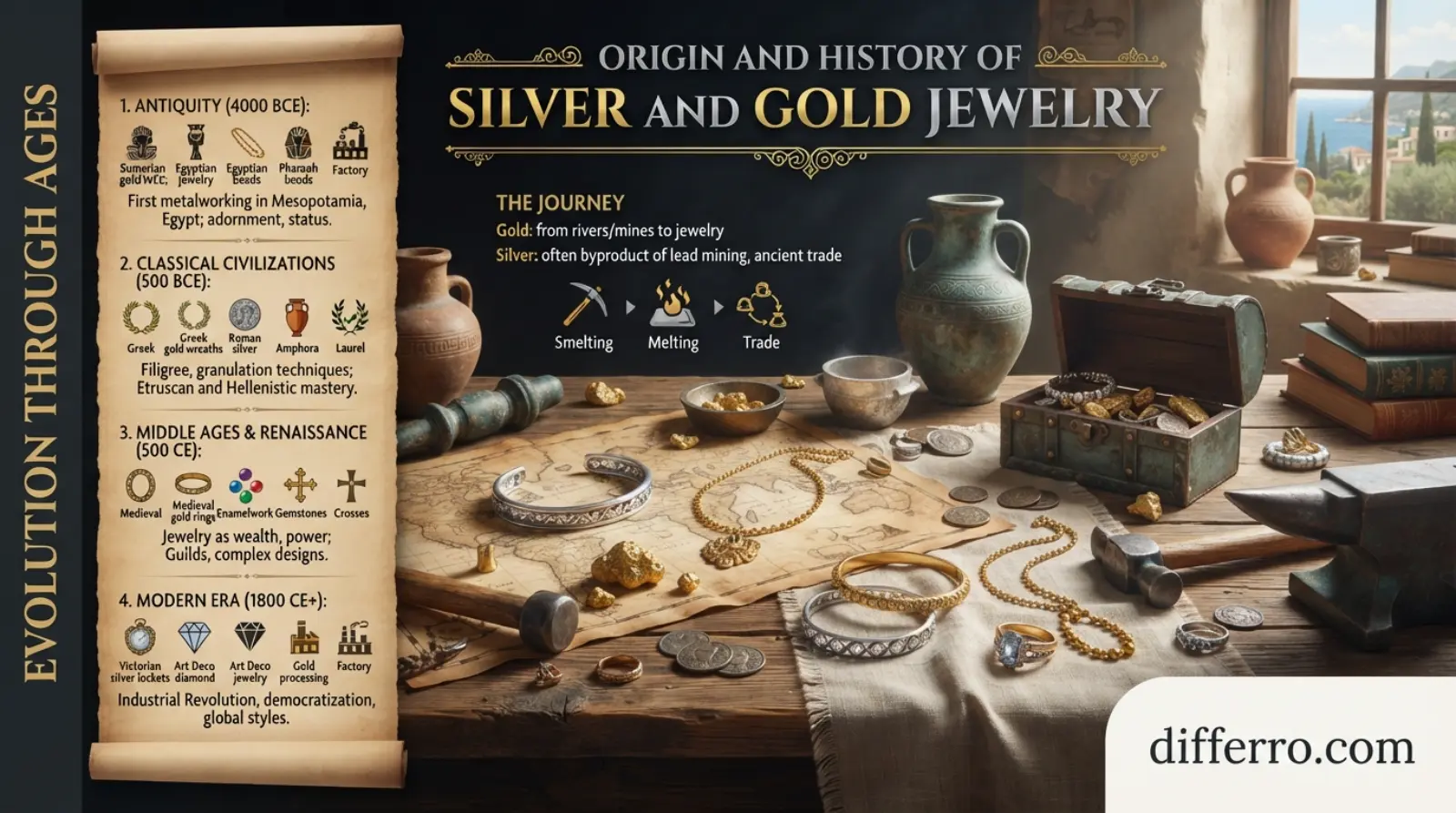
🕰️ Origin and History of Silver and Gold Jewelry
People have used gold and silver for jewelry, decoration, trade, and ceremonial objects for thousands of years. Their appearance, durability, and rarity helped make them valuable materials across many cultures.
Gold often became associated with wealth and status. Silver also served as a valuable metal for ornaments, coins, utensils, and decorative objects.
As jewelry production developed, makers introduced alloys and plating techniques. Hallmarks and purity standards helped buyers understand the metal content of their purchases.
Today, modern instruments can analyze precious metals more accurately than appearance-based checks. Traditional hallmarks still provide a useful starting point, but professional verification remains important for valuable items.
Similar Jewelry Terms
- Solid gold: Gold alloy throughout the main body, rather than only a surface layer.
- Gold-plated: A thin gold coating over another material.
- Gold-filled: A thicker mechanically bonded gold layer over a base metal.
- Sterling silver: An alloy containing 92.5% silver.
- Silver-plated: A thin silver coating over another material.
- White gold: A gold alloy designed to have a pale, silvery appearance.
These terms describe different materials and construction methods. Read product descriptions carefully before purchasing jewelry.
🇬🇧 British English vs American English
The words silver and gold have the same spelling and meaning in British and American English.
Jewelry is the usual American spelling, while jewellery is the usual British spelling.
Both terms refer to decorative items such as rings, necklaces, bracelets, and earrings.
British vs American English Comparison
| Feature | British English | American English |
|---|---|---|
| Standard spelling | Jewellery | Jewelry |
| Metal name | Silver | Silver |
| Metal name | Gold | Gold |
| Hallmark terminology | Hallmark | Hallmark |
| Meaning | Same | Same |
| Typical usage | Jewellery shops and descriptions | Jewelry shops and descriptions |
🛍️ When to Use Each Silver or Gold Jewelry Test
When to Check Silver Jewelry
Start with a hallmark check if you want to identify a silver ring, chain, or bracelet.
Look for marks such as 925, then inspect the piece for discoloration or signs of plating. A magnet test can provide another clue, but it cannot confirm silver purity.
Example: You find a necklace marked 925. The mark supports a sterling-silver identification, but a professional test can help verify its composition.
When to Check Gold Jewelry
Start by checking for karat or fineness marks, such as 14K, 18K, 585, or 750.
Examine worn areas for possible plating, but avoid scratching the item. If you plan to sell valuable jewelry, ask a reputable jeweler to verify its purity.
Example: A ring marked 750 may contain 75% gold. Professional testing can help confirm whether the mark matches the metal.
When to Test Both Metals Professionally
Choose professional testing when:
- You plan to buy expensive secondhand jewelry.
- You want to sell jewelry and need a reliable purity assessment.
- A hallmark appears suspicious or inconsistent.
- The piece contains gemstones or delicate finishes.
- You suspect gold or silver plating.
- You need documentation for insurance or valuation.
For valuable pieces, request a written report or receipt describing the test and its findings.
⚠️ Common Mistakes When Testing Silver and Gold Jewelry
Mistake 1: Trusting Color Alone
Incorrect: Yellow jewelry must be gold, and white jewelry must be silver.
Correct: Other metals and coatings can imitate both appearances. Check hallmarks and seek professional testing when necessary.
Mistake 2: Assuming a Magnet Proves Authenticity
Incorrect: If a piece does not stick to a magnet, it must be precious metal.
Correct: Many non-precious metals are nonmagnetic. A magnet can reveal some clues, but it cannot prove gold or silver.
Mistake 3: Treating Every Stamp as Genuine
Incorrect: A 925 or 750 stamp guarantees authentic silver or gold.
Correct: Counterfeit marks exist. Confirm uncertain pieces through a reputable jeweler or laboratory.
Mistake 4: Using Household Chemicals
Incorrect: Bleach or other harsh chemicals can safely identify jewelry metals.
Correct: Harsh chemicals may damage finishes, gemstones, and metal alloys. Use professional testing instead.
Mistake 5: Scratching Valuable Jewelry
Incorrect: Scraping the surface is always the best way to identify solid gold or silver.
Correct: Scratching can damage the item and reduce its resale value. Ask a professional about suitable testing methods.
Mistake 6: Assuming Tarnish Means Fake Silver
Incorrect: Real silver never changes color.
Correct: Silver can tarnish naturally. Tarnish does not automatically indicate fake or low-quality jewelry.
🧠 Easy Trick to Remember
Use this simple memory tip:
- Silver: Look for 925, a common sterling-silver mark.
- Gold: Look for karat or fineness marks such as 14K, 18K, 585, or 750.
- Magnet: Use it only as a preliminary clue.
- Professional test: Choose it when you need stronger evidence of authenticity or purity.
Remember that a hallmark identifies the claimed metal standard, not necessarily a genuine piece.
💍 Everyday-Life Examples: Silver or Gold Jewelry Test
1. Checking a Ring Before Buying
You see a ring advertised as 18-karat gold. It carries a 750 stamp, but you want to confirm its authenticity.
Best approach: Ask a reputable jeweler to test the ring before paying a high price. The stamp alone is not conclusive.
2. Identifying an Old Silver Necklace
You find a necklace in a family jewelry box. It has a 925 mark and some dark discoloration.
Possible explanation: The marks and tarnish are consistent with sterling silver, but they do not prove its composition. Professional testing can provide greater confidence.
3. Checking a Gold-Plated Bracelet
A bracelet has a bright gold color, but worn areas reveal a different shade underneath.
Possible explanation: The piece may have a gold coating over another metal. A jeweler can examine it and identify its construction.
4. Testing a Chain With a Magnet
You bring a magnet close to a chain, and the clasp attracts it slightly.
Possible explanation: The clasp may contain a magnetic component. Test results from one part do not necessarily represent the entire chain.
5. Preparing Jewelry for Sale
You want to sell a gold ring and a silver bracelet. Both carry purity marks.
Best approach: Have a reputable buyer or jeweler verify each item separately. Ask for the weight, tested purity, and valuation details.
🌍 Google Trends and Usage Insights: USA, UK, Australia, India, and Pakistan
Google Trends measures relative search interest, not exact search volume. The following observations are general expectations, not verified live rankings.
- USA: Searchers may focus on gold authenticity, silver testing, and checking jewelry before resale.
- UK: Interest may involve jewellery hallmarks, precious-metal purity, and secondhand purchases.
- Australia: Searches may cover gold testing, silver identification, and jewelry valuation.
- India: Gold purity, karat markings, and jewelry verification may be important search topics.
- Pakistan: Buyers may look for ways to verify gold jewelry, understand purity marks, and avoid counterfeit products.
SEO insight: Compare the exact keyword with related phrases in Google Trends for each country and the same date range. These observations do not establish which country has the highest search volume. Check current data before publishing numerical rankings or search-volume claims.
Comparison Table: Keyword Variations
| Keyword variation | Search intent | Suggested content use |
|---|---|---|
| Silver or gold jewelry test | Direct identification | Title and introduction |
| How to test silver or gold jewelry at home | Practical instructions | Home-testing section |
| How to tell gold from silver | Identification | Key differences |
| Real gold or silver test | Authenticity check | Professional testing |
| Gold purity test | Gold verification | Gold jewelry section |
| Silver purity test | Silver verification | Silver jewelry section |
| Gold-plated vs solid gold | Material comparison | Related jewelry terms |
❓ Frequently Asked Questions
1. Is “silver or gold jewelry test” a correct search phrase?
Yes. It is a clear search phrase for people who want to identify jewelry metals. A more natural question is “How do I test silver or gold jewelry?”
2. What is the difference between silver and gold jewelry?
Silver usually has a silvery-white appearance, while gold may look yellow, white, or rose-colored. Gold generally costs more per gram, but purity, weight, and market prices affect value.
3. Which metal is more common in jewelry?
Both metals are widely used. Gold is popular for rings, necklaces, and traditional jewelry, while silver is common in everyday accessories. Popularity varies by region, design, budget, and cultural preferences.
4. What is the most reliable way to test silver or gold jewelry?
A reputable jeweler or testing laboratory can use suitable methods, including XRF analysis or other metal tests. The best method depends on the item’s construction and the level of certainty required.
5. Why is it difficult to distinguish silver from gold jewelry?
Plating, mixed-metal alloys, white gold, and similar finishes can make identification difficult. Hallmarks and appearance offer clues, but professional testing provides stronger evidence when authenticity matters.
🏆 Final Verdict: Which Silver or Gold Jewelry Test Is Best?
The best silver or gold jewelry test depends on your purpose. A hallmark check is a useful first step, while a magnet and visual inspection can provide additional clues.
However, none of these home checks proves metal purity. Silver and gold jewelry can carry false stamps, use plating, or contain components made from different metals.
If you plan to buy, sell, or insure valuable jewelry, choose a reputable jeweler or qualified testing laboratory. Ask about the method, possible limitations, and whether the test could damage your item.
For everyday identification, start with the hallmark and inspect the piece carefully. For valuable or uncertain jewelry, professional verification offers greater confidence and helps you make an informed decision.
Conclusion
A silver or gold Jewelry test can help you identify precious metals and avoid costly mistakes. Hallmarks, visual inspection, and magnet checks offer useful starting points, but they cannot guarantee authenticity.
Silver often carries a 925 hallmark, while gold commonly uses marks such as 585, 750, or 999. These numbers indicate claimed purity, not guaranteed metal content.
Plating, counterfeit stamps, and mixed-metal components can make identification difficult. Avoid harsh chemicals and scratching, especially when handling valuable jewelry. Instead, consult a reputable jeweler or testing laboratory when you need reliable results.
Whether you are buying, selling, or checking inherited jewelry, verify its composition before making important financial decisions. Careful testing helps you understand the metal, assess its value, and choose the right next step.

Imran Lodhra is a comparison-focused content writer at Differro.com.
He specializes in creating clear, simple, and informative comparison articles.
His work helps readers understand key differences, pros and cons, and important details.
Imran focuses on accurate, practical, and easy-to-read content for everyday readers.