
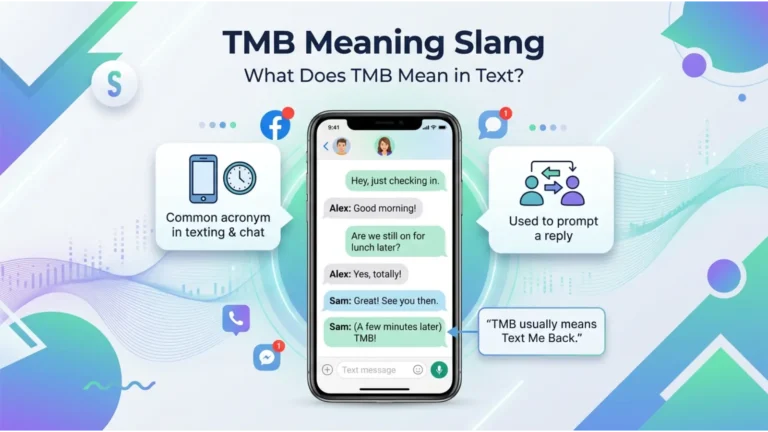
TMB meaning slang is a common search for people who see “TMB” in a text, DM, group chat, or social media conversation and are unsure what the three letters mean.
Like many texting abbreviations, TMB saves time by replacing a longer phrase with a short expression. In ordinary English texting, TMB most commonly means “Text Me Back.” It is usually used when someone wants another person to reply or continue a conversation.
However, context matters. TMB can have other meanings, including “Tag Me Back” or “Tweet Me Back,” depending on the platform and conversation.
Quick Answer:
TMB usually means “Text Me Back.” It is a casual way to ask someone to reply to a message.
What Does TMB Mean in Text?
In texting, TMB usually stands for “Text Me Back.” The letters come directly from the first letters of Text, Me, and Back.
For example:
“I’m going to class now. TMB later.”
This means:
“I’m going to class now. Text me back later.”
The abbreviation is informal and is most natural in casual conversations with friends, family members, partners, or other people you regularly message. Slang references also document “Text Me Back” as the primary texting meaning of TMB.
TMB Full Form
The most common TMB full form in texting is:
| Letter | Word |
|---|---|
| T | Text |
| M | Me |
| B | Back |
TMB = Text Me Back
It is an initialism because each letter represents the beginning of a word.
TMB Meaning Slang in Different Contexts
The meaning of TMB can change depending on where and how it appears.
1. In Text Messages
In a normal text conversation, TMB generally means Text Me Back.
Example:
“I need to tell you something. TMB when you’re free.”
The sender is asking the other person to respond when they have time.
2. On Social Media
On social platforms, TMB can still mean “Text Me Back,” but some slang references also record “Tweet Me Back” and “Tag Me Back.”
Therefore, look at the surrounding message before deciding what TMB means.
3. In Group Chats
Someone might write:
“I’m leaving the group for a bit. TMB later.”
Here, TMB is simply a quick request for someone to message them again.
4. In a Nostalgic Context
TMB can sometimes mean “Take Me Back.” For example, under an old photograph, someone might write “TMB,” meaning they want to return to or remember that past moment.
This meaning is much more dependent on context than “Text Me Back.”
Is TMB Rude, Offensive, or Neutral?
TMB is generally neutral and not offensive when it means “Text Me Back.”
However, the tone can change based on the surrounding words.
Compare:
- “TMB when you’re free 😊” — friendly
- “Hey, TMB when you get home.” — neutral
- “TMB ASAP!” — urgent
- “TMB!!!” — potentially impatient
So, the abbreviation itself is not normally rude. The wording, punctuation, capitalization, and relationship between the people can affect how it sounds.
Where Is TMB Commonly Used?
TMB is mainly associated with informal digital communication.
You may encounter it in:
- Text messages
- Private messages
- Group chats
- Social media conversations
- Online chats
- Casual conversations between friends
Slang references describe it primarily as a texting and online-chat abbreviation.
It is generally less suitable for formal emails, academic writing, job applications, business letters, or professional communication.
Real-Life TMB Conversation Examples
Friendly Example
Alex: I’m heading home now.
Sam: Okay, TMB when you get there.
Here, TMB means “Text Me Back” and sounds friendly.
Casual Example
Mia: Did you watch the new episode?
Noah: Not yet. TMB after you finish it.
The abbreviation keeps the conversation short and informal.
Argumentative Example
Person A: Why did you leave without telling me?
Person B: TMB when you’re ready to talk.
The phrase itself is not offensive, but the surrounding disagreement can make the exchange feel tense.
Work-Related Casual Example
Coworker: I sent you the document. TMB when you check it.
This can work between coworkers who regularly communicate casually, although a more professional phrase may be better in formal workplace communication.
Emotional and Psychological Meaning of TMB
When TMB means “Text Me Back,” it usually communicates a desire for continued communication.
The sender may simply want an answer, confirmation, or another message. In some situations, it can also show that the person is waiting for the conversation to continue.
However, you should not assume a specific emotion from TMB alone.
For example:
“TMB when you have time.”
sounds patient.
But:
“TMB NOW!”
clearly communicates urgency.
The surrounding context provides the emotional meaning.
Origin and Background of TMB
TMB developed as part of the broader culture of abbreviated digital communication. Texting encourages people to shorten familiar expressions, especially when conversations are quick and informal.
The exact history of the abbreviation is difficult to establish from everyday slang usage, but established slang references document “Text Me Back” as a texting meaning of TMB.
Like many abbreviations, TMB can develop different meanings in different online communities.
TMB vs Similar Slang
TMB is related to several other abbreviations used to request a response.
| Slang | Meaning | Typical use |
|---|---|---|
| TMB | Text Me Back | Asking someone to reply |
| CMB | Call Me Back | Asking for a return call |
| MMB | Message Me Back | Asking for a message |
| Tag Me Back | Return a social-media tag | Social media |
| Tweet Me Back | Respond on Twitter/X | Social media |
Slang references specifically list TMB alongside “Tag Me Back” and “Tweet Me Back,” showing why context is important.
When Should You Use TMB?
TMB works best when you are communicating casually with someone who understands texting abbreviations.
You can use it when:
- You want someone to reply later.
- You are ending a conversation temporarily.
- You need an update.
- You are chatting with friends.
- You are communicating through casual DMs.
For example:
“I’m busy right now. TMB tonight.”
This is short and easy to understand.
When Should You Avoid Using TMB?
Avoid TMB when clarity and professionalism are especially important.
For example, instead of:
“TMB ASAP.”
in a formal business email, write:
“Please reply when you have a chance.”
Other situations where the full phrase may be better include:
- Job applications
- Formal emails
- Academic assignments
- Official documents
- Customer-service communication
- Communication with someone unfamiliar with slang
Polite Alternatives to TMB
If you want to sound clearer or more professional, try:
- “Please text me back when you can.”
- “Please reply when you have a chance.”
- “Let me know when you’re available.”
- “Please get back to me.”
- “Send me a message when you’re free.”
These alternatives remove the ambiguity that can come with abbreviations.
Why Do People Use TMB?
People use TMB mainly because it is short, convenient, and informal.
Instead of typing:
“Please text me back when you have a chance.”
someone can simply write:
“TMB when you can.”
This type of abbreviation fits fast-paced digital conversations where participants already understand the meaning.
Is TMB Safe for Social Media?
Yes. TMB is generally harmless when used to mean “Text Me Back.” It is not normally a profanity or offensive expression.
However, remember that TMB can have different meanings. If the surrounding conversation does not involve texting or replying, check the context before assuming its meaning.
Common Misunderstandings About TMB
One common mistake is assuming that TMB always means “Text Me Back.”
Although that is the most common texting interpretation, references also document other meanings such as “Tag Me Back” and “Tweet Me Back.”
Another misunderstanding is assuming TMB always means “reply immediately.” It does not necessarily indicate urgency.
Compare:
“TMB whenever you’re free.”
with:
“TMB ASAP!”
The first gives the recipient flexibility, while the second explicitly requests a quick response.
Variations and Types of TMB
TMB can appear in several forms:
- TMB — uppercase
- tmb — lowercase
- Tmb — mixed case
The capitalization usually does not change the basic meaning.
For example:
“TMB later.”
and
“tmb later”
can both mean “Text Me Back later.”
The difference is mainly stylistic.
How to Respond When Someone Uses TMB
Your response depends on what the sender means and when you can reply.
If you are available:
“Sure, I’ll text you later.”
If you need time:
“Okay, I’ll get back to you tonight.”
If you are already replying:
“Hey, I’m here. What’s up?”
If you are unsure what they mean:
“Do you mean text me back?”
Asking for clarification is better than guessing when the context is unclear.
Regional and Cultural Usage
TMB is primarily associated with informal English-language digital communication, but slang usage can vary between communities and regions.
The same abbreviation may have a different interpretation in a particular online group. Social-media platforms can also create their own shorthand.
For this reason, context is more reliable than the abbreviation alone.
If TMB appears in a conversation about replying to a message, “Text Me Back” is a strong interpretation. If it appears in a completely different context, consider other possible meanings.
FAQs About TMB Meaning Slang
What does TMB mean in text?
TMB most commonly means “Text Me Back.” It is a casual request asking someone to reply to a message.
What does TMB stand for?
In ordinary texting, TMB stands for Text Me Back.
Is TMB rude?
No. TMB is generally neutral. However, wording such as “TMB NOW!” can sound demanding or impatient.
Can TMB mean something besides Text Me Back?
Yes. Depending on context, TMB can also mean “Tag Me Back” or “Tweet Me Back.”
Is TMB appropriate for professional communication?
Usually, it is better to use a complete phrase such as “Please reply when you have a chance” in formal or professional communication.
What does TMB mean on social media?
It can mean “Text Me Back,” but context-specific meanings such as “Tag Me Back” or “Tweet Me Back” are also documented.
Conclusion
The most common tmb meaning slang definition is “Text Me Back.” It is a short, informal way to ask someone to reply or continue a conversation. You may see it in texts, DMs, group chats, and other casual online conversations.
Remember that TMB does not always have one fixed meaning. Some slang references also list meanings such as “Tag Me Back” and “Tweet Me Back,” so the surrounding conversation is important.
For casual conversations, TMB can be a convenient shorthand. For formal or professional communication, however, spelling out your request is usually clearer. Understanding both the meaning and context will help you respond appropriately whenever you see TMB.

Ali Raza is an M.Phil. scholar and English language expert specializing in English grammar, slang meanings, vocabulary, and everyday expressions. He writes clear, practical, and easy-to-understand content that helps readers master confusing English words, phrases, spelling, and modern slang. His goal is to make English learning simple, useful, and accessible for students, beginners, and everyday readers.
1 thought on “TMB Meaning Slang What Does TMB Stand For”