
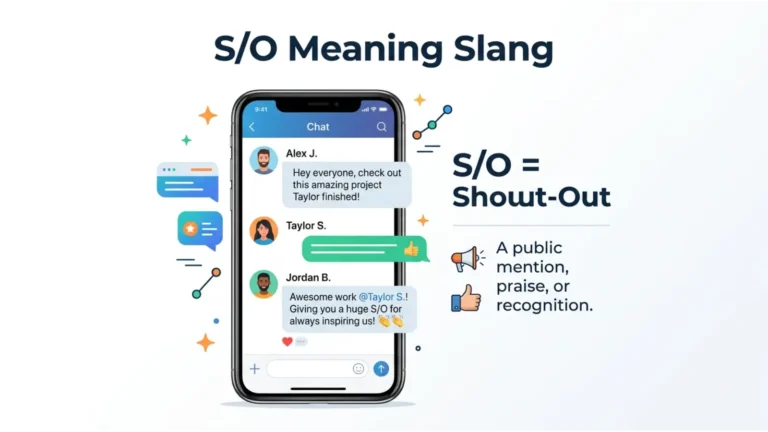
S/O meaning slang can be confusing because this short abbreviation has more than one possible meaning depending on where you see it.
On social media, in text messages, comments, and online conversations, people often use S/O as a quick way to give someone recognition or praise.
If you have seen someone write “S/O to my friend” or “S/O to everyone who helped,” you may wonder what they mean.
Slang and internet abbreviations change quickly, so understanding the context is important. The same letters can also have other meanings in different situations, which can create confusion.
In this guide, you will learn the S/O full form, what S/O stands for, its slang meaning, examples, tone, common uses, misunderstandings, and polite alternatives.
Quick Answer:
In slang and social media, S/O usually means “shout-out.” It is used to publicly recognize, praise, thank, or mention someone.
What Does S/O Mean in Text?
In texting and social media, S/O most commonly means “shout-out.”
A shout-out is a public mention or expression of appreciation toward a person, group, brand, or organization.
For example:
“S/O to my best friend for helping me with my project!”
Here, S/O means “shout-out,” and the writer is publicly thanking or recognizing their friend.
You may see the abbreviation written as:
- S/O
- s/o
- SO
- s.o.
The slash version, S/O, is especially common when people want to make the abbreviation clear.
S/O Full Form and Definition
The most common slang full form of S/O is “shout-out.”
A shout-out can be used to:
- Give someone public recognition
- Thank somebody
- Compliment a person
- Mention a friend
- Show appreciation
- Recognize someone’s achievement
- Draw attention to a particular person or group
For example:
“S/O to Sarah for winning the competition!”
This means:
“Shout-out to Sarah for winning the competition!”
The expression is generally positive and friendly.
S/O Meaning in Different Contexts
The meaning of S/O can change depending on the context.
S/O on Social Media
On Instagram, Facebook, TikTok, X, and similar platforms, S/O often means shout-out.
Example:
“S/O to everyone who supported my new video.”
The person is recognizing their supporters.
S/O in Text Messages
Friends may use S/O in casual texts.
“S/O to you for helping me today!”
This means:
“Shout-out to you for helping me today!”
S/O in Comments
Someone might comment:
“S/O to the photographer!”
They are publicly recognizing or praising the photographer.
S/O in Online Communities
People may use S/O to recognize contributors, creators, gamers, artists, or other community members.
“Big S/O to the whole team!”
This means the entire team is receiving recognition.
Is S/O Rude, Offensive, or Neutral?
When S/O means “shout-out,” it is generally neutral to positive.
It is not normally a rude or offensive expression. In fact, it is often used to show appreciation.
However, tone and context can change how a message feels. Someone could use a shout-out sarcastically, especially during an argument.
For example:
“S/O to you for ignoring my messages again.”
This may not be genuine praise. The writer could be using S/O sarcastically.
Therefore, do not look only at the abbreviation. Consider the complete sentence and the relationship between the people communicating.
Where Is S/O Commonly Used?
You are most likely to encounter S/O in informal digital communication, including:
- Text messages
- Instagram captions
- TikTok posts
- Facebook posts
- X posts
- YouTube comments
- Online communities
- Gaming chats
- Group chats
- Informal conversations
It is less appropriate in formal documents, academic writing, official reports, and professional correspondence unless the context specifically allows informal language.
S/O Meaning in Real-Life Conversation Examples
Friendly Example
Person A: “S/O to you for helping me study!”
Person B: “Anytime! Glad I could help.”
Here, S/O expresses genuine appreciation.
Casual Example
“S/O to my friends for making this weekend unforgettable.”
The writer is casually recognizing their friends.
Argumentative Example
“S/O to you for making everything more complicated.”
Here, S/O is probably sarcastic rather than complimentary.
Social Media Example
“S/O to everyone who liked and shared my post!”
The writer is thanking their audience.
Work-Related Casual Example
“S/O to our design team for finishing the project early.”
This recognizes the team’s contribution, although the abbreviation would usually be avoided in a formal business document.
Emotional and Psychological Meaning of S/O
When S/O means “shout-out,” it often communicates recognition, appreciation, gratitude, or social connection.
People naturally like to feel noticed and appreciated. A public shout-out can help someone feel valued, especially when it recognizes an achievement or helpful action.
For example:
“S/O to Mike for always supporting the team.”
The statement does more than mention Mike. It communicates appreciation for his contribution.
However, the emotional effect depends on the relationship and tone. A genuine shout-out can feel encouraging, while a sarcastic one can feel critical.
Origin and Background of S/O
The slang expression comes from the phrase “shout-out.” A shout-out originally referred to publicly mentioning or acknowledging someone.
As online communication became more informal and fast-paced, users began shortening common expressions into abbreviations. S/O became a convenient way to write “shout-out” in posts, captions, comments, and messages.
Its popularity is connected to the broader culture of social media, where publicly recognizing another person is common.
S/O vs Similar Slang Terms
| Term | Meaning | Common Use |
|---|---|---|
| S/O | Shout-out | Recognition or praise |
| Props | Respect or credit | Showing appreciation |
| TY | Thank you | Expressing thanks |
| TYSM | Thank you so much | Stronger casual thanks |
| Mention | Referring to someone | General reference |
| Respect | Appreciation or admiration | Giving credit |
Although these expressions can overlap, they are not always interchangeable.
For example, “props to you” directly gives credit, while “S/O to you” sounds more like a public recognition.
When Should You Use S/O?
S/O is suitable when the conversation is informal and the people involved understand internet slang.
You can use it when:
- Thanking a friend publicly
- Recognizing someone’s achievement
- Praising a teammate
- Mentioning someone in a social media post
- Giving credit to a creator
- Appreciating someone’s help
For example:
“S/O to my brother for helping me move.”
The abbreviation keeps the message short and casual.
When Should You Avoid Using S/O?
Avoid S/O when writing something highly formal or when the audience may not understand internet abbreviations.
For example, instead of:
“S/O to our manager for approving the proposal.”
A formal email could say:
“I would like to thank our manager for approving the proposal.”
You should also avoid using unexplained abbreviations when clarity is more important than brevity.
Polite Alternatives to S/O
If you want your message to sound more professional, use a complete phrase instead.
Some alternatives include:
- “I would like to thank…”
- “Special thanks to…”
- “I appreciate…”
- “Many thanks to…”
- “Credit goes to…”
- “I want to recognize…”
- “A special mention goes to…”
For example:
Casual: “S/O to Emma for helping me.”
Polite: “Special thanks to Emma for helping me.”
Why Do People Use S/O?
People use S/O because it is short, recognizable, and suitable for fast online communication.
Common reasons include:
- It saves space.
- It sounds casual.
- It works well on social media.
- It publicly recognizes someone.
- It can make a message feel friendly.
- It is easy to understand among people familiar with slang.
Online communication often favors short expressions, and S/O fits naturally into this style.
Impact of Using S/O in Communication
Using S/O can make an informal message feel friendly and conversational. It can also help publicly recognize someone’s contribution.
However, abbreviations can sometimes create confusion. Not everyone knows every slang term, and S/O may have different meanings in other contexts.
The safest approach is to consider your audience. If the person understands social-media slang, S/O is usually easy to understand. If you are communicating professionally, spelling out the phrase is clearer.
Is S/O Safe for Social Media?
Yes. When S/O means “shout-out,” it is generally harmless and widely used in informal social-media communication.
For example:
“S/O to everyone who supported my small business!”
There is nothing inherently offensive about the abbreviation.
Still, context matters. Since abbreviations can have multiple meanings, make sure the surrounding message makes your intended meaning clear.
Common Misunderstandings About S/O
One common mistake is assuming that S/O always means “shout-out.”
In different contexts, S/O can be interpreted differently. For example, in some writing, it may be an abbreviation unrelated to internet slang.
Another misunderstanding occurs when people see SO without the slash. Depending on context, “SO” can have meanings other than “shout-out.”
Therefore, always examine the sentence, platform, and conversation before deciding what S/O means.
Variations and Types of S/O
You may encounter several informal versions:
- S/O — common abbreviation for shout-out
- s/o — lowercase version
- SO — shortened form, but potentially ambiguous
- Big S/O — emphasizes strong recognition
- Special S/O — highlights particular appreciation
- S/O to… — common structure for recognizing someone
For example:
“Big S/O to my parents for supporting me.”
This means the writer is giving their parents special recognition.
How to Respond When Someone Uses S/O
If someone gives you a genuine shout-out, a simple response is usually enough.
You can say:
- “Thank you!”
- “Appreciate it!”
- “Thanks so much!”
- “Much appreciated!”
- “That means a lot!”
For example:
Friend: “S/O to Jake for helping us win!”
Jake: “Thanks! Happy to help.”
If the message appears sarcastic, consider the overall tone before responding.
Regional and Cultural Usage
S/O is mainly associated with informal English-language internet communication and social media. Its exact frequency can vary between online communities and regions.
People who regularly use English-language social media are more likely to recognize it. Younger internet users and communities centered around entertainment, gaming, creators, and social platforms may encounter it frequently.
However, slang is not universal. A person unfamiliar with online abbreviations may not immediately understand S/O. When communicating with an international or mixed audience, writing “shout-out” can improve clarity.
FAQs About S/O Meaning Slang
What does S/O mean in slang?
In slang and social media, S/O usually means “shout-out.” It is used to recognize, praise, thank, or mention someone publicly.
What does S/O stand for?
The most common slang meaning is “shout-out.” The exact meaning can depend on the context.
Is S/O a positive expression?
Usually, yes. When it means “shout-out,” it commonly expresses appreciation, recognition, or praise. However, it can also be used sarcastically.
What does “S/O to you” mean?
“S/O to you” generally means “shout-out to you.” It is a casual way of recognizing or thanking someone.
Can I use S/O in a professional email?
It is better to avoid it in formal professional communication. Use phrases such as “special thanks,” “I appreciate,” or “I would like to recognize” instead.
Is S/O the same as “props”?
They can have similar meanings because both can express recognition or respect. However, S/O specifically suggests a shout-out or public mention.
Conclusion
Understanding s/o meaning slang is simple once you know the context. In texting, social media, and informal online conversations, S/O most commonly means “shout-out.” People use it to recognize, praise, thank, or publicly mention someone.
For example, “S/O to my friends” means “Shout-out to my friends.”
The expression is generally friendly and positive, but it can sometimes be used sarcastically. Also remember that abbreviations can have different meanings in different contexts.
If you are chatting with friends or posting on social media, S/O can be a natural informal abbreviation. For school, business, or other formal writing, spelling out “shout-out” or using a more professional phrase is usually clearer.

Ali Raza is an M.Phil. scholar and English language expert specializing in English grammar, slang meanings, vocabulary, and everyday expressions. He writes clear, practical, and easy-to-understand content that helps readers master confusing English words, phrases, spelling, and modern slang. His goal is to make English learning simple, useful, and accessible for students, beginners, and everyday readers.