
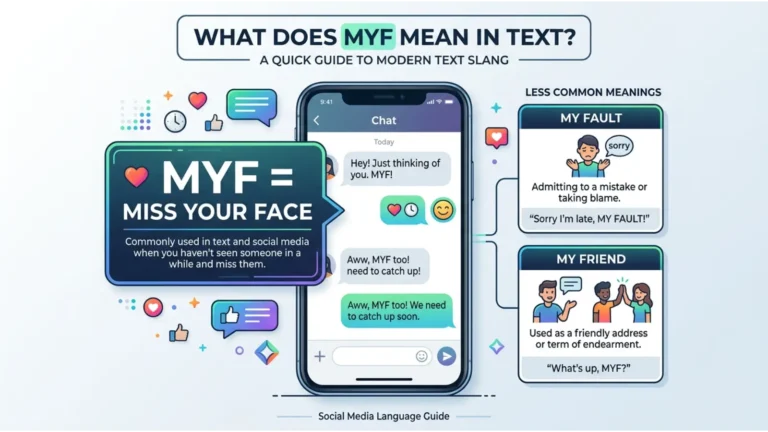
If you have received a text containing MYF and wondered what those three letters mean, you are not alone. Short forms like MYF can be confusing because their meaning can change depending on the conversation, relationship, and platform.
Current online usage commonly shows MYF with meanings such as “Miss Your Face,” “My Fault,” or “My Friend,” although it is not a universally standardized texting abbreviation.
People may use MYF in WhatsApp messages, Instagram DMs, Snapchat, TikTok comments, group chats, or private conversations. The words around the abbreviation usually provide the best clue.
Quick Answer:
In casual texting, MYF most commonly means “Miss Your Face,” a friendly or affectionate way to say that someone is missed. Depending on context, it can also mean “My Fault” or “My Friend.”
What Does MYF Mean in Text?
MYF does not have one universally accepted meaning in online slang. Its interpretation depends heavily on context.
The most commonly reported meanings include:
| MYF | Meaning | Typical tone |
|---|---|---|
| MYF | Miss Your Face | Friendly, affectionate |
| MYF | My Fault | Casual, apologetic |
| MYF | My Friend | Friendly, informal |
Among these, “Miss Your Face” is frequently reported in current casual texting guides. It is usually used when someone wants to say that they miss seeing another person.
For example:
“MYF! We need to hang out soon.”
Here, MYF means “Miss Your Face.”
However, if someone writes:
“Sorry, MYF.”
the intended meaning may be “My Fault.”
That is why reading the whole message is important.
What Is the MYF Full Form?
The most common affectionate full form of MYF is:
MYF = Miss Your Face
The letters represent:
- M = Miss
- Y = Your
- F = Face
In this use, “Miss Your Face” does not necessarily mean that the sender literally misses looking at someone’s face. It is a playful way of saying “I miss seeing you” or “I miss spending time with you.”
Other reported expansions include My Fault and My Friend, so you should not automatically assume that every MYF means the same thing.
MYF Meaning in Different Contexts
1. MYF = Miss Your Face
This is generally warm and affectionate.
Example:
“MYF! It has been so long.”
Meaning:
“I miss seeing you! It has been so long.”
It can be used between close friends, family members, couples, or other people who have a familiar relationship.
2. MYF = My Fault
In another context, MYF may be used as a short apology.
Example:
“I forgot to call you. MYF.”
Here, the sender means:
“My fault.”
This use is more about accepting responsibility than expressing affection.
3. MYF = My Friend
Some users also use MYF as informal shorthand for “my friend.” However, this meaning is less predictable and should be interpreted from the surrounding conversation. Current slang references show that different online communities use MYF differently.
Is MYF Rude, Offensive, or Neutral?
Usually, MYF is not rude or offensive when it is used to mean “Miss Your Face” or “My Friend.”
The tone can change based on the context.
For example:
“MYF ❤️”
sounds affectionate.
But:
“MYF, stop worrying about it.”
could mean something different depending on the relationship and conversation.
If MYF is being used as a community-specific abbreviation, its tone may also differ. Therefore, the surrounding words, punctuation, emojis, and relationship between the speakers are useful clues.
Where Is MYF Commonly Used?
MYF can appear in informal digital communication, including:
- Text messages
- WhatsApp chats
- Instagram DMs
- Snapchat
- TikTok comments
- Discord
- Group chats
- Casual online conversations
Social media and messaging encourage short forms because people often want to communicate quickly. Current sources also report MYF appearing across several of these platforms.
However, MYF is not a standard formal English abbreviation.
For school assignments, business emails, job applications, or professional communication, it is better to write the complete phrase.
Real-Life MYF Conversation Examples
Friendly Example
Alex: “MYF! When are you coming back?”
Sam: “Next weekend! I miss you too.”
Here, MYF means “Miss Your Face.”
Casual Example
Emma: “MYF. We haven’t had coffee together in months.”
Lily: “I know! Let’s meet Saturday.”
The expression shows that Emma misses spending time with Lily.
Argumentative Example
Suppose the conversation is about someone making a mistake:
Alex: “Why didn’t you send the file?”
Sam: “MYF. I thought you had already sent it.”
Here, MYF could mean “My Fault.”
Social Media Example
“Vacation is fun, but MYF already!”
In this sentence, MYF most naturally means “Miss Your Face.”
Relationship Example
“Goodnight ❤️ MYF.”
This can have a romantic or affectionate tone, depending on the relationship.
Emotional and Psychological Meaning of MYF
When MYF means “Miss Your Face,” it communicates a feeling of absence and connection.
The sender may be expressing:
- They miss seeing you.
- They want to spend time with you.
- They are thinking about you.
- They want to reconnect.
- They feel emotionally close to you.
The expression can therefore feel more personal than a simple “I miss you.”
Still, you should avoid assuming romantic feelings just because someone sends MYF. A close friend can use it in exactly the same way.
Origin and Background of MYF
There is no single, universally documented origin for MYF as a texting abbreviation. Like many internet abbreviations, its meaning has developed through informal digital communication.
Online slang frequently changes as different communities create and reuse short forms. This is one reason MYF can have several interpretations rather than one fixed dictionary definition.
The meaning can also be influenced by the sender’s personal texting habits.
MYF Compared With Similar Slang
| Slang | Common meaning | Tone |
|---|---|---|
| MYF | Miss Your Face / other meanings | Context-dependent |
| IMY | I Miss You | Affectionate |
| ILY | I Love You | Affectionate/romantic |
| BFF | Best Friends Forever | Friendly |
| BRB | Be Right Back | Casual |
| MB | My Bad | Apologetic |
If someone simply wants to say they miss you, IMY is generally clearer than MYF because its meaning is more recognizable.
When Should You Use MYF?
Use MYF when you are confident that the other person understands the abbreviation.
It can work well in:
- Friendly texts
- Personal DMs
- Casual conversations
- Messages to close friends
- Informal social media conversations
For example:
“MYF! Let’s catch up soon.”
This is natural in a casual conversation.
When Should You Avoid MYF?
Avoid using MYF when clarity is especially important.
For example, do not rely on it in:
- Formal emails
- Academic writing
- Job applications
- Business communication
- Official documents
- Messages to someone unfamiliar with texting slang
Instead of:
“MYF about the meeting.”
write:
“My fault about the meeting.”
This prevents confusion.
Polite Alternatives to MYF
If you want to express the “Miss Your Face” meaning clearly, you can say:
- “I miss seeing you.”
- “I miss you.”
- “I hope we can meet soon.”
- “It has been too long!”
- “I miss spending time with you.”
These alternatives are easier to understand and work in a wider range of situations.
Why Do People Use MYF?
People use abbreviations like MYF because they make informal communication faster and more conversational.
Instead of writing:
“I really miss seeing you and hope we can meet soon.”
someone might simply write:
“MYF ❤️”
Short forms can also make messages feel playful and personal.
However, abbreviations only work well when both people understand them.
Common Misunderstandings About MYF
One of the biggest mistakes is assuming that MYF always means “Miss Your Face.”
That is not necessarily true.
For example:
“MYF ❤️”
Likely means “Miss Your Face.”
But:
“Sorry, MYF.”
Could mean “My Fault.”
Another common mistake is assuming that MYF is always romantic. It can be affectionate without having a romantic meaning.
Finally, some friend groups or online communities may give MYF their own meaning. Context should always come first.
Variations and Types of MYF
MYF can appear in different forms depending on the writer:
- MYF
- myf
- Myf
- MYF ❤️
- MYF!
- MYF already
- Sorry, MYF
Capitalization usually does not change the intended meaning in texting. The words surrounding the abbreviation are much more useful.
How to Respond When Someone Uses MYF
Your response should depend on what MYF means.
If they mean “Miss Your Face,” you could reply:
“I miss you too!”
or:
“Same! Let’s meet soon.”
If they mean “My Fault,” you could respond:
“No worries!”
or:
“It’s okay.”
If you cannot understand the meaning, simply ask:
“What do you mean by MYF?”
There is nothing wrong with asking for clarification.
Regional and Cultural Usage
MYF does not have one fixed meaning across all English-speaking communities. Internet slang can vary by country, age group, social platform, and online community.
A phrase that is familiar to one group may be unfamiliar to another. This is especially true for less standardized abbreviations such as MYF.
Therefore, it is safer to interpret MYF from the complete message instead of relying on a single slang dictionary definition.
Is MYF Safe for Social Media?
Generally, yes, when you are using one of its ordinary meanings such as “Miss Your Face,” “My Fault,” or “My Friend.”
However, slang can sometimes have different meanings within particular communities. If you are posting publicly, consider whether your audience will understand the abbreviation.
For professional or public-facing content, using the full phrase is usually clearer.
Frequently Asked Questions
What does MYF mean in text?
MYF can have several meanings. In current casual texting, “Miss Your Face” is one commonly reported meaning. It can also mean “My Fault” or “My Friend,” depending on context.
What does MYF stand for?
The commonly reported affectionate full form is “Miss Your Face.” In other conversations, MYF may stand for “My Fault” or “My Friend.”
Is MYF a romantic abbreviation?
It can be romantic, but it does not have to be. Friends and family members may also use MYF to say they miss seeing someone.
Is MYF rude?
Usually, no. MYF is generally casual and can be friendly or affectionate. Its exact tone depends on the meaning intended by the sender.
What should I reply to MYF?
If MYF means “Miss Your Face,” you could reply, “I miss you too!” If you are unsure what the sender means, ask them to clarify.
Can MYF mean something other than Miss Your Face?
Yes. Current online references report other meanings, including “My Fault” and “My Friend.” Context is important when interpreting the abbreviation.
Conclusion
The myf meaning in slang depends on context, but “Miss Your Face” is a commonly reported meaning in casual texting. It is a friendly or affectionate way to tell someone that you miss seeing them.
However, MYF can also mean “My Fault” or “My Friend,” so you should always consider the surrounding message before deciding what the sender means.
For casual conversations with people who understand the abbreviation, MYF can make a message short and personal. In formal communication, writing the complete phrase is safer and clearer. When in doubt, simply ask the sender what they mean.

Ali Raza is an M.Phil. scholar and English language expert specializing in English grammar, slang meanings, vocabulary, and everyday expressions. He writes clear, practical, and easy-to-understand content that helps readers master confusing English words, phrases, spelling, and modern slang. His goal is to make English learning simple, useful, and accessible for students, beginners, and everyday readers.