
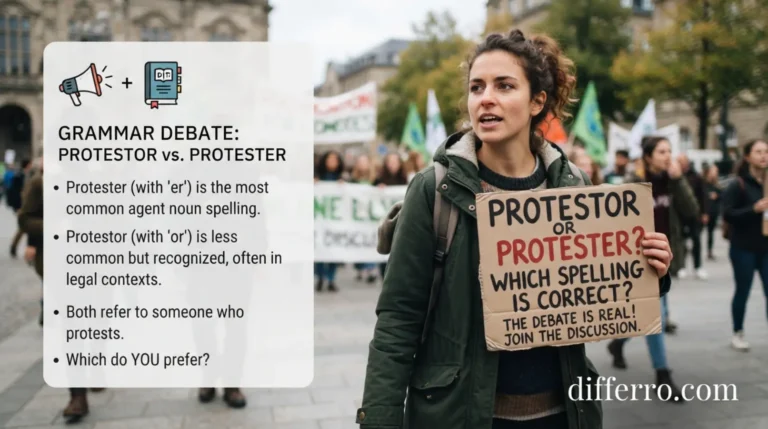
Protestor or protester is a common spelling question in English. Both words describe someone who takes part in a protest against a decision, policy, or action. However, many writers wonder which spelling they should use in articles, essays, and everyday conversations.
The good news is that both protestor and protester are correct English spellings. The main difference involves usage and popularity rather than meaning. Most modern dictionaries recognize both forms, but protester generally appears more often in contemporary English writing. American and British English speakers can use either spelling, although individual publications may prefer one form.
Choosing the right spelling can improve your writing and keep your content consistent. This guide explains the meanings, differences, origins, and common mistakes associated with protestor and protester. You will also learn which spelling works best for formal writing, news reports, academic work, and everyday communication.
⭐ Quick Answer
Both protestor and protester are correct spellings. They describe someone who participates in a protest. However, protester is generally the more common choice in modern English writing.
Example: The protesters gathered outside the government building to demand change.
📘 Meaning of Protester
A protester is someone who publicly expresses disagreement with a policy, decision, action, or situation. Protesters may participate in marches, demonstrations, rallies, or other forms of public opposition.
People protest for many reasons, including political change, workers’ rights, environmental protection, and social justice.
Examples of Protester
- Thousands of protesters gathered in the city to oppose the new law.
- The protesters carried signs demanding better working conditions.
In both examples, protester describes someone who takes part in a public demonstration or expresses opposition.
📘 Meaning of Protestor
A protestor has the same meaning as protester. It refers to someone who participates in a protest or publicly challenges something they oppose.
The spelling protestor is correct, although many modern writers prefer protester. You may encounter it in news reports, published documents, and other English-language texts.
Examples of Protestor
- Each protestor held a sign calling for environmental protection.
- The protestors marched peacefully through the town center.
Both sentences use protestor correctly. You can replace it with protester without changing the meaning.
🔎 Protestor or Protester: Key Differences
The two spellings share the same meaning. Their main difference concerns usage and frequency.
| Feature | Protester | Protestor |
|---|---|---|
| Meaning | Someone who participates in a protest | Someone who participates in a protest |
| Tone | Neutral and standard | Neutral and less common |
| Usage | Common in news, academic, and everyday writing | Accepted but less frequently preferred |
| Popularity | Generally more common | Generally less common |
| Grammar | Correct noun | Correct noun |
| Formal writing | Suitable | Suitable, depending on the publication’s style |
| British English | Correct | Correct |
| American English | Correct | Correct |
Which spelling should you choose? Use protester as your default choice unless a style guide, publication, or organization prefers protestor.

🕰️ Origin and History of Protester and Protestor
Both spellings come from the word protest, which entered English through French and Latin roots associated with declaring or expressing something publicly.
English uses the suffix -er to form nouns describing people who perform an action. For example, teach becomes teacher, and write becomes writer.
The suffix -or also forms nouns for people who perform certain actions. Examples include actor, creator, and contributor.
Writers have used both protester and protestor for a long time. Over time, protester became the more common form in much contemporary English usage.
The difference does not create two separate meanings. Both spellings refer to someone who protests.
Similar Word Examples
These examples show how English uses different endings to describe people:
- Teacher: Someone who teaches.
- Writer: Someone who writes.
- Actor: Someone who acts in a performance.
- Creator: Someone who creates something.
- Protester: Someone who participates in a protest.
- Protestor: Another accepted spelling for someone who protests.
The suffix alone does not determine which spelling people use most often. Established usage also influences English spelling preferences.
🇬🇧 British English vs American English Spelling
British and American English both recognize protester and protestor as correct spellings.
Neither spelling represents an exclusive British or American English difference. However, protester generally serves as the more familiar choice in modern writing.
Writers should follow the preferred spelling of their publication and use it consistently throughout an article.
British vs American English Comparison
| Feature | British English | American English |
|---|---|---|
| Preferred general choice | Protester | Protester |
| Alternative spelling | Protestor | Protestor |
| Meaning | Person who protests | Person who protests |
| Spelling rule | Both forms are accepted | Both forms are accepted |
| Formal writing | Follow the relevant style guide | Follow the relevant style guide |
| Consistency | Important | Important |
✍️ When to Use Protester
Use protester when you want a widely recognized spelling for general English writing. It works well in news articles, school assignments, essays, blogs, and professional documents.
This spelling offers a straightforward choice for readers across different English-speaking countries.
Examples of Protester in Sentences
- The protesters gathered outside parliament to demand reform.
- Police monitored the crowd as protesters marched through the streets.
- Every protester had the right to express an opinion peacefully.
- The newspaper interviewed several protesters after the demonstration.
- Environmental protesters called for stronger climate policies.
When Protester Works Best
Choose protester when:
- You write a general-interest article.
- You prepare school or university assignments.
- You publish news or educational content.
- You want to use the more common spelling.
- Your organization’s style guide does not specify another form.
For most everyday writing, protester is the simplest choice.
✍️ When to Use Protestor
Use protestor when your preferred dictionary, publisher, employer, or organization uses that spelling. The form remains grammatically correct and communicates the same meaning as protester.
You do not need to change an existing text simply because it contains protestor.
Examples of Protestor in Sentences
- Each protestor expressed opposition to the proposed development.
- The report described how protestors organized the demonstration.
- A protestor spoke to reporters about the community’s concerns.
- The protestors gathered peacefully outside the courthouse.
- The organization published a statement supporting peaceful protestors.
When Protestor Works Best
Choose protestor when:
- Your publication prefers this spelling.
- You follow an established house style.
- You edit a document that already uses this form consistently.
- You quote or reproduce a source that uses protestor.
The important point is consistency. Avoid switching between both spellings without a clear reason.
⚠️ Common Mistakes With Protester and Protestor
Writers sometimes confuse spelling preferences with grammatical rules. These examples explain how to avoid common errors.
Mistake 1: Calling Protestor Incorrect
Incorrect claim: Protestor is always a misspelling.
Correct explanation: Both protester and protestor are accepted spellings. However, protester is generally more common.
Mistake 2: Assuming the Words Have Different Meanings
Incorrect claim: A protester attends a march, but a protestor opposes a government.
Correct explanation: Both words describe someone who participates in a protest. Neither spelling defines a separate type of protester.
Mistake 3: Using Both Spellings Randomly
Inconsistent: The protesters arrived early. Later, the protestors addressed the crowd.
Better: The protesters arrived early. Later, the protesters addressed the crowd.
The second version maintains consistent spelling without changing the meaning.
Mistake 4: Adding an Unnecessary Ending
Incorrect: The protesteror spoke to the reporter.
Correct: The protester spoke to the reporter.
Use one accepted spelling. Do not combine both endings.
Mistake 5: Confusing Protester With Protest
Incorrect: The protester continued for three hours.
Correct: The protest continued for three hours.
A protester is a person. A protest is an expression of opposition or a public demonstration.
Mistake 6: Assuming American and British English Require Different Forms
Incorrect claim: Americans must write protester, while British writers must write protestor.
Correct explanation: Both forms are accepted in both varieties of English. Individual publications may have different preferences.
🧠 Easy Trick to Remember
Use this simple memory trick:
Protester is the preferred everyday choice; protestor is an accepted alternative.
Think of the common word teacher. Its ending helps you remember the familiar -er form in protester.
Remember these two points:
- Protester: Generally more common and a safe default.
- Protestor: Correct, but generally less common.
This trick helps you choose a spelling without treating the alternative as an error.
🌍 Everyday-Life Examples: Protester or Protestor
1. News Reports
Journalists often describe people attending demonstrations as protesters.
Example: Protesters gathered outside the city hall to oppose the proposed changes.
The word protesters clearly identifies the people participating in the demonstration.
2. School and University Assignments
Students can use either spelling, but protester offers a familiar choice for general academic writing.
Example: The protesters demanded equal rights and fair treatment.
For formal assignments, students should follow their instructor’s spelling requirements.
3. Political Demonstrations
People may protest against government decisions, election results, or proposed legislation.
Example: The protestors organized a peaceful march against the new policy.
The spelling protestors is correct. Writers can also use protesters without changing the sentence’s meaning.
4. Environmental Campaigns
Environmental groups may organize demonstrations about pollution, climate change, or wildlife protection.
Example: The protesters called for stronger laws to protect local rivers.
Here, protesters describes people who publicly support environmental change.
5. Workplace and Community Issues
Workers and residents sometimes protest against decisions affecting their communities.
Example: The protestors gathered outside the factory to request safer working conditions.
You could replace protestors with protesters and preserve the original meaning.
🌐 Google Trends and Usage Data: USA, UK, Australia, India, and Pakistan
Google Trends reports relative search interest over a selected period. It does not provide exact search volume, and country rankings require live data.
- USA: Compare both spellings to identify the more popular search term among American users.
- UK: Check whether searches favor protester or protestor during the selected period.
- Australia: Compare both terms to understand local spelling preferences.
- India and Pakistan: Check both variants and consider whether news coverage affects search interest.
SEO insight: Protester is a sensible primary keyword because it generally appears more often in contemporary writing. Treat this as a general usage preference, not a verified Google Trends ranking for these five countries.
Comparison Table: Keyword Variations
| Keyword variation | Search intent | Recommended use |
|---|---|---|
| Protestor or protester | Spelling comparison | Main title and introduction |
| Protester vs protestor | Direct comparison | Key differences section |
| Protesters or protestors | Plural spelling question | FAQ and examples |
| Is protestor a word? | Spelling validation | FAQ section |
| Protester meaning | Definition | Meaning section |
| Protestor meaning | Definition and spelling | Meaning section |
| Protester correct spelling | Spelling confirmation | Quick Answer section |
❓ Frequently Asked Questions
1. Is protestor a correct English word?
Yes. Protestor is an accepted English spelling. It has the same meaning as protester, although protester generally appears more often in modern writing.
2. What is the difference between protester and protestor?
Both words describe someone who participates in a protest. Their main difference concerns spelling preference and frequency, not meaning or grammar.
3. Which spelling is more common, protester or protestor?
Protester is generally more common in contemporary English writing. It is a good default choice for articles, school assignments, and everyday communication.
4. Should I use protester or protestor in formal writing?
Use protester unless your organization, publisher, or style guide prefers protestor. Both spellings are correct, but consistency matters in professional documents.
5. Why do people confuse protester and protestor?
English uses both -er and -or endings to form nouns describing people. Since both spellings developed through established usage, writers may wonder whether one is incorrect. In this case, both forms are accepted.
🏁 Final Verdict: Protestor or Protester?
Both protestor and protester are correct English words. They describe someone who takes part in a protest, and neither spelling carries a different meaning.
However, protester is generally the better choice for everyday and professional writing because it is more common in contemporary usage. It works well in articles, educational content, news reports, and academic assignments.
Use protestor when your preferred style guide or publication requires it. You can also retain that spelling when editing an existing document that uses it consistently.
Remember that this is a spelling preference, not a difference between British and American English. Both varieties accept the two forms. Choose one spelling, maintain consistency, and focus on clear communication.
Conclusion
The question of protestor or protester has a simple answer: both spellings are correct. Each word describes a person who participates in a protest or publicly expresses opposition. However, protester generally appears more often in modern English writing, making it the better default choice for most readers and writers.
Use protester in blog posts, school assignments, news articles, and professional documents unless a style guide specifies otherwise. Choose protestor when your publication prefers that form, and keep your spelling consistent throughout the text.
Neither spelling represents a separate British or American English rule. Both forms communicate the same meaning. By understanding this distinction, you can avoid common spelling mistakes and write with greater confidence.

Imran Lodhra is a comparison-focused content writer at Differro.com.
He specializes in creating clear, simple, and informative comparison articles.
His work helps readers understand key differences, pros and cons, and important details.
Imran focuses on accurate, practical, and easy-to-read content for everyday readers.
1 thought on “Protestor or Protester: Which Spelling Is Correct?”