
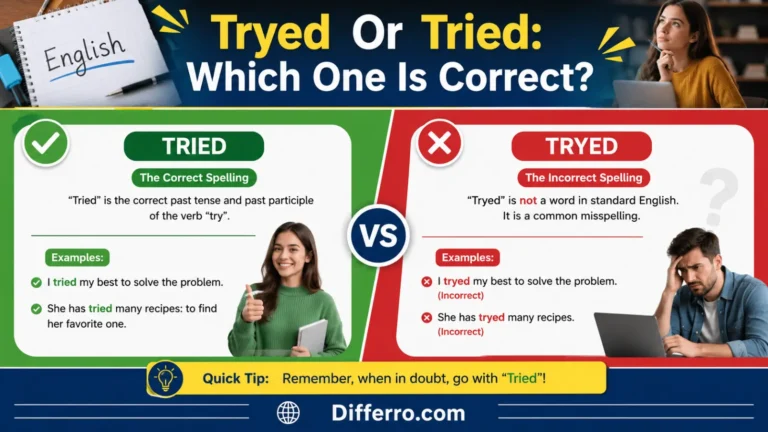
Tryed or tried is a common spelling confusion in English. Many people type the first one when writing quickly. However, only one spelling is correct in modern English grammar. This mistake often happens because English verbs change differently in the past tense.
If you are learning English, writing blogs, or creating professional content, knowing the correct form matters. Using the wrong spelling can affect readability and SEO quality. It can also make your writing look less professional.
In this guide, you will learn the meaning of both words, the key differences, proper usage, examples, and grammar rules. You will also discover why people confuse these spellings and how to remember the correct one easily.
⭐ Quick Answer
The correct spelling is tried. The other word is incorrect in modern English.
“Try” changes to “tried” in the past tense because verbs ending in “y” usually replace “y” with “i” before adding “ed.”
✅ Example:
“I tried to call you yesterday.”
❌ Incorrect:
“I tryed to call you yesterday.”
📘 Meaning of Tryed
“Tryed” is not a correct English word. It is a spelling mistake people make when writing the past tense of “try.”
Examples of incorrect usage
❌ “She tryed her best.”
❌ “I tryed to fix the phone.”
📘 Meaning of Tried
“Tried” is the correct past tense and past participle of the verb “try.”
Simple Definition
“Tried” means someone attempted, tested, or made an effort to do something.
Examples
✅ “He tried to open the door.”
✅ “We tried a new restaurant last night.”
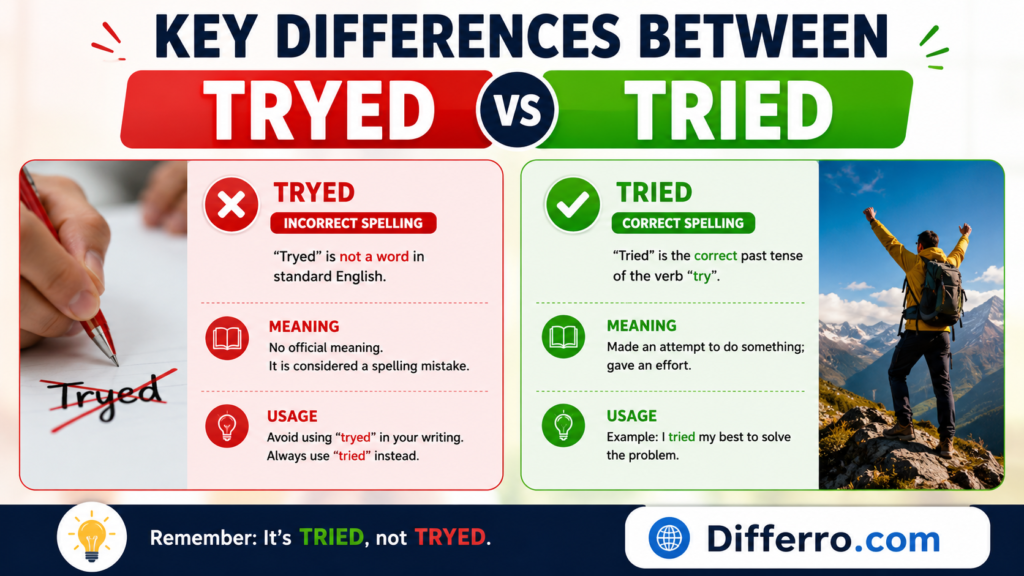
🔍 Key Differences Between Tryed and Tried
| Feature | Tryed | Tried |
|---|---|---|
| Correct spelling | ❌ No | ✅ Yes |
| Meaning | None | Past tense of try |
| Usage | Incorrect | Correct grammar |
| Popularity | Rare and mistaken | Common worldwide |
| Tone | Informal error | Professional and proper |
📜 Origin & History
The verb “try” comes from Old French and became part of English many centuries ago. English grammar follows a spelling rule for verbs ending in consonant + “y.”
When changing such verbs into the past tense:
- Remove “y”
- Add “ied”
Examples:
- Cry → Cried
- Fry → Fried
- Reply → Replied
- Try → Tried
This rule explains why “tried” is correct and the other is wrong.
🇬🇧 British English vs American English Spelling
Both British English and American English use the spelling tried. There is no regional difference in this case. “Tryed” is considered incorrect everywhere.
Comparison Table: British vs American English
| English Type | Correct Form | Incorrect Form |
|---|---|---|
| British English | Tried | Tryed |
| American English | Tried | Tryed |
| Australian English | Tried | Tryed |
✍️ When to Use Tried
Use “tried” when talking about a past action, effort, or attempt.
Examples
✅ “She tried to learn Spanish.”
✅ “They tried every solution.”
✅ “I tried your recipe yesterday.”
✍️ When to Use Tryed
You should never use this word in formal or correct English writing.
Examples of wrong usage
❌ “We tryed to help him.”
❌ “They tryed a different method.”
❌ Common Mistakes
Adding “ed” directly to “try”
Tryed ❌
Tried ✅
- Forgetting to change “y” into “i”
He tryed again. ❌
He tried again. ✅
- Using the wrong spelling in formal writing
I have tryed many apps. ❌
I have tried many apps. ✅
- Typing too quickly without checking spelling
She tryed calling me. ❌
She tried calling me. ✅

🧠 Easy Trick to Remember
Remember this simple rule:
If a verb ends in consonant + “y,” change “y” to “i” before adding “ed.”
Examples:
- Try → Tried
- Cry → Cried
- Reply → Replied
Think of this sentence:
👉 “You TRIED after changing Y to I.”
📝 Write 5 Examples
1. School Example
“I tried to finish my homework early.”
2. Work Example
“She tried a new marketing strategy.”
3. Sports Example
“They tried hard to win the match.”
4. Family Example
“My mother tried a new recipe today.”
5. Technology Example
“We tried restarting the computer.”
🔑 Related Keywords
- tried meaning
- tryed or tried correct spelling
- past tense of try
- tried vs tryed
- grammar spelling rules
- English word confusion
- how to spell tried
📈 Google Trends & Usage Data
Search interest shows that “tried” is far more popular than other word in all major English-speaking regions. Many users search “tryed” because they are unsure about grammar rules.
Countries like the USA, UK, Australia, India, and Pakistan mostly use “tried” in correct writing. However, “tryed” still appears in search queries due to spelling confusion.
Educational blogs and grammar websites often target this keyword because people frequently make this mistake online.
Comparison Table: Keyword Variations
| Keyword Variation | Search Intent |
|---|---|
| tryed or tried | Spelling confusion |
| tried meaning | Definition |
| past tense of try | Grammar learning |
| how to spell tried | Educational |
| tried vs tryed | Comparison |
| is tryed a word | Validation |
| correct spelling of tried | Grammar correction |
FAQs ,
IIs “tryed” correct?
No, it is incorrect in English grammar.
What is the difference between in these two words?
“Tried” is the correct spelling, while the other is a spelling mistake.
Which spelling is more common worldwide?
“Tried” is the standard and widely used form.
Is “tried” formal English?
Yes, it is correct in both formal and informal writing.
Why does this confusion happen?
Many people simply add “ed” to verbs without following proper spelling rules.
✅ Final Verdict
The correct word is tried. You should always use “tried” when writing the past tense of “try.” The spelling “tryed” is incorrect and should be avoided in professional, academic, and casual writing.
If you remember the grammar rule for verbs ending in “y,” you will never make this mistake again.
Conclusion
The confusion between tryed or tried is very common among English learners and online writers. Still, the correct spelling is always tried. English grammar changes verbs ending in “y” by replacing the “y” with “i” before adding “ed.”
Using the right spelling improves your writing quality and helps you communicate clearly. It also makes your content look more professional and trustworthy. Whether you write emails, blog posts, assignments, or social media captions, using “tried” correctly is important.
Now you know the difference, the grammar rule, and the easiest way to remember it. Next time, you will confidently write “tried” without hesitation.
Discover More Post ,
Masters or Master’s : What’s the Correct Usage?
Bingeing or Binging : Which Spelling Is Correct?
More Or Less : Meaning, Differences, Usage & Grammar Guide

Sara Taylor is a passionate writer and language enthusiast. She specializes in creating simple and easy-to-understand articles about English grammar, spelling differences, and commonly confused words. Her writing style focuses on helping students, writers, and English learners improve their language skills with confidence. Through informative guides and practical examples, Sara makes complex grammar topics easier for everyday readers.