
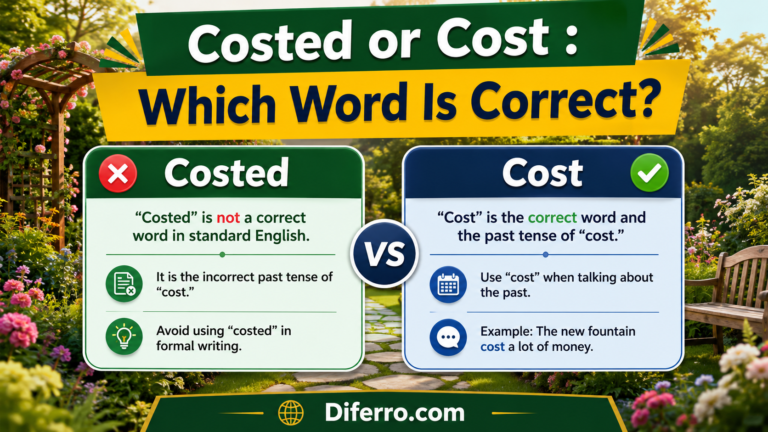
Costed or cost is a common grammar confusion in English. Many people wonder which word is correct in daily writing and speaking. The confusion happens because “cost” is an irregular verb. Some learners use “costed” as the past tense, while others use “cost.”
In most cases, “cost” is the correct past tense and past participle. However, “costed” also exists in specific business and accounting situations. That is why many English learners get confused.
Understanding the difference helps you write clearly and avoid grammar mistakes. This guide explains the meanings, usage rules, examples, history, and common mistakes related to “costed” and “cost” in simple English.
⭐ Quick Answer
The correct past tense of cost is usually cost.
✅ Correct: “The car cost $5,000.”
❌ Incorrect: “The car costed $5,000.”
However, costed is correct in accounting or business contexts.
✅ Example: “The project was carefully costed before approval.”

📖 Meaning of Cost
Cost means the price of something or the amount needed to buy or do something.
It is also an irregular verb.
Examples
- The shoes cost $50.
- The mistake cost him his job.
📖 Meaning of Costed
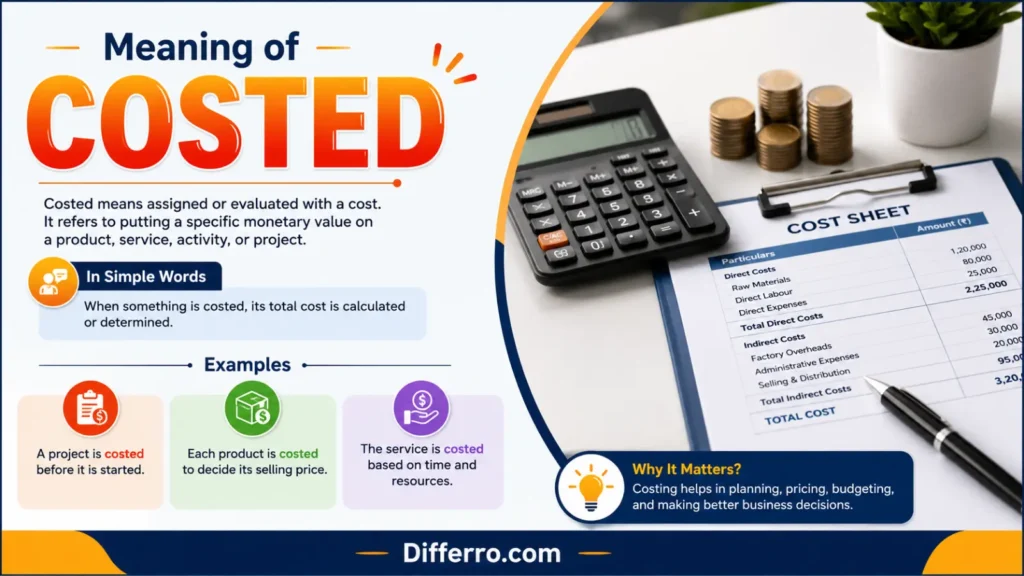
Costed means something was calculated or estimated financially.
It is mostly used in business, accounting, and project management.
Examples
- The company costed the new project carefully.
- The event was fully costed before planning started.
📊 Key Differences Between Costed and Cost
| Feature | Cost | Costed |
|---|---|---|
| Meaning | Price or expense | Financial estimation |
| Tone | General English | Business and accounting |
| Usage | Everyday speaking and writing | Professional contexts |
| Popularity | Very common | Less common |
| Grammar Role | Present and past tense | Specialized verb form |
🕰️ Origin & History
The word cost comes from Old French and Latin roots related to price and expense. English kept “cost” as an irregular verb. That is why the present and past tense remain the same.
Later, business English introduced “costed” for accounting purposes. It became common in finance and budgeting.
Similar Irregular Verbs
- Cut → Cut
- Put → Put
- Hit → Hit
🇬🇧 British English vs American English Spelling
Both British and American English mostly use cost as the past tense. The word “costed” appears in both forms of English, mainly in business settings.
British English uses “costed” slightly more in corporate language. American English prefers simpler forms in daily writing.
Comparison Table: British vs American English
| Usage | British English | American English |
|---|---|---|
| Everyday past tense | Cost | Cost |
| Business usage | Costed | Costed |
| Common preference | Cost | Cost |
✍️ When to Use Cost
Use cost when talking about price, expense, or loss in normal English.
Examples
- The laptop cost too much.
- The trip cost us a lot of money.
- His mistake cost the team victory.
✍️ When to Use Costed
Use costed when discussing budgets, estimates, or accounting work.
Examples
- The engineers costed the building plan.
- The company costed every stage carefully.
- The menu was professionally costed.
❌ Common Mistakes
Mistake 1
❌ The phone costed $300.
✅ The phone cost $300.
Mistake 2
❌ My holiday costed too much.
✅ My holiday cost too much.
Mistake 3
❌ The bag has costed me a fortune.
✅ The bag has cost me a fortune.
Mistake 4
❌ They costed a new car yesterday.
✅ They bought a new car yesterday.
🧠 Easy Trick to Remember
Remember this simple rule:
👉 If you talk about price, use cost.
👉 If you talk about budget planning, use costed.
Think of “costed” as a business word.
🏡 Write 5 Examples
1. Shopping Example
The jacket cost $80 last winter.
2. Travel Example
Our family trip cost more than expected.
3. Business Example
The manager costed the entire project carefully.
4. Restaurant Example
The chef costed every dish before launch.
5. Education Example
Books cost students a lot each year.
🔍 Related Keywords
- cost or costed
- past tense of cost
- costed meaning
- cost vs costed
- is costed correct
- grammar of cost
- irregular verbs in English
📈 Google Trends & Usage Data
The keyword “cost or costed” is searched heavily in countries where English learners are active. Interest is highest in India and Pakistan because many students learn grammar for exams and professional writing.
The USA and UK mostly search this topic for grammar clarification. Australia also shows moderate interest. Global searches increase during academic seasons.
Comparison Table: Keyword Variations
| Keyword Variation | Popularity |
|---|---|
| Cost or Costed | Very High |
| Past tense of cost | High |
| Costed meaning | Medium |
| Cost vs Costed | High |
| Is costed correct | Medium |
Country-Based Usage
| Country | Search Interest |
|---|---|
| USA | High |
| UK | High |
| AUS | Medium |
| IND | Very High |
| PAK | Very High |
⚖️ Final Verdict
In normal English, cost is the correct word for both present and past tense.
Use costed only in accounting, finance, or project planning situations.
For everyday writing, speaking, and exams, “cost” is usually the safest and most correct choice.
FAQs ,
Is “costed” correct?
Yes, but mainly in business and accounting contexts.
What is the difference between cost and costed?
“Cost” refers to price, while “costed” refers to financial calculation.
Which is more common?
“Cost” is far more common in everyday English.
Is “costed” formal English?
Yes. It is formal and mostly used in professional settings.
Why does this confusion exist?
The confusion exists because “cost” is an irregular verb.
📝 Conclusion
The confusion between costed or cost is very common among English learners. In most situations, the correct past tense of “cost” is simply “cost.” English keeps this verb irregular, just like “cut” and “put.”
However, “costed” has a special meaning in business and accounting. It refers to financial planning or estimating expenses. That is why both words exist in English.
Using the correct form improves grammar and makes your writing clearer. Remember the simple rule: use “cost” for normal price discussions and “costed” for budgeting or financial calculations.
Discover More Post ,
Alumna Or Alumni : What’s the Correct Difference?
Resale or Resell : What’s the Correct Difference?
Stopping Or Stoping : Which Spelling Is Correct?

Sara Taylor is a passionate writer and language enthusiast. She specializes in creating simple and easy-to-understand articles about English grammar, spelling differences, and commonly confused words. Her writing style focuses on helping students, writers, and English learners improve their language skills with confidence. Through informative guides and practical examples, Sara makes complex grammar topics easier for everyday readers.