
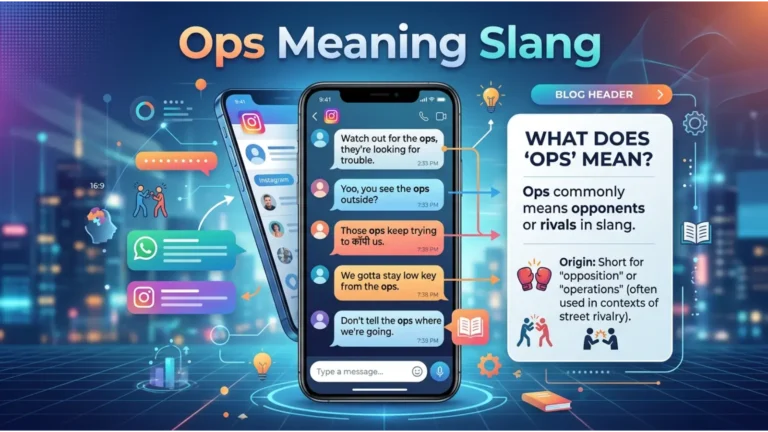
OPS meaning slang can be confusing because “ops” may have different meanings depending on the conversation. You may see it in texts, TikTok comments, Instagram posts, gaming chats, or messages between friends.
In slang, it is often connected to “opps,” a shortened form of opponents or opposition, especially when someone is talking about rivals or people they are against.
However, “ops” does not always have a negative meaning. In some situations, it can be a shortened form of “operations,” especially in business, gaming, technology, or workplace conversations. The surrounding words usually tell you what the person means.
Quick Answer:
In slang, “ops” usually means “opps,” referring to opponents, rivals, or people considered to be against you. Its exact meaning depends on the context.
What Does Ops Mean in Text?
In informal texting and social media, ops is commonly used as a variation or shortened spelling of opps.
“Opps” itself is commonly understood as short for opposition or opponents. Someone might use it when referring to rivals, enemies, competitors, or people they have a conflict with.
For example:
“We saw the ops at the party.”
Here, “ops” means people the speaker considers rivals or opponents.
The term is informal and strongly depends on the social context. It can be used seriously, jokingly, or as part of online slang.
Ops Full Form and Definition
There is no single full form of ops because the meaning changes by context.
Common interpretations include:
| Term | Meaning | Common Context |
|---|---|---|
| Ops / Opps | Opponents or rivals | Slang, texting, social media |
| Ops | Operations | Business, technology, work |
| Ops | Opposition | Informal discussions |
| Ops | Opportunities | Occasionally used as an abbreviation |
When someone specifically asks about ops meaning slang, the first interpretation is usually the slang meaning related to opponents or rivals.
Ops Meaning in Different Contexts
1. Social Media
On platforms such as TikTok, Instagram, and X, “ops” can refer to people who oppose or dislike someone.
Example:
“Don’t tell the ops where we’re going.”
The speaker is referring to rivals or people they do not trust.
2. Text Messages
Friends may use “ops” casually when talking about someone they have an issue with.
“Are the ops coming tonight?”
Depending on the relationship, this could be serious or simply playful slang.
3. Gaming
Gamers may use “ops” to describe opposing players or teams.
“The ops are camping near the building.”
Here, “ops” means the opposing side.
4. Music and Pop Culture
The word is also common in hip-hop and internet culture. In lyrics, captions, and conversations, “ops” may refer to rivals or people involved in a conflict.
Because slang can carry cultural meaning, its interpretation depends heavily on the speaker and situation.
Is Ops Rude, Offensive, or Neutral?
Ops is informal rather than automatically offensive.
However, calling someone an “op” or “opp” can suggest that the person is an enemy, rival, or source of conflict. Because of this, it may sound aggressive in certain situations.
For example:
- Friendly: “Haha, you’re one of the ops now.”
- Casual: “The ops are online.”
- Serious: “Stay away from the ops.”
The tone matters. A joke between friends may be harmless, while the same phrase during a real argument could sound threatening or hostile.
Where Is Ops Commonly Used?
You may encounter this slang in:
- Text messages
- TikTok comments
- Instagram captions
- Snapchat
- Online gaming
- Memes
- Rap and hip-hop culture
- Casual conversations
- Online communities
It is much less appropriate in formal writing, academic assignments, professional emails, or official documents.
Real-Life Conversation Examples
Friendly Example
A: “You joined their team?”
B: “Yeah, I guess I’m with the ops now 😂”
Here, the term is being used humorously.
Casual Example
A: “Who’s coming to the game?”
B: “Everyone except the ops.”
The speaker casually refers to rivals or opposing people.
Argumentative Example
A: “Why are you talking to them?”
B: “They’re not the ops anymore.”
This example shows how the word can be connected to personal conflict.
Gaming Example
Player 1: “Where are the enemies?”
Player 2: “The ops are near the bridge.”
Here, “ops” refers to opponents in the game.
Emotional and Psychological Meaning of Ops
When people call someone an “op,” they are often creating a simple distinction between “us” and “them.”
The word can communicate feelings such as:
- Distrust
- Competition
- Anger
- Loyalty
- Humor
- Group identity
- Rivalry
However, the word alone does not prove that someone genuinely hates another person. Online slang is often exaggerated for humor or dramatic effect.
Origin and Background of Ops
The slang opp is generally connected to words such as opponent and opposition. The plural form opps refers to multiple opponents or rivals.
Over time, the expression became popular in music, street slang, online communities, gaming, and social media.
The spelling ops may appear as a shortened or alternative form of “opps.” Because slang develops quickly, different communities may use slightly different spellings and meanings.
Ops vs. Opps vs. Opp
These terms are closely related but may be written differently.
| Slang | Common Meaning | Example |
|---|---|---|
| Opp | One opponent or rival | “He’s an opp.” |
| Opps | Multiple opponents or rivals | “The opps are here.” |
| Ops | Informal variation of opps | “Watch out for the ops.” |
The spelling does not always determine the meaning. Context is more important.
When Should You Use Ops?
Use ops mainly in informal situations where the people reading it understand the slang.
It can work in:
- Casual texts
- Memes
- Social media
- Gaming chats
- Conversations with friends
Avoid it in:
- School assignments
- Job applications
- Business emails
- Academic writing
- Formal reports
- Professional communication
If your audience may not understand slang, use a clearer word such as opponents, rivals, competitors, or opposition.
Polite Alternatives to Ops
If you want to communicate the same general idea without sounding aggressive, you can say:
- Opponents
- Rivals
- Competitors
- The opposing team
- People on the other side
- Opposition
- Other players
For example:
Slang: “The ops are coming.”
Neutral: “The opposing team is coming.”
Why Do People Use Ops?
People use slang because it makes communication feel shorter, more casual, and more connected to a particular social group.
“Ops” can also make a message sound humorous, dramatic, or culturally familiar.
Social media has helped slang spread quickly. A word that begins in one community can become widely recognized through music, memes, videos, and online conversations.
Impact of Using Ops in Communication
The effect of “ops” depends on who receives the message.
Among friends, it may sound funny and casual. Among strangers, it may create confusion or make the message seem more aggressive than intended.
This is why context and tone are important when using slang.
Common Misunderstandings About Ops
One common mistake is assuming that “ops” always means enemies.
It does not.
For example, in a workplace, ops may simply mean operations:
“I work in ops.”
Here, the speaker probably means the operations department.
Another example is gaming:
“The ops team fixed the server.”
In this situation, “ops” could refer to an operations team rather than rivals.
Always look at the surrounding words before deciding what “ops” means.
Variations and Types
Some related forms include:
- Opp — one rival or opponent
- Opps — multiple rivals or opponents
- Ops — shortened or alternative spelling
- The opposition — a more formal expression
- Rivals — a neutral alternative
The exact spelling can vary across online communities.
How to Respond When Someone Uses Ops
Your response should depend on the situation.
If you understand the slang, you can respond naturally:
“Who are the ops?”
Or:
“What happened with them?”
If you are unsure about the meaning, simply ask:
“What do you mean by ops?”
If the message sounds threatening or aggressive, avoid escalating the conversation. A neutral response is usually safer than responding with more hostile language.
Regional and Cultural Usage
Slang does not have exactly the same meaning everywhere. “Ops” is particularly associated with informal English used in online communities, music culture, gaming, and social media.
Its popularity and interpretation can vary by country, age group, community, and platform.
For English learners, the safest approach is to understand the context before using it yourself.
Is Ops Safe for Social Media?
The word “ops” itself is not automatically unsafe or offensive. However, the context can change how it is interpreted.
If it is being used to describe real people as enemies or rivals, the message can sound hostile. If it is clearly a joke or gaming reference, the meaning may be much lighter.
Think about your audience before posting slang publicly.
FAQs About Ops Meaning Slang
What does ops mean in slang?
In slang, ops commonly refers to opponents, rivals, or people considered to be against someone. It is often related to “opps.”
What does ops stand for?
In slang, “ops” can refer to opponents or opposition, although it does not have one universal full form.
Is ops the same as opps?
Often, yes. Ops can be used as an informal spelling or shortened form of opps, especially in online conversations.
Is calling someone an op rude?
It can be. The word may suggest that someone is a rival or enemy, but friends may also use it jokingly.
What does ops mean in gaming?
In gaming, “ops” can mean opposing players, opponents, or the other team. However, in some games or technical communities, it can have another meaning.
Can I use ops in formal writing?
Generally, no. In formal writing, use clearer terms such as opponents, rivals, competitors, or opposition, depending on the intended meaning.
Conclusion
Understanding ops meaning slang requires paying attention to context. In informal online conversations, “ops” commonly refers to opponents, rivals, or people viewed as being on the other side. It is closely related to the slang terms “opp” and “opps.”
However, ops can also mean operations in business, technology, and other professional contexts. That is why the surrounding conversation is important.
Use “ops” casually when the audience understands the slang, but choose clearer words in formal or professional communication. When in doubt, consider the context, tone, and relationship between the people involved before using the term.

Ali Raza is an M.Phil. scholar and English language expert specializing in English grammar, slang meanings, vocabulary, and everyday expressions. He writes clear, practical, and easy-to-understand content that helps readers master confusing English words, phrases, spelling, and modern slang. His goal is to make English learning simple, useful, and accessible for students, beginners, and everyday readers.
1 thought on “Ops Meaning Slang in Text: What Does Ops Mean?”