

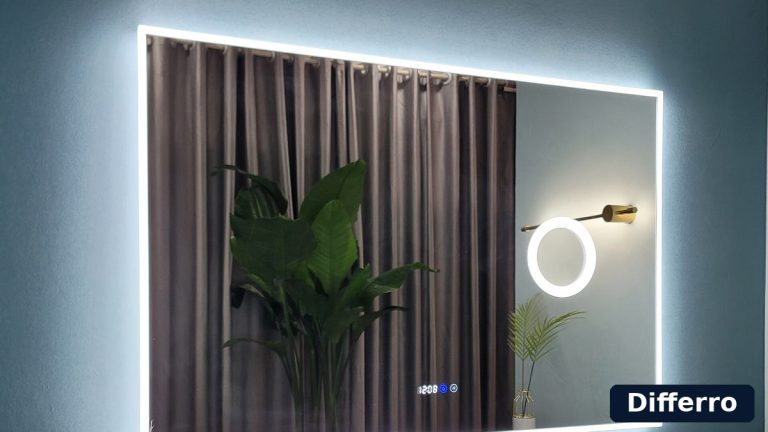
Choosing the right large wall mounted makeup mirror with light starts with the jobs it has to do: close detail work, honest colour, and a clear view without leaning over the sink.
Get it right and the mirror pulls toward you for eyeliner, pushes flat when you are done, and lights your face evenly. Get it wrong and you live with glare, distortion or a wobbly arm.
This guide works through magnification, lighting, size, mounting and bathroom safety in order, so each decision narrows the next one instead of sending you back to the start.
Large Wall Mounted Makeup Mirrors at a Glance
The short version first: the right mirror is the one whose magnification, light and movement match your routine, not the one with the longest feature list.
| Decision | Main options | What it settles |
|---|---|---|
| Magnification | 1X only, or 1X with 5X–10X | How close you can work |
| Light colour | Fixed, or adjustable warm to daylight | How true colours look |
| Power | Battery, plug-in or hardwired | Where it can be mounted |
| Movement | Fixed plate or swing arm | Working distance and storage |
| Shape | Round, square or double-sided | Field of view and style |
Every row gets its own section below. If time is short, read the ones that match your bathroom and your routine first.
Why Large Wall-Mounted Makeup Mirrors Are Useful
A wall-mounted mirror on an adjustable arm moves to you. It pulls in close for detail work and folds back flat when the counter needs to be clear.
That positioning suits makeup, shaving, eyebrow grooming and contact-lens routines, where a fixed bathroom mirror leaves your face too far away to see fine edges clearly.
Mounting on the wall also frees the vanity surface. In a small bathroom, losing the tabletop mirror can be the difference between a crowded counter and a calm one.
Understanding Magnification Levels
A 1X surface gives a true, undistorted reflection. It is the view for checking overall makeup, hair and skin before you leave the house.
Magnifying sides enlarge detail. A 5X surface suits general close work, while 10X is reserved for precise tasks such as tweezing, eyeliner and checking individual lashes.
Higher is not automatically better. Strong magnification shrinks the visible area and demands steadier positioning, so a 1X and moderate pairing beats one extreme surface for daily use.
Why Working Distance Matters
Magnification only works at the distance it was ground for. The stronger the mirror, the closer your face must be before the reflection turns sharp.
An extending arm solves the gap. Some models reach more than a foot out from the wall and swivel through a full circle, bringing the surface to you instead.
Judge the two together when you shop. A powerful mirror on a short, stiff arm is frustrating, whatever the specification sheet promises.
Choosing the Right LED Lighting
Built-in light is the other half of the design. The goal is even illumination across the face, without glare in the eyes or hard shadows under the chin.
Color Temperature
Light colour is measured in kelvin. Warm settings sit near 2,700–3,000K, neutral light around 3,500–4,000K, and daylight-style settings between roughly 5,000K and 6,500K on the colour temperature scale.
For makeup, a neutral or daylight setting shows colours most honestly. A high colour rendering index matters too: scores in the 90s mean reds and skin tones render close to how daylight shows them.
Adjustable mirrors that offer all three tones are the safest buy. You can match the light to the room you are heading into, from office daylight to evening warmth.
Brightness Control
Brightness needs range as much as power. Full output helps with detailed grooming, but the same ring of light is harsh first thing in the morning or late at night.
Dimming solves that, whether it comes from a touch strip, a dial or a long-press button. Check that the mirror remembers your last setting instead of resetting to full.
Wall Mounting and Installation Considerations
An arm-mounted mirror moves every day, so its fixing works harder than a static decorative mirror’s. Drywall alone rarely gives the same hold as a stud or a proper anchor.
Power decides placement as much as the wall does. Plug-in models need a reachable outlet, hardwired models need an electrician, and rechargeable models can go almost anywhere.
Follow the manufacturer’s fixing instructions and your local electrical code for anything wired. In a bathroom, that is not the place for improvisation or guesswork.
Mounting Height and Placement Tips
Set the mirror’s centre close to the eye level of the people who use it most. On an arm, check the full swing: extended, folded, and everywhere between.
Leave clearance for cabinet doors, taps, shelves and towel bars. A mirror that clears the wall when folded can still clip a fixture at full stretch.
Comparing models side by side is easier in a large showroom, which is why shoppers weighing Lowes or Home Depot often test the arm’s reach and stiffness before checking anything else.
Bathroom Moisture and Electrical Safety
Bathrooms mix humidity, condensation and electricity in a small space. A mirror for that room should carry specifications meant for it, not just a pretty frame.
Look for an IP rating on the listing. The code’s second digit grades water protection, and a rating such as IP44 covers splashes of water from any direction.
A rating is not a free pass to mount anywhere. Distance from the bath or shower, the product’s own instructions and local codes still govern the final position.
How to Choose the Right Mirror Size
Size the mirror to the wall and to your working distance. A compact round mirror on a long arm can outperform a wide plate you have to lean toward.
Measure the wall before ordering, and measure the space the mirror needs in use, not folded. The extended arm is the dimension that catches people out.
Larger mirrors give a broader view for hair and outfit checks. Just confirm the extra width does not crowd light fittings or neighbouring cabinets.
Round, Square, or Double-Sided Designs?
Round mirrors pair naturally with ring lighting and swivel joints, which is why they dominate the category. Square and rectangular designs read more modern and can show more of the face at once.
Double-sided models pair a true 1X reflection with a magnifying reverse. That single fitting replaces two mirrors and suits shared bathrooms well.
Choose by task first. If detail work drives the purchase, magnification and arm movement matter more than the outline of the frame.
Common Features Worth Comparing
Listings compete on features: LED rings, full rotation, extension arms, dimming, several magnifications, rechargeable power and dual sides. The list is not the point.
Match features to a problem you actually have. Limited counter space argues for wall mounting; detailed grooming argues for magnification and a long, steady arm.
A dim bathroom argues for adjustable light above everything else. Buying the feature that solves your problem beats buying the longest list.
Common Mistakes to Avoid
The classic mistake is buying the highest magnification on the shelf. A 10X or stronger surface is superb for tiny detail and awkward for almost everything else.
The second is judging light by brightness alone. A fierce LED ring with poor colour rendering still shows foundation shades wrongly.
The third is measuring only the folded mirror. Check the swing, the clearance and the bathroom rating before the box is opened, not after.
Is a Large Lighted Wall Mirror Worth It?
For occasional makeup, a plain mirror under good room lighting is honestly enough. The dedicated fitting earns its wall space through daily use.
Daily grooming, shaving, detailed cosmetic work and small bathrooms all tilt the answer to yes. So does a vanity that stays buried under bottles and brushes.
Value comes from the match, not the spend. A modest mirror that fits your routine outperforms a flagship model whose features you never touch.
Final Considerations Before Choosing
Judge the mirror as one system: reflection, magnification, light, movement, mounting, power, size and bathroom rating. A weakness in any one of them shows up daily.
Start from the task, then set magnification, working distance and lighting, and only then check installation. That order prevents most returns and regrets.
Frequently Asked Questions
What magnification is best for everyday makeup?
A 1X side for the overall view, paired with 5X to 10X for detail, covers nearly every routine. Stronger magnification suits single tasks but frustrates general grooming.
What colour temperature is best for applying makeup?
A neutral to daylight setting, roughly 4,000K to 5,000K, with a high colour rendering index shows shades most truthfully. Adjustable mirrors let you check a look under warmer evening light too.
Can a lighted mirror be used safely in a bathroom?
Yes, when it is rated for the environment and installed to its instructions and local code. Look for an IP rating such as IP44, and use a qualified electrician for hardwiring.
How high should a wall mounted makeup mirror be fitted?
Centre it near the eye level of its main users, then confirm the arm’s full swing clears taps, doors and shelves. Shared bathrooms may need the compromise height.
Is a rechargeable or a plug-in mirror better?
Rechargeable models mount anywhere and keep cables out of sight, but need regular charging. Plug-in and hardwired models give constant brightness with no battery to manage.
Conclusion
Choosing well comes down to fit: the right magnification at the right distance, honest light, and a mounting that suits your wall and your bathroom.
Work through the decisions in order and the shortlist shrinks fast. What remains is a mirror you will use every day without thinking about it.

