

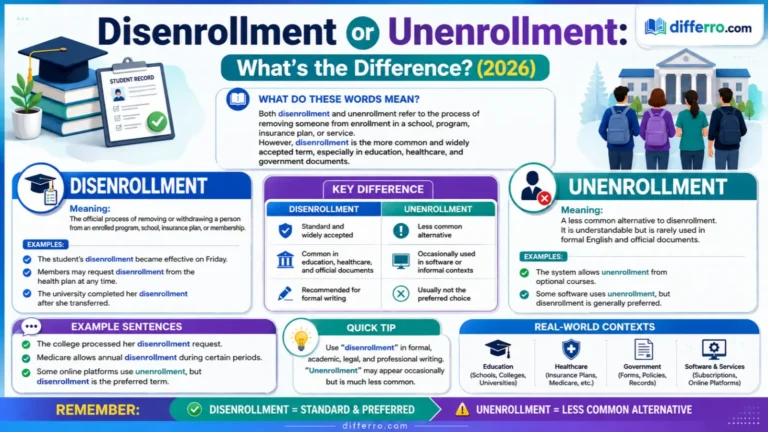
Disenrollment or Unenrollment is a common language question, especially in education, healthcare, and membership programs.
Many people wonder whether these words mean the same thing or if one is more correct than the other.
The confusion happens because both words describe the process of removing someone from a program, service, school, or organization. However, their usage can vary depending on the context, region, and industry.
In modern English, both terms are considered correct. Yet, one is often used more frequently than the other in official documents and professional communication.
This guide explains the meanings, differences, history, examples, common mistakes, and usage trends of disenrollment and unenrollment in simple English.
⭐ Quick Answer
Disenrollment and unenrollment both mean removing a person from a program, membership, school, or service. However, disenrollment is much more common and widely accepted in formal writing.
Example: A student who leaves a university before graduation goes through disenrollment from the institution.
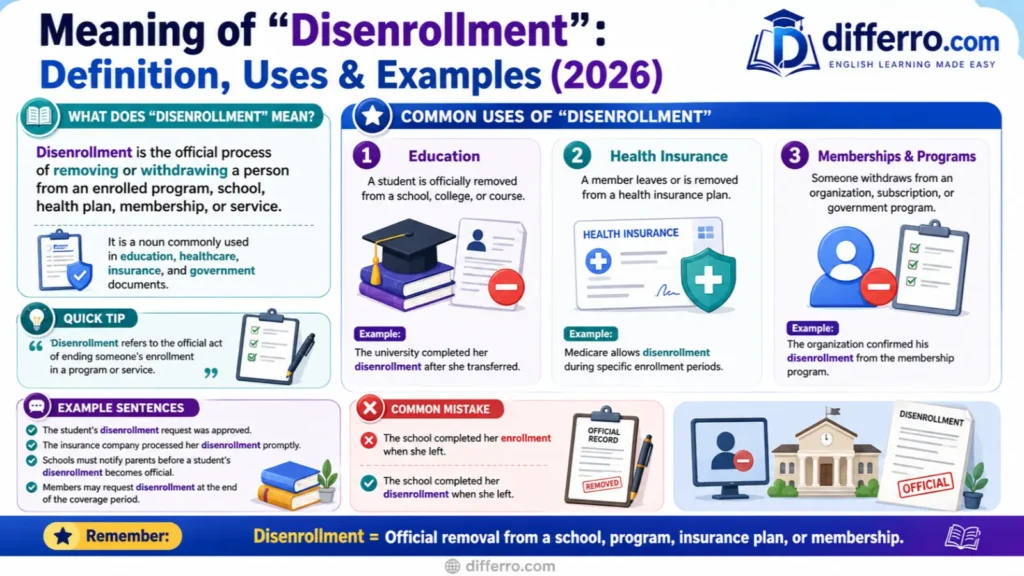
📖 Meaning of Disenrollment
Disenrollment means the process of officially removing someone from enrollment in a program, school, healthcare plan, or organization.
Examples
- The student completed the disenrollment process before transferring schools.
- The healthcare provider sent a disenrollment notice to members.
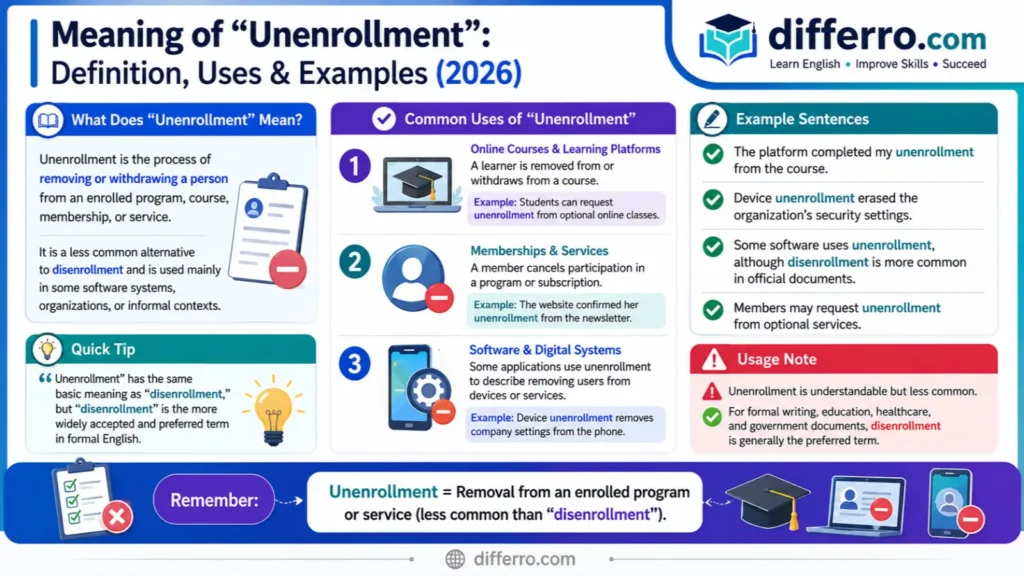
📖 Meaning of Unenrollment
Unenrollment means the act of canceling or ending enrollment in a program or service.
Examples
- The parent requested the unenrollment of their child from the daycare center.
- The company processed the employee’s unenrollment from the training program.
📊 Key Differences Between Disenrollment and Unenrollment
| Feature | Disenrollment | Unenrollment |
|---|---|---|
| Meaning | Removal from enrollment | Cancellation of enrollment |
| Tone | Formal and official | Less formal |
| Usage | Common in institutions and healthcare | Less commonly used |
| Popularity | Highly popular | Relatively uncommon |
🏛️ Origin & History
The prefix dis- often means removal, reversal, or separation. That is why words like disconnect, disqualify, and disengage are common in English.
The prefix un- also expresses reversal or removal. Examples include unlock, untie, and unplug.
Over time, institutions such as schools, universities, and healthcare organizations adopted disenrollment as the standard term. As a result, it became more common in official communication.
Similar Word Examples
- Disconnect vs Unplug
- Disengage vs Untie
- Disqualify vs Remove
- Discontinue vs Stop
🇬🇧 British English vs American English Spelling
Unlike words such as colour/color or organise/organize, disenrollment and unenrollment are not primarily British-versus-American spelling differences.
Both versions appear in American English, while British English often prefers alternative phrases like withdrawal from enrollment or removal from a course.
Comparison Table: British vs American English
| British English | American English |
|---|---|
| Withdrawal from enrollment | Disenrollment |
| Removal from course | Disenrollment |
| Course withdrawal | Unenrollment (less common) |
| Deregistration | Disenrollment |
✅ When to Use Disenrollment
Use disenrollment when:
- Writing formal documents
- Discussing healthcare plans
- Referring to educational institutions
- Creating legal or administrative content
Examples
- The college completed the student’s disenrollment.
- Medicare issued a disenrollment notice.
- The university requires a disenrollment form.
✅ When to Use Unenrollment
Use unenrollment when:
- Referring to general enrollment cancellation
- Using less formal language
- Explaining enrollment changes to the public
Examples
- Parents requested unenrollment from the program.
- The club accepted her unenrollment request.
- The service allows online unenrollment.
❌ Common Mistakes
Mistake 1
❌ The student was unenrolled through disenroll.
✅ The student completed the disenrollment process.
Mistake 2
❌ Disenrollment means registration.
✅ Disenrollment means removal from registration.
Mistake 3
❌ Unenrollment is always incorrect.
✅ Unenrollment is correct but less common.
Mistake 4
❌ Both words have different meanings in every context.
✅ Both words usually describe ending enrollment.
🧠 Easy Trick to Remember
Remember this simple rule:
Disenrollment = Official removal
Unenrollment = Undo enrollment
If the situation sounds formal or administrative, choose disenrollment.
✍️ Write 5 Examples
Example 1: School Transfer
The student’s disenrollment was completed before joining a new school. The unenrollment request was approved quickly.
Example 2: Healthcare Plan
The insurance company processed the member’s disenrollment after coverage ended. Some documents also referred to it as unenrollment.
Example 3: Online Course
The platform allows unenrollment from courses at any time. Official records may show disenrollment.
Example 4: Gym Membership
The gym accepted the member’s unenrollment request. The final paperwork described it as disenrollment.
Example 5: Employee Training Program
HR handled the employee’s disenrollment from the training program. The internal guide used the word unenrollment.
🔍 Related Keywords
- disenrollment meaning
- unenrollment meaning
- disenrollment vs unenrollment
- enrollment cancellation
- student disenrollment
- healthcare disenrollment
- enrollment withdrawal
🌎 Google Trends & Usage Data
Across major English-speaking countries, disenrollment receives significantly more usage than unenrollment. Educational institutions and healthcare organizations strongly favor the term.
In search behavior, users often compare both words because they appear similar. The gap is especially noticeable in official government and academic documents.
Countries such as the USA, UK, Australia, India, and Pakistan show stronger recognition of disenrollment.
Insight
If your goal is SEO, professional writing, or official communication, disenrollment is usually the better keyword target.
Comparison Table: Keyword Variations
| Country | More Popular Term | Less Popular Term |
|---|---|---|
| USA | Disenrollment | Unenrollment |
| UK | Disenrollment | Unenrollment |
| Australia | Disenrollment | Unenrollment |
| India | Disenrollment | Unenrollment |
| Pakistan | Disenrollment | Unenrollment |
⚖️ Final Verdict
Both disenrollment and unenrollment are correct English words.
However, disenrollment is more widely accepted, more professional, and more common in schools, universities, healthcare plans, and government documents.
Choose unenrollment when discussing a simple cancellation of enrollment in less formal situations.
For most writing purposes, disenrollment is the preferred choice.
❓ Frequently Asked Questions
1. Is disenrollment a correct word?
Yes. Disenrollment is a standard English word used in education, healthcare, and administration.
2. What is the difference between disenrollment and unenrollment?
Both refer to ending enrollment. Disenrollment is more formal and more widely used.
3. Which is more common, disenrollment or unenrollment?
Disenrollment is much more common in official and professional contexts.
4. Which word should I use in formal writing?
Use disenrollment for formal, academic, healthcare, and legal documents.
5. Why does confusion exist between these words?
Both prefixes, dis- and un-, indicate reversal or removal, making the words appear interchangeable.
Conclusion
Disenrollment or unenrollment is a question many English learners and writers encounter. While both terms describe removing someone from a program, school, membership, or service, they are not equally popular. Disenrollment is the preferred term in professional, educational, healthcare, and administrative settings.
It appears more frequently in official documents and online searches. Unenrollment is still correct, but it is less common and often used in casual contexts. Understanding the difference helps you choose the right word for your audience. If you need a formal and widely recognized option, use disenrollment. For general conversations, either word may work depending on the situation.

