

College or university is a common comparison for students planning their higher education. Both institutions offer learning opportunities, career preparation, and qualifications. However, their meanings and roles can differ depending on the country.
In the United States, colleges often focus on undergraduate degrees, while universities usually offer undergraduate and graduate programs. Some colleges also provide graduate degrees, and some universities include specialized colleges. In the United Kingdom, the terms can have different meanings. A college may provide further education, vocational training, or part of a university.
Understanding the difference helps students choose the right educational path. It also helps parents compare admission requirements, tuition fees, campus life, and future career options. Neither option is automatically better for everyone. The right choice depends on your goals, budget, preferred subject, and plans after graduation.
⭐ Quick Answer
A college often offers undergraduate degrees or specialized education, while a university usually offers undergraduate and postgraduate degrees across several subjects. However, definitions vary by country and institution.
Example: In the United States, a student might earn a bachelor’s degree at a college or university. A university may also offer master’s and doctoral programs.
🎓 Meaning of College
A college is an educational institution that provides higher education, vocational training, or other advanced learning. Its exact role depends on the country and institution.
In the United States, many colleges award associate and bachelor’s degrees. Some also offer master’s degrees and professional programs. In the United Kingdom, colleges may offer further education, technical qualifications, or courses within a university.
Examples of College
Example 1: A student attends a community college to complete an associate degree before transferring to a four-year university.
Example 2: A student enrolls in a liberal arts college to earn a bachelor’s degree in English.
Both examples show how colleges can serve different educational needs.
🏛️ Meaning of University
A university is an institution that typically offers several fields of study and awards academic degrees. Universities commonly provide undergraduate and postgraduate programs.
Many universities also conduct research and operate specialized schools or colleges. These may include medical schools, business schools, engineering departments, and law schools.
However, degree options vary. Some universities focus on specific subjects, while others offer a broad range of academic programs.
Examples of University
Example 1: A student attends a university to earn a bachelor’s degree in computer science and later completes a master’s degree.
Example 2: A researcher joins a university’s doctoral program to study environmental science.
These examples highlight the academic and research opportunities many universities provide.
🔍 College or University: Key Differences
The following table explains common differences, especially within the United States. Other countries may use these terms differently.
| Feature | College | University |
|---|---|---|
| Meaning | Institution offering higher or specialized education | Institution offering higher education across one or more academic fields |
| Typical programs | Associate and bachelor’s degrees; some offer graduate degrees | Bachelor’s, master’s, and doctoral degrees are common |
| Academic focus | May emphasize undergraduate teaching or specialized subjects | Often combines teaching, research, and postgraduate study |
| Size | Often smaller, but not always | Often larger, but not always |
| Campus life | May offer a close-knit learning environment | May offer more departments, facilities, and student organizations |
| Research | Depends on the institution | Many universities have extensive research programs |
| Tone and usage | Common in everyday education discussions | Common in formal academic and institutional contexts |
| Popularity | Widely used in American education | Widely used internationally, with local differences |
Important: These are general patterns, not strict rules. A college can offer graduate degrees, and a university does not always provide every type of degree.
📚 Origin and History
The words college and university have different historical roots.
The word college comes from the Latin collegium, which referred to a group of people organized for a shared purpose. Over time, it became associated with educational communities and institutions.
The word university comes through Old French from the Latin universitas. It originally referred to a community or organized body of people. During the Middle Ages, universities developed into recognized centers of advanced learning.
Today, both terms describe educational institutions, but their meanings depend on national education systems.
Similar Education Terms
- Community college: A US institution that commonly offers two-year programs, certificates, and transfer pathways.
- Liberal arts college: A college that emphasizes broad learning across the humanities, sciences, and social sciences.
- Technical college: An institution that focuses on technical or vocational education in some countries.
- Graduate school: A school or division offering advanced study after a bachelor’s degree.
- University college: A term with different meanings across countries, sometimes describing an institution linked to a university.
🇬🇧 British English vs American English
The words college and university use the same spelling in British and American English.
However, their meanings and everyday usage differ between the two countries. American students often use college when discussing undergraduate education, while British students may use it for further education or a university division.
Always consider the country’s education system when interpreting these terms.
British vs American English Comparison
| Feature | British English | American English |
|---|---|---|
| College | May offer further education, vocational courses, or form part of a university | Often offers undergraduate degrees or two-year programs |
| University | Commonly offers undergraduate and postgraduate degrees | Commonly offers undergraduate and postgraduate degrees |
| College student | May attend a further education college or university college | Often refers to a student pursuing higher education |
| Undergraduate education | Usually discussed using terms such as university or higher education | Often described as going to college |
| Spelling | College, university | College, university |
🎯 When to Use College
Use college when the institution’s official name includes the word or when the context fits its role in the relevant education system.
In the United States, people often use college when talking about undergraduate education. The word can also describe specialized institutions and community colleges.
Examples of College Usage
- “I plan to attend college after high school.”
- “She earned her bachelor’s degree at a small liberal arts college.”
- “He enrolled in a community college to study nursing prerequisites.”
- “My brother attends a technical college for professional training.”
Writing tip: Use the institution’s official name when you discuss a specific school. Do not assume every college follows the same degree structure.
🎓 When to Use University
Use university when referring to an institution that officially uses that name or when discussing a university’s academic programs.
The term often fits discussions about postgraduate study, academic research, and institutions with multiple departments. However, the institution’s actual programs matter more than its name.
Examples of University Usage
- “She hopes to study medicine at a university.”
- “He earned a master’s degree from a public university.”
- “The university offers several doctoral programs.”
- “Researchers at the university are studying climate change.”
Writing tip: Check the institution’s official website or prospectus before describing its degree options.
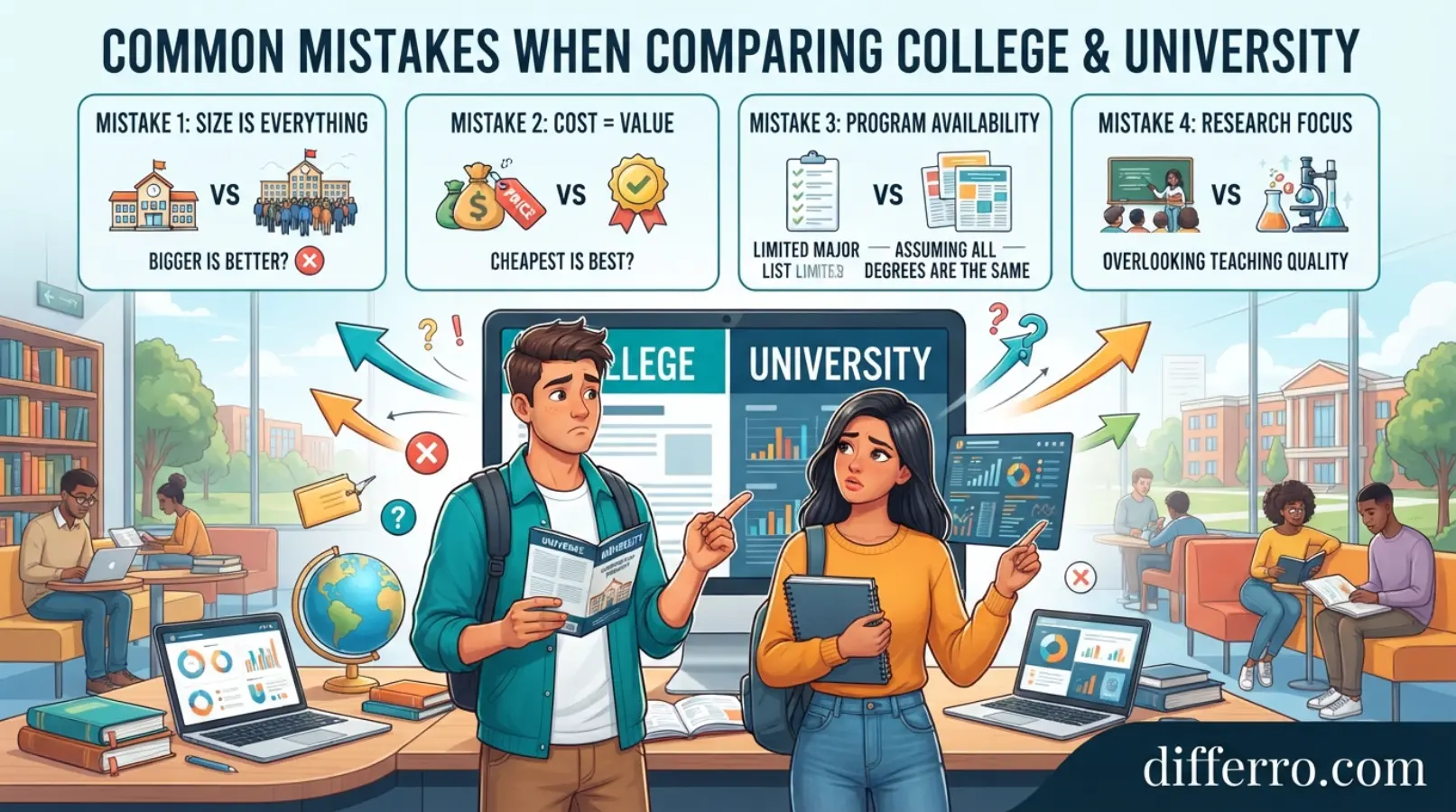
⚠️ Common Mistakes When Comparing College and University
Mistake 1: Assuming Every College Is Smaller
Incorrect: Every college has fewer students than every university.
Correct: Colleges are often smaller, but some enroll large student populations. Compare actual enrollment figures before making this claim.
Mistake 2: Assuming Colleges Never Offer Master’s Degrees
Incorrect: You must attend a university to earn a master’s degree.
Correct: Some colleges offer master’s degrees and other postgraduate qualifications. Check the institution’s program list.
Mistake 3: Assuming College Means the Same Thing Everywhere
Incorrect: A college in the United Kingdom always provides the same education as a college in the United States.
Correct: Education systems use the term differently. Check the country’s definitions and the institution’s role.
Mistake 4: Believing Universities Always Provide Better Education
Incorrect: A university always offers better teaching than a college.
Correct: Teaching quality depends on faculty, resources, accreditation, student support, and the specific program.
Mistake 5: Thinking Only Universities Conduct Research
Incorrect: Colleges never conduct academic research.
Correct: Some colleges conduct significant research. Research opportunities depend on the institution, department, and available resources.
Mistake 6: Choosing an Institution Based Only on Its Name
Incorrect: A university name automatically guarantees better career opportunities.
Correct: Compare accreditation, program quality, costs, internships, graduate outcomes, and employer recognition.
🧠 Easy Trick to Remember
Use this simple memory tip:
- College: Think of undergraduate education, specialized learning, or a smaller academic community.
- University: Think of a broader academic structure that often includes undergraduate and postgraduate programs.
Remember that this trick describes common patterns, not universal rules. The official programs and qualifications matter most.
🌟 Everyday-Life Examples: College or University
1. Choosing Your First Degree
Sara has finished high school in the United States. She wants to earn a bachelor’s degree in psychology.
She compares a liberal arts college with a university. Both offer her preferred degree, so she reviews tuition, class sizes, and internship opportunities.
Keyword usage: College or university depends on her academic needs and personal preferences.
2. Planning for a Master’s Degree
Ahmed wants to earn a master’s degree in computer science. He checks programs at several colleges and universities.
One college offers the degree he needs, while another institution does not.
Keyword usage: The college or university label alone does not determine postgraduate options.
3. Looking for a Smaller Campus
Maya prefers smaller classes and closer contact with professors. She begins by researching liberal arts colleges.
She also considers smaller universities that offer similar learning environments.
Keyword usage: College or university is a useful comparison, but actual class sizes matter more.
4. Studying in the United Kingdom
James wants to continue his education after completing secondary school. He finds colleges that offer vocational qualifications and universities that offer bachelor’s degrees.
He compares entry requirements and course structures before applying.
Keyword usage: The difference between college and university depends on the British education system.
5. Comparing Costs and Career Options
A student receives admission offers from a college and a university. The college offers lower tuition, while the university provides a specific internship program.
The student compares total costs, financial aid, course quality, and career support.
Keyword usage: College or university is not simply a choice between smaller and larger campuses. It is a decision about educational fit.
🌍 Google Trends and Usage Insights: USA, UK, Australia, India, and Pakistan
Google Trends shows relative search interest over time, rather than exact search volumes. Without live country-level data, exact rankings for these phrases cannot be confirmed.
- USA: “College” commonly appears in searches about undergraduate education, admissions, and student life.
- UK: “University” often appears in searches about degree programs, applications, and higher education.
- Australia: Both terms appear in education discussions, but their meanings depend on the institution and qualification.
- India: Students commonly compare colleges and universities when researching admissions, degrees, and career options.
- Pakistan: Search intent may focus on university admissions, college education, degree recognition, and fees.
SEO insight: These observations describe common usage patterns, not verified Google Trends results. Compare both phrases in Google Trends for each country and select the same date range. Review related queries before deciding which variation deserves the most prominent placement.
Comparison Table: Keyword Variations
| Keyword variation | Search intent | Recommended placement |
|---|---|---|
| College or university | Direct comparison | H1 and introduction |
| College vs university | Informational comparison | Key differences heading |
| Difference between college and university | Explanation | Introduction and FAQ |
| College vs university in USA | Country-specific research | US education section |
| College vs university in UK | Country-specific research | British English section |
| Is college the same as university? | Question-based search | FAQ section |
| College or university for bachelor’s degree | Decision-making | Practical examples |
❓ Frequently Asked Questions
1. Is “college or university” a correct phrase?
Yes. “College or university” is a correct phrase when comparing two types of educational institutions. The best choice depends on the country’s education system and your intended meaning.
2. What is the main difference between a college and a university?
A college often focuses on undergraduate or specialized education. A university usually offers a wider range of academic programs, including postgraduate degrees. However, institutions can differ significantly.
3. Which is more common, college or university?
Usage depends on the country and context. Americans often say “college” when discussing undergraduate education. British speakers commonly use “university” for degree-level study. Neither term is universally more common.
4. Should I use college or university in formal writing?
Use the institution’s official name in formal writing. When discussing education generally, choose the term that matches the country’s education system and the institution’s actual role.
5. Why do people confuse college and university?
People confuse these terms because educational systems define them differently. Both can offer higher education and bachelor’s degrees. Some colleges also offer postgraduate programs, which makes the distinction less straightforward.
🏆 Final Verdict: College or University?
Neither college nor university is automatically the better choice. Both can provide valuable education and prepare students for successful careers.
Choose a college if it offers your preferred program, suitable costs, and the learning environment you want. Consider a university if you need its specific degree options, research facilities, or postgraduate pathways.
However, do not make your decision based on the name alone. Check accreditation, course content, tuition, financial aid, faculty experience, internships, and graduate outcomes. Also confirm that employers or licensing bodies recognize your qualification.
The best institution is the one that meets your educational goals and financial needs. Compare actual programs rather than relying on general assumptions about colleges and universities.
Conclusion
College or university can describe different educational paths, depending on the country and institution. In the United States, colleges often offer undergraduate degrees, while universities commonly provide undergraduate and postgraduate programs. In the United Kingdom, colleges may offer further education, vocational training, or courses within a university.
Neither institution guarantees better teaching, career opportunities, or student experiences. Your choice should depend on your preferred subject, budget, qualifications, and future plans. Check each institution’s accreditation, course options, tuition fees, and career support before applying. Remember that some colleges offer advanced degrees, while universities vary in size and academic focus. Understanding these differences helps you make a more informed decision. Focus on the quality and suitability of the program rather than the institution’s name alone.

Imran Lodhra is a comparison-focused content writer at Differro.com.
He specializes in creating clear, simple, and informative comparison articles.
His work helps readers understand key differences, pros and cons, and important details.
Imran focuses on accurate, practical, and easy-to-read content for everyday readers.
1 thought on “College or University: What Is the Difference?”