
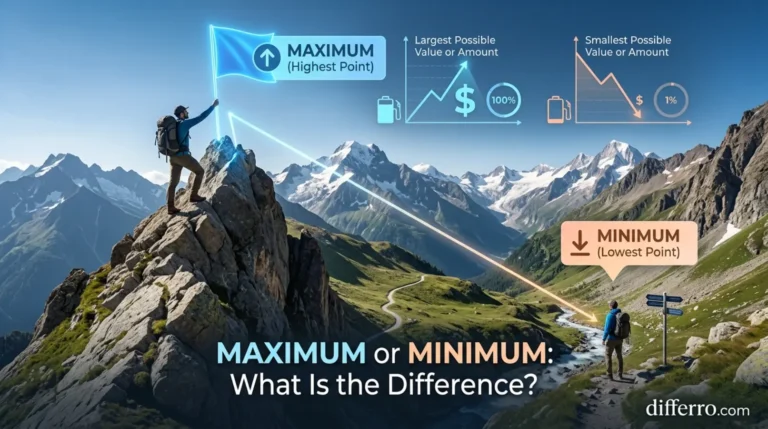
Maximum or Minimum can confuse writers because both words describe limits, but they point in opposite directions. Maximum means the highest possible amount, level, number, or limit. Minimum means the lowest possible amount, level, number, or limit.
You will often see these words in mathematics, rules, prices, temperatures, scores, ages, and everyday instructions. For example, a school may set a maximum class size of 40 students. It may also require a minimum attendance of 75 percent.
Understanding the difference helps you choose the right word quickly. Maximum focuses on the highest point, while minimum focuses on the lowest point. Both words can work as nouns, adjectives, and in some contexts, verbs.
This guide explains Maximum or Minimum, their meanings, differences, origins, usage, mistakes, and everyday examples.
⭐ Quick Answer
Maximum means the highest possible amount or limit. Minimum means the lowest possible amount or limit. Maximum looks upward, while minimum looks downward.
Example: “The maximum speed is 80 km/h, while the minimum speed is 40 km/h.”
📘 Meaning of Maximum
Maximum means the greatest amount, number, degree, or level that something can reach or have.
It describes the highest limit or point within a situation.
Examples of Maximum
- The maximum capacity of the hall is 500 people.
- You can spend a maximum of $100 on the gift.
In mathematics, the maximum represents the greatest value in a given set or range.
For example, if the numbers are 5, 8, 12, and 20, the maximum is 20.
📗 Meaning of Minimum
Minimum means the smallest amount, number, degree, or level that something can reach or have.
It describes the lowest limit or point within a situation.
Examples of Minimum
- You need a minimum of five votes to win.
- The machine requires a minimum temperature of 10°C.
In mathematics, the minimum represents the smallest value in a given set or range.
For example, if the numbers are 5, 8, 12, and 20, the minimum is 5.
🔎 Maximum or Minimum: Key Differences
| Feature | Maximum | Minimum |
|---|---|---|
| Meaning | Highest possible amount or level | Lowest possible amount or level |
| Direction | Toward the highest point | Toward the lowest point |
| Tone | Suggests an upper limit | Suggests a lower limit |
| Usage | Rules, limits, scores, quantities | Requirements, limits, scores, quantities |
| Popularity | Very common | Very common |
| Example | Maximum age is 60 | Minimum age is 18 |
The easiest way to remember the difference is maximum = most and minimum = least.
If a rule tells you the highest amount allowed, use maximum.
If a rule tells you the lowest amount required, use minimum.
🕰️ Origin and History
The words maximum and minimum come from Latin.
Maximum comes from the Latin word maximum, meaning “greatest” or “largest.”
Minimum comes from the Latin word minimum, meaning “smallest” or “least.”
Both words entered English through the language of mathematics, science, and scholarship.
They later became common in everyday English.
Similar word pairs include:
- maximum and minimum
- greatest and least
- highest and lowest
- largest and smallest
- most and least
- upper limit and lower limit
These pairs often describe opposite ends of a range.
🇬🇧 British English vs American English
British and American English use maximum and minimum in the same basic way.
The spelling does not normally change between the two varieties.
Both forms are standard in formal writing, education, business, science, and everyday communication.
| Word | British English | American English |
|---|---|---|
| Maximum | maximum | maximum |
| Minimum | minimum | minimum |
| Meaning | Highest limit | Highest limit |
| Meaning | Lowest limit | Lowest limit |
| Spelling difference | None | None |
✍️ When to Use Maximum
Use maximum when you mean the highest permitted, possible, or recorded amount.
1. For limits
- The maximum speed is 100 km/h.
- The room has a maximum capacity of 200 people.
2. For numbers
- The maximum number of guests is six.
- You can select a maximum of three options.
3. For levels
- The temperature reached its maximum level.
- The athlete achieved his maximum performance.
Remember: maximum points upward toward the highest value.
✍️ When to Use Minimum
Use minimum when you mean the lowest required, permitted, or possible amount.
1. For requirements
- You need a minimum score of 50 percent.
- Applicants must have a minimum age of 18.
2. For quantities
- Please order a minimum of ten units.
- The package requires a minimum weight of two kilograms.
3. For levels
- The temperature reached its minimum level.
- The company wants to maintain a minimum service standard.
Remember: minimum points downward toward the lowest value.

⚠️ Common Mistakes With Maximum or Minimum
Mistake 1: Using maximum for the lowest limit
❌ The minimum age is 18, so 16 is the maximum age.
✅ The minimum age is 18, so 16 is below the required age.
Why? Minimum describes the lowest acceptable limit.
Mistake 2: Using minimum for the highest limit
❌ The minimum speed is 120 km/h.
✅ The maximum speed is 120 km/h.
Why? Maximum describes the highest permitted speed.
Mistake 3: Confusing “maximum” with “most”
❌ The maximum students in the class are 30.
✅ The maximum number of students in the class is 30.
The second sentence clearly describes an upper limit.
Mistake 4: Confusing “minimum” with “least” in every situation
❌ The minimum price was the cheapest product I bought.
✅ The minimum price was $20.
Both can refer to the lowest value, but minimum often sounds more precise.
🧠 Easy Trick to Remember Maximum or Minimum
Use this simple memory trick:
MAX = MOST
MIN = LEAST
Think of maximum as the top of a mountain.
Think of minimum as the bottom of a valley.
For example:
Maximum: the highest price you can pay.
Minimum: the lowest price you can pay.
Another quick trick is:
Maximum = highest limit
Minimum = lowest limit
Once you remember these two ideas, the difference becomes easy.
🏠 Maximum or Minimum in Everyday Life
1. Maximum or Minimum Age
A job may have a minimum age requirement.
A competition may have a maximum age limit.
Example: The minimum age is 18, but the maximum age is 35.
2. Maximum or Minimum Price
Stores often use maximum and minimum prices.
Example: The minimum price is $10, while the maximum price is $50.
The maximum price means the highest allowed amount.
The minimum price means the lowest allowed amount.
3. Maximum or Minimum Speed
Traffic signs commonly show maximum speed limits.
Example: The maximum speed on this road is 80 km/h.
A vehicle may also have a recommended minimum speed.
4. Maximum or Minimum Number
Rules often specify a maximum or minimum number.
Example: You need a minimum of three players.
Example: The team can have a maximum of eleven players.
5. Maximum or Minimum Temperature
Weather reports use both terms when describing temperature ranges.
Example: The maximum temperature will reach 35°C.
Example: The minimum temperature may fall to 20°C.
These examples show why maximum or minimum depends on the direction of the limit.
🔑 Related Keywords
- maximum vs minimum
- maximum and minimum difference
- maximum meaning
- minimum meaning
- maximum or minimum usage
- maximum and minimum examples
- highest and lowest difference
⚖️ Final Verdict: Maximum or Minimum?
Maximum and minimum are both correct words, but they describe opposite limits.
Use maximum for the highest possible amount, number, level, or limit.
Use minimum for the lowest required amount, number, level, or limit.
For example, “maximum speed” means the highest permitted speed. “Minimum age” means the lowest permitted age.
The best memory rule is simple:
Maximum = highest
Minimum = lowest
If you are describing an upper limit, choose maximum. If you are describing a lower limit, choose minimum.
📈 Google Trends and Usage Data
Search interest for maximum and minimum remains strong because both words appear across education, mathematics, business, technology, health, and everyday English.
➤In the USA and UK, searches often relate to grammar, mathematics, limits, and usage questions.
In Australia and India, both terms also appear frequently in educational and technical searches.
In Pakistan, learners commonly search these words for English usage, mathematics, and vocabulary clarification.
Exact Google Trends scores change by date, location, and search category, so relative interest should be checked for the specific time period.
| Country | Common Search Intent | Keyword Variation |
|---|---|---|
| USA | English usage and mathematics | maximum vs minimum |
| UK | Grammar and academic usage | maximum or minimum |
| Australia | Education and general English | maximum meaning |
| India | Mathematics and English learning | minimum meaning |
| Pakistan | Vocabulary and academic English | maximum and minimum difference |
Keyword Variation Comparison
| Keyword Variation | Main Intent | Best Content Angle |
|---|---|---|
| maximum vs minimum | Comparison | Difference and examples |
| maximum or minimum | Confusion | Correct usage |
| maximum meaning | Informational | Definition and examples |
| minimum meaning | Informational | Definition and examples |
| maximum and minimum difference | Comparison | Side-by-side explanation |
| maximum and minimum examples | Informational | Everyday examples |
| highest vs lowest | Comparison | Related concept |
❓ Frequently Asked Questions
Is “maximum or minimum” correct?
Yes. Both maximum and minimum are correct English words. They describe opposite limits.
What is the difference between maximum and minimum?
Maximum means the highest possible value or limit. Minimum means the lowest possible value or limit.
Which is more common, maximum or minimum?
Both words are very common. Their frequency depends on the subject and context. Mathematics, education, rules, and measurements use both frequently.
Are maximum and minimum formal words?
Yes. Both words are standard and widely accepted in formal English. They work well in academic, professional, technical, and everyday writing.
Why do people confuse maximum and minimum?
People confuse them because both describe limits or values. The key difference is direction. Maximum means highest, while minimum means lowest.
📝 Conclusion
Maximum or Minimum becomes easy when you remember their opposite meanings. Maximum refers to the highest amount, level, number, or limit. Minimum refers to the lowest amount, level, number, or limit.
You can use both words in mathematics, education, business, rules, prices, temperatures, and everyday conversations. For example, a school can set a minimum age of 18 and a maximum class size of 40.
Remember this simple rule: maximum means highest, while minimum means lowest. This distinction helps you avoid common grammar and vocabulary mistakes.
When describing an upper limit, choose maximum. When describing a lower limit, choose minimum. Once you connect MAX with most and MIN with least, the difference becomes easy to remember.

Imran Lodhra is a comparison-focused content writer at Differro.com.
He specializes in creating clear, simple, and informative comparison articles.
His work helps readers understand key differences, pros and cons, and important details.
Imran focuses on accurate, practical, and easy-to-read content for everyday readers.
1 thought on “Maximum or Minimum: What Is the Difference?”