
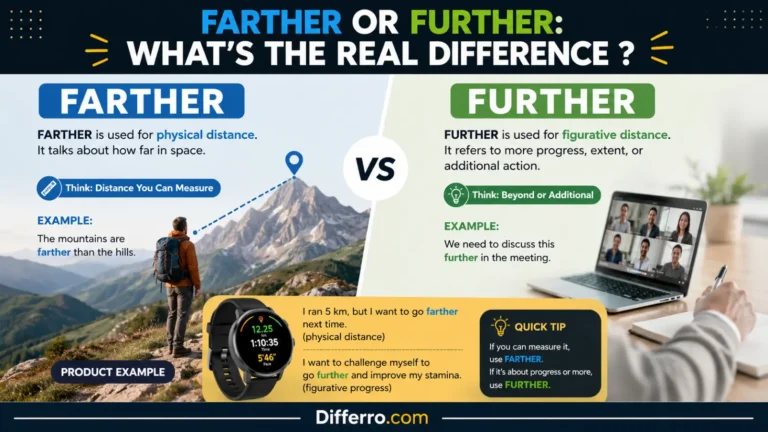
Farther or Further is one of the most common grammar confusions in English. Many people use these words interchangeably because they sound similar and both relate to distance or progress.
However, there is a small but important difference between them.The first one is usually refers to physical distance, while “further” often refers to figurative or abstract distance.
Native speakers sometimes mix them too, especially in casual writing. That is why many learners search for the correct usage of these two wordsF.
Understanding the difference helps improve your grammar, writing clarity, and communication skills. In this guide, you will learn the meaning, history, usage rules, examples, and easy memory tricks for these confusing words.
⭐ Quick Answer
“First word” is mainly used for physical distance. “Further” is used for abstract, figurative, or additional ideas.
Example:
- The school is farther down the road.
- We need further discussion before deciding.
Meaning of Farther
its means a greater physical distance.
It is commonly used when talking about measurable space or location.
Examples of first word
- The park is a greater distance away than I expected.
- She walked a longer distance than her brother.
Meaning of Further
“Further” means more advanced, additional, or figurative distance.
It is often used in discussions, education, progress, and explanations.
Examples of Further
- We need further information about the project.
- His studies helped him further his career.
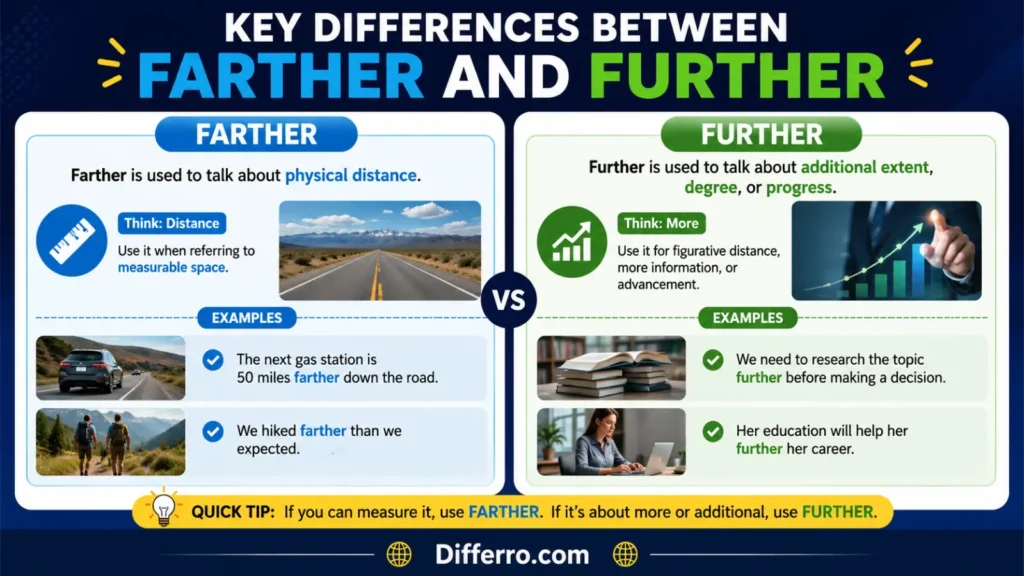
Key Differences Between Farther and Further
| Feature | Farther | Further |
|---|---|---|
| Main Meaning | Physical distance | Figurative or additional distance |
| Usage | Measurable space | Ideas, progress, discussion |
| Tone | Specific and literal | Flexible and broader |
| Grammar Role | Adverb and adjective | Adverb, adjective, verb |
| Popularity | Less common | More common overall |
Origin & History
Both words come from the Old English word “furthor,” which meant “more forward” or “at a greater distance.”
Over time, English speakers started separating the meanings. “Farther” became linked to physical distance, while “further” gained broader meanings.
Similar confusing word pairs include:
- Affect vs Effect
- Fewer vs Less
- Then vs Than
- Among vs Amongst
British English vs American English Spelling
In American English, people usually follow the distance rule carefully. “First Word” is used for physical distance, while “further” is used for figurative meanings.
In British English, “further” is more common in both situations. Many British writers use “further” even for physical distance.
Both spellings remain correct, but style guides often prefer the distinction.
Comparison Table: British vs American English
| English Style | Preferred Word for Distance | Preferred Word for Figurative Meaning |
|---|---|---|
| American English | Farther | Further |
| British English | Further | Further |
When to Use First Word?
Use “farther” when discussing real, measurable distance.
Examples
- The hotel is farther from the airport.
- Can you throw the ball farther?
- We drove farther into the countryside.
When to Use Further
Use “further” for abstract ideas, progress, or additional details.
Examples
- We need further research.
- She wanted to further her education.
- Further questions will be answered tomorrow.
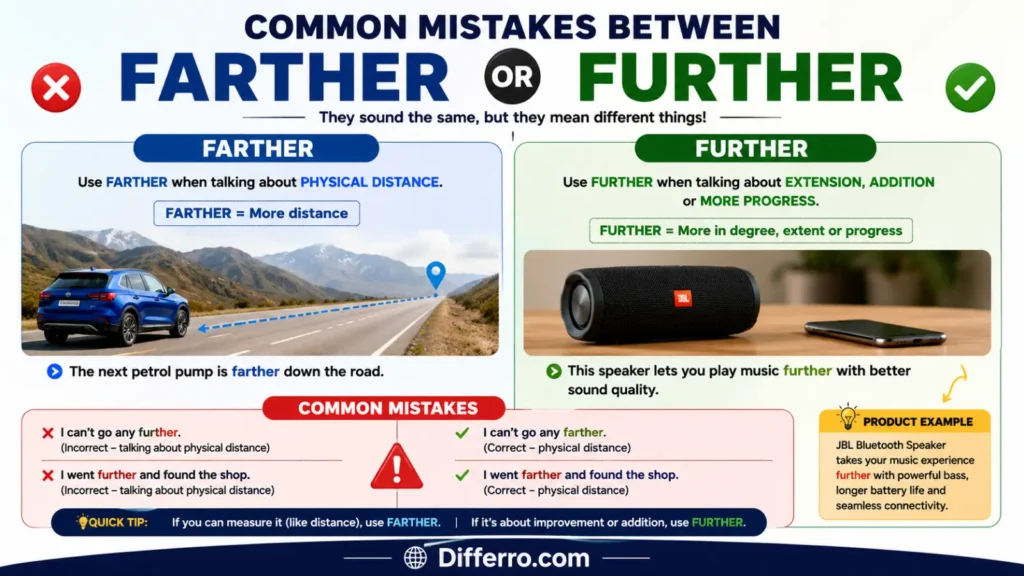
Common Mistakes
| Incorrect Sentence | Correct Sentence |
|---|---|
| We need farther explanation. | We need further explanation. |
| The station is further down the road. | The station is farther down the road. |
| He wants to farther his career. | He wants to further his career. |
| She walked further than me yesterday. | She walked farther than me yesterday. |
Easy Trick to Remember
Use this simple memory trick:
- First word = Far = Physical distance
- Second word = Further discussion or progress
If you can measure the distance, choose “farther.”
If the meaning is abstract or additional, choose “further.”
write 5 examples
1. Travel Example
The gas station is farther from our house than the supermarket.
We need more directions to reach it safely.
2. Education Example
She studied further after completing college.
Her new university is farther from home.
3. Workplace Example
The office moved farther outside the city.
Management asked for additional feedback from employees.
4. Sports Example
He kicked the football farther this season.
The coach requested extra practice sessions.
5. Daily Conversation Example
Can you move farther away from the door?
I do not want any more problems today.
Related Keywords
- farther vs further
- difference between these two words
- first word meaning
- further meaning
- grammar rules for these words
- when to use farther
- when to use further
Final Verdict
Both words are correct, but they serve different purposes.
Use first word for physical distance.
Use “further” for abstract ideas, extra information, or progress.
In modern English, “further” is more flexible and more common overall. Still, using the correct distinction improves grammar accuracy and professional writing quality.
Google Trends & Usage Data
In the USA, people commonly search “these two words” because schools and grammar guides teach the difference clearly.
Meanwhile in the UK, “further” appears more often in both formal and casual writing styles.
In Australia, both terms receive balanced searches, especially in education-related content.
In India and Pakistan, many users search these words to improve English grammar and writing skills.
Comparison Table: Keyword Variations
| Keyword Variation | Search Intent |
|---|---|
| farther or further | Grammar confusion |
| farther vs further | Comparison |
| difference between farther and further | Educational |
| farther meaning | Definition |
| further meaning | Definition |
| when to use further | Usage help |
| when to use farther | Usage help |
FAQs ,
Is the first word is correct in English?
Yes, first word is correct and mainly refers to physical distance.
What is the difference between these two words?
One relates to measurable distance, while the other refers to abstract ideas or additional information.
Which word is more common?
“Further” is more common because it works in more situations.
Which word is better for formal writing?
Both are correct in formal writing when used properly.
Why does confusion exist between these words?
They share similar meanings, pronunciation, and historical roots.
Conclusion
Farther and further may look similar, but their usage differs slightly. “First word” usually refers to physical distance, while “further” refers to abstract ideas, progress, or additional information.
Modern English speakers often use “further” in many situations, especially in British English. However, understanding the traditional rule helps improve grammar accuracy and writing confidence.
When discussing measurable distance, choose “farther.” When discussing ideas, progress, or extra details, choose “further.”
Learning this simple distinction makes your writing clearer, more professional, and easier to understand.
Discover More Post ,
Gasses or gases : Which Word Should You Use?
Incall Or Outcall : What’s the Real Difference?
Honour Or Honor : Which Spelling Is Correct?

Sara Taylor is a passionate writer and language enthusiast. She specializes in creating simple and easy-to-understand articles about English grammar, spelling differences, and commonly confused words. Her writing style focuses on helping students, writers, and English learners improve their language skills with confidence. Through informative guides and practical examples, Sara makes complex grammar topics easier for everyday readers.