
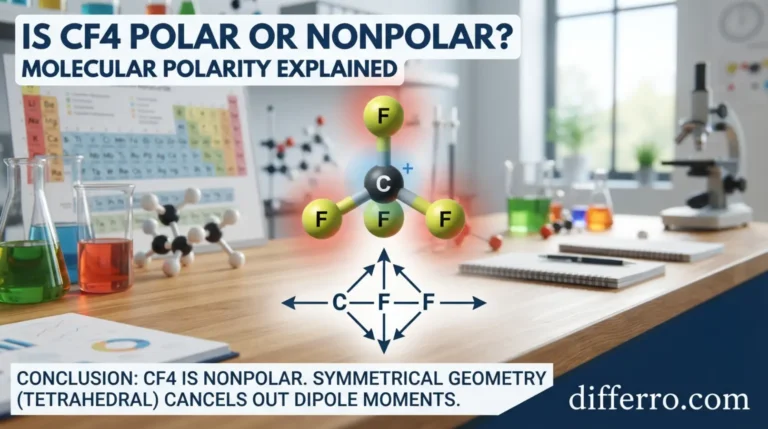
is cf4 polar or nonpolar is a common chemistry question about molecular polarity. The answer is simple: CF₄ is nonpolar. However, each C–F bond inside CF₄ is polar. This difference often causes confusion among students.
CF₄ contains one carbon atom bonded to four fluorine atoms. Fluorine attracts electrons more strongly than carbon. Therefore, every C–F bond has a bond dipole. However, bond polarity does not always make the whole molecule polar.
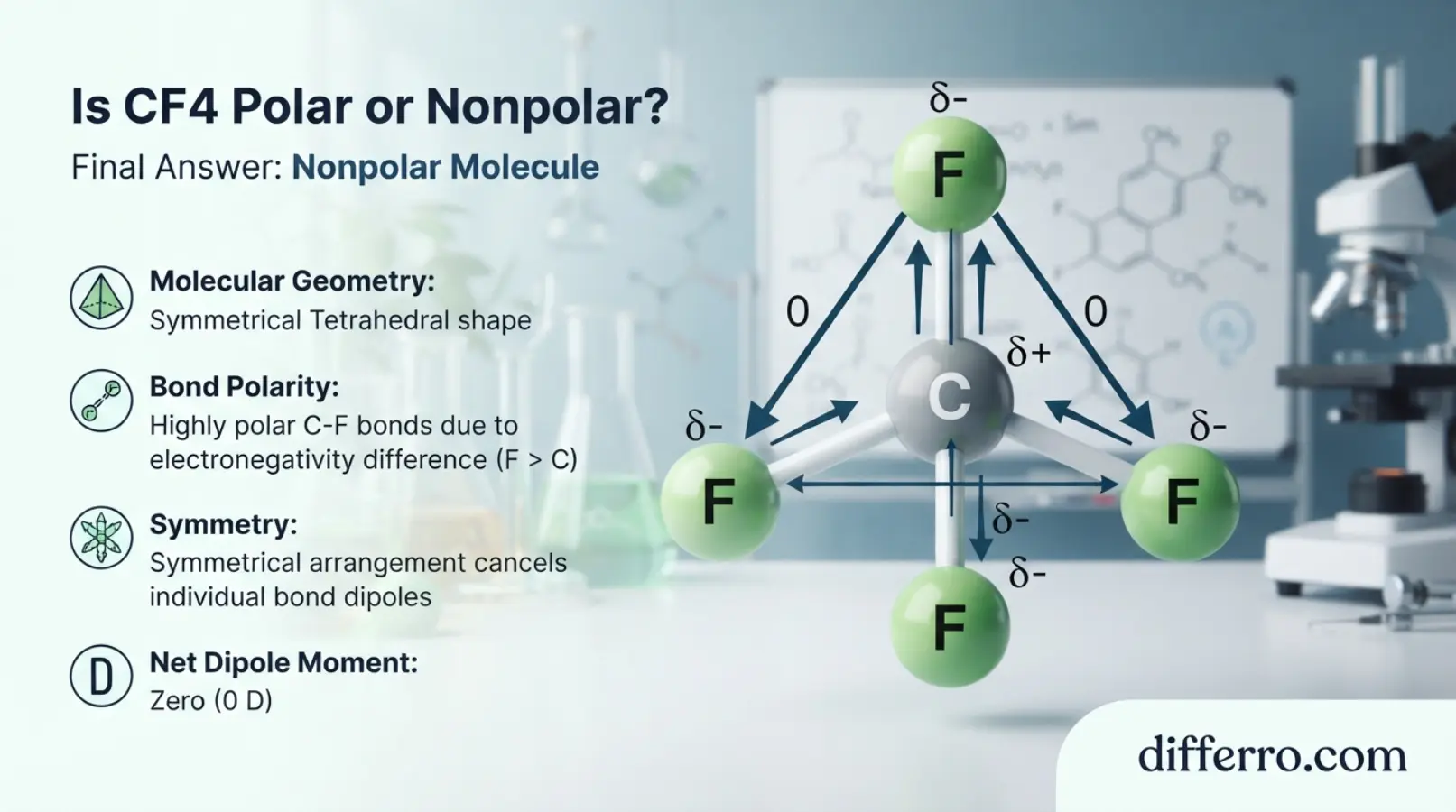
CF₄ has a symmetrical tetrahedral shape. The four bond dipoles point toward the four fluorine atoms. They cancel one another because of this symmetry. As a result, CF₄ has a net dipole moment of zero. Its molecular geometry is tetrahedral, with bond angles close to 109.5°.
⭐ Quick Answer
CF₄ is nonpolar. Its four C–F bonds are polar, but its symmetrical tetrahedral shape makes their dipoles cancel. Therefore, the molecule has a net dipole moment of zero.
Example: CF₄ is nonpolar, while CH₃F is polar because its atoms are not arranged symmetrically.
🔬 What Does Polar Mean?
A polar molecule has an uneven distribution of electrical charge. It has a permanent separation between slightly positive and negative regions.
Molecular polarity depends on two main factors:
- Bond polarity
- Molecular shape
For example, water is polar because its bent shape prevents its O–H bond dipoles from canceling.
Examples of Polar Molecules
H₂O: Its bent structure creates a net dipole.
NH₃: Its trigonal pyramidal shape creates an overall dipole.
🧪 What Does Nonpolar Mean?
A nonpolar molecule has no permanent overall dipole. Its charge distribution is relatively balanced.
A molecule can contain polar bonds and still be nonpolar. CF₄ is a classic example.
Examples of Nonpolar Molecules
CF₄: Its four identical C–F bond dipoles cancel.
CO₂: Its two C=O bond dipoles cancel because its structure is linear and symmetrical.
📊 Key Differences: Polar vs Nonpolar
| Feature | Polar | Nonpolar |
|---|---|---|
| Meaning | Has a net molecular dipole | Has no net molecular dipole |
| Charge distribution | Uneven | More balanced overall |
| Molecular shape | Often asymmetrical | Often symmetrical |
| Bond dipoles | May not cancel | Usually cancel |
| Example | H₂O | CF₄ |
🧬 CF4 Meaning and Molecular Structure
CF₄ is the chemical formula for carbon tetrafluoride, also called tetrafluoromethane.
It contains:
- 1 carbon atom
- 4 fluorine atoms
- 4 C–F bonds
- No lone pairs on the central carbon
The carbon atom sits at the center. The four fluorine atoms surround it in a tetrahedral arrangement.
The ideal C–F–C-related tetrahedral bond angle is about 109.5°. NIST data also reports a tetrahedral symmetry and an F–C–F angle of about 109.47°.
⚛️ Is the C–F Bond Polar?
Yes, each C–F bond is polar.
Fluorine has a much higher electronegativity than carbon. It therefore pulls the shared electrons toward itself.
This creates partial charges:
- Carbon becomes partially positive.
- Fluorine becomes partially negative.
However, this describes bond polarity, not the overall molecular polarity.
That distinction is the key to understanding CF₄.
🔺 Why Is CF4 Nonpolar?
CF₄ is nonpolar because of its symmetrical tetrahedral geometry.
Each C–F bond produces a dipole pointing toward fluorine. Four identical dipoles are arranged evenly around the central carbon.
Their vector sum equals zero:
Net dipole moment = 0 D
Therefore, CF₄ has no permanent overall molecular dipole. Chemistry resources and NIST data support its symmetrical tetrahedral structure and zero overall dipole.
The important rule is:
Polar bonds do not automatically mean a polar molecule.
You must examine the molecular geometry before deciding polarity.
📐 CF4 Lewis Structure
To understand CF₄, start with its Lewis structure.
Carbon has four valence electrons. Each fluorine has seven valence electrons.
Carbon forms one single bond with each fluorine atom.
The basic arrangement is:
F — C — F
with two additional C–F bonds positioned in three-dimensional space.
Each fluorine completes its octet with three lone pairs. Carbon forms four bonds and has no lone pairs.
This gives carbon four electron regions around it.
According to VSEPR theory, these regions arrange themselves tetrahedrally.
🔄 CF4 Geometry and Polarity
The molecular geometry of CF₄ is tetrahedral.
Its four fluorine atoms occupy equivalent positions around carbon. This produces a highly symmetrical molecule.
Because the four C–F bond dipoles have equal strength and symmetrical directions, they cancel.
Therefore:
C–F bonds = polar
CF₄ molecule = nonpolar
This is the most important distinction for exam questions.
🇬🇧 British English vs American English Spelling
The words polar and nonpolar do not have a British-American spelling difference in this context.
Both British and American chemistry writing commonly uses polar and nonpolar.
The chemical formula CF₄ also remains identical in both forms.
British vs American English
| Feature | British English | American English |
|---|---|---|
| Polar | polar | polar |
| Nonpolar | nonpolar | nonpolar |
| Chemical formula | CF₄ | CF₄ |
| Meaning | Same | Same |
🧪 When to Use “Polar”
Use polar when a molecule has a nonzero overall dipole moment.
Examples:
- Water is a polar molecule.
- NH₃ is polar because its shape prevents complete dipole cancellation.
- CH₃F is polar because its substituents are not identical.
When answering chemistry questions, distinguish polar bonds from molecular polarity.
🧪 When to Use “Nonpolar”
Use nonpolar when the molecule has no overall permanent dipole.
Examples:
- CF₄ is nonpolar.
- CO₂ is nonpolar.
- CCl₄ is nonpolar.
These molecules contain bonds that can be polar. Their symmetrical shapes can still make the overall molecule nonpolar.
⚠️ Common Mistakes About CF4 Polarity
Mistake 1: Saying CF4 Has Nonpolar Bonds
Incorrect: CF₄ has four nonpolar C–F bonds.
Correct: CF₄ has four polar C–F bonds.
The difference in electronegativity makes each C–F bond polar.
Mistake 2: Calling CF4 Polar Because Fluorine Is More Electronegative
Incorrect: Fluorine attracts electrons, so CF₄ must be polar.
Correct: The C–F bonds are polar, but their dipoles cancel.
Mistake 3: Ignoring Molecular Shape
Incorrect: Polarity depends only on electronegativity.
Correct: Molecular shape also determines the overall dipole.
Mistake 4: Confusing CF4 With CH3F
Incorrect: CF₄ and CH₃F have the same polarity.
Correct: CF₄ is nonpolar, while CH₃F is polar.
CH₃F has three hydrogen atoms and one fluorine atom around carbon. Its arrangement does not have the same symmetry as CF₄.
Mistake 5: Thinking Tetrahedral Always Means Nonpolar
Incorrect: Every tetrahedral molecule is nonpolar.
Correct: Tetrahedral shape alone does not guarantee nonpolarity.
The atoms attached to the central atom also matter.
🧠 Easy Trick to Remember CF4 Polarity
Use this simple rule:
“Four same, dipoles tame.”
CF₄ has four identical fluorine atoms around carbon.
Their bond dipoles cancel because the molecule is symmetrical.
Remember:
Same outer atoms + symmetrical shape = often nonpolar.
Always check the molecular structure before applying this shortcut.
🌎 Everyday-Life and Chemistry Examples
1. CF4 and Molecular Symmetry
CF₄ shows why molecular symmetry matters. Four identical fluorine atoms surround one carbon atom.
Primary keyword: is CF4 polar or nonpolar
Secondary keyword: CF4 molecular polarity
2. CF4 vs CO2
Both CF₄ and CO₂ are nonpolar overall.
However, CF₄ has tetrahedral geometry, while CO₂ has linear geometry.
Their different shapes still allow their bond dipoles to cancel.
3. CF4 vs H2O
H₂O is polar because its bent shape prevents complete dipole cancellation.
CF₄ is nonpolar because its tetrahedral symmetry allows cancellation.
This makes them useful examples for learning molecular polarity.
4. CF4 vs CH3F
CF₄ has four identical fluorine atoms.
CH₃F has different atoms attached to carbon.
Therefore, CF₄ has complete dipole cancellation, while CH₃F has a net dipole.
5. CF4 in Chemistry Exams
A common exam question asks whether CF₄ is polar or nonpolar.
The strongest answer includes three points:
- C–F bonds are polar.
- CF₄ has tetrahedral geometry.
- The bond dipoles cancel, making CF₄ nonpolar.
📈 Google Trends & Usage Insight
Google Trends does not provide a fixed global search-volume number for this chemistry phrase without selecting a specific Trends property and time range.
Search interest for this topic is closely tied to chemistry study and exam-related searches.
Related searches often include CF4 molecular geometry, CF4 Lewis structure, and CF4 dipole moment.
The strongest SEO opportunity is to answer polarity, geometry, bond polarity, and dipole questions together.
Keyword Variations Comparison
| Keyword Variation | Search Intent | Main Topic |
|---|---|---|
| is CF4 polar or nonpolar | Informational | Molecular polarity |
| is CF4 polar | Informational | Polarity |
| is CF4 nonpolar | Informational | Polarity |
| CF4 molecular polarity | Educational | Dipole moment |
| CF4 Lewis structure | Educational | Structure |
| CF4 molecular geometry | Educational | Shape |
| CF4 dipole moment | Educational | Molecular dipole |
🏁 Final Answer: Is CF4 Polar or Nonpolar?
CF₄ is nonpolar.
The reason is its highly symmetrical tetrahedral structure.
Each C–F bond is polar because fluorine attracts electrons more strongly than carbon. However, the four bond dipoles point in symmetrical directions.
They cancel each other completely.
Therefore, the net dipole moment of CF₄ is zero. NIST lists CF₄ with tetrahedral symmetry and equal F–C–F angles, supporting this structural explanation.
So, remember this distinction:
Polar bonds + symmetrical molecule = nonpolar CF₄.
❓ Frequently Asked Questions
Is CF4 polar or nonpolar?
CF₄ is nonpolar. Its four polar C–F bond dipoles cancel because of its symmetrical tetrahedral structure.
What is the difference between a polar bond and a polar molecule?
A polar bond has unequal electron sharing. A polar molecule has an overall net dipole.
CF₄ has polar bonds but is nonpolar overall.
Which is more common, polar or nonpolar CF4?
The correct classification of CF₄ is nonpolar. The molecule has a zero net dipole moment.
Is CF4 polar in formal chemistry writing?
No. In standard chemistry, CF₄ is classified as a nonpolar molecule.
Its four C–F bonds remain polar.
Why does confusion about CF4 polarity exist?
The confusion usually comes from mixing up bond polarity and molecular polarity.
Fluorine strongly attracts electrons, making C–F bonds polar. Molecular symmetry then cancels those dipoles.
📝 Conclusion
Is CF4 polar or nonpolar? CF₄ is nonpolar. Its four C–F bonds are individually polar because fluorine attracts electrons strongly. However, CF₄ has a symmetrical tetrahedral molecular structure. The four equal bond dipoles point in balanced directions and cancel completely. Therefore, the molecule has a net dipole moment of zero. The key lesson is that bond polarity and molecular polarity are not always the same. You must consider both electronegativity and molecular geometry. CF₄ is a useful example because it clearly shows how molecular symmetry can turn polar bonds into a nonpolar molecule overall.

Imran Lodhra is a comparison-focused content writer at Differro.com.
He specializes in creating clear, simple, and informative comparison articles.
His work helps readers understand key differences, pros and cons, and important details.
Imran focuses on accurate, practical, and easy-to-read content for everyday readers.