
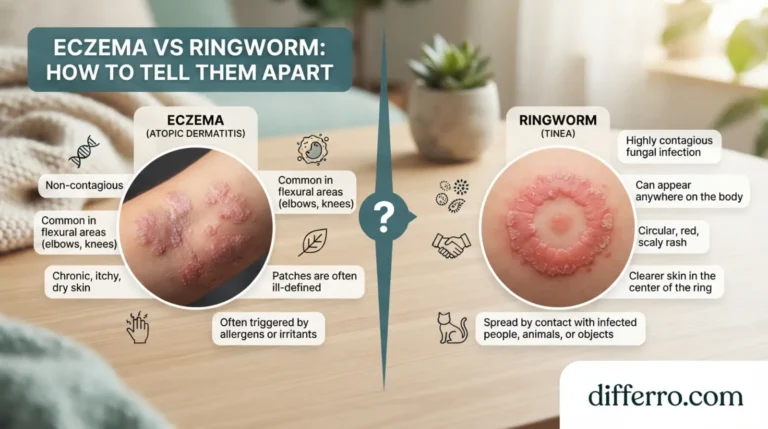
Eczema or ringworm can cause red, itchy, irritated patches on the skin. However, these conditions have different causes and need different treatments. Eczema is an inflammatory skin condition that often causes dryness, itching, and recurring flare-ups. Ringworm is a fungal infection that can create a circular, scaly rash. Both Eczema vs Ringworm conditions can look similar, especially during their early stages. This similarity can make it difficult to identify the problem correctly. Eczema often causes dry, irritated skin with unclear borders. Ringworm may form a round patch with a raised, scaly edge and clearer skin in the center. However, not every case follows these patterns.
Understanding the differences can help you choose the right next step. The wrong treatment may delay healing or make symptoms worse. A healthcare professional can examine your skin and recommend suitable care.
⭐ Quick Answer
Eczema is an inflammatory skin condition, while ringworm is a contagious fungal infection. Eczema often causes dry, itchy patches. Ringworm commonly creates a circular, scaly rash with a more defined edge.
Example: Dry, recurring patches may suggest eczema, while an expanding ring-shaped rash may suggest ringworm. A clinician can confirm the cause.
Meaning of Eczema
Eczema is a group of conditions that cause skin inflammation, dryness, itching, and irritation. Atopic dermatitis is one common type of eczema. The condition often involves a weakened skin barrier and may run in families.
Eczema does not result from a fungal infection, and you cannot catch it from another person. Symptoms may come and go, and certain soaps, allergens, weather changes, or other irritants can trigger flare-ups.
Common symptoms include:
- Dry, itchy skin
- Red, brown, purple, or gray patches, depending on skin tone
- Cracked or rough skin
- Swelling or irritation
- Thickened skin after repeated scratching
- Occasional fluid-filled bumps or oozing during flare-ups
Examples of Eczema
Example 1: A person develops dry, itchy patches on their hands after frequent washing. The irritation returns whenever their skin becomes dry.
Example 2: A child experiences recurring itchy patches inside the elbows and behind the knees. A healthcare professional identifies the pattern as atopic dermatitis.
These examples may fit eczema, but other skin conditions can cause similar symptoms.
Meaning of Ringworm
Ringworm is a fungal infection that affects the skin. Despite its name, it does not involve a worm or parasite. Fungi called dermatophytes cause the infection.
Ringworm can affect the body, feet, scalp, groin, and other areas. It spreads through direct contact with an infected person or animal. People can also catch it from contaminated items or surfaces.
Common symptoms include:
- A circular or ring-shaped rash
- A raised, scaly outer edge
- Itching or irritation
- Gradually expanding patches
- Sometimes, lighter or darker skin in the center
- Hair loss when the infection affects the scalp
Ringworm can spread to other body areas without appropriate treatment. Scalp infections may need prescription oral antifungal medicine.
Examples of Ringworm
Example 1: An adult develops an itchy, circular patch on their arm. The patch slowly expands and develops a scaly border.
Example 2: A child develops a scaly area on the scalp with broken hairs and a patch of hair loss. A clinician suspects a fungal infection.
These examples illustrate common patterns, but a healthcare professional may need testing to confirm ringworm.
🔎 Eczema or Ringworm: Key Differences
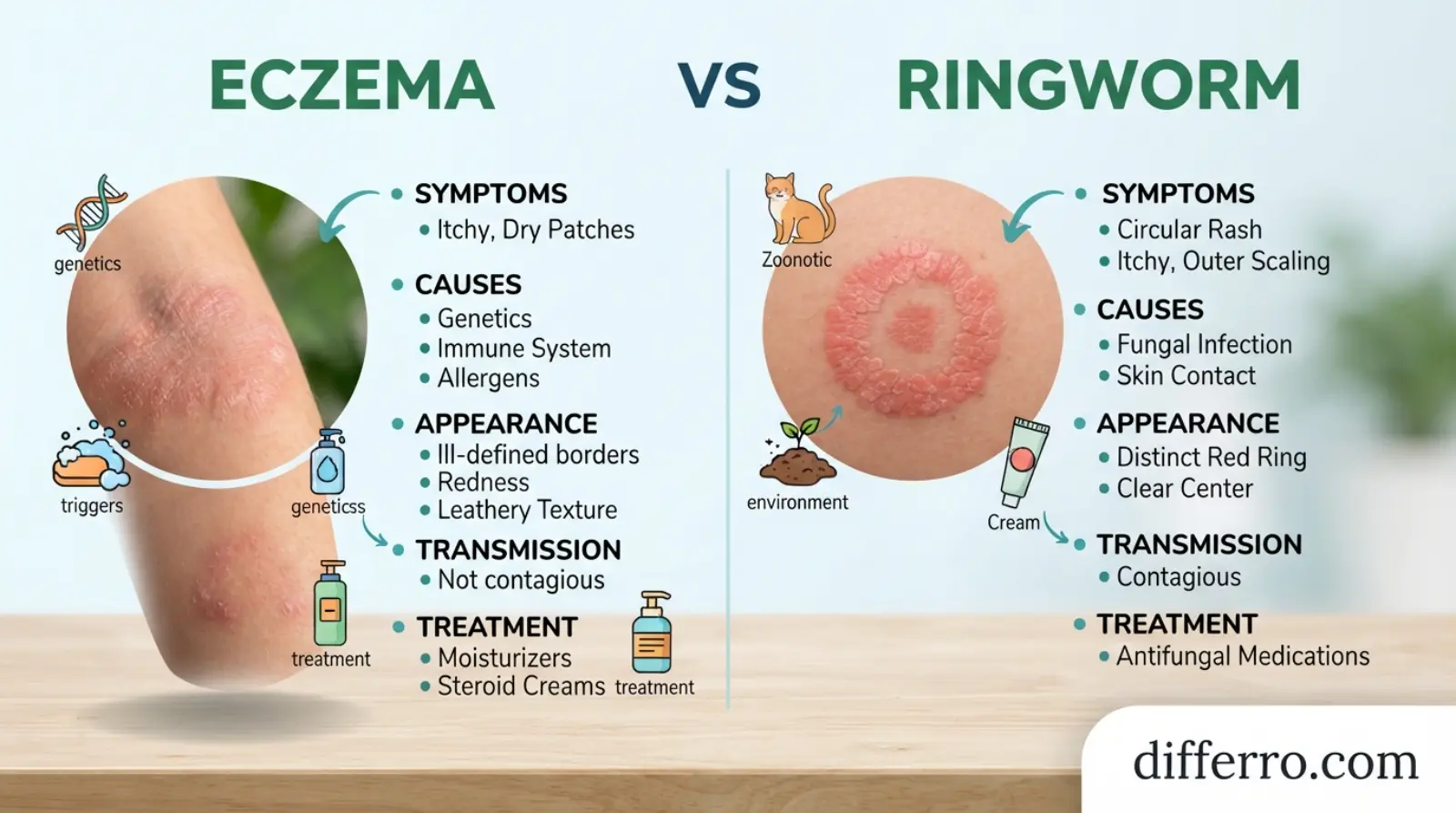
Eczema and ringworm can both cause itching, redness, and scaling. Their causes, patterns, and treatments help distinguish them.
| Feature | Eczema | Ringworm |
|---|---|---|
| Main cause | Skin inflammation and barrier problems | Dermatophyte fungal infection |
| Contagiousness | Not contagious | Can spread between people and from animals |
| Common appearance | Dry, irritated, itchy patches | Often a circular, scaly rash |
| Rash border | May have unclear or irregular edges | Often has a more defined, raised edge |
| Center of rash | May remain dry or inflamed | May look clearer in some cases |
| Itching | Common, sometimes intense | Common |
| Usual pattern | Often recurring or long-lasting | May expand outward without treatment |
| Common locations | Hands, face, elbows, knees, and other areas | Body, feet, groin, scalp, and other areas |
| Main treatment | Moisturizers and suitable anti-inflammatory treatments | Antifungal medicines |
| Can it spread? | Flare-ups may affect different areas, but eczema itself is not contagious | Infection can spread through contact |
Important: These differences provide clues, not a guaranteed diagnosis. Ringworm does not always form a perfect ring, and eczema can sometimes have circular patches. A clinician can help distinguish them when symptoms overlap.
🕰️ Origin and History
The word eczema comes from a Greek word associated with bubbling or erupting. Medical professionals now use it for several inflammatory skin conditions.
The word ringworm describes the circular appearance that some fungal infections create. The name can mislead people because no worm causes the condition.
Medical professionals also use the term tinea for dermatophyte infections. The specific name often depends on the affected body area.
Similar Medical Terms
- Atopic dermatitis: A common type of eczema associated with itching and inflammation.
- Contact dermatitis: Skin inflammation caused by an irritant or allergen.
- Tinea corporis: Ringworm affecting the body.
- Tinea capitis: A fungal infection affecting the scalp.
- Athlete’s foot: A fungal infection affecting the feet.
- Psoriasis: An inflammatory skin condition that can cause thick, scaly patches.
These conditions can share symptoms. Their causes and treatments differ, so accurate identification matters.
🇬🇧 British English vs American English Spelling
The words Eczema vs Ringworm use the same spelling in British and American English.
Both Eczema vs Ringworm countries use these terms in medical settings and everyday conversations.
Differences may appear in related words, such as localized in American English and localised in British English.
British vs American English Comparison
| Feature | British English | American English |
|---|---|---|
| Eczema | Eczema | Eczema |
| Ringworm | Ringworm | Ringworm |
| Localized rash | Localised rash | Localized rash |
| Medical meaning | Same | Same |
| Common usage | Medical and everyday discussion | Medical and everyday discussion |
🩺 When to Suspect Eczema
Eczema may be more likely when your skin becomes dry, itchy, irritated, and prone to repeated flare-ups.
Look for these clues:
- The affected skin feels dry or rough.
- Itching occurs before or during a flare-up.
- Similar patches return over time.
- Soap, detergents, weather, or other irritants worsen symptoms.
- The rash appears in common eczema areas, such as the hands or elbow creases.
Eczema can affect people of all ages. Its appearance may also vary with skin tone and the affected body area.
Example of Possible Eczema
A person develops itchy, dry patches on both Eczema vs Ringworm hands after using cleaning products. The skin improves with gentle care but flares up again after repeated exposure.
This pattern may suggest eczema or contact dermatitis. A clinician can help identify the cause.
What Can Help?
Depending on the type and severity of eczema, a healthcare professional may recommend:
- Fragrance-free moisturizers to support the skin barrier
- Gentle, fragrance-free cleansers
- Short, lukewarm showers instead of hot showers
- Avoiding known irritants
- Appropriate topical corticosteroids or other prescribed treatments
Do not assume every itchy patch needs a steroid cream. Steroids may hide or worsen an untreated fungal infection.
🍄 When to Suspect Ringworm
Ringworm may be more likely when an itchy, scaly patch gradually expands and develops a defined outer edge.
Look for these clues:
- The rash forms a circular or ring-like shape.
- The outer edge looks raised or scaly.
- The patch slowly grows.
- Similar rashes appear after contact with an infected person or animal.
- The rash spreads to other areas.
Ringworm can also appear without a clear ring. Scalp infections may cause scaling, broken hairs, or hair loss. A clinician should assess suspected scalp ringworm because creams alone usually cannot cure it.
Example of Possible Ringworm
A person notices a small, itchy patch on their arm. Over several days, the patch expands and develops a scaly outer border.
This pattern may suggest ringworm. A healthcare professional can confirm the diagnosis and recommend an antifungal treatment.
How Do Doctors Treat Ringworm?
Doctors and pharmacists may recommend antifungal creams for suitable infections on the body. Treatment choice depends on the location, severity, and patient’s age.
Scalp ringworm and some extensive infections usually require prescription oral antifungal medicines. A healthcare professional should guide this treatment.
To reduce the risk of spreading ringworm:
- Avoid sharing towels, clothing, and hairbrushes.
- Wash hands after touching the affected area.
- Keep the area clean and dry.
- Avoid scratching the rash.
- Seek veterinary advice if a pet has suspicious skin patches.
Do not use steroid creams alone on a rash that may be ringworm. Steroids can change the rash’s appearance and allow the infection to worsen.
⚠️ Common Mistakes When Comparing Eczema and Ringworm
Mistake 1: Assuming Every Circular Rash Is Ringworm
Incorrect: Every round, itchy patch means ringworm.
Correct: Eczema and other skin conditions can also create circular patches. A clinician can assess the rash and confirm its cause.
Mistake 2: Assuming Eczema Is Contagious
Incorrect: You can catch eczema by touching someone’s skin.
Correct: Eczema itself is not contagious. However, an infection affecting someone with eczema may spread, depending on its cause.
Mistake 3: Treating Suspected Ringworm With Steroid Cream Alone
Incorrect: A steroid cream will cure any itchy rash.
Correct: Steroids reduce inflammation but do not kill fungi. Steroid-only treatment may hide ringworm and allow it to worsen.
Mistake 4: Assuming Ringworm Always Forms a Perfect Ring
Incorrect: Ringworm must have a clear circular center.
Correct: Ringworm can have different appearances, especially on the scalp or after using steroid creams.
Mistake 5: Stopping Antifungal Treatment Too Early
Incorrect: Stop treatment as soon as the itching improves.
Correct: Follow the product instructions or your clinician’s advice. Symptoms may improve before the infection has cleared.
Mistake 6: Ignoring Signs of a Secondary Infection
Incorrect: All eczema flare-ups are harmless and need no assessment.
Correct: Seek medical advice if the skin becomes increasingly painful, hot, swollen, or develops pus. Fever or rapidly spreading redness requires urgent assessment.
🧠 Easy Trick to Remember
Use this simple memory tip:
- Eczema = inflammation. Think of dry skin, recurring itching, and flare-ups.
- Ringworm = fungus. Think of a potentially spreading, scaly rash with a defined edge.
This tip can help you remember the difference, but it cannot confirm a diagnosis.
🌿 Everyday-Life Examples: Eczema or Ringworm
1. Dry, Itchy Hands After Washing
A person washes their hands frequently and develops dry, cracked, itchy skin. The problem returns after repeated washing.
Possible explanation: Eczema or irritant contact dermatitis may explain the symptoms. Gentle skin care and professional advice can help.
2. A Circular Rash on the Arm
An adult develops an expanding, itchy patch with a raised, scaly border.
Possible explanation: Ringworm may fit this pattern. A clinician or pharmacist can advise on appropriate antifungal treatment.
3. Recurring Patches Behind the Knees
A child experiences repeated itchy patches behind the knees and inside the elbows. The skin becomes dry and rough during flare-ups.
Possible explanation: Atopic dermatitis may explain the pattern. A healthcare professional can assess the child and recommend suitable skin care.
4. A Scaly Patch on the Scalp
A child develops scalp scaling and broken hairs in one area. The affected patch begins losing hair.
Possible explanation: Scalp ringworm is a concern. Arrange prompt medical assessment because oral antifungal treatment is usually necessary.
5. An Itchy Rash That Worsens With Steroid Cream
A person applies steroid cream to a circular rash. The itching changes, but the rash continues to expand.
Possible explanation: A fungal infection, including ringworm, may need consideration. Seek medical advice rather than continuing steroid-only treatment.
🌍 Google Trends and Usage Insights: Five Countries
Google Trends measures relative search interest rather than exact search volumes. Without live comparison data, these country-specific patterns should be treated as research suggestions, not verified rankings.
- USA: Compare searches for “eczema vs ringworm” and “ringworm symptoms” to assess comparison and treatment intent.
- UK: Compare “eczema” and “ringworm” with related searches about itchy skin and fungal infections.
- Australia: Explore interest in eczema, fungal skin infections, and circular rashes.
- India: Check variations such as “ringworm treatment” and “eczema symptoms.”
- Pakistan: Compare searches about itchy skin, fungal infections, and ringworm treatment.
SEO insight: Compare both Eczema vs Ringworm terms over the same period and by country before making claims about popularity. Review related queries to find useful subtopics and long-tail keywords.
Comparison Table: Keyword Variations
| Keyword variation | Search intent | Suggested content use |
|---|---|---|
| Eczema or ringworm | Direct comparison | Main title and introduction |
| Eczema vs ringworm | Informational comparison | Key differences section |
| Eczema symptoms | Symptom research | Eczema section |
| Ringworm symptoms | Symptom research | Ringworm section |
| Eczema or fungal infection | Diagnosis-related research | Comparison and FAQ |
| Circular rash eczema or ringworm | Symptom identification | Everyday examples |
| How to tell eczema from ringworm | Practical guidance | Quick answer and FAQ |
❓ Frequently Asked Questions
1. Is “eczema or ringworm” a correct comparison?
Yes. The phrase compares two skin conditions that can cause itching, redness, and scaling. Eczema involves inflammation, while ringworm results from a fungal infection.
2. What is the main difference between eczema and ringworm?
Eczema often causes dry, itchy skin that flares up repeatedly. Ringworm often causes an expanding, scaly rash with a defined edge. However, appearances can overlap.
3. Which condition is more common?
Both Eczema vs Ringworm conditions affect many people, but their frequency varies by population, age, and location. Their overall prevalence cannot be compared accurately without specific population data and consistent diagnostic definitions.
4. Can doctors distinguish eczema from ringworm?
Yes. Doctors often assess the rash’s appearance, location, history, and progression. They may examine skin scrapings or use other tests when they suspect a fungal infection.
5. Why do people confuse eczema with ringworm?
Both conditions can cause itching, redness, and scaly patches. Some eczema patches look circular, while ringworm does not always form a typical ring. These similarities can make self-diagnosis difficult.
📝 Final Verdict: Which Condition Is It?
Eczema and ringworm can cause similar skin symptoms, but their causes and treatments differ. Eczema involves skin inflammation and often causes recurring dryness and itching. Ringworm is a fungal infection that may create an expanding, circular rash.
Dry, recurring patches may suggest eczema, while a scaly rash with a defined border may suggest ringworm. However, these clues cannot confirm either condition.
Avoid using steroid creams alone when ringworm remains a possibility. Seek medical advice if the rash spreads, does not improve, affects the scalp, or causes significant discomfort. Prompt assessment can help identify the cause and guide appropriate treatment.
Conclusion
Eczema or ringworm can be difficult to distinguish because both conditions cause itching, redness, and scaling. Their main difference lies in their causes. Eczema involves inflammation, while ringworm results from a fungal infection.
Eczema often causes dry, recurring patches. Ringworm may create an expanding rash with a raised, scaly edge. However, these patterns are not universal, and other skin conditions can look similar.
The correct treatment depends on the diagnosis. Moisturizers and suitable anti-inflammatory treatments can help eczema, while ringworm requires antifungal medicine. Steroid creams alone may worsen an untreated fungal infection. Seek medical advice when symptoms persist, spread, or remain unclear. Early assessment helps you choose the right treatment and avoid unnecessary irritation or delays in healing.

Imran Lodhra is a comparison-focused content writer at Differro.com.
He specializes in creating clear, simple, and informative comparison articles.
His work helps readers understand key differences, pros and cons, and important details.
Imran focuses on accurate, practical, and easy-to-read content for everyday readers.
2 thoughts on “Eczema vs Ringworm: How to Tell Them Apart”