

Trust vs will can confuse English learners because both words can express confidence, intention, or future meaning in different contexts. However, Trust vs Will have different meanings and grammatical uses. Trust means believing someone or something is reliable, honest, or dependable. Will can express future actions, willingness, determination, or a person’s legal instructions about their property after death.
For example, “I trust you” expresses confidence in someone. “I will help you” expresses a promise or intention to help. You cannot always replace one word with the other without changing the sentence’s meaning. Understanding their differences helps you speak clearly and write correctly. This guide explains the meanings, grammar, examples, common mistakes, and everyday uses of trust and will. You will also learn how these words work in different situations and how to choose the right word confidently.
⭐ Quick Answer
Trust means believing that someone or something is reliable. Will expresses future actions, willingness, determination, or a legal document that explains how someone wants their property distributed after death.
Example: “I trust my friend” shows confidence. “I will call my friend” expresses a future intention.
📘 Meaning of Trust
Trust means believing that someone is honest, reliable, or capable of doing something. It can also mean having confidence in a plan, system, or situation.
People use trust when they depend on someone or believe something will work as expected.
Examples of Trust
- I trust my brother. I believe he will keep his promise.
- We trust this company. We believe it provides reliable products and services.
Common Uses of Trust
- Trust a friend or family member.
- Trust someone’s judgment.
- Trust a business or organization.
- Trust a process or system.
- Build trust through honesty and consistent actions.
Trust can function as both a noun and a verb.
- Noun: Trust is important in every strong relationship.
- Verb: I trust my teacher to guide me.
📘 Meaning of Will
Will has several meanings in English. It commonly expresses future actions, willingness, determination, or a legal document.
As a modal verb, will helps describe something that someone expects, intends, or agrees to do.
Examples of Will
- I will finish my homework tonight. This sentence expresses a future intention.
- She will help you. This sentence describes a future action or expectation.
Common Uses of Will
- Express future actions: I will visit tomorrow.
- Make promises: I will never forget your kindness.
- Show willingness: I will carry your bag.
- Express determination: We will succeed.
- Refer to a legal document: He wrote a will before his death.
Will also functions as a noun when it refers to determination or a legal document.
- Determination: She has a strong will.
- Legal document: My grandfather left a will.
🔍 Trust Vs Will: Key Differences
| Feature | Trust | Will |
|---|---|---|
| Main meaning | Confidence in someone or something | Future action, willingness, determination, or legal instructions |
| Part of speech | Noun and verb | Modal verb and noun |
| Tone | Often personal, emotional, or practical | Often neutral, future-focused, or formal |
| Common usage | Relationships, reliability, confidence | Promises, predictions, intentions, legal documents |
| Example | I trust my friend. | I will help my friend. |
| Time reference | No fixed time reference | Often refers to the future when used as a modal verb |
| Formal usage | Common in personal and professional contexts | Common in everyday English and legal contexts |
| Popularity | Common everyday word | Common everyday word |
Remember: Trust and will do not have the same meaning. Choose the word that expresses your intended message.
🕰️ Origin and History
The word trust developed from older Germanic and Norse language roots associated with confidence, reliance, and faithfulness. English has used trust for centuries to describe dependable relationships and beliefs.
The word will comes from Old English willan, which expressed wishing, wanting, or intending. Over time, English speakers also began using will as a modal verb to express future actions and other meanings.
Both words remain important in modern English, but they serve different purposes.
Similar Word Examples
- Trust and believe: Both can express confidence, but trust often involves reliability or dependence.
- Trust and rely: Both suggest dependence on someone or something.
- Will and shall: Both can express future actions, although their uses differ.
- Will and would: Will often expresses a present intention or expected future action, while would has several conditional and past-related uses.
- Will and intention: Both can relate to plans, but will serves several grammatical functions.
🇬🇧 British English vs American English
Trust vs Will have the same spelling and basic meanings in British and American English.
Both varieties use will to discuss future actions, promises, and willingness.
Neither variety requires a different spelling for trust or will.
British vs American English Comparison
| Feature | British English | American English |
|---|---|---|
| Trust | Trust | Trust |
| Will | Will | Will |
| Spelling difference | None | None |
| Future example | I will call you tomorrow. | I will call you tomorrow. |
| Legal document | A will | A will |
| General meaning | Same basic meanings | Same basic meanings |
✍️ When to Use Trust
Use trust when you want to express confidence in a person, organization, decision, or situation.
1. When You Believe Someone Is Honest
Example: I trust my best friend with my secrets.
This sentence means you believe your friend will protect your private information.
2. When You Depend on Someone
Example: We trust our doctor to give us sound advice.
Here, trust expresses confidence in the doctor’s knowledge and judgment.
3. When You Believe Something Is Reliable
Example: I trust this website for accurate information.
This sentence shows confidence in the website’s reliability.
4. When You Discuss Relationships
Example: Trust makes a strong relationship healthier.
Here, trust works as a noun and describes an important part of a relationship.
5. When You Express Confidence in a Decision
Example: I trust your judgment about this matter.
This sentence means you believe the other person can make a good decision.
✍️ When to Use Will
Use will when you express a future action, promise, willingness, determination, or another meaning that fits the sentence.
1. When You Talk About the Future
Example: I will visit my parents next weekend.
The sentence describes a planned or expected future action.
2. When You Make a Promise
Example: I will always support you.
This sentence expresses a commitment to support someone.
3. When You Offer Help
Example: I will carry those bags for you.
The speaker expresses willingness to help.
4. When You Show Determination
Example: We will overcome this challenge.
The sentence expresses strong determination.
5. When You Discuss Legal Instructions
Example: My aunt wrote a will to distribute her property.
Here, will means a legal document that sets out instructions for distributing someone’s property after death.
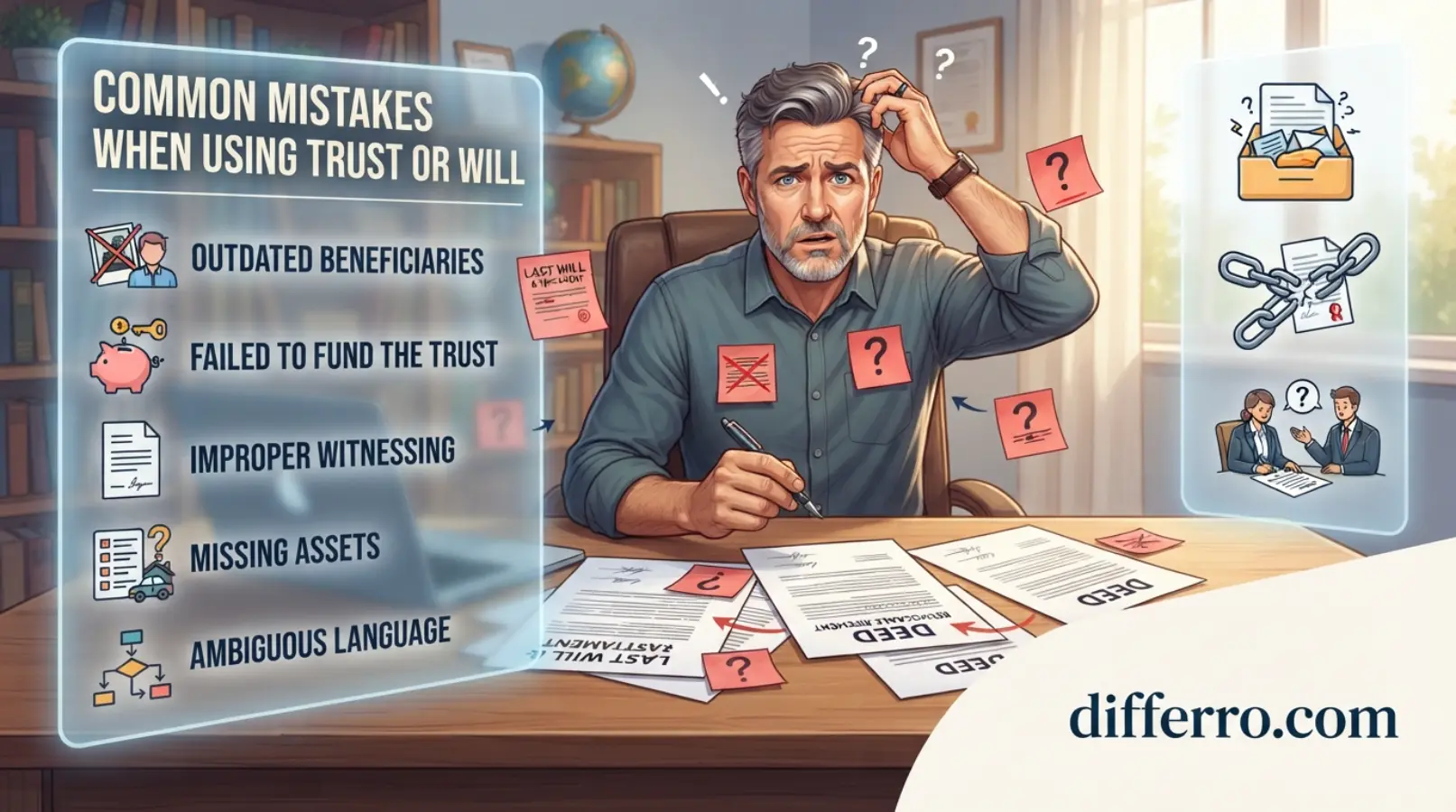
⚠️ Common Mistakes When Using Trust or Will
Mistake 1: Using Will Instead of Trust
Incorrect: I will you with my secrets.
Correct: I trust you with my secrets.
Why: Trust expresses confidence in someone. Will does not serve this purpose as a modal verb.
Mistake 2: Using Trust Instead of Will for a Future Action
Incorrect: I trust call you tomorrow.
Correct: I will call you tomorrow.
Why: Will helps express a future action. Trust cannot replace it in this sentence.
Mistake 3: Confusing Trust With a Promise
Incorrect: I trust help you with your work.
Correct: I will help you with your work.
Why: Will expresses willingness or intention. Trust expresses confidence.
Mistake 4: Assuming Trust Always Means Believe
Incorrect: Trust and believe always mean exactly the same thing.
Correct: Trust often involves confidence in someone’s reliability, while believe can refer to accepting something as true.
Example: I believe the story, but I do not trust the person telling it.
Mistake 5: Confusing Will With a Legal Document
Incorrect: My father will explains who receives his property.
Correct: My father’s will explains who receives his property.
Why: The noun will refers to a legal document. The modal verb will needs a main verb in a sentence like “My father will explain the plan.”
Mistake 6: Using Trust Without the Correct Sentence Structure
Incorrect: I trust to my brother.
Correct: I trust my brother.
Why: Trust usually takes a direct object when it means having confidence in someone. You can also say, “I trust in my brother.”
🧠 Easy Trick to Remember
Use this simple memory trick:
- Trust = confidence. Ask yourself, “Do I believe this person or thing is reliable?”
- Will = future or intention. Ask yourself, “Am I talking about what someone will do?”
- Will = legal document. Ask yourself, “Am I talking about instructions for property after death?”
Quick examples:
- I trust you. = I believe you are reliable.
- I will help you. = I intend or agree to help.
- She wrote a will. = She prepared a legal document.
🌟 Everyday-Life Examples: Trust or Will
1. Trusting a Friend
I trust my friend because she always keeps her promises.
This sentence uses trust to express confidence in another person’s honesty and reliability.
2. Making a Future Plan
I will meet my friend at the park tomorrow.
This sentence uses will to express a future plan.
3. Showing Confidence at Work
Our manager trusts the team to complete the project on time.
Trust expresses confidence in the team’s ability to finish the work.
4. Offering Help at Home
I will help my mother prepare dinner tonight.
Will expresses the speaker’s intention and willingness to help.
5. Discussing Family Property
My grandfather wrote a will to explain how he wanted his property distributed.
Here, will refers to a legal document rather than a future action.
🌍 Google Trends and Usage Insights: Five Countries
Google Trends reports relative search interest rather than exact search volumes. Without a live comparison, specific rankings for these terms cannot be confirmed.
- USA: Searches for trust and will may relate to personal relationships, future plans, and estate planning.
- UK: Both words appear in everyday English, while will also has an important role in legal discussions.
- Australia: Search interest may include trust in relationships, future intentions, and wills for estate planning.
- India: English learners may search for the meanings, grammar, and sentence examples of trust and will.
- Pakistan: Searchers may focus on English usage, translation, grammar, and everyday sentence construction.
SEO insight: These observations describe likely search intents, not verified country-level trends. Compare exact phrases in Google Trends before claiming that one keyword receives more searches than another.
Comparison Table: Keyword Variations
| Keyword variation | Search intent | Best content placement |
|---|---|---|
| Trust or will | Word confusion | H1 and introduction |
| Trust vs will | Direct comparison | Key differences section |
| Difference between trust and will | Meaning and usage | Featured snippet and FAQ |
| Trust meaning and examples | Definition | Trust section |
| Will meaning in English | Grammar and vocabulary | Will section |
| Trust or will in a sentence | Practical examples | Everyday examples |
| When to use trust and will | Usage guidance | Dedicated usage sections |
❓ Frequently Asked Questions
1. Is “trust or will” a correct English phrase?
Yes. Trust and will are both correct English words, but they have different meanings. The phrase “trust or will” works when comparing their usage. The correct choice depends on the sentence.
2. What is the difference between Trust vs Will?
Trust means having confidence in someone or something. Will can express future actions, willingness, or determination. It can also refer to a legal document that explains how someone wants their property distributed after death.
3. Which word is more common, Trust vs Will?
Both words are common in everyday English. Their frequency depends on the context, sentence structure, and topic. A meaningful comparison requires a defined source or search dataset.
4. Is Trust vs Will more appropriate for formal writing?
Both words suit formal writing when they express the intended meaning. Trust often appears in professional discussions about confidence and reliability. Will appears in business commitments, future statements, and legal documents.
5. Why do people confuse trust and will?
People may confuse them when learning English because both words can relate to expectations about other people. However, trust expresses confidence, while will can express intention or future action. Their grammatical roles also differ.
✅ Final Verdict: Trust or Will?
Neither trust nor will is universally better. Each word serves a different purpose in English.
Use trust when you want to express confidence in a person’s honesty, ability, or reliability. For example, “I trust my teacher” communicates confidence in the teacher.
Use will when you want to describe a future action, make a promise, offer help, or express determination. For example, “I will help my teacher” expresses an intention to help.
Use will as a noun when discussing determination or a legal document. For example, “She has a strong will” describes determination.
The easiest way to choose correctly is to consider your intended meaning. Trust expresses confidence, while will often expresses intention or future action. Choose the word that fits your sentence.
📝 Conclusion
Understanding Trust vs Will helps you use English more accurately in everyday conversations and formal writing. Although both words can relate to expectations, they serve different purposes. Trust expresses confidence in a person, organization, decision, or situation. Will commonly expresses future actions, promises, willingness, or determination. It can also refer to a legal document that explains how someone wants their property distributed after death.
Remember the simple rule: trust means confidence, while will often expresses intention or future action. Use trust when discussing reliability and relationships. Choose will when discussing plans, promises, or legal documents. Neither word replaces the other in every sentence. Learn their meanings, study the examples, and practice using both words naturally. This approach will help you avoid common grammar mistakes and communicate your ideas clearly.

Imran Lodhra is a comparison-focused content writer at Differro.com.
He specializes in creating clear, simple, and informative comparison articles.
His work helps readers understand key differences, pros and cons, and important details.
Imran focuses on accurate, practical, and easy-to-read content for everyday readers.
1 thought on “Trust vs Will : Which Word Should You Use?”