
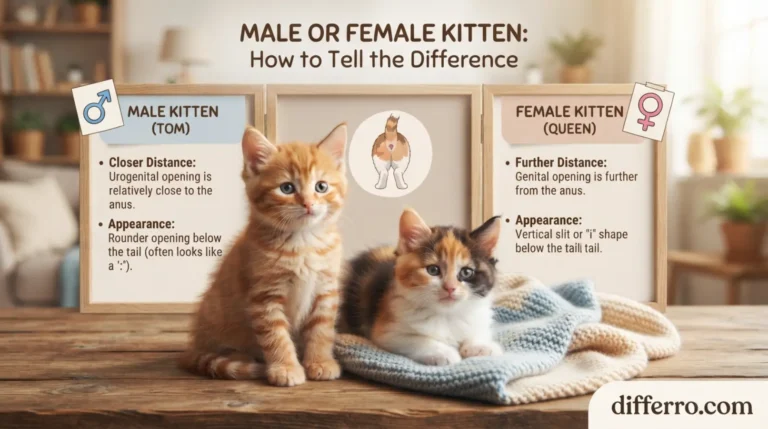
Male or female kitten identification can help you understand your kitten’s needs and choose a suitable name. However, many new cat owners struggle to identify a kitten’s sex correctly. Male and female kittens look almost identical during their first few weeks. Their small bodies and developing features make visual identification difficult. You can usually identify a kitten’s sex by examining the area beneath its tail. The distance between the anus and genital opening provides an important clue. Coat color and behavior may offer additional hints, but neither guarantees an accurate answer.
This guide explains how to tell whether a kitten is male or female. You will learn the physical differences, common identification mistakes, and useful tips for beginners. You will also discover when a veterinarian can help confirm your kitten’s sex.
⭐ Quick Answer
To identify a male or female kitten, gently lift its tail and examine the genital area. Female kittens usually have a vertical slit close to the anus. Male kittens typically have a round genital opening farther from the anus.
Example: A kitten with two openings that resemble an exclamation mark is likely female. A kitten with openings that resemble a colon is likely male.
Young kittens can be difficult to identify, so ask a veterinarian to confirm your findings.
🐱 Meaning of a Male Kitten
A male kitten is a young cat with male reproductive anatomy. People may also call a male cat a tom, although tomcat usually refers to an adult male.
Male kittens develop reproductive organs as they grow. Their external genital features can be subtle during the first few weeks.
Examples:
- We adopted a male kitten with orange fur and green eyes.
- The veterinarian confirmed that our eight-week-old kitten was male.
🐱 Meaning of a Female Kitten
A female kitten is a young cat with female reproductive anatomy. People sometimes call a female cat a queen, especially when discussing breeding or adult cats.
Female kittens have a vulva beneath the anus. The vulva usually appears as a small vertical slit.
Examples:
- Our female kitten has soft gray fur and blue eyes.
- The veterinarian identified the kitten as female during its first health check.
📊 Key Differences Between Male and Female Kittens
| Feature | Male Kitten | Female Kitten |
|---|---|---|
| Genital opening | Usually round | Usually a vertical slit |
| Distance between openings | Generally greater | Generally shorter |
| Appearance beneath the tail | Often resembles a colon | Often resembles an exclamation mark |
| Testicles | May become visible or palpable as the kitten develops | No testicles |
| Coat color | Can have any common cat coat color | Can have any common cat coat color |
| Behavior | Varies by individual | Varies by individual |
| Identification difficulty | Often difficult in very young kittens | Often difficult in very young kittens |
Physical anatomy provides better clues than behavior or personality. A veterinarian can confirm the sex when the appearance remains unclear.
📚 Origin and History of Male and Female Cat Terms
People have distinguished male and female cats for centuries. These terms help owners, breeders, veterinarians, and animal shelters describe cats accurately.
The word male refers to the sex associated with male reproductive anatomy. The word female refers to the sex associated with female reproductive anatomy.
Cat-related terms include:
- Tomcat: An adult male cat.
- Queen: An adult female cat, especially in breeding contexts.
- Kitten: A young cat of either sex.
- Ginger cat: A cat with orange or reddish fur.
- Tortoiseshell cat: A cat with a mixed coat pattern, usually black and orange.
These terms describe different features, ages, or roles. A kitten can be male or female regardless of its coat pattern.
🇬🇧 British English vs. American English
British and American English use the same spellings for male kitten and female kitten.
Both varieties use the words male, female, and kitten in the same basic way. The main differences involve pronunciation or other vocabulary, not these terms.
| Feature | British English | American English |
|---|---|---|
| Male kitten | Male kitten | Male kitten |
| Female kitten | Female kitten | Female kitten |
| Young cat | Kitten | Kitten |
| Adult male cat | Tomcat | Tomcat |
| Adult female cat | Queen | Queen |
🔍 When to Identify a Male Kitten
You may want to identify a male kitten before choosing a name, arranging veterinary care, or discussing neutering.
1. When You Notice a Greater Distance Between Openings
Male kittens generally have more space between the anus and genital opening.
Example: You notice that the lower opening looks round and sits farther from the anus.
This pattern suggests a male kitten, but very young kittens can be difficult to identify.
2. When the Testicles Begin to Develop
As male kittens grow, their testicles may become easier to see or feel. However, their appearance varies with age and development.
Example: Your veterinarian notices developing testicles during a routine examination.
Do not squeeze or press the area to check for testicles. Let a veterinarian perform the examination if you feel unsure.
3. When Planning Neutering
Knowing a kitten’s sex helps your veterinarian discuss suitable reproductive care.
Example: You ask your veterinarian when your male kitten should receive neutering surgery.
Your veterinarian can recommend appropriate timing based on the kitten’s age, health, and development.
🔍 When to Identify a Female Kitten
Identifying a female kitten helps you discuss reproductive health and plan appropriate veterinary care.
1. When the Genital Opening Looks Like a Slit
Female kittens usually have a vertical slit close to the anus.
Example: You see two openings with a short distance between them, and the lower opening resembles a line.
This pattern suggests a female kitten.
2. When Planning Spaying
A veterinarian can explain when your female kitten should receive spaying surgery.
Example: You schedule a wellness visit to discuss spaying and routine vaccinations.
The veterinarian can assess her health and recommend a suitable schedule.
3. When Adopting From a Shelter
Shelter staff often record a kitten’s sex during intake. However, mistakes can happen, especially with very young kittens.
Example: You adopt a kitten listed as female and ask your veterinarian to confirm the identification.
A quick professional check can resolve uncertainty.
⚠️ Common Mistakes When Identifying a Male or Female Kitten
New cat owners sometimes rely on unreliable clues. Avoid these common mistakes.
Mistake 1: Judging Sex by Coat Color Alone
Incorrect assumption: Every orange kitten is male.
Correct information: Orange cats are often male, but female orange cats also exist.
Coat color can suggest a pattern, but it cannot confirm an individual kitten’s sex.
Mistake 2: Assuming Personality Reveals Sex
Incorrect assumption: An energetic kitten must be male.
Correct information: Both male and female kittens can be playful, calm, bold, or shy.
Personality depends on many factors, including genetics, socialization, and individual temperament.
Mistake 3: Checking Only the Distance Between Openings
Incorrect approach: Identifying a kitten by distance alone.
Correct approach: Examine the shape and position of both openings together.
The overall pattern offers a better clue, but a veterinarian should confirm uncertain cases.
Mistake 4: Handling a Young Kitten Too Roughly
Incorrect approach: Pulling the tail or pressing the genital area to see more clearly.
Correct approach: Support the kitten gently and lift its tail without force.
Stop if the kitten struggles or becomes distressed. Ask a veterinarian for help instead.
Mistake 5: Assuming Every Kitten Is Easy to Identify
Incorrect assumption: You can always identify a kitten’s sex immediately after birth.
Correct information: Very young kittens have small, undeveloped genital features.
Identification often becomes easier as kittens grow, but some cases remain difficult.
Mistake 6: Treating a Visual Guess as a Medical Confirmation
Incorrect approach: Relying entirely on your first observation.
Correct approach: Ask a veterinarian to confirm the kitten’s sex during a health examination.
This step is especially helpful when you need accurate information for medical or reproductive care.
🧠 Easy Trick to Remember Male or Female Kitten Differences
Use this simple visual memory trick:
- Female: Exclamation mark. The anus and nearby vertical slit often resemble an exclamation mark.
- Male: Colon. The anus and round genital opening often resemble a colon because they usually sit farther apart.
Remember that these shapes are visual guides, not guaranteed results.
If you cannot clearly see the openings, avoid guessing. A veterinarian can examine the kitten safely and confirm its sex.

🌟 Everyday-Life Examples: Male or Female Kitten
Example 1: Choosing a Kitten’s Name
You adopt a tiny kitten and want to choose a suitable name.
You examine its genital area gently but cannot identify the sex confidently. Your veterinarian confirms that the kitten is female during its first checkup.
Lesson: Confirm the sex before making assumptions based on appearance.
Example 2: Adopting an Orange Kitten
Your family adopts an orange kitten and assumes it must be male.
The veterinarian examines the kitten and confirms that it is female.
Lesson: Orange fur does not guarantee that a kitten is male.
Example 3: Caring for Two Littermates
You notice that two kittens have different genital features.
One kitten has a round opening farther from the anus. The other has a vertical slit close to the anus.
Lesson: These patterns can help you distinguish a male kitten from a female kitten.
Example 4: Preparing for Veterinary Care
You bring a six-week-old kitten to the clinic for a health check.
The veterinarian examines the kitten and confirms its sex. You then discuss vaccinations, parasite prevention, and future reproductive care.
Lesson: A veterinary examination can answer questions beyond sex identification.
Example 5: Correcting an Adoption Record
An animal shelter lists a kitten as male, but you notice features that suggest a female.
You ask the shelter or veterinarian to check the kitten again. A professional confirms the correct identification and updates the record.
Lesson: Verify uncertain information instead of relying on an earlier guess.
These variations address related questions and help readers find useful information about kitten identification.
📈 Google Trends and Usage Data: Five Countries
People may search for male or female kitten identification when adopting pets or learning basic cat care.
- USA: Search intent may relate to kitten adoption, pet ownership, and veterinary care.
- UK: Owners may look for practical guides to identifying kittens at home.
- Australia: Searches may relate to kitten care, adoption, and responsible pet ownership.
- India: New pet owners may seek simple visual explanations of kitten anatomy.
- Pakistan: People adopting kittens may look for accessible guidance on identifying their pets.
Google Trends insight: These points describe likely search needs, not verified search-volume rankings. I have not checked live Google Trends figures for these five countries. Search interest can vary with season, pet adoption trends, and local search behavior.
Comparison Table: Keyword Variations
| Keyword variation | Search intent | Recommended content angle |
|---|---|---|
| Male or female kitten | Identification | Main physical differences |
| How to tell if a kitten is male or female | Informational | Step-by-step identification |
| Male vs. female kitten | Comparison | Anatomy and development |
| How to identify a kitten’s sex | Practical guidance | Visual clues and limitations |
| Male kitten vs. female kitten behavior | Comparison | Individual behavior differences |
| Male kitten genital area | Specific information | Anatomy and safe examination |
| Female kitten genital area | Specific information | Anatomy and safe examination |
To compare real search interest, enter these terms into Google Trends and select each country separately. Use the same time range and search settings for a fair comparison.
⚖️ Final Verdict: Male or Female Kitten?
Neither a male nor a female kitten is inherently better. The right choice depends on your preferences, lifestyle, and ability to provide proper care.
You can often identify a kitten’s sex by examining the shape and spacing of its genital openings. Female kittens usually have a vertical slit close to the anus. Male kittens generally have a round opening farther away.
However, kittens can be difficult to identify during their first weeks. Coat color and behavior cannot confirm sex reliably.
If you are adopting a kitten, focus on health, temperament, and responsible care rather than sex alone. Ask a veterinarian to confirm the identification and discuss vaccinations, parasite prevention, and future spaying or neutering.
❓ Frequently Asked Questions
1. Is it correct to say male or female kitten?
Yes. Male kitten and female kitten are correct and widely understood expressions. They describe a young cat’s sex and help owners, shelters, and veterinarians communicate clearly.
2. What is the difference between a male and female kitten?
The main visible differences involve the genital openings beneath the tail. Male kittens usually have a round genital opening farther from the anus. Female kittens usually have a vertical slit closer to the anus.
3. Which is more common, male or female kittens?
Neither sex is universally more common among kittens. The proportions vary across litters and populations. Coat color may correlate with sex in some patterns, but it does not reliably identify an individual kitten.
4. Is male or female kitten identification important for veterinary care?
Yes. Knowing a kitten’s sex helps veterinarians discuss reproductive development and future spaying or neutering. However, both sexes need routine veterinary care, vaccinations, parasite prevention, nutrition, and regular health checks.
5. Why is it difficult to tell whether a kitten is male or female?
Very young kittens have small, undeveloped genital features. Their fur and body size can also make examination difficult. A veterinarian can confirm the sex when visual clues remain unclear.
📝 Conclusion
Identifying a male or female kitten becomes easier when you understand the physical differences beneath the tail. Female kittens usually have a vertical genital slit close to the anus. Male kittens generally have a round opening farther from the anus. These patterns offer useful clues, but they do not guarantee an accurate identification in every case. Coat color, behavior, and personality cannot confirm a kitten’s sex. Handle young kittens gently and avoid pressing their genital area. If you feel uncertain, ask a veterinarian to check your kitten during a routine health visit. Most importantly, remember that both male and female kittens need love, proper nutrition, safe surroundings, and regular veterinary care. Responsible care matters far more than choosing a kitten based on sex alone.

Imran Lodhra is a comparison-focused content writer at Differro.com.
He specializes in creating clear, simple, and informative comparison articles.
His work helps readers understand key differences, pros and cons, and important details.
Imran focuses on accurate, practical, and easy-to-read content for everyday readers.
1 thought on “Male or Female Kitten: How to Tell the Difference”