
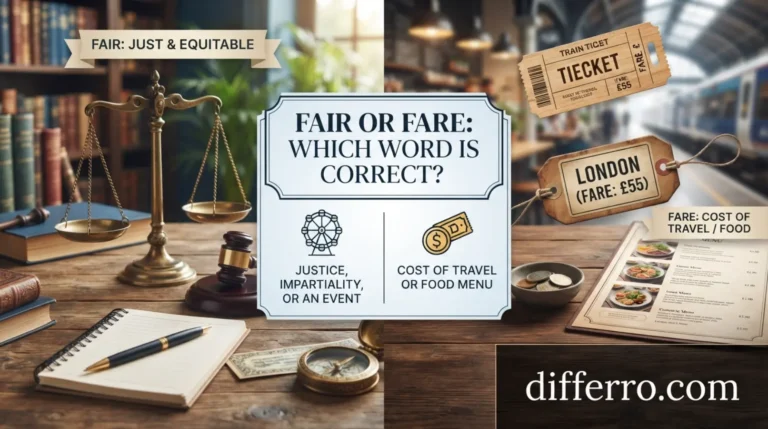
fair or fare is a common English word confusion. Both words sound exactly the same, but their meanings and spellings differ. They are homophones, so you cannot tell them apart by pronunciation alone. You must understand the sentence to choose the correct word.
Fair has several meanings. It can describe something reasonable, honest, attractive, average, or clear. It can also mean a public event, such as a county fair or book fair.
Fare usually refers to a travel cost, food, or the way someone performs or gets along. For example, you pay a bus fare, eat traditional fare, or ask how someone will fare.
⭐ Quick Answer
Fair means reasonable, just, attractive, or a public event. Fare means a travel price, food, or how someone performs. They sound alike but have different meanings.
Example: The bus fare was expensive, but the ticket price was still fair.
Meaning of Fair
Fair has several common meanings in English. As an adjective, it can mean reasonable, honest, or free from unfair treatment. It can also describe something average, attractive, pale, or related to pleasant weather.
As a noun, fair can mean a public event where people gather for business, entertainment, education, or recreation.
Examples of Fair
- The judge made a fair decision.
- We visited the county fair last weekend.
Other common examples include:
- fair price
- fair treatment
- fair weather
- book fair
- job fair
Meaning of Fare
Fare commonly works as a noun and a verb.
As a noun, fare can mean the price paid for transportation. It can also mean food or a type of entertainment. As a verb, fare means to get along, perform, or turn out in a particular way.
Examples of Fare
- The train fare increased this month.
- How did you fare in your final exam?
Other common examples include:
- bus fare
- taxi fare
- airfare
- local fare
- traditional fare
- fare well
- fare badly

🔍 Fair or Fare: Key Differences
| Feature | Fair | Fare |
|---|---|---|
| Main meaning | Reasonable, just, attractive, or an event | Travel cost, food, or performance |
| Part of speech | Adjective, noun, adverb, rare verb | Noun and verb |
| Tone | Common and flexible | Common but meaning depends on context |
| Usage | Justice, quality, weather, events | Travel, food, performance |
| Popularity | Very common | Very common |
| Example | That was a fair decision. | The bus fare was high. |
The biggest difference is meaning, not pronunciation. Both words have the same sound in standard English.
📚 Origin and History
The two words have different histories, even though modern speakers pronounce them alike.
Fair comes from Old English forms related to beauty, appearance, and pleasantness. Its spelling developed through Middle English before reaching the modern form fair. The Oxford English Dictionary records many historical spellings, including forms such as fæger, faier, fayr, and fair.
Fare has a different history. It comes from Old English faran, meaning to go or travel. It later developed meanings connected with journeys, travel costs, food, and personal experience.
Similar historical word pairs can also confuse English learners:
- there / their / they’re
- brake / break
- principal / principle
- right / write
- peace / piece
- weather / whether
These words show why English spelling cannot always be predicted from pronunciation.
🇬🇧 British English vs American English Spelling
Fair and fare are spelled the same in British and American English.
The meanings are also essentially the same in both varieties. British English often uses fare for bus, train, and aeroplane travel costs, while American English uses the same word for bus, train, and airplane fares.
British vs American English
| Word | British English | American English |
|---|---|---|
| Fair | fair | fair |
| Travel cost | fare | fare |
| Food | fare | fare |
| Public event | fair | fair |
| Verb meaning “get along” | fare | fare |
There is no British-versus-American spelling difference between fair and fare.
✍️ When to Use Fair
Use fair when you mean reasonable, just, equal, or free from bias.
Examples:
- The teacher gave everyone a fair chance.
- That seems like a fair price.
- We want a fair competition.
- The judge reached a fair decision.
✎Use fair when describing pleasant or clear weather.
- We enjoyed fair weather during our trip.
- The forecast predicts fair skies tomorrow.
Use fair for public events.
- The school held a science fair.
- We went to the county fair on Saturday.
✎Use fair when describing light coloring or appearance.
- She has fair skin.
- He has fair hair.
🚍 When to Use Fare
Use fare when you mean the price of transportation.
- The bus fare is affordable.
- I paid my taxi fare.
- The airline increased its fare.
- What is the train fare?
✎Use fare when you mean food or a type of cuisine.
- The restaurant serves traditional Italian fare.
- Local fare was available at the festival.
Use fare as a verb when discussing someone’s performance or experience.
- How did you fare in the interview?
- The team fared well this season.
- She fared better than expected.
⚠️ Common Mistakes With Fair and Fare
1. Using “fair” for a travel price
Incorrect: The bus fair is $3.
Correct: The bus fare is $3.
A transportation price is always called a fare.
2. Using “fare” for reasonable treatment
Incorrect: The teacher gave us a fare chance.
Correct: The teacher gave us a fair chance.
Something reasonable or equal is fair.
3. Writing “How did you fair?”
Incorrect: How did you fair in the exam?
Correct: How did you fare in the exam?
The verb meaning “perform” or “get along” is fare.
4. Writing “fair well”
Incorrect: I hope you fair well.
Correct: I hope you fare well.
The expression fare well means to do well or get along well.
5. Confusing food with fairness
Incorrect: The restaurant serves traditional fair.
Correct: The restaurant serves traditional fare.
Fare can mean a particular type of food.
6. Confusing a public event with food
Incorrect: We attended a food fare.
Correct: We attended a food fair.
A public event is a fair.
🧠 Easy Trick to Remember Fair or Fare
Use this simple memory trick:
FAIR = FAIR treatment
Think about fairness, justice, equal treatment, and public fairs.
FARE = FARE for travel
Think about the money you pay for a bus, taxi, train, or plane.
You can also remember:
- Fair = just or event
- Fare = travel, food, or performance
Try this sentence:
“The fare was high, but the price was fair.”
Here, fare means the travel cost. Fair means reasonable.
🌎 Everyday Life Examples of Fair or Fare
1. At the Bus Station
You may need to ask about the cost of transportation.
Example: What is the bus fare to Lahore?
Here, fare means the amount you must pay for the journey.
2. At a School Event
Schools often organize fairs for students and families.
Example: Our school held a book fair this week.
Here, fair means an organized public event.
3. During an Exam
You can use fare when asking about someone’s performance.
Example: How did you fare in your English exam?
Here, fare means perform or do.
4. During a Discussion
Use fair when talking about equal treatment.
Example: The manager made a fair decision.
Here, fair means reasonable and just.
5. At a Restaurant
Use fare when describing food.
Example: The restaurant serves traditional Pakistani fare.
Here, fare means a type or range of food.
🔑 Related Keywords
Use these related keyword variations naturally in an SEO article:
- fair or fare difference
- fair vs fare
- difference between fair and fare
- fair meaning
- fare meaning
- when to use fair or fare
- fair and fare examples
These variations cover comparison, spelling, meaning, and usage intent.
📈 Google Trends and Usage Data
Google Trends measures search interest, not the total number of words used in everyday language. Its results also depend on the exact search term and selected period.
For USA, UK, Australia, India, and Pakistan, the useful SEO insight is to target both words rather than treating them as interchangeable. Search interest can also change when users search for specific phrases such as bus fare, airfare, or fair price.
Broad web usage supports this approach because fair has many meanings, while fare has strong travel, food, and performance meanings. Dictionary.com also identifies both words as common but distinguishes their separate uses.
Google Trends provides country-specific exploration, including the United States, United Kingdom, India, and Australia.
Country-Level SEO Insight
| Country | Useful Search Intent | Content Opportunity |
|---|---|---|
| USA | fair price, bus fare, airfare | Comparison and everyday examples |
| UK | train fare, fair treatment | Travel and formal English |
| Australia | transport fare, fair price | Transport and general English |
| India | fair or fare meaning | English learning and spelling |
| Pakistan | fair or fare difference | English learning and exam usage |
SEO insight: Do not optimize only for fair. Build topical coverage around both fair and fare, including their most common phrases.
📊 Comparison Table: Keyword Variations
| Keyword Variation | Search Intent | Main Topic |
|---|---|---|
| fair or fare | Comparison | Main confusion |
| fair vs fare | Comparison | Difference |
| fair and fare | Informational | Usage |
| difference between fair and fare | Informational | Meaning |
| fair meaning | Definition | Fair |
| fare meaning | Definition | Fare |
| when to use fair or fare | Educational | Correct usage |
| fair fare examples | Educational | Examples |
⚖️ Fair or Fare: Final Verdict
There is no single replacement for fair and fare because they have different meanings.
Use fair for something reasonable, just, attractive, pleasant, or a public event.
Use fare for transportation costs, food, or someone’s performance.
Remember these three examples:
- Fair price = a reasonable price.
- Bus fare = the cost of a bus journey.
- Fare well = do well or get along well.
If you are unsure, look at the meaning of the sentence. If you mean justice or an event, choose fair. And if you mean travel cost, food, or performance, choose fare.
❓ Frequently Asked Questions
Is “fair or fare” correct?
Yes. Both fair and fare are correct English words. The correct choice depends on the meaning and grammatical role.
What is the difference between fair and fare?
Fair commonly means reasonable, just, attractive, or a public event. Fare commonly means transportation cost, food, or someone’s performance.
Which is more common, fair or fare?
Both are established English words. Fair has a wider range of meanings, including justice, weather, appearance, quality, and public events. Fare has strong uses related to transportation, food, and performance.
Is fair or fare used in formal English?
Both words appear in formal English. Use the word that matches your intended meaning. For example, fair treatment and transportation fare are both appropriate in formal writing.
Why do people confuse fair and fare?
People often confuse them because they are homophones. They have the same pronunciation but different spellings and meanings.
Is “fare well” correct?
Yes. Fare well is correct when you mean to do well or get along well. Farewell is also a standard word used as a goodbye.
Is “fair price” correct?
Yes. Fair price means a price considered reasonable or acceptable.
Is “bus fare” or “bus fair” correct?
Bus fare is correct. It means the amount charged for traveling by bus.
📝 Conclusion
Fair or fare is a common English confusion because both words sound the same. Their meanings, however, are different. Fair usually describes something reasonable, just, attractive, pleasant, or a public event. Fare commonly means a transportation cost, a type of food, or how someone performs. Remember that you pay a fare when you travel. You attend a fair when you visit a public event. You can receive fair treatment and fare well in an exam. Understanding the meaning makes the spelling easy. Once you connect each word with its main uses, you can confidently choose between fair and fare in everyday and formal English.

Imran Lodhra is a comparison-focused content writer at Differro.com.
He specializes in creating clear, simple, and informative comparison articles.
His work helps readers understand key differences, pros and cons, and important details.
Imran focuses on accurate, practical, and easy-to-read content for everyday readers.
2 thoughts on “Fair or Fare: Which Word Is Correct?”