
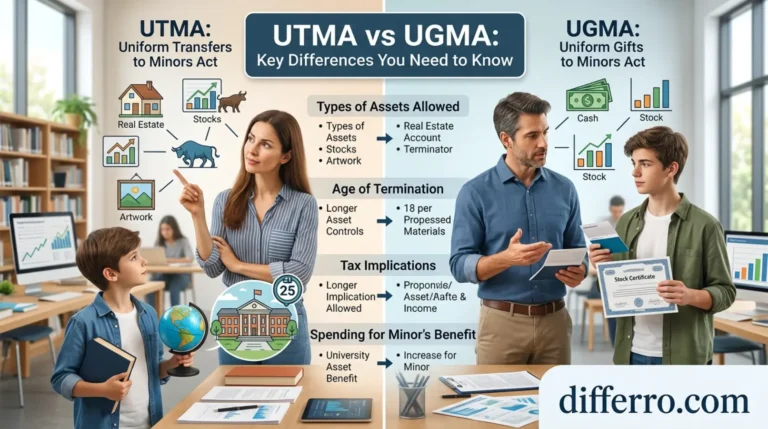
UTMA vs UGMA can be confusing because both terms describe custodial accounts for minors. They let an adult manage money or investments for a child. The main difference involves the type of property each law can cover. UGMA stands for Uniform Gifts to Minors Act. UTMA means Uniform Transfers to Minors Act. UTMA expanded the older UGMA framework to cover a wider range of property.
In everyday financial conversations, people often use UTMA vs UGMA almost interchangeably. Both involve an adult custodian managing assets for a minor. The child ultimately owns the assets. Contributions generally become irrevocable gifts to the child.
⭐ Quick Answer
UTMA or UGMA are custodial account frameworks for minors. UGMA mainly covers financial gifts, while UTMA generally allows a broader range of property.
Example: A parent can place stocks into a UGMA account. A UTMA can also accommodate broader property types under applicable state law.
📘 Meaning of UGMA
What Does UGMA Mean?
UGMA stands for Uniform Gifts to Minors Act.
It is a U.S. state-law framework for giving assets to minors without creating a formal trust. An adult custodian manages the assets for the child.
UGMA traditionally focuses on financial assets such as:
- Cash
- Stocks
- Bonds
- Mutual funds
- Certain other financial instruments
UGMA Examples
Example 1:
A grandparent gives $5,000 in stocks to a child’s UGMA account.
Example 2:
A parent deposits cash into a UGMA account for future expenses.
📗 Meaning of UTMA
What Does UTMA Mean?
UTMA stands for Uniform Transfers to Minors Act.
It expanded the older UGMA framework. UTMA can cover financial assets and additional types of property under state law.
Potential UTMA assets can include:
- Cash
- Stocks
- Bonds
- Mutual funds
- Real estate
- Artwork
- Patents
- Other qualifying property
The exact rules depend on the applicable state law.
UTMA Examples
Example 1:
A parent transfers stocks into a UTMA account for a child.
Example 2:
A family transfers qualifying non-financial property under a state’s UTMA rules.
🔍 UTMA or UGMA: Key Differences
| Feature | UGMA | UTMA |
|---|---|---|
| Full name | Uniform Gifts to Minors Act | Uniform Transfers to Minors Act |
| Meaning | Older custodial gifting framework | Expanded custodial transfer framework |
| Main use | Gifts and financial assets | Gifts and broader property |
| Asset flexibility | More limited | Generally broader |
| Tone | Legal and financial | Legal and financial |
| Usage | Still appears in account terminology | Common modern custodial-account terminology |
| Popularity | Older framework | More widely used in states adopting it |
The exact account rules depend on state law and the financial institution.
📜 Origin and History of UGMA and UTMA
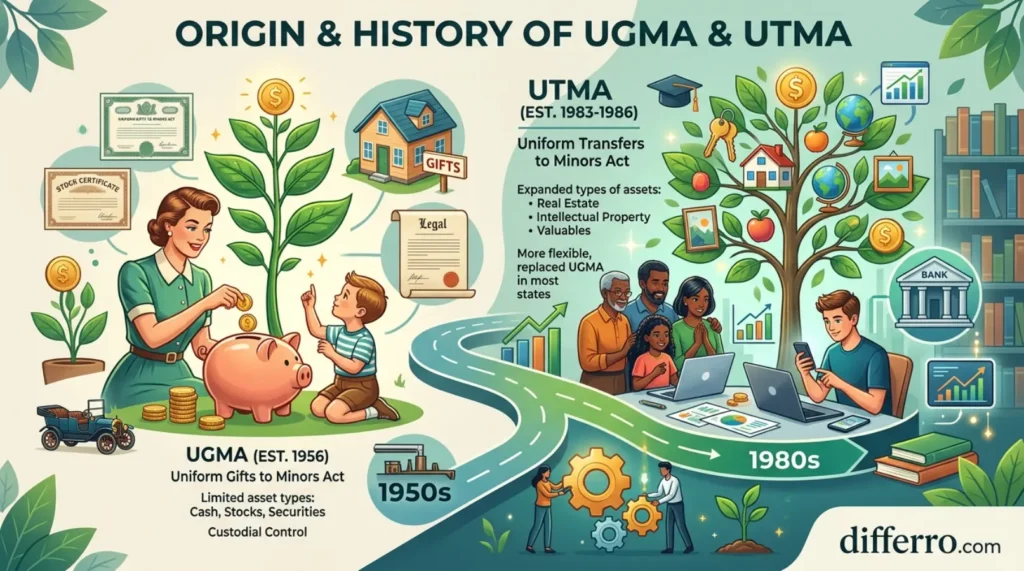
The UGMA framework dates back to 1956. It gave adults a simpler way to transfer property to minors without requiring a traditional trust.
Over time, states expanded their UGMA rules. The UTMA was developed to provide a broader and more consistent framework.
The 1983 UTMA expanded the types of property that could be transferred. It built upon the earlier UGMA model.
Similar Legal Terms
You may also see related terms such as:
- Custodial account
- Minor beneficiary
- Custodian
- Beneficiary
- Irrevocable gift
- Age of termination
- Uniform Transfers to Minors Act
🇬🇧 British English vs 🇺🇸 American English Spelling
UGMA and UTMA are U.S. legal terms, not British or American spelling variants.
Their names remain the same in English-speaking countries when discussing U.S. law.
The difference comes from legal frameworks, not English spelling rules.
British vs American English Comparison
| Feature | British English | American English |
|---|---|---|
| UGMA | UGMA | UGMA |
| UTMA | UTMA | UTMA |
| Main difference | No spelling change | U.S. legal terminology |
| Meaning | Refers to U.S. laws | Refers to U.S. laws |
🟢 When to Use UGMA
Use UGMA when discussing the older custodial gifting framework.
It can also appear in the names of existing financial accounts.
Examples
- “The grandmother opened a UGMA account.”
- “The child received stocks through a UGMA.”
- “The broker offers UGMA and UTMA accounts.”
Remember that state laws can affect how these accounts operate.
🔵 When to Use UTMA
Use UTMA when discussing the broader custodial transfer framework.
It is especially useful when the account involves property beyond traditional financial gifts.
Examples
- “The parents opened a UTMA investment account.”
- “The UTMA account holds stocks for the child.”
- “The custodian manages the UTMA until the required transfer age.”
Many modern custodial accounts use the UGMA/UTMA label together.
⚠️ Common UTMA and UGMA Mistakes
1. Treating Them as Completely Different Account Types
Incorrect:
“UGMA and UTMA are completely unrelated accounts.”
Correct:
“UGMA and UTMA are related custodial account frameworks.”
2. Assuming UTMA Means Only Stocks
Incorrect:
“UTMA accounts can only hold stocks.”
Correct:
“UTMA can cover broader property under applicable state law.”
3. Assuming the Parent Owns the Money
Incorrect:
“The parent owns the money until the child turns 18.”
Correct:
“The child owns the assets, while the custodian manages them.”
4. Assuming Every State Has Identical Rules
Incorrect:
“Every UTMA account transfers at exactly age 18.”
Correct:
“Transfer and termination ages vary by state.”
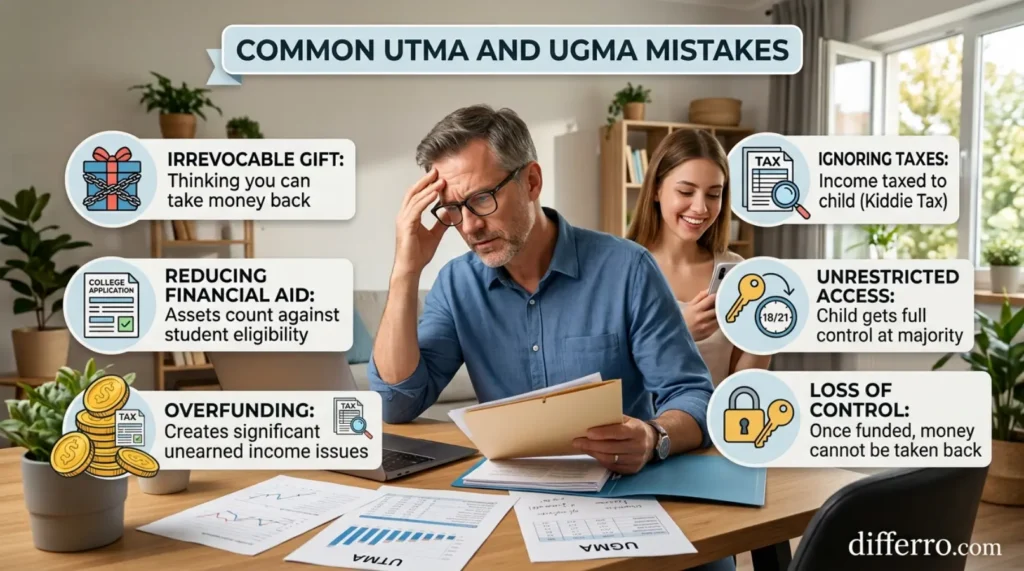
5. Thinking Contributions Can Always Be Reversed
Incorrect:
“Parents can take back their UGMA contribution.”
Correct:
“Contributions generally become irrevocable gifts to the child.”
🧠 Easy Trick to Remember
Think of G in UGMA as Gift.
Think of T in UTMA as Transfer.
UGMA = Gifts to Minors
UTMA = Transfers to Minors
The T also helps remind you that UTMA generally expanded the types of property covered.
🌎 UTMA or UGMA: Everyday-Life Examples
1. Grandparent Giving Stocks
A grandparent gives stocks to a child through a custodial account.
Primary keyword: UTMA or UGMA
Secondary keyword: custodial account for a child
2. Parent Saving for a Child
A parent invests money for a child’s future expenses.
Primary keyword: UTMA or UGMA
Secondary keyword: custodial investment account
3. Child Receiving an Inheritance
A minor receives assets that need adult management.
Primary keyword: UTMA or UGMA
Secondary keyword: custodial account for minors
4. Family Giving Investment Gifts
Relatives can contribute qualifying assets for a child’s benefit.
Primary keyword: UTMA or UGMA
Secondary keyword: UGMA vs UTMA account
5. Preparing for Adulthood
The custodian manages the assets until the required transfer age.
Primary keyword: UTMA or UGMA
Secondary keyword: UTMA custodial account
The assets belong to the child, and the custodian manages them for the child’s benefit.
📊 Google Trends and Usage Data
Google Trends lets users compare search interest across countries. It does not provide absolute search-volume numbers.
For this topic, UTMA and UGMA searches are strongly tied to U.S. financial terminology.
Interest is therefore most relevant in the USA, while UK, Australia, India, and Pakistan generally have less direct relevance.
Search interest can also change as financial products and state laws change.
| Country | Expected Search Relevance | Main Search Intent |
|---|---|---|
| 🇺🇸 USA | High | Account comparison and investing |
| 🇬🇧 UK | Low | Research into U.S. accounts |
| 🇦🇺 Australia | Low | U.S. financial terminology |
| 🇮🇳 India | Low | U.S. investing and financial research |
| 🇵🇰 Pakistan | Low | U.S. finance and educational searches |
SEO insight: The USA should be the primary target market for this keyword. UK, Australia, India, and Pakistan can provide secondary international traffic.
📈 Comparison Table: Keyword Variations
| Keyword Variation | Search Intent | Best Content Angle |
|---|---|---|
| UTMA or UGMA | Comparison | Main comparison article |
| UTMA vs UGMA | Comparison | Detailed differences |
| UGMA vs UTMA | Comparison | Reverse comparison |
| What is UTMA? | Informational | UTMA definition |
| What is UGMA? | Informational | UGMA definition |
| UTMA custodial account | Informational | Account guide |
| UGMA custodial account | Informational | Account guide |
⚖️ Final Verdict: UTMA or UGMA?
UTMA or UGMA are both legitimate terms connected to custodial accounts for minors.
UGMA represents the older Uniform Gifts to Minors Act.
UTMA expanded the framework and generally supports a broader range of property.
For most modern comparisons, UTMA is the more useful term to understand. However, the correct framework depends on the state and account structure.
The terms are also commonly combined as UGMA/UTMA by financial institutions.
If you are opening an account, check your state’s rules and the financial institution’s requirements.
❓ Frequently Asked Questions
Is UTMA or UGMA correct?
Both are correct. They refer to different but related U.S. custodial-account laws.
What is the difference between UTMA and UGMA?
UGMA is the older framework. UTMA expanded the types of property that can generally be transferred.
Which is more common, UTMA or UGMA?
UTMA is generally more common in states that adopted the expanded framework. Many financial institutions use the combined term UGMA/UTMA.
Is UGMA or UTMA more formal?
Both are formal legal terms. Neither is a casual spelling variation.
Why do people confuse UTMA and UGMA?
Both terms describe custodial arrangements for minors. Their purposes overlap, and financial institutions often group them together.
📝 Conclusion
UTMA or UGMA refers to two related U.S. custodial-account frameworks. UGMA came first and focused on gifts of certain financial assets. UTMA expanded the framework to cover a broader range of property. Both allow an adult custodian to manage assets for a minor. The child remains the beneficiary and owner of the assets. Contributions generally become irrevocable gifts. State rules determine important details, including the transfer age and permitted assets. For most modern financial discussions, UTMA is the broader term. Still, many banks and brokerages use UGMA/UTMA together. Understanding this difference can help you choose the right account terminology and avoid common mistakes.

Imran Lodhra is a comparison-focused content writer at Differro.com.
He specializes in creating clear, simple, and informative comparison articles.
His work helps readers understand key differences, pros and cons, and important details.
Imran focuses on accurate, practical, and easy-to-read content for everyday readers.