
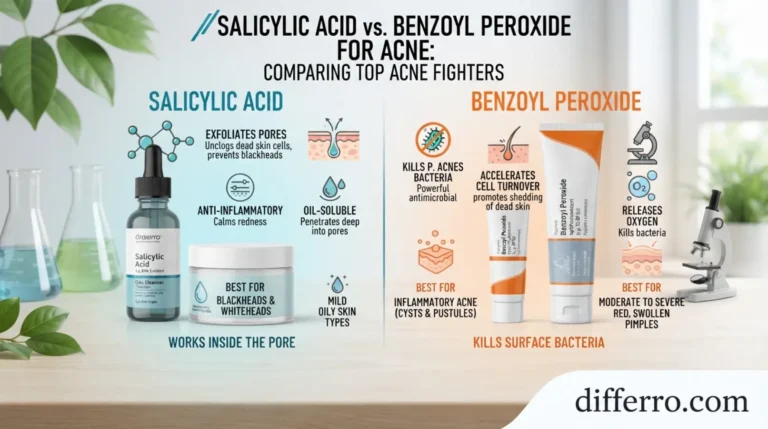
Salicylic acid or benzoyl peroxide is a common skincare question for people struggling with acne, clogged pores, and pimples. Both ingredients help treat acne, but they work in different ways. Choosing the right one depends on your skin type, acne symptoms, and skincare goals. Salicylic acid helps unclog pores by removing dead skin cells and excess buildup. Salicylic Acid vs. Benzoyl Peroxide and helps reduce inflammatory pimples. Both ingredients can improve acne, but neither works equally well for every person.
Your skin may respond better to one ingredient than the other. Some people also benefit from using both in a carefully planned routine. However, using too many acne treatments can cause dryness, redness, and irritation.
This guide explains the differences between salicylic acid and benzoyl peroxide, their benefits, common mistakes, and how to choose an appropriate acne treatment.
⭐ Quick Answer
Salicylic acid is often a good choice for blackheads, whiteheads, and clogged pores. Benzoyl peroxide often works better for inflamed pimples because it targets acne-causing bacteria.
Example: Someone with blackheads may try salicylic acid, while someone with red, inflamed pimples may benefit from benzoyl peroxide. Your skin’s needs determine the best option.
🧴 Meaning of Salicylic Acid
Salicylic acid is a beta hydroxy acid (BHA) used in many acne skincare products. It helps loosen dead skin cells and clear material from clogged pores.
This ingredient can help people who experience blackheads, whiteheads, and oily skin. Many cleansers, toners, gels, and leave-on treatments contain salicylic acid.
Examples of Salicylic Acid Use
- A person with blackheads uses a salicylic acid cleanser to help unclog pores.
- Someone with oily skin chooses a salicylic acid treatment to reduce pore buildup.
Salicylic acid can irritate sensitive skin, especially when someone uses it too often or combines it with other strong treatments.
🧪 Meaning of Benzoyl Peroxide
Benzoyl peroxide is a topical acne treatment that kills acne-associated bacteria and helps reduce inflammatory acne lesions. It also has mild effects on clogged pores.
This ingredient commonly appears in acne washes, creams, gels, and spot treatments. Products come in different strengths, so users should choose one that suits their skin and follow the label.
Examples of Benzoyl Peroxide Use
- Someone with red, inflamed pimples uses a benzoyl peroxide acne wash.
- A person with recurring inflammatory acne tries a benzoyl peroxide gel as part of an acne routine.
Benzoyl peroxide can cause dryness, redness, peeling, or irritation. It can also bleach towels, pillowcases, and clothing.
📊 Salicylic Acid vs. Benzoyl Peroxide: Key Differences
| Feature | Salicylic Acid | Benzoyl Peroxide |
|---|---|---|
| Main action | Helps unclog pores | Kills acne-associated bacteria |
| Best-known use | Blackheads, whiteheads, clogged pores | Inflamed pimples and inflammatory acne |
| Skin concerns | Oily skin and pore congestion | Red, swollen acne lesions |
| Effect on bacteria | Not its main treatment action | Strong antibacterial action |
| Common forms | Cleansers, gels, toners, creams | Cleansers, gels, creams, washes |
| Common side effects | Dryness, redness, peeling | Dryness, redness, peeling, irritation |
| Special concern | Can irritate sensitive skin | Can bleach fabrics |
| Speed of results | Often takes several weeks | Often takes several weeks |
| Suitability | Depends on skin type and acne | Depends on skin type and acne |
| Can they be combined? | Sometimes, with careful planning | Sometimes, with careful planning |
Neither ingredient is universally better. The right choice depends on your acne type, skin sensitivity, and tolerance.
📚 Origin and History of These Acne Ingredients
History of Salicylic Acid
Salicylic acid has a long history in skin care and medicine. Scientists studied salicylates found in plants, including willow bark, and developed related compounds for medical use.
Modern skincare products use salicylic acid for its ability to loosen dead skin cells and help unclog pores. It now appears in many over-the-counter acne treatments.
History of Benzoyl Peroxide
Benzoyl peroxide became an established topical acne treatment because of its antibacterial action. Researchers and dermatologists have used it for decades to treat acne.
Today, many acne products contain benzoyl peroxide alone or combine it with other acne-fighting ingredients. It remains a common option for inflammatory acne.
Similar Skincare Ingredients
Other ingredients can help manage acne, depending on the symptoms and skin type.
- Adapalene: A topical retinoid that helps prevent clogged pores and treats acne.
- Azelaic acid: Helps treat acne and may improve some forms of post-acne discoloration.
- Glycolic acid: An alpha hydroxy acid that exfoliates the skin.
- Sulfur: Appears in some products that target acne and excess oil.
These ingredients work differently. Choose a treatment based on your skin’s needs rather than assuming all acne ingredients provide the same benefits.
🇬🇧 British English vs. American English
Salicylic acid and benzoyl peroxide have the same spelling in British and American English.
Their scientific names and basic skincare uses also remain the same. Product labels, available strengths, and regulatory requirements may vary by country.
| Feature | British English | American English |
|---|---|---|
| Ingredient name | Salicylic acid | Salicylic acid |
| Ingredient name | Benzoyl peroxide | Benzoyl peroxide |
| Common term | Spot treatment | Spot treatment |
| Common term | Moisturiser | Moisturizer |
| Product availability | Depends on local regulations | Depends on local regulations |
🧴 When to Use Salicylic Acid
Salicylic acid may suit people who struggle with clogged pores, blackheads, or whiteheads. It helps remove dead skin cells and clear pore buildup.
1. When You Have Blackheads
Blackheads form when pores become clogged with oil and dead skin cells. Salicylic acid helps loosen this buildup.
Example: Someone with blackheads on their nose may try a salicylic acid cleanser.
2. When You Have Whiteheads
Whiteheads develop when clogged pores remain closed at the skin’s surface. Salicylic acid can help reduce this type of pore congestion.
Example: A person with small whiteheads may choose a salicylic acid leave-on product.
3. When Your Skin Feels Oily
Salicylic acid may help improve the appearance of oily, congested skin. However, it does not permanently stop oil production.
Example: Someone with oily skin may use a salicylic acid cleanser according to its directions.
4. When You Want Pore-Focused Treatment
Salicylic acid can help clear pore buildup, but it cannot permanently shrink your pores.
Example: A person with recurring clogged pores may benefit from a suitable salicylic acid product.
Start with a low concentration and use the product as directed. Reduce use if your skin becomes irritated.
🧪 When to Use Benzoyl Peroxide
Benzoyl peroxide may suit people with inflammatory acne, including red pimples. It reduces acne-associated bacteria and can help lower the number of inflammatory lesions.
1. When You Have Red Pimples
Inflammatory acne often causes red, swollen, or tender pimples. Benzoyl peroxide can help treat these lesions.
Example: Someone with recurring red pimples may try a low-strength benzoyl peroxide product.
2. When You Have Mild Inflammatory Acne
Benzoyl peroxide is a common treatment for mild inflammatory acne. A suitable product may help reduce breakouts with regular use.
Example: A person with several inflamed pimples uses a benzoyl peroxide wash according to the label.
3. When You Want an Antibacterial Treatment
Benzoyl peroxide kills acne-associated bacteria and can help limit bacterial resistance when used appropriately with certain antibiotic treatments.
Example: A dermatologist may recommend benzoyl peroxide as part of a treatment plan for inflammatory acne.
4. When You Want to Treat Recurring Breakouts
Benzoyl peroxide can help manage recurring inflammatory acne. Consistent use matters more than applying excessive amounts.
Example: Someone with repeated breakouts follows a simple routine that includes a suitable benzoyl peroxide product.
Start with a lower strength when appropriate. Stop using the product and seek medical advice if you develop severe irritation or swelling.
⚠️ Common Mistakes When Choosing Salicylic Acid or Benzoyl Peroxide
Mistake 1: Assuming One Ingredient Treats Every Type of Acne
Incorrect: Salicylic acid is always better than benzoyl peroxide.
Correct: Salicylic acid often suits clogged pores, while benzoyl peroxide often suits inflamed pimples.
Different acne types may need different treatments.
Mistake 2: Using Too Much Product
Incorrect: Applying extra product will clear acne faster.
Correct: Follow the product label and increase use only when your skin tolerates it.
Excessive use can cause dryness, peeling, redness, and irritation.
Mistake 3: Starting Both Ingredients at Full Strength
Incorrect: Using strong salicylic acid and benzoyl peroxide together immediately.
Correct: Introduce one product at a time and monitor your skin’s response.
Some people can use both ingredients, but combining them may increase irritation.
Mistake 4: Ignoring Moisturizer
Incorrect: Skipping moisturizer because acne-prone skin already produces oil.
Correct: Use a gentle, non-comedogenic moisturizer to support your skin barrier.
Dry skin can still develop acne, and acne treatments can increase dryness.
Mistake 5: Expecting Overnight Results
Incorrect: Stopping treatment after two or three days because pimples remain.
Correct: Give an appropriate acne treatment several weeks to work, unless irritation develops.
Many acne treatments need around six to eight weeks to show improvement. Some require longer.
Mistake 6: Forgetting Sun Protection
Incorrect: Using acne treatments without considering sun exposure.
Correct: Apply broad-spectrum SPF 30 or higher sunscreen during the day.
Sun protection helps reduce sun damage and may help prevent acne marks from becoming darker.
🧠 Easy Trick to Remember
Use this simple memory tip:
- Salicylic acid = unclog pores. Think of blackheads, whiteheads, and pore buildup.
- Benzoyl peroxide = target acne bacteria. Think of red, inflamed pimples.
For example, someone with blackheads may consider salicylic acid first. Someone with inflamed pimples may consider benzoyl peroxide.
This shortcut can guide your initial choice, but it cannot diagnose your acne or guarantee results.
🌟 Everyday-Life Examples: Salicylic Acid or Benzoyl Peroxide
Example 1: Blackheads on the Nose
A person notices blackheads around their nose and chin. They want a treatment that helps clear clogged pores.
Salicylic acid may be a reasonable starting option because it helps loosen pore buildup.
Possible choice: Salicylic acid.
Example 2: Red Pimples on the Cheeks
Someone develops recurring red pimples on their cheeks. They want a topical treatment that targets acne-associated bacteria.
Benzoyl peroxide may be a suitable option for this type of inflammatory acne.
Possible choice: Benzoyl peroxide.
Example 3: Oily Skin With Whiteheads
A person has oily skin and frequent whiteheads. They want to improve pore congestion without adding several products.
Salicylic acid may help address the clogged pores. A gentle cleanser and moisturizer can also support the routine.
Possible choice: Salicylic acid.
Example 4: Combination of Blackheads and Inflamed Pimples
Someone has blackheads on their nose and red pimples on their forehead. Both ingredients may address different parts of their acne.
However, starting both simultaneously can increase irritation. Introduce one treatment first or ask a dermatologist about a suitable combination.
Possible choice: One ingredient initially, followed by a carefully planned routine if needed.
Example 5: Sensitive Skin With Occasional Breakouts
A person has sensitive skin and occasional pimples. They worry about redness, dryness, and peeling.
Either ingredient may cause irritation. They should choose a suitable low-strength product, introduce it slowly, and stop if their skin reacts badly.
Possible choice: Seek pharmacist or dermatologist advice if sensitivity makes product selection difficult.
📈 Google Trends and Usage Data: Five Countries
People in the United States, United Kingdom, Australia, India, and Pakistan may search for these ingredients when comparing acne treatments.
- USA: Searches may reflect interest in over-the-counter acne products and skincare routines.
- UK: Users may compare product ingredients, strengths, and local availability.
- Australia: Searches may reflect acne care, sun protection, and skincare product choices.
- India: Users may compare acne treatments for oily skin, clogged pores, and inflammatory pimples.
- Pakistan: Searchers may look for affordable products, ingredient guidance, and suitable acne routines.
Google Trends insight: These are possible search interests, not verified search-volume findings. I have not checked live Google Trends data for these countries. Search interest can change with seasons, skincare trends, and product availability.
Comparison Table: Keyword Variations
| Keyword variation | Search intent | Recommended content angle |
|---|---|---|
| Salicylic acid or benzoyl peroxide | Comparison | Main differences and best uses |
| Salicylic acid vs. benzoyl peroxide | Research | Benefits and side effects |
| Benzoyl peroxide or salicylic acid for acne | Treatment selection | Match the ingredient to acne type |
| Salicylic acid for blackheads | Specific concern | Pore congestion |
| Benzoyl peroxide for pimples | Specific concern | Inflammatory acne |
| Can you use both together? | Safety and routine | Irritation risks and gradual introduction |
| Which is better for oily skin? | Skin-type comparison | Pore buildup and product tolerance |
For a reliable search comparison, enter the exact terms into Google Trends and compare the same period, category, and country. Do not treat relative search interest as an exact search-volume count.
⚖️ Final Verdict: Which Is Better for Acne?
Salicylic acid may be the better starting point for blackheads, whiteheads, and clogged pores. Benzoyl peroxide may be the better starting point for red, inflamed pimples.
Neither ingredient suits everyone, and both can irritate the skin. Your acne type, skin sensitivity, product strength, and routine all influence the results.
If you have both clogged pores and inflammatory acne, a carefully planned combination may help. However, introduce treatments gradually rather than starting several active ingredients together.
Use a gentle cleanser, moisturizer, and broad-spectrum sunscreen alongside your acne treatment. Seek professional advice if your acne causes painful deep lumps, scarring, or persistent symptoms.
Bottom line: Choose salicylic acid for pore congestion and consider benzoyl peroxide for inflammatory acne. If you are unsure, a dermatologist can help you choose a treatment that fits your skin.
❓ Frequently Asked Questions
1. Is salicylic acid or benzoyl peroxide better for acne?
Both can treat acne, but they work differently. Salicylic acid helps unclog pores, while benzoyl peroxide targets acne-associated bacteria. Your acne type and skin tolerance determine which ingredient may work better.
2. What is the difference between salicylic acid and benzoyl peroxide?
Salicylic acid helps remove dead skin cells and clear clogged pores. Benzoyl peroxide kills acne-associated bacteria and helps reduce inflammatory pimples. Both can cause dryness and irritation.
3. Which is more commonly used for acne?
Both ingredients are widely used in acne products. Benzoyl peroxide is a common choice for inflammatory acne, while salicylic acid is popular for blackheads and clogged pores. Actual popularity varies by market and product availability.
4. Can you use salicylic acid and benzoyl peroxide together?
Some people can use both ingredients, but the combination may increase dryness and irritation. Introduce one product at a time and follow product directions. Ask a dermatologist or pharmacist for advice if you have sensitive skin or use prescription acne treatments.
5. Why do people confuse salicylic acid and benzoyl peroxide?
People compare these ingredients because both treat acne and appear in similar skincare products. However, they work differently. Salicylic acid focuses on pore congestion, while benzoyl peroxide provides antibacterial action.
📝 Conclusion
Choosing salicylic acid or benzoyl peroxide depends on your acne type and skin sensitivity. Salicylic acid helps unclog pores, making it useful for blackheads and whiteheads. Benzoyl peroxide targets acne-associated bacteria and often suits red, inflamed pimples. Both ingredients can improve acne, but neither guarantees clear skin for everyone. Start with one suitable product, follow its directions, and introduce it gradually. Use a gentle moisturizer and broad-spectrum sunscreen to support your skincare routine. Avoid combining several strong treatments at once, as irritation can worsen your experience. If acne causes pain, scarring, or persistent breakouts, consult a dermatologist. Choosing the right ingredient and using it consistently can help you build a more effective acne treatment routine.

Imran Lodhra is a comparison-focused content writer at Differro.com.
He specializes in creating clear, simple, and informative comparison articles.
His work helps readers understand key differences, pros and cons, and important details.
Imran focuses on accurate, practical, and easy-to-read content for everyday readers.
1 thought on “Salicylic Acid vs. Benzoyl Peroxide for Acne”