
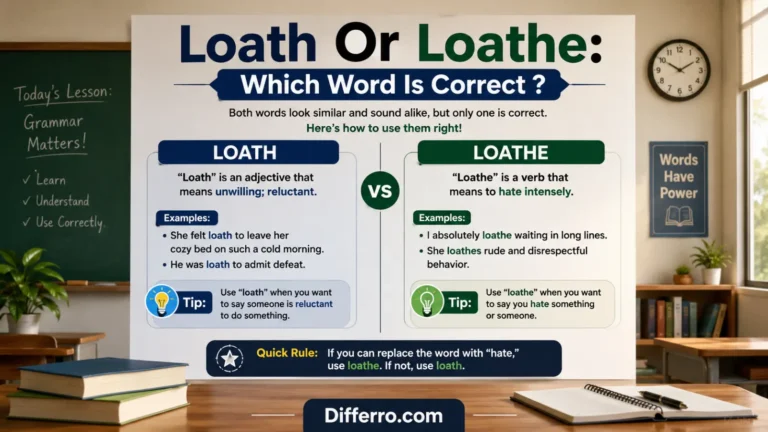
Loath or loathe often confuse English learners because the words look almost the same. However, they have different meanings and grammar roles. One is an adjective, while the other is a verb.
Many people use these words incorrectly in writing and speech. This confusion happens because both words relate to dislike or unwillingness. Their pronunciation is also very similar.
Understanding the difference between loath and loathe improves grammar and makes your writing clearer. In this guide, you will learn their meanings, examples, usage rules, history, and common mistakes. You will also discover easy memory tricks and SEO-friendly comparisons to help you remember them forever.
⭐ Quick Answer
Loath means unwilling or reluctant.
Loathe means to strongly hate something or someone.
Example:
- I am loath to leave early.
- I loathe dishonesty.
📖 Meaning of Loath
Loath is an adjective. It describes someone who feels unwilling or hesitant.
Simple Definition
Unwilling or reluctant to do something.
Examples
- She was loath to share her secrets.
- He felt loath to admit his mistake.
📖 Meaning of Loathe
Loathe is a verb. It means to strongly dislike or hate something.
Simple Definition
To deeply hate or dislike.
Examples
- I loathe waking up early.
- They loathe rude behavior.
📊 Key Differences Between Loath and Loathe
| Feature | Loath | Loathe |
|---|---|---|
| Part of Speech | Adjective | Verb |
| Meaning | Unwilling | Strongly hate |
| Tone | Mild hesitation | Strong dislike |
| Usage | Describes feelings | Shows action |
| Popularity | Less common | More common |
🏛️ Origin & History
The word loath comes from Old English lāth, meaning unwilling or hostile.
The word loathe developed later as a verb form meaning to hate deeply.
English often creates similar pairs like:
- Bath → Bathe
- Breath → Breathe
- Cloth → Clothe
These pairs show how adding “e” can change a word into a verb.
🇬🇧 British English vs American English Spelling
Both British and American English use loath and loathe the same way. There is no spelling difference between the two regions.
However, American English uses loathe more often in modern writing. British English still uses both words regularly in formal texts.
Comparison Table: British vs American English
| Feature | British English | American English |
|---|---|---|
| Loath | Common | Less common |
| Loathe | Very common | Very common |
| Spelling Difference | None | None |
| Usage Style | More formal | More conversational |

✍️ When to Use Loath
Use loath when describing reluctance or unwillingness.
Examples
- The manager was loath to change the policy.
- She seemed loath to answer the question.
- I am loath to waste money.
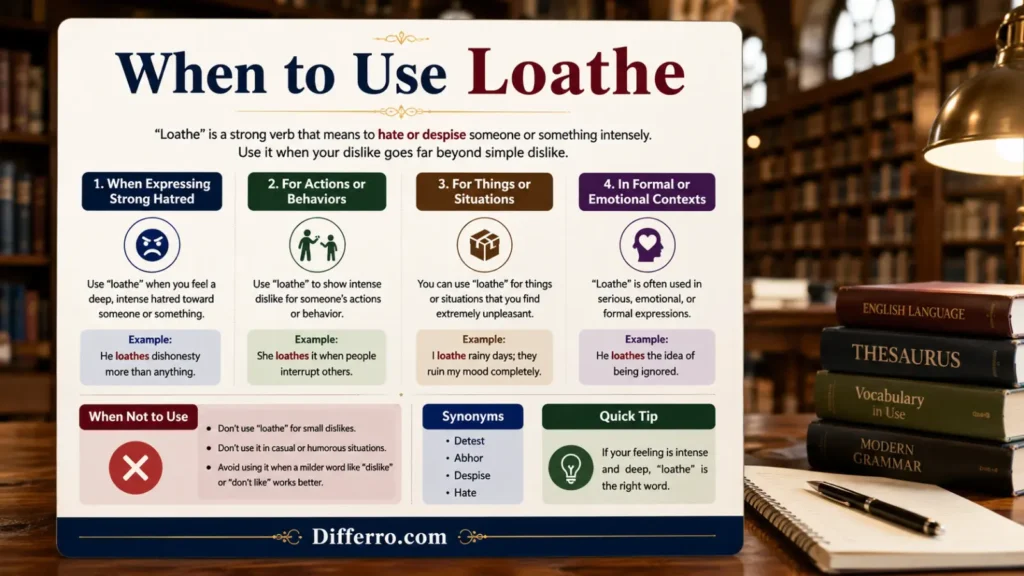
✍️ When to Use Loathe
Use loathe when expressing strong hatred or dislike.
Examples
- Many people loathe traffic jams.
- He loathed fake promises.
- She loathes noisy places.
❌ Common Mistakes
| Incorrect Usage | Correct Usage |
|---|---|
| I loath bad manners. | I loathe bad manners. |
| She was loathe him. | She loathed him. |
| He is loathe to travel. | He is loath to travel. |
| They loath waiting in lines. | They loathe waiting in lines. |
🧠 Easy Trick to Remember
- Loath = unwilling
- Loathe = hate
Memory Tip
The extra “e” in loathe stands for emotion or extreme hate.
📝 Write 5 Examples
1. School Life Example
Students are often loath to wake up early, but many loathe surprise tests.
2. Workplace Example
Employees may feel loath to work overtime if they loathe stress.
3. Family Example
Parents are sometimes loath to punish children they deeply love.
4. Travel Example
Some travelers loathe crowded airports during holidays.
5. Social Media Example
Many users loathe online scams and fake accounts.
🔍 Related Keywords
- loath meaning
- loathe meaning
- loath vs loathe
- difference between loath and loathe
- loath definition
- loathe definition
- how to use loath and loathe
⚖️ Final Verdict
Use loath when talking about reluctance or hesitation.
Use loathe when talking about strong dislike or hatred.
Although the words look similar, they play different grammar roles. One is an adjective, and the other is a verb. Using them correctly improves writing accuracy and avoids confusion.
🌍 Google Trends & Usage Data
In the USA, “loathe” receives more searches because it appears often in conversations and media.
Meanwhile, the UK searches both words regularly in grammar and writing topics.
In Australia, users commonly search “loath vs loathe” to understand the difference.
In India and Pakistan, many searches come from students and English learners comparing spelling and usage.
Insight
Globally, loathe is more popular because people commonly express dislikes in daily communication.
📈 Comparison Table: Keyword Variations
| Keyword Variation | Search Intent |
|---|---|
| loath or loathe | Comparison |
| loath meaning | Definition |
| loathe meaning | Definition |
| difference between loath and loathe | Grammar confusion |
| loath vs loathe examples | Learning usage |
| how to use loath | Educational |
| how to use loathe | Educational |
FAQs ,
Is “loath” correct?
Yes. “Loath” is correct when describing unwillingness.
What is the difference between loath and loathe?
“Loath” means reluctant. “Loathe” means strongly hate.
Which word is more common?
“Loathe” is more common in modern English.
Is loathe formal or informal?
“Loathe” works in both formal and informal writing.
Why does confusion exist?
The words look and sound similar, which causes grammar mistakes.
🧾 Conclusion
Loath or loathe is a common English confusion, but the difference is simple once you understand it. Loath describes unwillingness, while loathe expresses strong hatred. Their similar spelling causes mistakes, especially for English learners.
Remember that loath is an adjective and loathe is a verb. This grammar difference makes their usage easier to understand. Using the right word improves both speaking and writing skills.
If you want clearer English, practice these words with daily examples. Over time, their meanings will become natural and easy to remember.
Discover More Post ,
Extravert Or Extrovert : Which Word Is Correct?
Transferred Or Transfered : Which Spelling Is Correct?
Undescribable Or Indescribable : Which Word Is Correct?

Sara Taylor is a passionate writer and language enthusiast. She specializes in creating simple and easy-to-understand articles about English grammar, spelling differences, and commonly confused words. Her writing style focuses on helping students, writers, and English learners improve their language skills with confidence. Through informative guides and practical examples, Sara makes complex grammar topics easier for everyday readers.