
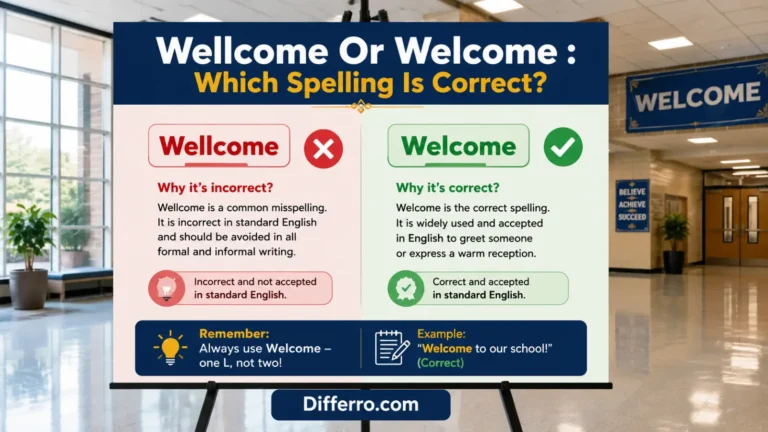
Wellcome Or Welcome is a common spelling confusion in English. Many people type “wellcome” when they actually mean “welcome.” This mistake often happens because the word sounds like “well” and “come” together. However, only one spelling is correct in standard English.
The word “welcome” is widely used in greetings, invitations, and polite conversations. You may see it in emails, signs, websites, and everyday speech. On the other hand, “wellcome” is usually a spelling error and is not accepted in formal writing.
Understanding the difference helps improve your grammar and writing skills. In this guide, you will learn the meanings, usage, history, examples, and common mistakes related to these two words.
Quick Answer
Welcome is the correct English spelling.
Wellcome is incorrect in modern English and is usually a spelling mistake.
✅ Example: You are welcome to join us tonight.
❌ Incorrect: You are wellcome to join us tonight.
Meaning of Wellcome
“Wellcome” is not a standard English word today. Most dictionaries consider it a misspelling of “welcome.”
Examples of Wellcome
- ❌ Wellcome to our website.
- ❌ You are wellcome here.
Meaning of Welcome
“Welcome” means greeting someone warmly or accepting someone happily.
Examples of Welcome
- ✅ Welcome to our home.
- ✅ She gave me a warm welcome.
Key Differences Table
| Feature | Wellcome | Welcome |
|---|---|---|
| Meaning | Incorrect spelling | Greeting or friendly acceptance |
| Tone | Informal mistake | Correct and professional |
| Usage | Rarely used | Common in daily English |
| Popularity | Very low | Extremely popular worldwide |
Origin & History 📚
The word “welcome” comes from Old English wilcuma, which meant “a pleasing guest.” Over time, the spelling changed into the modern form “welcome.”
The spelling “wellcome” appeared occasionally in old writings, but modern English standardized “welcome” as the correct version.
Similar Word Examples
- Goodbye
- Welcome
- Farewell
- Greeting
British English vs American English Spelling
Both British and American English use the spelling welcome. There is no regional difference between them. “Wellcome” is incorrect in both styles of English.
Comparison Table: British vs American English
| Language Style | Correct Spelling |
|---|---|
| British English | Welcome |
| American English | Welcome |
| Australian English | Welcome |
When to Use Each Word ✍️
When to Use “Welcome”
Use “welcome” in greetings, invitations, or polite responses.
Examples
- Welcome to the party.
- You are always welcome here.
- The teacher welcomed the new students.
When to Use “Wellcome”
Do not use “wellcome” in formal or informal English writing unless it is part of a brand or name.
Example
- ❌ Wellcome to my office.
Common Mistakes 🚫
| Incorrect Usage | Correct Usage |
|---|---|
| Wellcome home | Welcome home |
| You are wellcome | You are welcome |
| Wellcome everyone | Welcome everyone |
| Wellcome to Pakistan | Welcome to Pakistan |
Easy Trick to Remember 🧠
Remember this simple tip:
👉 Welcome has one “L.”
If you add an extra “L,” the spelling becomes incorrect.
Think of it this way:
✅ We welcome guests warmly.
❌ We wellcome guests warmly.

Write 5 Examples ✨
1. Welcome at School
- Welcome to our school assembly.
- Students gave the new teacher a warm welcome.
2. Welcome in Emails
- You are welcome to contact us anytime.
- Clients are always welcome here.
3. Welcome in Travel
- Welcome to Lahore.
- Tourists receive a friendly welcome.
4. Welcome in Business
- We welcome customer feedback.
- New employees are welcome to ask questions.
5. Welcome in Daily Life
- Guests are welcome at dinner.
- Everyone is welcome to participate.

Related Keywords 🔍
- Welcome meaning
- Wellcome or welcome correct spelling
- Difference between wellcome and welcome
- Welcome spelling
- How to spell welcome
- Welcome grammar
- Correct use of welcome
Final Verdict ✅
“Welcome” is the correct and accepted English spelling. It works in formal, informal, academic, and business writing. “Wellcome” is considered a spelling mistake in modern English.
Use “welcome” whenever greeting someone or showing friendly acceptance.
Google Trends & Usage Data 🌍
In the USA, “welcome” receives far more searches because it is widely used in communication and greetings.
Meanwhile, the UK and Australia use “welcome” heavily in education, business, and daily language.
In India and Pakistan, many users search “wellcome or welcome” to learn the correct spelling.
Overall, “welcome” is the globally accepted and most searched spelling.
Comparison Table: Keyword Variations
| Keyword Variation | Search Popularity |
|---|---|
| Welcome | Very High |
| Wellcome | Low |
| Welcome meaning | High |
| Welcome spelling | Medium |
| Wellcome or welcome | Medium |
FAQs ,
Is “wellcome” correct?
No, “wellcome” is not correct in standard English.
What is the difference between wellcome and welcome?
“Welcome” is the correct spelling, while “wellcome” is a spelling mistake.
Which is more common, welcome or wellcome?
“Welcome” is far more common worldwide.
Is welcome formal or informal?
“Welcome” works in both formal and informal writing.
Why does the confusion exist?
The confusion happens because some people think the word combines “well” and “come.”
Conclusion 📝
The confusion between Wellcome Or Welcome is very common among English learners. However, the correct spelling is always “welcome.” It is used in greetings, invitations, and polite conversations worldwide. The spelling “wellcome” is considered incorrect in modern English and should be avoided in writing.
Learning the correct spelling improves your grammar and makes your communication more professional. A simple way to remember it is that “welcome” uses only one “L.” Whether you are writing emails, messages, or formal documents, always choose “welcome” for accurate English usage.
Discover More Post ,
Extravert Or Extrovert : Which Word Is Correct?
Loath Or Loathe : Which Word Is Correct ?
Infeasible or unfeasible Explained Simply

Sara Taylor is a passionate writer and language enthusiast. She specializes in creating simple and easy-to-understand articles about English grammar, spelling differences, and commonly confused words. Her writing style focuses on helping students, writers, and English learners improve their language skills with confidence. Through informative guides and practical examples, Sara makes complex grammar topics easier for everyday readers.