
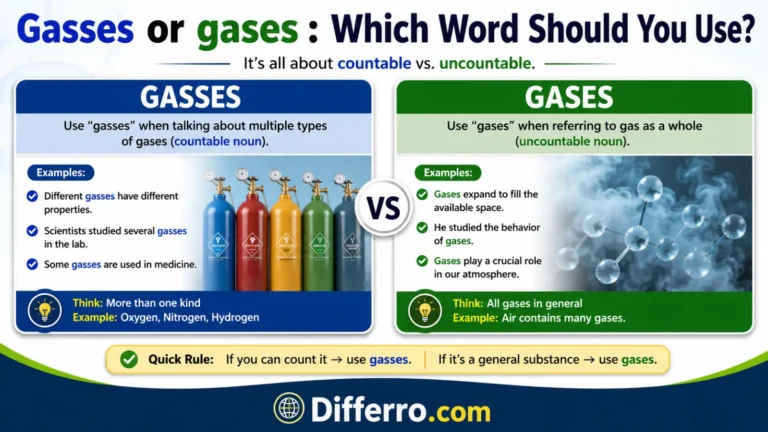
Gases or Gasses is a frequent spelling mix-up in English. Many writers are unsure which form is correct when referring to air, vapors, fumes, or substances studied in science.
The uncertainty arises because English pluralization rules are not always straightforward.
In most cases, gases is the correct plural of the noun gas. It is the standard form used in scientific writing, education, professional documents, and everyday communication. By contrast, gasses is typically a verb.
It means to emit gas, treat someone with gas, or, in informal usage, to chat excessively.
Although the difference is only one letter, it creates an entirely different meaning. For this reason, students, professionals, and English learners often search for “gases or gasses” to understand the correct spelling and usage.
In this article, you will discover the definitions, distinctions, origins, examples, grammatical rules, and proper uses of both words in clear and easy-to-understand English.
⭐ Quick Answer
“Gases” is the correct plural form of “gas.” It refers to two or more gases, such as oxygen, hydrogen, and carbon dioxide.
“Gasses” is generally a verb form that means to expose someone or something to gas or to release gas.
Example: The researchers analyzed several gases, including oxygen and helium.
Meaning of Gasses
Gasses is usually a verb form of “gas.”
It can mean:
- To release gas
- To expose someone to gas
- To talk endlessly in informal speech
Examples:
- The chemical mixture gasses during the reaction.
- He always gasses about his achievements.
Meaning of Gases
Gases is the plural noun form of “gas.”
It refers to more than one gas or air-like substance.
Examples:
- Oxygen and helium are important gases.
- Cars release harmful gases into the air.
📊 Key Differences Between Gasses and Gases
| Feature | Gasses | Gases |
|---|---|---|
| Meaning | Verb form of gas | Plural noun of gas |
| Grammar Type | Verb | Noun |
| Usage | Rare | Very common |
| Tone | Informal or technical | Standard and formal |
| Popularity | Less popular | Highly popular |
| Example | The liquid gasses quickly | Toxic gases filled the room |
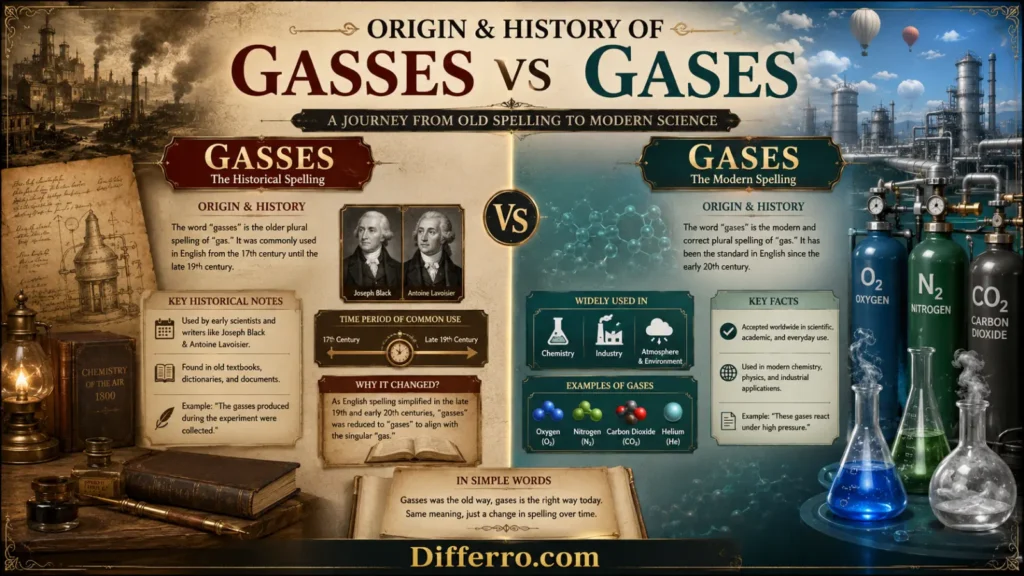
📜 Origin & History
The word gas entered English in the 17th century from Dutch and Greek roots. Scientists later created the plural form gases for scientific writing.
The word gasses appeared later as a verb form. English often adds “-es” to verbs ending in “s.”
Similar examples:
- Kiss → Kisses
- Pass → Passes
- Guess → Guesses
In modern English, gases became the standard plural noun used worldwide.
🇬🇧 British English vs American English Spelling
Both British English and American English use gases as the correct plural spelling. There is no major spelling difference between the two versions of English for this word.
The confusion mainly comes from grammar, not regional spelling rules. In both styles, gasses is generally treated as a verb.
Comparison Table: British vs American English
| English Style | Correct Plural |
|---|---|
| British English | Gases |
| American English | Gases |
| Australian English | Gases |
| Canadian English | Gases |
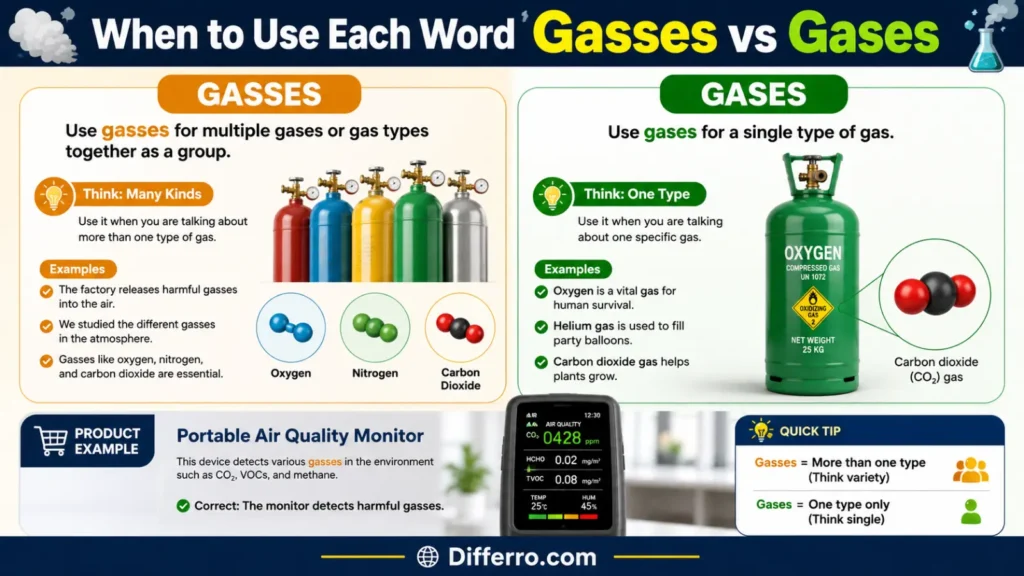
✍️ When to Use Each Word
Use “Gases” When:
Use gases when talking about multiple types of gas.
Examples:
- Scientists studied greenhouse gases.
- The balloon contains different gases.
Use “Gasses” When:
Use gasses as a verb describing gas emission.
Examples:
- The engine gasses heavily in cold weather.
- The material gasses under heat.
❌ Common Mistakes
| Incorrect Usage | Correct Usage |
|---|---|
| The lab tested dangerous gasses. | The lab tested dangerous gases. |
| Several gasses filled the room. | Several gases filled the room. |
| Oxygen and nitrogen are gasses. | Oxygen and nitrogen are gases. |
| The liquid gases quickly. | The liquid gasses quickly. |
🧠 Easy Trick to Remember
Remember this simple rule:
- Gases = plural noun
- Gasses = action verb
Think of it this way:
If you can replace the word with “many kinds of gas,” use gases.

📝 Write 5 Examples
1. Science Classroom Example
Students learned about greenhouse gases during chemistry class.
2. Factory Example
The machine gasses when pressure increases.
3. Environmental Example
Cars produce harmful gases every day.
4. Medical Example
Doctors monitor oxygen gases in hospitals.
5. Informal Speaking Example
My friend always gasses about football matches.
📈 Google Trends & Usage Data
In the USA, searches for gases are much higher because the word is common in science and education.
Meanwhile in the UK and Australia, users mostly search “gases” for academic and environmental topics.
In India and Pakistan, many people search “gasses or gases” to understand grammar and spelling differences.
Overall, gases is the globally preferred and correct plural spelling in modern English.
Comparison Table: Keyword Variations
| Keyword Variation | Search Intent |
|---|---|
| gasses or gases | Spelling confusion |
| gases meaning | Definition |
| plural of gas | Grammar help |
| gases vs gasses | Comparison |
| correct spelling of gases | Usage clarification |
✅ Final Verdict
Gases is the correct plural noun and should be used in most writing situations.
Gasses is only correct as a verb. It is far less common in daily writing.
If you are talking about more than one gas, always choose gases.
FAQs ,
Is “gasses” correct?
Yes, but mainly as a verb, not as a plural noun.
What is the difference between gasses and gases?
“Gases” is a plural noun, while “gasses” is a verb.
Which is more common: gases or gasses?
“Gases” is much more common in English writing.
Is gases formal English?
Yes. “Gases” is the standard formal spelling.
Why does the confusion exist?
The confusion happens because both words look similar but have different grammar roles.
Conclusion
The confusion between gasses or gases is easy to understand once you know the grammar rule. The word gases is the standard plural form of “gas” and is correct in almost all situations. It appears in science, education, environmental studies, and everyday communication.
Meanwhile, gasses is mainly used as a verb. It describes the action of releasing gas or speaking excessively in informal English. Because both words look nearly identical, many writers accidentally use the wrong one.
To avoid mistakes, remember this simple tip: if you mean more than one gas, always use gases. This small grammar detail can improve your writing accuracy and clarity.
Discover More Post ,
Payed Or Paid : Which Spelling Is Correct?
Lable Or Label : Which Spelling Is Correct?
Bougie Or Boujee Explained in Simple Words

Sara Taylor is a passionate writer and language enthusiast. She specializes in creating simple and easy-to-understand articles about English grammar, spelling differences, and commonly confused words. Her writing style focuses on helping students, writers, and English learners improve their language skills with confidence. Through informative guides and practical examples, Sara makes complex grammar topics easier for everyday readers.