
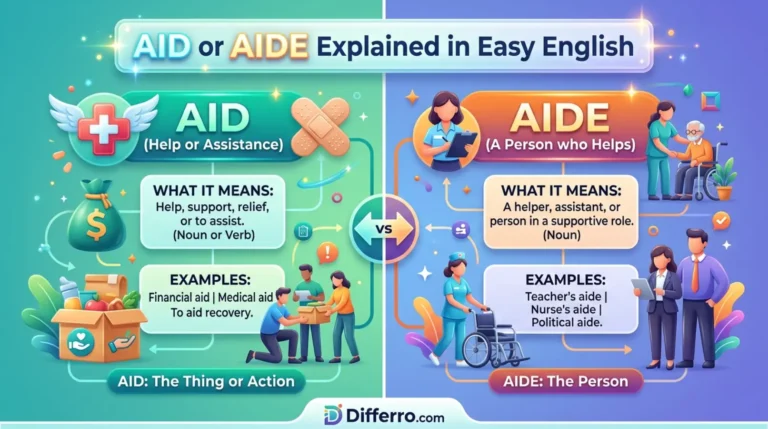
Aid or Aide is a common word confusion in English. Many people mix these two words because they sound almost the same. However, their meanings are different.
“Aid” usually refers to help, support, or assistance. “Aide” refers to a person who gives help, especially in a professional role. Even native English speakers sometimes use them incorrectly.
Understanding the difference is important for writing emails, school assignments, office documents, and daily communication. A small spelling mistake can change the meaning of your sentence.
In this guide, you will learn the meaning of each word, their differences, examples, memory tricks, and common mistakes. You will also see usage trends in different countries and discover when to use each word correctly.
⭐ Quick Answer
“Aid” means help or support. “Aide” means a person who gives help or assistance.
Example:
- The charity sent financial aid to families.
- The teacher’s aide helped students in class.
📘 Meaning of Aid
The word “aid” means help, assistance, or support. It can be used as both a noun and a verb.
Examples of Aid
- The government provided aid after the flood.
- Doctors worked quickly to aid injured people.
📘 Meaning of Aide
The word “aide” means an assistant or helper. It is usually used for a person with a support role.
Examples of Aide
- The president’s aide arranged the meeting.
- A classroom aide helped the children read.
📊 Key Differences Between Aid and Aide
| Feature | Aid | Aide |
|---|---|---|
| Meaning | Help or support | A person who helps |
| Part of Speech | Noun and verb | Noun only |
| Tone | General | Professional/job-related |
| Usage | Assistance, relief, support | Assistant, helper |
| Popularity | More common | Less common |
🕰️ Origin & History
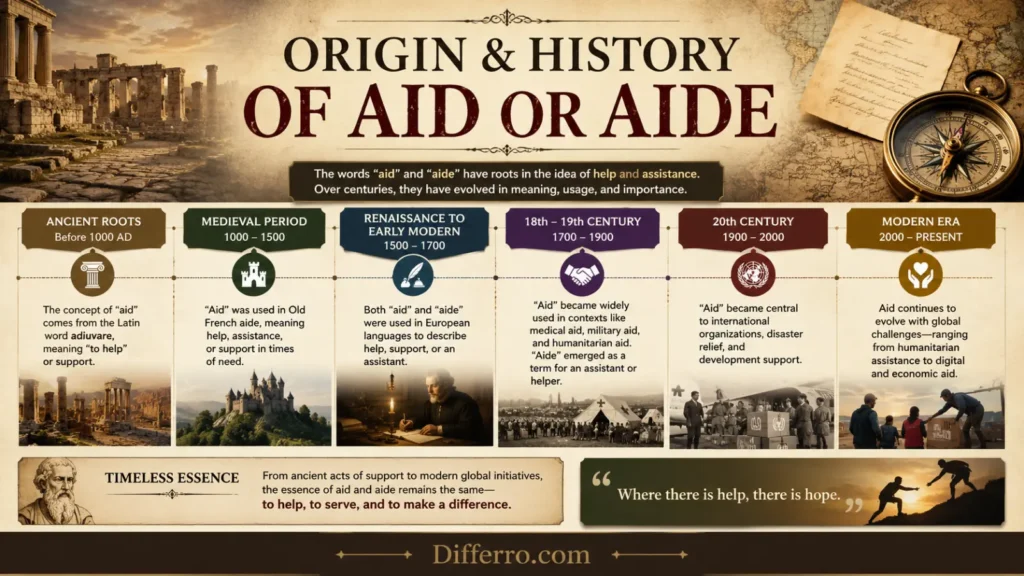
The word “aid” comes from Old French and Latin words meaning “help” or “support.” It has been used in English for centuries.
“Aide” developed later as a French-inspired spelling for a helper or assistant. It became popular in military and government settings.
Similar word pairs include:
- Advice vs Advise
- Practice vs Practise
- Principal vs Principle
🇬🇧 British English vs American English Spelling
Both British and American English use “aid” and “aide” with the same meanings. There is no major spelling difference between the two forms.
However, Americans use “aide” more often in politics and office jobs. British English sometimes prefers words like “assistant” instead.
Comparison Table: British vs American English
| Type | British English | American English |
|---|---|---|
| Help/support | Aid | Aid |
| Assistant/helper | Aide | Aide |
| Common office term | Assistant | Aide |
| Political usage | Less common | Very common |
✍️ When to Use Aid
Use “aid” when talking about help, support, relief, or assistance.
Examples
- The country received foreign aid.
- She used a walking aid after surgery.
- Volunteers aided the rescue team.
✍️ When to Use Aide
Use “aide” when referring to a person who helps another person professionally.
Examples
- The senator’s aide answered questions.
- A nurse aide cared for patients.
- The teacher hired an aide for the classroom.
❌ Common Mistakes
| Incorrect Usage | Correct Usage |
|---|---|
| The nurse aid helped patients. | The nurse aide helped patients. |
| The school gave aide to students. | The school gave aid to students. |
| He works as the president’s aid. | He works as the president’s aide. |
| International aide arrived quickly. | International aid arrived quickly. |
🧠 Easy Trick to Remember
- Aid = Assistance
- Aide = Employee/helper
Memory Tip:
“Aide” ends with “e,” just like “employee.”
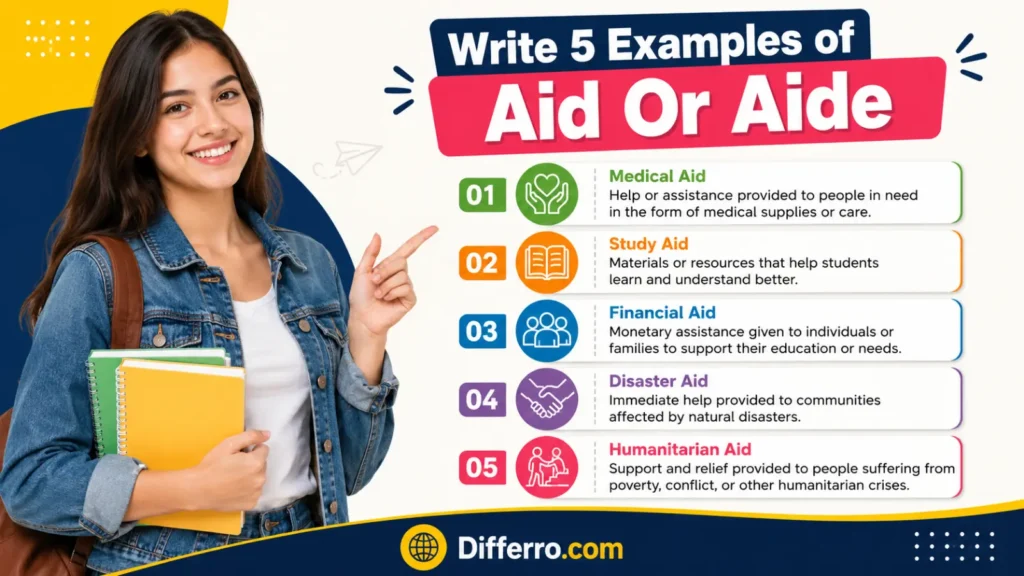
📝 Write 5 Examples
1. School Example
The school provided financial aid to students.
A classroom aide helped children complete homework.
2. Hospital Example
Doctors gave emergency aid after the accident.
A medical aide assisted nurses during treatment.
3. Office Example
The manager asked for technical aid.
His personal aide scheduled appointments.
4. Government Example
The country received disaster aid.
The minister’s aide spoke to reporters.
5. Home Example
She used a hearing aid at home.
The elderly man hired an aide for daily care.
🔍 Related Keywords
- Aid vs Aide
- Difference between aid and aide
- Aid meaning
- Aide meaning
- Aid or aide grammar
- Aid and aide examples
- Common English word confusion
📈 Google Trends & Usage Data
In the USA, “aid” gets far more searches because it is used in healthcare, education, and financial support topics.
Meanwhile in the UK, both words are searched regularly, but “aid” remains more common in news and charity discussions.
In Australia, searches for “aid” increase during natural disasters and emergency events.
In India and Pakistan, many users search “Aid Or Aide” because of grammar confusion and English learning needs.
Comparison Table: Keyword Variations
| Keyword Variation | Search Intent |
|---|---|
| Aid or aide | Word comparison |
| Aid meaning | Definition |
| Aide meaning | Definition |
| Difference between aid and aide | Grammar confusion |
| Aid vs aide examples | Learning usage |
| How to use aide | Writing help |
FAQs ,
Is “aid” correct?
Yes, “aid” is correct when talking about help or support.
What is the difference between aid and aide?
“Aid” means assistance. “Aide” means a helper or assistant.
Which word is more common?
“Aid” is much more common in daily English.
Is “aide” formal?
Yes, “aide” is commonly used in formal jobs and professional titles.
Why does the confusion exist?
The confusion exists because both words sound the same but have different meanings.
⚖️ Final Verdict
Use “aid” when talking about help, relief, or support. Use “aide” when referring to a person who helps someone professionally.
If you remember that “aide” is a helper and “aid” is assistance, you can avoid most mistakes easily.
📝 Conclusion
Understanding the difference between Aid Or Aide can improve your writing and communication. These words may sound identical, but their meanings are not the same.
“Aid” refers to help, support, or assistance. It can also work as a verb. “Aide” refers to a person who gives support in a professional role.
Using the correct word makes your sentences clearer and more professional. This is especially important in schools, workplaces, hospitals, and official writing.
A simple memory trick can help you remember the difference quickly. Practice using both words in daily sentences, and the confusion will disappear over time.
Discover More Post ,
Farther or Further : What’s the Real Difference ?
Gasses or gases : Which Word Should You Use?
Payed Or Paid : Which Spelling Is Correct?

Sara Taylor is a passionate writer and language enthusiast. She specializes in creating simple and easy-to-understand articles about English grammar, spelling differences, and commonly confused words. Her writing style focuses on helping students, writers, and English learners improve their language skills with confidence. Through informative guides and practical examples, Sara makes complex grammar topics easier for everyday readers.