
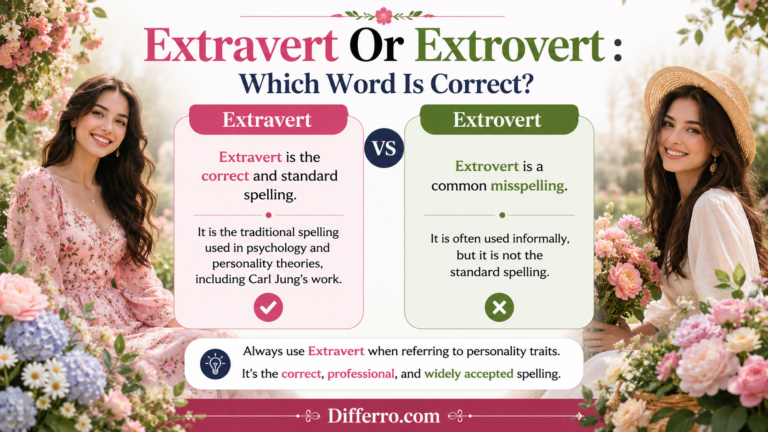
Extravert or extrovert is a common spelling confusion in English. Many people wonder which word is correct and which one they should use in writing. The good news is that both words are correct. However, they have slightly different histories and usage patterns.
The confusion started because psychologists and dictionaries used different spellings over time. Today, “extrovert” is more popular in everyday English. On the other hand, “extravert” appears more often in psychology and academic writing.
Both words describe a person who enjoys social interaction and gains energy from being around others. Still, choosing the right spelling can improve clarity and professionalism in your writing.
This guide explains the meaning, differences, history, usage, and examples of both words in simple language.
Quick Answer
Both extravert and extrovert are correct spellings. They describe a social and outgoing person who enjoys being around others. “Extrovert” is more common in everyday English, while “extravert” is often used in psychology.
Example:
- She is an extrovert who loves parties.
- Carl Jung originally used the term extravert in psychology.
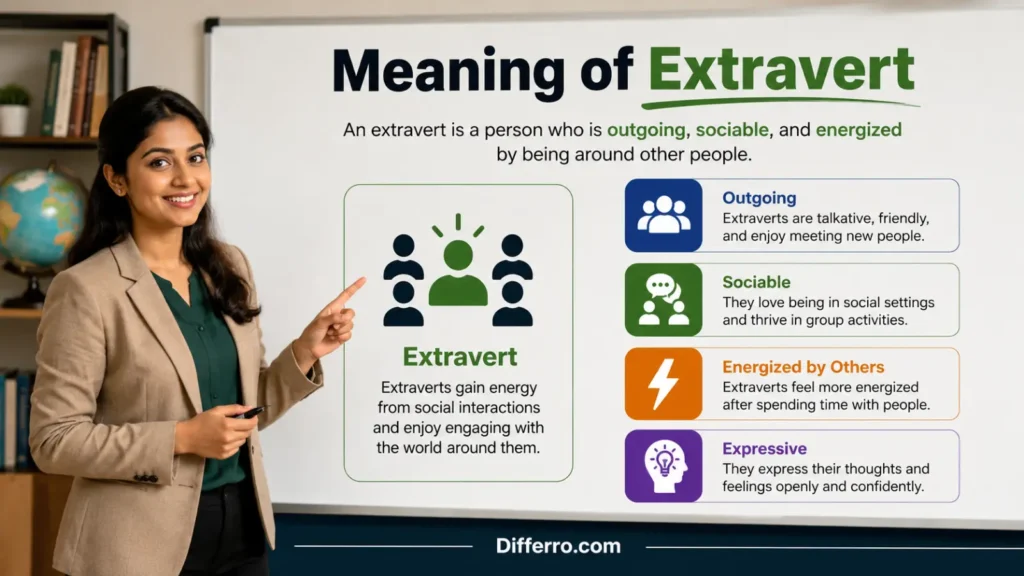
Meaning of Extravert 📘
An extravert is a person who feels energized by social activities and enjoys interacting with others.
Examples:
- Maria is an extravert who enjoys group discussions.
- Most extraverts prefer teamwork over working alone.

Meaning of Extrovert 📗
An extrovert also refers to a friendly and outgoing person who likes social settings.
Examples:
- Jake is an extrovert who talks to everyone.
- Many extroverts enjoy public speaking.
Key Differences Between Extravert And Extrovert 🔍
| Feature | Extravert | Extrovert |
|---|---|---|
| Meaning | Outgoing person | Outgoing person |
| Tone | Academic/Psychology | Everyday English |
| Usage | Less common | More common |
| Popularity | Lower | Higher |
| Origin | Original spelling | Adapted spelling |
Origin & History 🕰️
The word extravert came from the Latin prefix “extra,” meaning “outside.” Swiss psychologist Carl Jung introduced the term in personality theory.
Later, English speakers started using extrovert because it sounded more natural. Over time, dictionaries accepted both spellings.
Similar Word Examples:
- Inward → Introvert
- Outward → Extrovert
- External → Exterior
British English vs American English Spelling 🌍
Both British and American English accept extravert and extrovert. However, “extrovert” appears more often in modern writing and media.
Psychology books may still prefer “extravert” because it follows the original Latin root. Everyday communication usually favors “extrovert.”
Comparison Table: British vs American English
| English Style | Preferred Usage |
|---|---|
| British English | Extrovert |
| American English | Extrovert |
| Academic Psychology | Extravert |
| Casual Writing | Extrovert |
When to Use Extravert ✍️
Use extravert in:
- Psychology discussions
- Academic papers
- Personality theory writing
Examples:
- The study focused on highly social extraverts.
- Jung described the behavior of an extravert.
When to Use Extrovert ✍️
Use extrovert in:
- Everyday writing
- Blogs and articles
- Casual conversations
Examples:
- Sarah is an extrovert who enjoys meeting new people.
- Most people describe him as an extrovert.
Common Mistakes ❌
| Incorrect Usage | Correct Usage |
|---|---|
| He is a extravert. | He is an extravert. |
| She acts like introvert and extrovert. | She acts like an introvert and an extrovert. |
| Extrovert is the only correct spelling. | Both spellings are correct. |
| Extravert means shy person. | Extravert means outgoing person. |
Easy Trick to Remember 🧩
- Extravert = “extra” energy from people.
- Extrovert = common modern spelling used in daily English.
If you write casually, choose extrovert.
If you write academically, choose extravert.
Write 5 Examples 📝
1. School Discussion Example
The teacher called Ali an extrovert because he always joined class discussions.
2. Workplace Example
An extravert may enjoy teamwork and presentations more than solo tasks.
3. Friendship Example
My best friend is an extrovert who loves meeting new people.
4. Psychology Example
The professor explained how an extravert gains energy from social interaction.
5. Party Example
Every party needs at least one cheerful extrovert to keep conversations active.
Related Keywords 🔑
- extravert vs extrovert
- extrovert meaning
- extravert meaning
- introvert vs extrovert
- outgoing personality
- extrovert personality traits
- psychology personality types
Final Verdict ✅
Both extravert and extrovert are correct spellings. The meaning stays the same in most situations.
Choose:
- Extrovert for everyday writing and communication
- Extravert for psychology and academic contexts
Since “extrovert” is more common, most readers recognize it faster.
Google Trends & Usage Data 📈
In the USA, “extrovert” receives far more searches because it is common in personality discussions and self-help content.
Meanwhile, the UK and Australia use both spellings, although “extrovert” still dominates online searches.
In India and Pakistan, many searches come from English learners comparing the two spellings.
Overall, “extrovert” has stronger global popularity because it appears more in modern media and social content.
Comparison Table: Keyword Variations
| Keyword Variation | Popularity |
|---|---|
| Extrovert | Very High |
| Extravert | Medium |
| Introvert vs Extrovert | High |
| Extrovert Meaning | High |
| Extravert Meaning | Medium |
FAQs ,
Is extravert correct?
Yes, “extravert” is a correct spelling.
What is the difference between extravert and extrovert?
There is no major meaning difference. The variation mainly comes from spelling and usage style.
Which is more common?
“Extrovert” is more common in modern English.
Which spelling is formal?
“Extravert” is often preferred in psychology and academic writing.
Why does the confusion exist?
The confusion exists because the original psychological term changed over time in common English usage.
Conclusion 🏁
Extravert or extrovert is a spelling difference that often confuses English learners and writers. Both words describe an outgoing person who enjoys social interaction and gains energy from being around others. The main difference comes from usage style rather than meaning.
“Extravert” follows the original psychological spelling introduced by Carl Jung. “Extrovert” became more popular in modern English because it sounds more natural to many speakers.
In casual writing, “extrovert” works best because readers recognize it easily. In academic or psychology-related content, “extravert” may sound more precise. Understanding both spellings helps you write with confidence and avoid common mistakes.
Discover More Post ,
Grill Or Grille : What’s the Real Difference?
Infeasible or unfeasible Explained Simply
Site Or Cite : Simple English Guide for Writers

Sara Taylor is a passionate writer and language enthusiast. She specializes in creating simple and easy-to-understand articles about English grammar, spelling differences, and commonly confused words. Her writing style focuses on helping students, writers, and English learners improve their language skills with confidence. Through informative guides and practical examples, Sara makes complex grammar topics easier for everyday readers.