

W-2 vs 1099 is a common comparison for people choosing between employee jobs and independent contractor work. Both options let you earn money, but they come with different responsibilities. A W-2 worker usually works as an employee for a company. A 1099 worker generally operates as an independent contractor or self-employed individual.
The biggest differences involve taxes, benefits, job security, and control over your work. Employers usually withhold income taxes and payroll taxes from employee paychecks. Independent contractors generally handle their own tax payments and business expenses. Employees may receive health insurance, paid leave, and retirement benefits. Contractors usually need to arrange these benefits themselves.
Neither option suits everyone. Your best choice depends on your income, expenses, work preferences, and financial goals. Understanding W-2 and 1099 work can help you compare job offers, estimate your take-home pay, and avoid costly tax mistakes.
⭐ Quick Answer
W-2 means employee work, while 1099 generally refers to independent contractor work in the United States. W-2 employers handle payroll withholding, while 1099 contractors generally manage their own taxes and expenses.
Example: A company employee receives a W-2. A freelance graphic designer working as an independent contractor may receive Form 1099-NEC.
💼 Meaning of W-2
A W-2 is a tax form that employers use to report an employee’s annual wages and taxes withheld. People often use “W-2” as shorthand for traditional employment.
W-2 employees typically work under an employer’s direction. The employer generally withholds federal income tax, Social Security tax, and Medicare tax from their paychecks.
Employees may also qualify for employer-sponsored benefits. These can include health insurance, retirement contributions, paid holidays, and sick leave.
Examples of W-2 Employment
Example 1: Sarah works full-time for a hospital. The hospital pays her every two weeks and withholds payroll taxes. At year-end, it provides her with a W-2.
Example 2: James works as a store manager. His employer controls his schedule, pays his salary, and provides an employee benefits package. He receives a W-2 for tax reporting.
🧾 Meaning of 1099
A 1099 is a family of tax forms used to report certain payments and other financial information. People often use “1099” to describe independent contractor or self-employed work.
Businesses may issue Form 1099-NEC to report qualifying payments for nonemployee services. Contractors generally report their business income and eligible expenses on their tax returns.
Independent contractors often have more control over how they complete their work. However, the business relationship determines their actual classification, not just the form they receive.
Examples of 1099 Work
Example 1: Michael runs a freelance writing business. Several companies pay him for articles, and a client issues Form 1099-NEC when reporting rules require it.
Example 2: Lisa operates an independent consulting business. She invoices clients, pays eligible business expenses, and handles her own tax obligations.
🔍 W2 or 1099: Key Differences
| Feature | W-2 Employee | 1099 Independent Contractor |
|---|---|---|
| Work status | Employee | Generally self-employed or an independent contractor |
| Tax reporting | Employer reports wages on Form W-2 | Businesses may report payments on Form 1099-NEC |
| Tax withholding | Employer generally withholds payroll taxes | Contractor generally handles tax payments |
| Social Security and Medicare | Employee and employer share payroll tax responsibilities | Contractor generally pays self-employment tax |
| Benefits | May receive employer benefits | Usually arranges benefits independently |
| Work control | Employer typically directs the work | Contractor generally controls how the work is performed |
| Business expenses | Employee deductions are limited under federal law | Eligible business expenses may be deductible |
| Income pattern | Often regular wages or salary | May vary by client or project |
| Job protection | May qualify for employee protections | Usually has fewer employee-specific protections |
| Tax paperwork | Receives Form W-2 | May receive Form 1099-NEC or other applicable forms |
The exact rules depend on the working relationship, applicable laws, and tax circumstances. Not every employee receives benefits, and not every contractor receives a 1099 form.
📚 Origin and History of W-2 and 1099
The W-2 vs 1099 forms belong to the United States tax reporting system. Employers use Form W-2 to report employee wages and withholding. The IRS uses different 1099 forms to track specific types of payments and income.
Form 1099-NEC reports qualifying nonemployee compensation. Other 1099 forms cover payments such as interest, dividends, and certain miscellaneous income.
These forms do not automatically determine whether someone qualifies as an employee or contractor. The actual work relationship and applicable classification rules matter.
Similar Tax Terms
- W-2: Reports employee wages and tax withholding.
- 1099-NEC: Reports qualifying nonemployee compensation.
- 1099-MISC: Reports certain other types of payments.
- W-4: Helps an employer determine employee income tax withholding.
- W-9: Provides a taxpayer’s identification information to a requesting business.
🇺🇸 British English vs American English
W-2 vs 1099 are United States tax terms, not British or American spelling variations.
British English generally uses different employment and tax terminology, including PAYE for Pay As You Earn.
The forms and rules discussed here primarily apply to US tax reporting.
British vs American English Comparison
| Feature | British English | American English |
|---|---|---|
| Main employee tax system | PAYE | Federal income tax withholding and payroll taxes |
| Employee wage statement | P60 and other relevant documents | Form W-2 |
| Independent contractor terminology | Self-employed or contractor | Independent contractor or 1099 worker |
| Common tax reporting system | UK tax rules | US tax rules |
| W-2 or 1099 usage | Not standard UK tax forms | Standard US tax form terminology |
👔 When to Choose W-2 Employment
W-2 employment may suit people who value predictable income, employer support, and a more traditional work arrangement.
Consider W-2 work if you want:
- Regular paychecks and payroll tax withholding
- Potential access to employer-sponsored health insurance
- Possible paid vacation and sick leave
- Employer contributions to a retirement plan
- A clearer separation between personal and business finances
- An employer who manages payroll administration
These benefits depend on the employer and your eligibility. US law does not require every employer to offer every benefit.
Example of When W-2 Makes Sense
You receive a full-time job offer with a steady salary, health insurance, and paid leave. You prefer predictable income and do not want to manage business taxes.
A W-2 position may fit your needs better than independent contracting.
🧑💻 When to Choose 1099 Contract Work
Independent contracting may suit people who want more control over their work and business decisions.
Consider 1099 work if you want:
- Greater control over how you complete projects
- The ability to serve multiple clients
- Opportunities to build an independent business
- Potential deductions for eligible business expenses
- Flexible project arrangements
- The possibility of earning more through specialized services
However, contractors must account for taxes, insurance, retirement savings, unpaid leave, and periods without work.
Example of When 1099 Makes Sense
You run a web design business and serve several clients. You set project rates, manage your schedule, and pay your own business expenses.
Independent contracting may offer the flexibility you want, provided you plan for taxes and changing income.
⚠️ Common Mistakes When Comparing W2 or 1099
Mistake 1: Thinking 1099 Means Tax-Free Income
Incorrect: A contractor does not pay taxes because no employer withholds them.
Correct: Contractors generally must report taxable income and may need to pay estimated taxes and self-employment tax.
Mistake 2: Assuming Every 1099 Worker Is Properly Classified
Incorrect: A company can classify any worker as a contractor by issuing Form 1099.
Correct: The actual relationship determines worker classification under applicable rules. A form alone does not settle the question.
Mistake 3: Comparing Gross Pay Instead of Take-Home Pay
Incorrect: A $60,000 contractor offer always beats a $55,000 employee salary.
Correct: Compare taxes, business expenses, insurance, retirement contributions, unpaid leave, and other benefits before deciding.
Mistake 4: Assuming All W-2 Jobs Include Benefits
Incorrect: Every W-2 employee receives health insurance and paid vacation.
Correct: Benefits depend on the employer, employment terms, and applicable law.
Mistake 5: Assuming Contractors Always Earn More
Incorrect: Every 1099 position pays better than a W-2 job.
Correct: Contractors may charge higher rates, but they also cover expenses and manage periods without paid work.
Mistake 6: Confusing Form 1099 With One Specific Form
Incorrect: Every person who receives a 1099 receives Form 1099-NEC.
Correct: The IRS uses different 1099 forms for different types of payments. The correct form depends on the payment and reporting rules.
🧠 Easy Trick to Remember W2 or 1099
Use this simple memory trick:
- W-2 = Worker on payroll. An employer generally withholds payroll taxes and reports wages.
- 1099 = Independent income reporting. A business may report qualifying contractor payments, while the contractor manages tax obligations.
Remember that 1099 is a family of tax forms. Receiving a particular form does not automatically establish your legal work status.
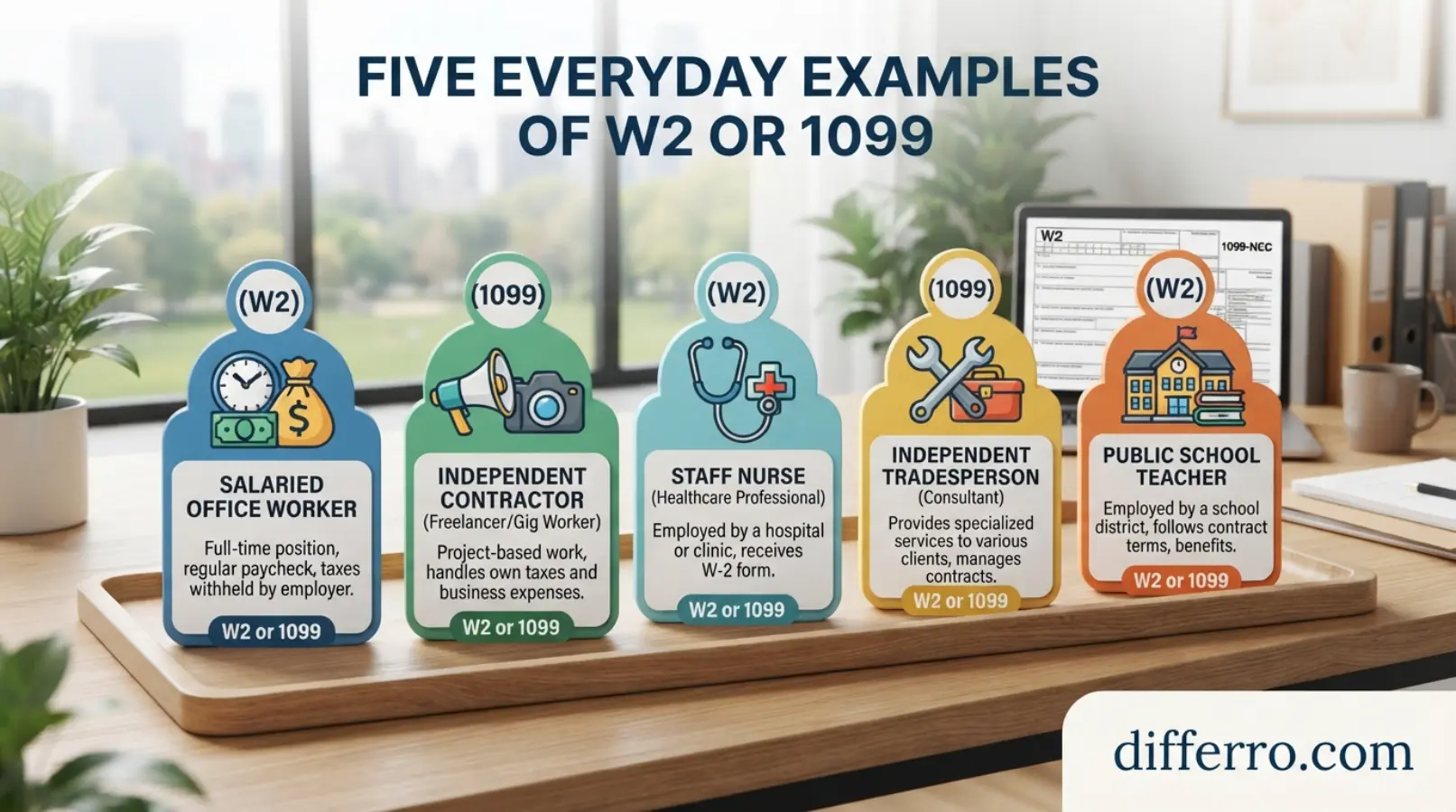
🌟 Five Everyday Examples of W2 or 1099
1. A Full-Time Office Employee
Emma works in an office under her manager’s direction. Her employer pays her salary and withholds applicable taxes.
Likely arrangement: W-2 employment.
2. A Freelance Content Writer
Noah writes articles for several businesses. He negotiates project rates, invoices clients, and manages his expenses.
Likely arrangement: Independent contracting, with Form 1099-NEC possible when reporting rules apply.
3. A Delivery Worker
A delivery worker receives payments through a platform. The correct classification depends on the actual work arrangement and applicable law.
Possible arrangement: W-2 employment or independent contracting, depending on the circumstances.
4. A Business Consultant
Olivia operates a consulting business and advises several companies. She controls her business operations and bills clients for her services.
Likely arrangement: Independent contracting, if the actual relationship supports that classification.
5. A Part-Time Retail Worker
Ethan works scheduled shifts at a store. The employer directs his duties and processes his wages through payroll.
Likely arrangement: W-2 employment, even though he works part-time.
🌍 Google Trends and Search Interest in Five Countries
Google Trends shows relative search interest rather than exact search volume. Without live comparison data, country-specific rankings cannot be verified.
- USA: W-2 versus 1099 searches directly relate to US employment, tax obligations, and contractor decisions.
- UK: Searchers may encounter these terms when researching American jobs or working with US companies.
- Australia: Interest may relate to US contracting opportunities and international remote work.
- India: Freelancers and remote workers may compare these forms when serving US clients.
- Pakistan: Remote professionals may search these terms when evaluating US-based contracts and payment arrangements.
SEO insight: The strongest direct intent is likely US-focused because these are US tax forms. Treat the other country observations as possible search intents, not verified trend rankings.
Comparison Table: Keyword Variations
| Keyword variation | Search intent | Suggested section |
|---|---|---|
| W2 or 1099 | General comparison | Introduction |
| W-2 vs 1099 | Direct comparison | Key differences |
| W-2 vs 1099 taxes | Tax obligations | Meaning and differences |
| W2 employee vs 1099 contractor | Worker classification | Definitions |
| W-2 or 1099 which pays more | Income comparison | Choosing each option |
| 1099 self-employment tax | Tax planning | Contractor section |
| W-2 benefits vs 1099 benefits | Benefits comparison | Final verdict |
❓ Frequently Asked Questions
1. Is “W2 or 1099” correct?
Yes. “W2 or 1099” is a common informal search phrase. The standard written forms are W-2 and 1099.
2. What is the difference between W-2 and 1099?
A W-2 reports employee wages and tax withholding. A 1099 form reports certain types of payments or income. People commonly use “1099” to refer to independent contractor work.
3. Which is more common, W-2 or 1099?
W-2 forms cover employee wages, while different 1099 forms cover several types of payments. Their prevalence depends on the population and reporting category. A precise comparison requires current, comparable data.
4. Should I use W-2 or 1099 in formal writing?
➤Use Form W-2 when discussing employee wage reporting. Use the specific 1099 form name, such as Form 1099-NEC, when discussing nonemployee compensation. Use “independent contractor” when describing the work relationship.
5. Why do people confuse W-2 and 1099?
Both forms relate to income reporting in the United States. However, they serve different purposes. People also confuse tax forms with worker classification, even though the actual work relationship determines classification.
🏆 Final Verdict: Which Is Better?
Neither W-2 nor 1099 is automatically better for everyone. W-2 employment may suit people who value steady pay, payroll withholding, and potential employer benefits. Independent contracting may suit people who want business flexibility, multiple clients, and greater control over their work.
Before accepting an offer, compare total compensation rather than gross income alone. Include taxes, insurance, retirement savings, unpaid time off, and business expenses. Also consider the reliability of the work and the responsibilities each arrangement creates.
Remember that US worker classification depends on the actual relationship, not simply the tax form a business issues. Choose the arrangement that fits your financial needs, work preferences, and legal circumstances.
Conclusion
W2 or 1099 describes two common ways people earn income in the United States. W-2 employees work for employers who generally handle payroll withholding and report their wages. Independent contractors manage their own business income and tax obligations, while clients may report qualifying payments on Form 1099-NEC.
W-2 employment may offer more predictable pay and access to employer benefits. Contract work may offer greater flexibility and opportunities to serve multiple clients. However, contractors must plan for taxes, insurance, retirement, and unpaid time off.
Compare the complete financial picture before choosing either option. Check the actual job arrangement, tax responsibilities, and benefits. Neither form alone determines worker classification. The best choice depends on your goals, expenses, and individual circumstances.

Imran Lodhra is a comparison-focused content writer at Differro.com.
He specializes in creating clear, simple, and informative comparison articles.
His work helps readers understand key differences, pros and cons, and important details.
Imran focuses on accurate, practical, and easy-to-read content for everyday readers.
1 thought on “W-2 vs 1099: Which Is Better for You?”