
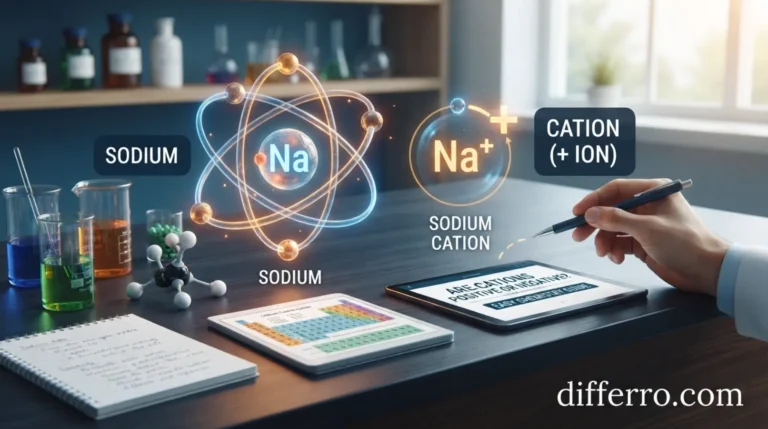
Are cations positive or negative? Cations carry a positive electrical charge because they lose one or more electrons. This basic chemistry concept helps explain how atoms form ions and how chemical reactions work.
Students often confuse cations with anions because both are electrically charged particles. However, these ions have opposite charges. A cation forms when an atom loses electrons, while an anion forms when an atom gains electrons. Understanding this difference makes chemistry easier to learn.
Cations play important roles in everyday life, from body functions to batteries and chemical compounds. Sodium, potassium, calcium, and magnesium form positive ions. These ions help support nerve signals, muscle movement, and many other processes. Learning how cations form also helps you understand ionic bonding and the periodic table. This guide explains cations, anions, their differences, and simple examples you can remember.
⭐ Quick Answer
Cations are positive ions. They form when atoms or molecules lose one or more electrons. Anions are negative ions because they gain electrons.
Example: A sodium atom loses one electron and forms a positive sodium ion, Na⁺.
🔬 Meaning of Cations
A cation is an atom or group of atoms with a positive electrical charge. It forms when an atom or molecule loses more electrons than it gains.
Electrons carry negative charges. When an atom loses negatively charged electrons, its remaining protons create a net positive charge.
Examples of Cations
Example 1: Sodium ion (Na⁺)
A sodium atom loses one electron and forms Na⁺. The ion carries a positive charge of +1.
Example 2: Calcium ion (Ca²⁺)
A calcium atom loses two electrons and forms Ca²⁺. The ion carries a positive charge of +2.
Other common cations include K⁺, Mg²⁺, and Al³⁺.
🔬 Meaning of Anions
An anion is an atom or group of atoms with a negative electrical charge. It forms when an atom or molecule gains more electrons than it loses.
Electrons carry negative charges. When an atom gains extra electrons, its negative charges exceed its positive charges.
Examples of Anions
Example 1: Chloride ion (Cl⁻)
A chlorine atom gains one electron and forms Cl⁻. The ion carries a negative charge of −1.
Example 2: Oxide ion (O²⁻)
An oxygen atom gains two electrons and forms O²⁻. The ion carries a negative charge of −2.
Other common anions include F⁻, S²⁻, and OH⁻.
📊 Are Cations Positive or Negative? Key Differences
Cations and anions have opposite charges, but both are ions.
| Feature | Cations | Anions |
|---|---|---|
| Meaning | Positively charged ions | Negatively charged ions |
| Electrical charge | Positive (+) | Negative (−) |
| Electron behavior | Lose electrons when forming from neutral atoms | Gain electrons when forming from neutral atoms |
| Proton-electron balance | More protons than electrons | More electrons than protons |
| Examples | Na⁺, Ca²⁺, Al³⁺ | Cl⁻, O²⁻, F⁻ |
| Chemical behavior | Attracted to negative charges | Attracted to positive charges |
| Common role | Form positive components of ionic compounds | Form negative components of ionic compounds |
Important: Cations are positive, and anions are negative. Neither term describes an electrically neutral atom.
🕰️ Origin and History of Cations and Anions
The word ion comes from a Greek word meaning “going.” English scientist Michael Faraday introduced the term into scientific use during the 1830s.
Faraday used the terms cation and anion to describe ions moving toward opposite electrodes during electrolysis. A cation moves toward the cathode, while an anion moves toward the anode.
These terms remain important in chemistry today.
Similar Chemistry Terms
- Cation: A positively charged ion.
- Anion: A negatively charged ion.
- Atom: The smallest unit of an element that retains its chemical identity.
- Electron: A negatively charged subatomic particle.
- Proton: A positively charged subatomic particle.
- Ion: An atom or group of atoms with a net electrical charge.
🇬🇧 British English vs American English Spelling
The words cation and anion have the same spelling in British and American English.
Both countries use the same scientific definitions and chemical symbols.
Differences may appear in related words, such as ionisation in British English and ionization in American English.
British vs American English Comparison
| Feature | British English | American English |
|---|---|---|
| Cation | Cation | Cation |
| Anion | Anion | Anion |
| Ion | Ion | Ion |
| Ionisation | Ionisation | Ionization |
| Chemical meaning | Same | Same |
⚗️ When to Use the Term Cation
Use cation when discussing a positively charged ion in chemistry.
A cation forms when an atom or molecule loses electrons or otherwise develops a net positive charge.
Examples of Cations in Chemistry
- Sodium forms Na⁺ after losing one electron.
- Magnesium forms Mg²⁺ after losing two electrons.
- Aluminum forms Al³⁺ after losing three electrons.
- Ammonium, NH₄⁺, is a positively charged polyatomic ion.
Cations also appear in ionic compounds. For example, sodium chloride contains Na⁺ and Cl⁻ ions.
Remember that cations do not always contain only one atom. Groups of atoms can also carry positive charges.
⚗️ When to Use the Term Anion
Use anion when discussing a negatively charged ion.
An anion forms when an atom gains electrons or when a molecule develops a net negative charge.
Examples of Anions in Chemistry
- Chlorine forms Cl⁻ after gaining one electron.
- Oxygen forms O²⁻ after gaining two electrons.
- Fluorine forms F⁻ after gaining one electron.
- Hydroxide, OH⁻, is a negatively charged polyatomic ion.
Anions combine with cations to form many ionic compounds. Their charges balance in the overall formula of a neutral compound.
For example, magnesium chloride contains one Mg²⁺ ion for every two Cl⁻ ions in its simplest formula unit.
❌ Common Mistakes About Cations and Anions
Mistake 1: Thinking Cations Are Negative
Incorrect: Cations carry negative charges.
Correct: Cations carry positive charges because they have fewer electrons than protons.
Mistake 2: Thinking Anions Are Positive
Incorrect: Anions form when atoms lose electrons and become positive.
Correct: Anions carry negative charges because they have more electrons than protons.
Mistake 3: Confusing Electron Loss With Negative Charge
Incorrect: An atom becomes negative when it loses electrons.
Correct: Losing negatively charged electrons makes an atom more positive.
Mistake 4: Assuming All Ions Have a Charge of One
Incorrect: Every cation has a +1 charge, and every anion has a −1 charge.
Correct: Ions can carry different charges. Examples include Ca²⁺, Al³⁺, O²⁻, and N³⁻.
Mistake 5: Confusing Cations With Cathodes
Incorrect: A cation and a cathode mean the same thing.
Correct: A cation is a positively charged ion. A cathode is an electrode where reduction occurs.
Mistake 6: Assuming Every Atom Is an Ion
Incorrect: All atoms carry electrical charges.
Correct: Neutral atoms have equal numbers of protons and electrons. Ions have a net electrical charge.
🧠 Easy Trick to Remember
Use this simple memory trick:
CATions are PAWsitive!
Think of a cat’s paws and remember that cations carry positive charges.
For anions, remember that they carry negative charges.
You can also remember the electron rule:
- Lose electrons = positive cation.
- Gain electrons = negative anion.
This rule works because electrons carry negative electrical charges.
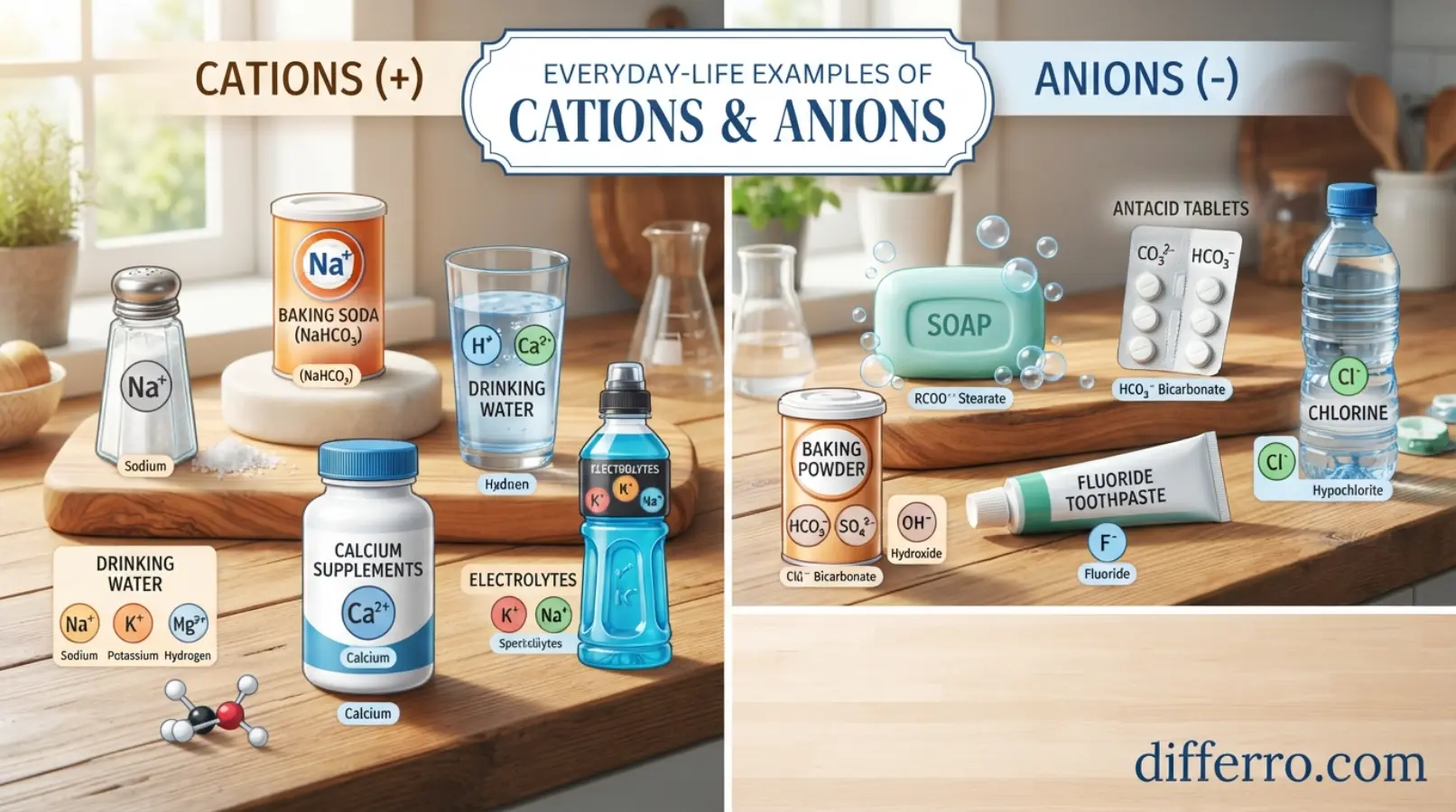
🌍 Everyday-Life Examples of Cations and Anions
1. Sodium in Table Salt
Table salt contains sodium ions (Na⁺) and chloride ions (Cl⁻). Sodium forms a cation, while chloride forms an anion.
This example shows how positive and negative ions combine to form an electrically neutral compound.
2. Potassium in the Human Body
➤Potassium ions (K⁺) help regulate nerve signals, muscle contractions, and fluid balance. Potassium is a common example of a cation in biological systems.
The body also uses other ions to maintain normal functions.
3. Calcium in Bones and Teeth
➤Calcium ions (Ca²⁺) play important roles in bone structure, muscle movement, and cell signaling. Calcium carries a positive charge because it has lost two electrons when forming from a neutral calcium atom.
4. Batteries and Electrical Energy
Many batteries rely on the movement of ions through an electrolyte. Cations and anions help maintain charge balance as electrochemical reactions occur.
The exact ion movements depend on the battery’s chemistry and design.
5. Fertilizers and Plant Nutrition
Plants absorb essential nutrients as ions from soil or nutrient solutions. Examples include positive potassium ions (K⁺) and negative nitrate ions (NO₃⁻).
Both cations and anions help plants obtain the nutrients they need for growth.
🌎 Google Trends and Usage Insights: Five Countries
Google Trends reports relative search interest rather than exact search volumes. Without checking live data, country-specific rankings for these terms cannot be verified.
- USA: Searches may focus on cations, anions, and introductory chemistry questions.
- UK: Students may search for ion charges, electron transfer, and chemistry revision.
- Australia: Educational searches may include ion formation and ionic bonding.
- India: Searches may focus on cation-anion differences and school chemistry examples.
- Pakistan: Students may search for positive ions, negative ions, and examination preparation.
SEO insight: These observations describe likely educational search intent, not verified Google Trends results. Compare the exact keyword with related phrases using the same date range and country filters. This can help identify which wording attracts more relative interest.
Comparison Table: Keyword Variations
| Keyword variation | Search intent | Suggested use |
|---|---|---|
| Are cations positive or negative | Direct factual question | H1 and introduction |
| Cation vs anion | Comparison | Key differences section |
| Difference between cations and anions | Educational explanation | Main comparison section |
| Examples of cations and anions | Learning through examples | Examples section |
| How do cations form | Chemistry concept | Cation meaning section |
| Why are cations positive | Concept clarification | FAQ section |
| Positive and negative ions | General educational search | Introduction and related headings |
❓ Frequently Asked Questions
1. Are cations positive or negative?
Cations are positive ions. They form when atoms or molecules lose electrons or otherwise develop a net positive electrical charge.
2. What is the difference between a cation and an anion?
A cation carries a positive charge, while an anion carries a negative charge. Cations have more protons than electrons, while anions have more electrons than protons.
3. Which is more common, cations or anions?
Neither type is universally more common. Their abundance depends on the substance and environment. Many ionic compounds contain both cations and anions to maintain electrical neutrality.
4. Is the term cation appropriate for formal scientific writing?
Yes. Cation is the standard scientific term for a positively charged ion. Students, teachers, researchers, and textbooks use it in chemistry.
5. Why do people confuse cations and anions?
Both terms describe electrically charged ions, and their names sound similar. Remembering that cations are positive and anions are negative helps prevent confusion.
✅ Final Verdict: Are Cations Positive or Negative?
Cations are positive, while anions are negative. The difference comes from how electrons affect an atom’s overall electrical charge.
When an atom loses electrons, it loses negative charge and becomes a cation. When an atom gains electrons, it gains negative charge and becomes an anion.
For example, sodium forms Na⁺, while chlorine forms Cl⁻. These ions can combine to form sodium chloride, a common ionic compound.
Remember the simple rule: losing electrons produces a positive charge, while gaining electrons produces a negative charge. This concept helps explain ion formation, chemical bonding, and many important reactions. Once you understand this rule, distinguishing cations from anions becomes much easier.
Conclusion
Are cations positive or negative? Cations are positively charged ions, while anions carry negative charges. This distinction is one of the most important concepts in basic chemistry.
Cations form when atoms or molecules lose electrons or develop a net positive charge. Anions form when they gain electrons or develop a net negative charge. Sodium (Na⁺), calcium (Ca²⁺), chloride (Cl⁻), and oxide (O²⁻) provide simple examples.
Both types of ions play important roles in ionic compounds, batteries, biological processes, and plant nutrition. You can remember the difference with one simple rule: losing electrons makes an ion more positive, while gaining electrons makes it more negative.
Understanding this rule makes chemical formulas, ionic bonding, and other chemistry topics easier to learn.

Imran Lodhra is a comparison-focused content writer at Differro.com.
He specializes in creating clear, simple, and informative comparison articles.
His work helps readers understand key differences, pros and cons, and important details.
Imran focuses on accurate, practical, and easy-to-read content for everyday readers.
1 thought on “Are Cations Positive or Negative? Easy Chemistry Guide”