
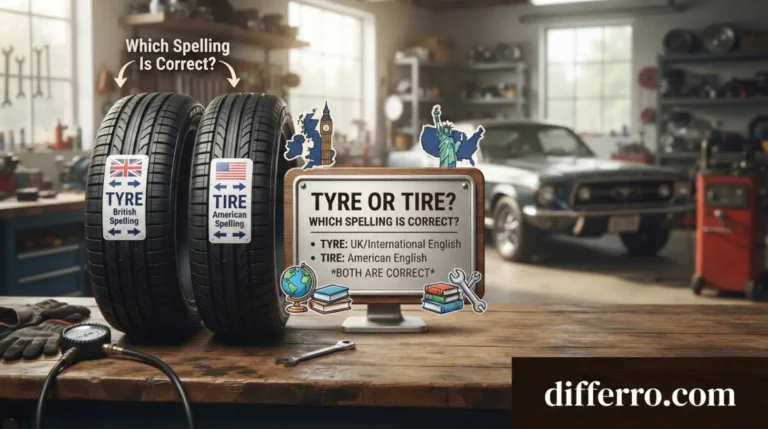
Tyre or tire is a common spelling confusion for people learning English. Both spellings are correct, but their usage depends on the country. British English uses tyre for the rubber covering around a vehicle’s wheel. American English uses tire for the same object. Both words have the same meaning and pronunciation in this context.
This difference often confuses writers, students, bloggers, and people who write about cars. For example, someone in the United Kingdom may search for car tyres, while someone in the United States searches for car tires. Neither spelling is wrong when used in the appropriate regional variety of English. However, choosing the right spelling helps your writing look natural and professional. In this guide, you’ll learn the meanings, origins, differences, common mistakes, and everyday uses of tyre and tire. You’ll also discover which spelling works best for your audience and SEO strategy.
⭐ Quick Answer
Tyre is the standard British English spelling, while tire is the standard American English spelling for the rubber covering around a vehicle’s wheel.
Example: British English: “I need new tyres.” American English: “I need new tires.”
🔎 Meaning of Tyre
Tyre is a noun that describes the rubber covering fitted around a vehicle’s wheel. It helps provide grip, absorb road shocks, and support safe movement.
British English, Australian English, and many other varieties commonly use tyre.
Examples of Tyre
- My car needs two new tyres before our road trip.
- The mechanic checked the tyre pressure before servicing the vehicle.
🔎 Meaning of Tire
Tire has the same meaning as tyre when it refers to the rubber covering around a vehicle’s wheel.
American English uses tire in everyday writing, vehicle manuals, repair shops, and automotive websites.
Tire also has a separate meaning as a verb. It means to become tired or make someone feel tired.
Examples of Tire
- I need to replace one of my car tires.
- Long drives tire me when I do not take breaks.
The second example uses tire as a verb, not as a vehicle part.
📊 Tyre or Tire: Key Differences
The main difference between tyre and tire is regional spelling. Both nouns describe the same vehicle part.
| Feature | Tyre | Tire |
|---|---|---|
| Meaning | Rubber covering around a wheel | Rubber covering around a wheel |
| Part of speech | Noun | Noun; also a verb |
| Tone | Neutral | Neutral |
| Main usage | British English | American English |
| Common countries | UK, Australia, New Zealand, India, Pakistan | USA |
| Pronunciation | Same as “tire” | Same as “tyre” |
| Correctness | Correct in British-style writing | Correct in American-style writing |
| Popularity | Common in British English | Common in American English |
Neither spelling is universally better. Your intended audience determines the best choice.
🕰️ Origin and History of Tyre and Tire
The spelling difference developed through the history of English spelling. British English retained tyre for the vehicle part, while American English standardized tire.
Both spellings refer to the same object. Their difference reflects regional spelling conventions rather than a difference in meaning.
The word tire also existed in English with meanings related to weariness. That separate verb remains common today.
Similar British and American Spelling Differences
English contains many regional spelling variations beyond tyre and tire.
- Colour / Color: British English uses colour, while American English uses color.
- Centre / Center: British English uses centre, while American English uses center.
- Travelling / Traveling: British English often doubles the l, while American English usually uses one.
- Organise / Organize: British English accepts organise and organize, while American English commonly uses organize.
- Licence / License: British English uses licence as a noun and license as a verb. American English generally uses license for both.
These examples show why writers should consider their audience before choosing a spelling.
🇬🇧 British English vs American English Spelling
British English generally uses tyre, while American English uses tire for the vehicle part.
Australia, New Zealand, India, and Pakistan generally follow the British spelling in standard English writing.
American publications and businesses usually prefer tire, so writers should follow their chosen style consistently.
British vs American English Comparison Table
| Word or phrase | British English | American English |
|---|---|---|
| Vehicle wheel covering | Tyre | Tire |
| More than one | Tyres | Tires |
| Tyre or tire pressure | Tyre pressure | Tire pressure |
| Flat tyre or tire | Flat tyre | Flat tire |
| Spare tyre or tire | Spare tyre | Spare tire |
| Tyre or tire shop | Tyre shop | Tire shop |
| Winter tyres or tires | Winter tyres | Winter tires |
✍️ When to Use Tyre
Use tyre when writing for readers who expect British English spelling.
This spelling works well for websites, newspapers, educational materials, and businesses targeting the UK and other British-English markets.
Common Uses of Tyre
- Tyre pressure
- Car tyres
- Flat tyre
- Spare tyre
- Tyre replacement
- Tyre repair
- Winter tyres
Examples of Tyre in Sentences
✎Example 1: The driver noticed a flat tyre on the motorway.
Example 2: Please check your tyre pressure before driving.
Example 3: The garage offers affordable tyre replacement services.
✎Example 4: These winter tyres provide better grip in cold conditions.
Example 5: The company sells tyres for cars, vans, and trucks.
Use tyre consistently throughout British-English content.
🇺🇸 When to Use Tire
Use tire when writing for an American audience.
American newspapers, automotive websites, repair shops, and vehicle manufacturers commonly use this spelling.
Common Uses of Tire
- Tire pressure
- Car tires
- Flat tire
- Spare tire
- Tire replacement
- Tire repair
- Winter tires
Examples of Tire in Sentences
✎Example 1: I found a nail in my front tire.
Example 2: Check your tire pressure before a long journey.
Example 3: The mechanic replaced two worn tires.
✎Example 4: Keep a spare tire in your vehicle.
Example 5: This store sells affordable tires for family cars.
Remember that tire can also function as a verb.
Example: Long working hours tire me.
⚠️ Common Mistakes With Tyre or Tire
Mistake 1: Thinking One Spelling Is Always Wrong
Incorrect: Tire is always a spelling mistake.
Correct: Tire is standard American English, while tyre is standard British English.
Mistake 2: Mixing Regional Spellings
Incorrect: The garage sells new tyres and offers tire repairs.
Better British English: The garage sells new tyres and offers tyre repairs.
Better American English: The garage sells new tires and offers tire repairs.
Keep the spelling consistent within the same piece of writing.
Mistake 3: Using Tyre for an American Audience
Less suitable for American readers: I need to replace my car tyres.
Better for American readers: I need to replace my car tires.
The British spelling remains correct, but American readers expect tires.
Mistake 4: Using Tire for a British Audience
Less suitable for British readers: The mechanic checked my car tires.
Better for British readers: The mechanic checked my car tyres.
Choose the spelling that matches your publication’s style.
Mistake 5: Confusing the Noun and Verb
Incorrect: I need to tyre after work.
Correct: I tend to tire after work.
Use tire as a verb when describing becoming tired or causing tiredness.
Mistake 6: Changing Spellings Within One Article
Incorrect: Our tyre shop sells affordable tires for every vehicle.
Better British English: Our tyre shop sells affordable tyres for every vehicle.
Better American English: Our tire shop sells affordable tires for every vehicle.
Consistency improves readability and supports a clear regional style.

🧠 Easy Trick to Remember Tyre or Tire
Use this simple memory trick:
- Tyre = UK style. Remember the British spelling used across many Commonwealth English markets.
- Tire = US style. Remember the spelling commonly used in the United States.
For example:
- London: “I need new tyres.”
- New York: “I need new tires.”
- Sydney: “The shop sells car tyres.”
- Chicago: “The shop sells car tires.”
Both spellings describe the same vehicle part. Simply match the spelling to your audience.
🚗 Everyday-Life Examples: Tyre or Tire
1. Visiting a Garage in the UK
A driver notices a flat tyre while travelling through London. The driver visits a nearby garage for a replacement.
Correct spelling: Tyre.
Related keyword: Flat tyre.
2. Buying Tires in the USA
An American driver compares tire prices before purchasing a new set. The shop offers several brands and sizes.
Correct spelling: Tire.
Related keyword: Car tires.
3. Checking Tyre Pressure in Australia
A family checks its tyre pressure before a long holiday drive. The correct pressure helps support safe driving and tyre performance.
Correct spelling: Tyre.
Related keyword: Tyre pressure.
4. Searching for Tire Repair in America
A driver searches online for a tire repair shop after finding a nail in a wheel covering.
Correct spelling: Tire.
Related keyword: Tire repair.
5. Writing an Automotive Blog for Pakistan
A blogger writes an article about choosing suitable tyres for local roads. The article follows British-style spelling for its intended readership.
Correct spelling: Tyre.
Related keyword: Best tyres for cars.
🌍 Google Trends and Usage Insights: Five Countries
Google Trends reports relative search interest, not exact search volumes. A live comparison is necessary to confirm current rankings.
- USA: Tire is the standard spelling and the natural choice for American automotive searches.
- UK: Tyre is the standard spelling for vehicle-related searches.
- Australia: Tyre generally matches local spelling conventions and automotive terminology.
- India: Tyre is commonly used in British-influenced English and automotive content.
- Pakistan: Tyre generally suits British-style spelling conventions used in English writing.
SEO insight: These are regional spelling expectations, not verified Google Trends rankings. Compare both terms using the same date range and country settings before reporting numerical results.
Comparison Table: Keyword Variations
| Keyword variation | Likely search intent | Best content use |
|---|---|---|
| Tyre or tire | Spelling clarification | Main title and introduction |
| Tyre vs tire | Regional comparison | Key differences section |
| Tyre spelling | British English spelling | FAQ section |
| Tire spelling | American English spelling | FAQ section |
| Car tyre or tire | Automotive terminology | Meaning section |
| Tyre pressure or tire pressure | Vehicle maintenance | Everyday examples |
| Flat tyre or flat tire | Common automotive phrase | Examples and related content |
❓ Frequently Asked Questions
1. Is tyre or tire the correct spelling?
Both spellings are correct. British English uses tyre, while American English uses tire for the rubber covering around a vehicle’s wheel.
2. What is the difference between tyre and tire?
There is no difference in meaning when these words describe a vehicle part. The difference comes from regional spelling conventions.
3. Which spelling is more common?
Tire is standard in American English. Tyre is standard in British English and commonly appears in Australia, India, Pakistan, and other Commonwealth markets. Overall popularity depends on the country and audience.
4. Should I use tyre or tire in formal writing?
Use tyre for British-English publications and tire for American-English publications. Follow the spelling guide used by your employer, publisher, or website.
5. Why do people confuse tyre and tire?
Both spellings have the same meaning and pronunciation. British and American English developed different spelling conventions, which explains the confusion.
✅ Final Verdict: Tyre or Tire?
Tyre and tire are both correct spellings. Neither word is better in every situation because each belongs to a different regional spelling convention.
Choose tyre when writing for readers in the UK, Australia, India, Pakistan, or other markets that commonly follow British English. Choose tire when targeting readers in the United States.
For SEO, match your spelling to the audience’s language and search habits. Use related phrases naturally, but avoid switching between spellings without a clear reason.
The most important rule is consistency. Choose one regional style, use it throughout your article, and make sure the spelling matches your readers’ expectations.
Conclusion
Tyre or tire is a common spelling question because British and American English use different forms of the same word. Both spellings describe the rubber covering around a vehicle’s wheel. British English generally uses tyre, while American English uses tire.
The correct choice depends on your audience, publication, and regional writing style. Use tyre for British-style English content and tire for American-style English content. Remember that tire also functions as a verb meaning to become tired or cause tiredness.
For bloggers and SEO writers, consistency matters more than choosing one spelling for every country. Match your wording to your target market, use related keywords naturally, and maintain the same regional style throughout your article. This approach makes your writing clear, professional, and relevant to readers.

Imran Lodhra is a comparison-focused content writer at Differro.com.
He specializes in creating clear, simple, and informative comparison articles.
His work helps readers understand key differences, pros and cons, and important details.
Imran focuses on accurate, practical, and easy-to-read content for everyday readers.
1 thought on “Tyre or Tire: Which Spelling Is Correct?”