
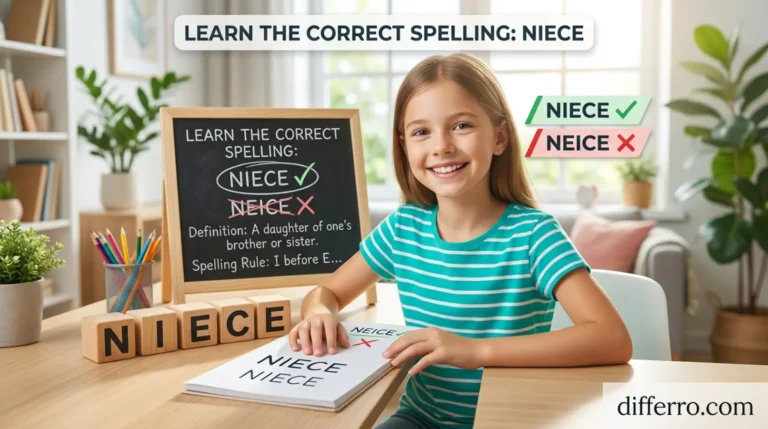
Niece or Neice is a common spelling confusion in English. Only one of these spellings is correct. The correct spelling is niece. Neice is a common misspelling and should not appear in formal writing.
The word niece describes the daughter of your brother or sister. It can also describe the daughter of your spouse’s sibling. Many people write “neice” because the letters sound familiar when spoken. English spelling rules can make this word especially confusing.
Knowing the correct spelling helps you write emails, schoolwork, cards, and family messages correctly. This guide explains niece vs neice, their meanings, usage, common mistakes, and easy memory tricks. You will also see practical examples from everyday English.
⭐ Quick Answer
Niece is the correct spelling. Neice is incorrect. A niece is the daughter of your brother or sister.
Example: My niece is visiting us this weekend.
Meaning of Niece
Meaning of Niece
Niece is a noun. It means the daughter of your brother or sister.
It can also mean the daughter of your spouse’s brother or sister. The word refers to a female family member one generation below you.
The plural form is nieces.
Examples:
- My niece loves reading adventure books.
- I bought a birthday gift for my niece.
Meaning of Neice
Neice has no standard meaning in modern English. It is an incorrect spelling of niece.
People often write “neice” because they remember the sound but not the spelling. However, dictionaries and standard English use niece.
Incorrect examples:
- My neice is coming tomorrow.
- I sent a gift to my neice.
Correct versions:
- My niece is coming tomorrow.
- I sent a gift to my niece.
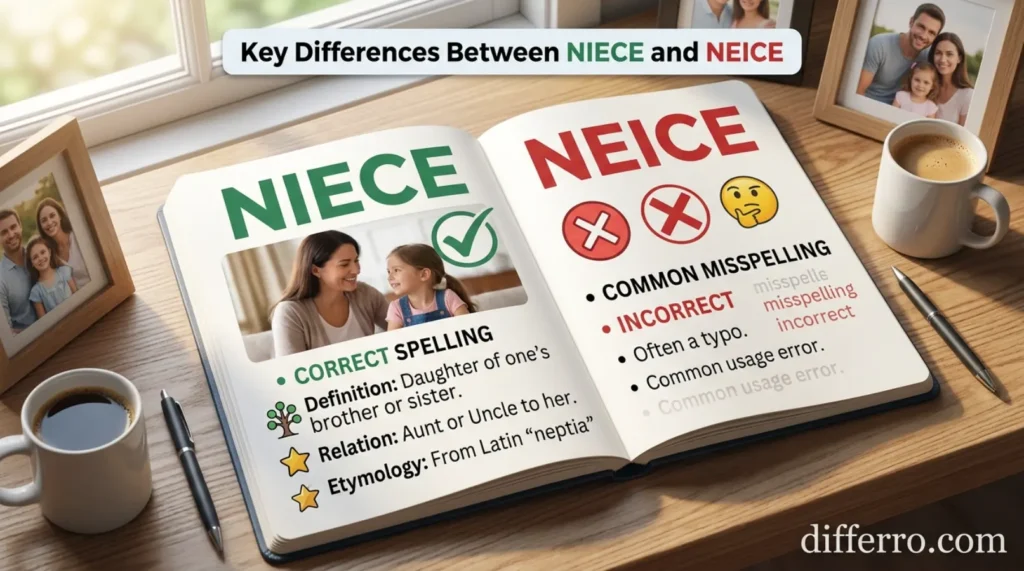
🔍 Key Differences Between Niece and Neice
| Feature | Niece | Neice |
|---|---|---|
| Meaning | Daughter of a sibling | No standard meaning |
| Tone | Standard English | Incorrect spelling |
| Usage | Correct in all normal contexts | Avoid in formal and informal writing |
| Popularity | Widely accepted | Common misspelling |
| Part of speech | Noun | Incorrect form |
| Plural | Nieces | Not standard |
The main difference is simple: niece is correct, while neice is incorrect.
📚 Origin and History
The word niece has a long history in English and French. It came from the Old French word niece, meaning a niece or granddaughter.
Old French influenced English vocabulary after the Norman Conquest. Many family terms entered English through French and related languages.
The spelling developed over time, but niece became the accepted modern English form.
Several English family words have similar historical changes.
Examples include:
- nephew
- cousin
- daughter
- brother
- sister
The spelling neice does not represent a separate historical English word. It mainly appears as a spelling mistake.
🇬🇧 British English vs American English Spelling
British and American English both use niece as the standard spelling.
There is no meaningful spelling difference between British and American English for this word. Writers in both varieties should use niece.
| English Variety | Correct Spelling | Incorrect Spelling |
|---|---|---|
| British English | niece | neice |
| American English | niece | neice |
| Australian English | niece | neice |
| Indian English | niece | neice |
| Pakistani English | niece | neice |
Therefore, you do not need a different spelling for British or American readers.
✍️ When to Use Niece
Use niece whenever you mean the daughter of your sibling or your spouse’s sibling.
It works in casual, academic, professional, and formal writing.
Examples:
- My niece starts school next week.
- Her niece lives in London.
- We invited our niece to dinner.
- His niece won the school competition.
- I am proud of my young niece.
You can also use possessive forms.
Singular possessive:
- My niece’s birthday is tomorrow.
Plural:
- My nieces enjoy playing together.
Plural possessive:
- My nieces’ parents arrived early.
❌ When to Use Neice
You should not use neice in standard English.
It is simply a misspelling of niece. You may see it in informal messages, social media posts, comments, or poorly edited text.
However, frequent online use does not make it correct.
Always replace neice with niece when editing your writing.
Incorrect:
- My neice lives nearby.
Correct:
- My niece lives nearby.
Incorrect:
- I visited my neice yesterday.
Correct:
- I visited my niece yesterday.
⚠️ Common Mistakes
1. Writing Neice Instead of Niece
This is the most common mistake.
Incorrect: My neice is seven years old.
Correct: My niece is seven years old.
2. Using Niece for a Nephew
A niece is female. A nephew is male.
Incorrect: My niece is my brother’s son.
Correct: My nephew is my brother’s son.
3. Confusing Niece With Cousin
A niece is the daughter of your sibling.
A cousin is generally the child of your aunt or uncle.
Incorrect: My sister’s daughter is my cousin.
Correct: My sister’s daughter is my niece.
4. Using the Wrong Plural
The plural of niece is nieces.
Incorrect: I have three niece.
Correct: I have three nieces.
5. Adding an Unnecessary Apostrophe
Do not use an apostrophe for the simple plural.
Incorrect: My niece’s are playing outside.
Correct: My nieces are playing outside.
The apostrophe is correct only for possession.
Example: My niece’s bicycle is new.
🧠 Easy Trick to Remember Niece
Use this simple memory trick:
“I before E in niece.”
Think of the spelling as:
N + I + E + C + E = NIECE
The common mistake reverses the first two vowels:
NEICE ❌
NIECE ✅
Another useful trick is to connect niece with piece.
Both contain the ending pattern:
-iece
So remember:
niece → piece
This makes the correct spelling easier to recall.
🌟 Everyday Life Examples
1. Talking About a Family Visit
My niece is coming to our house this weekend. We plan to have lunch together.
Here, niece refers to the daughter of a sibling.
2. Writing a Birthday Message
I hope my niece has a wonderful birthday filled with happiness and laughter.
The correct family term is niece, not neice.
3. Discussing School
My niece received an award for excellent performance at school.
The word niece works naturally in everyday family conversations.
4. Buying a Gift
I bought my niece a new storybook for her birthday.
This sentence shows how niece commonly appears in family-related writing.
5. Describing a Family Relationship
My niece is the daughter of my older sister.
This is one of the clearest ways to understand the meaning of niece.
📊 Google Trends and Usage Insight
Search interest for niece is consistently much stronger than neice across major English-speaking markets. This reflects the accepted spelling rather than two competing words.
In the USA and UK, people commonly search spelling questions involving “niece” and “neice.” Australia shows a similar pattern.
In India and Pakistan, spelling confusion can also appear because English is widely used as a second language.
Overall, niece is the clear standard form across these five markets. Neice remains a common misspelling rather than an accepted alternative.
Keyword Variation Comparison
| Keyword Variation | Correct? | Main Search Intent | Usage Insight |
|---|---|---|---|
| niece | ✅ Yes | Meaning and family relationship | Standard word |
| neice | ❌ No | Spelling confusion | Common misspelling |
| niece or neice | ⚠️ Comparison | Spelling check | Strong confusion intent |
| neice or niece | ⚠️ Comparison | Correct spelling | Common query format |
| niece vs neice | ⚠️ Comparison | Word comparison | Useful SEO variation |
| correct spelling of niece | ✅ Yes | Spelling help | High clarity intent |
| how to spell niece | ✅ Yes | Spelling help | Strong educational intent |
🌍 Usage in the USA, UK, Australia, India, and Pakistan
| Country | Standard Form | Common Confusion | Overall Insight |
|---|---|---|---|
| USA | niece | neice | Niece is standard |
| UK | niece | neice | Niece is standard |
| Australia | niece | neice | Niece is standard |
| India | niece | neice | Niece is standard |
| Pakistan | niece | neice | Niece is standard |
The important SEO insight is that “niece” and “neice” represent spelling intent, not two different meanings. People searching both forms usually want to confirm the correct spelling.
❓ Frequently Asked Questions
Is “neice” correct?
No. Neice is not the standard English spelling. The correct spelling is niece.
What is the difference between niece and neice?
Niece is the correct English word for the daughter of your brother or sister. Neice is a misspelling.
Which is more common, niece or neice?
Niece is far more common in standard English because it is the accepted spelling. Neice usually appears as a spelling error.
Is “niece” formal usage?
Yes. Niece is a standard English noun. You can use it in casual, academic, professional, and formal writing.
Why does the spelling confusion between niece and neice exist?
The confusion mainly comes from English vowel patterns. People may remember the sound but reverse the letters i and e.
How do you spell niece correctly?
Spell it N-I-E-C-E: niece.
What is the plural of niece?
The plural form is nieces.
Example: I have two nieces.
Is my sister’s daughter my niece?
Yes. Your sister’s daughter is your niece. Your brother’s daughter is also your niece.
🏆 Final Verdict
Niece is the correct spelling.
Neice is a common misspelling and should not be used in standard English. If you mean the daughter of your brother or sister, always write niece.
Remember the simple pattern:
NIECE ✅
NEICE ❌
Use niece in emails, school assignments, social media posts, family messages, and professional writing. The same spelling works in American, British, Australian, Indian, and Pakistani English.
Conclusion
The niece or neice confusion is easy to solve once you remember the correct spelling. Niece is the standard English word for the daughter of your brother or sister. Neice is simply a misspelling.
The easiest way to remember niece is to focus on the letters I-E. You can connect niece with words such as piece to remember the spelling pattern. The word stays the same in British and American English.
When you write about a female child of your sibling, choose niece every time. Use nieces for more than one. With this simple rule, you can avoid one of the most common family-word spelling mistakes in English.

Imran Lodhra is a comparison-focused content writer at Differro.com.
He specializes in creating clear, simple, and informative comparison articles.
His work helps readers understand key differences, pros and cons, and important details.
Imran focuses on accurate, practical, and easy-to-read content for everyday readers.