
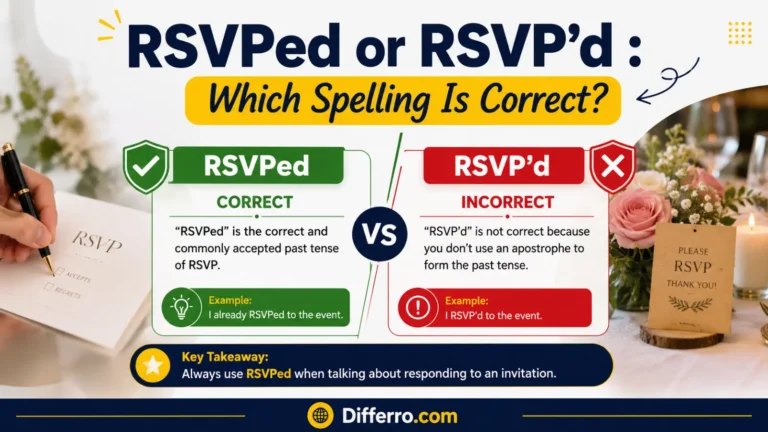
RSVPed or RSVP’d are both correct spellings. Many writers feel confused about which one to use. The confusion happens because “RSVP” is an abbreviation, not a regular verb. Some people add -ed, while others use an apostrophe before d.
Both forms appear in emails, invitations, blogs, and social media. However, usage style depends on writing preference, region, and tone. American English often prefers simpler spellings without apostrophes. Formal invitations may still use the apostrophe version.
This guide explains the difference between RSVPed and RSVP’d in simple words. You will learn meanings, grammar rules, examples, common mistakes, and which version sounds more natural today.
⭐ Quick Answer
Both RSVPed and RSVP’d are correct.
RSVPed is more common in modern writing, especially in American English.
RSVP’d looks slightly more formal and traditional.
Example:
✅ “She RSVPed for the wedding.”
✅ “He RSVP’d to the dinner invitation.”
📘 Meaning of RSVPed
RSVPed means someone replied to an invitation.
The word comes from the abbreviation RSVP, which means “please respond.”
Examples
- She RSVPed for the birthday party.
- We RSVPed before Friday.
📘 Meaning of RSVP’d
RSVP’d has the same meaning as RSVPed.
The apostrophe shows that the word comes from an abbreviation.
Examples
- He RSVP’d to the wedding invitation.
- They RSVP’d by email yesterday.
🔍 Key Differences Between RSVPed and RSVP’d
| Feature | RSVPed | RSVP’d |
|---|---|---|
| Meaning | Replied to an invitation | Replied to an invitation |
| Tone | Modern and simple | Slightly formal |
| Usage | Common in blogs and emails | Common in invitations |
| Popularity | More popular today | Less common today |
🕰️ Origin & History
RSVP comes from the French phrase “Répondez s’il vous plaît.” It means “please respond.”
English speakers later turned RSVP into a verb. That created forms like:
- RSVP
- RSVPed
- RSVP’d
- RSVPing
Many abbreviations become verbs in English. Examples include:
- emailed
- texted
- PDFed
British English vs American English Spelling
American English usually removes extra punctuation. That is why RSVPed appears more often in the US.
British English sometimes keeps apostrophes with abbreviations. So, RSVP’d may appear more in formal British writing.
Comparison Table: British vs American English
| Style | Preferred Form |
|---|---|
| American English | RSVPed |
| British English | RSVP’d |
| Informal Writing | RSVPed |
| Formal Invitations | RSVP’d |

✍️ When to Use RSVPed
Use RSVPed in:
- Blog posts
- Emails
- Social media
- Casual writing
- American English content
Examples
- I RSVPed online yesterday.
- She RSVPed for the office event.
- Everyone RSVPed before the deadline.

✍️ When to Use RSVP’d
Use RSVP’d in:
- Formal invitations
- Traditional writing
- Event planning language
- British-style writing
Examples
- Guests RSVP’d by phone.
- He RSVP’d immediately after receiving the invitation.
- They RSVP’d to confirm attendance.
❌ Common Mistakes
1. Using the wrong apostrophe
❌ “She RSVPed’d yesterday.”
✅ “She RSVP’d yesterday.”
2. Forgetting past tense
❌ “He RSVP tomorrow.”
✅ “He RSVPed tomorrow.”
3. Mixing styles in one sentence
❌ “They RSVPed and RSVP’d together.”
✅ “They RSVPed together.”
4. Using unnecessary spaces
❌ “RSVP ed”
✅ “RSVPed”
🧠 Easy Trick to Remember
Think of RSVPed like other modern verbs:
- emailed
- messaged
- texted
If you want clean and simple writing, choose RSVPed.
If you want a traditional style, choose RSVP’d.
📝 Write 5 Examples
1. Wedding Invitations
Most guests RSVPed before the final date.
2. Office Events
Our manager RSVP’d to the company dinner.
3. Birthday Parties
I RSVPed through the event app.
4. School Functions
Parents RSVP’d by email last week.
5. Online Invitations
Everyone RSVPed quickly after receiving the message.
🔑 Related Keywords
- RSVP meaning
- RSVPed meaning
- RSVP’d grammar
- RSVP past tense
- RSVP spelling
- RSVP examples
- RSVP abbreviation
📊 Google Trends & Usage Data
Search data shows that RSVPed is more common worldwide. Modern digital writing prefers shorter and cleaner spellings.
In the USA and India, people mostly search for RSVPed. The UK and Australia still show some use of RSVP’d in formal contexts. Pakistan follows American-style spelling trends online.
Comparison Table: Keyword Variations
| Country | More Popular Form |
|---|---|
| USA | RSVPed |
| UK | RSVP’d |
| Australia | RSVP’d |
| India | RSVPed |
| Pakistan | RSVPed |
⚖️ Final Verdict
Both spellings are correct.
Choose RSVPed for:
- SEO writing
- Blogs
- Emails
- Modern American English
Choose RSVP’d for:
- Formal invitations
- Traditional writing
- British-style tone
For most online content, RSVPed is the better choice because it looks cleaner and ranks better in modern search results.
FAQs
Is RSVPed correct?
Yes. RSVPed is grammatically correct and widely used online.
What is the difference between RSVPed and RSVP’d?
The only difference is spelling style. The meaning stays the same.
Which is more common?
RSVPed is more common in modern English writing.
Is RSVP’d formal?
Yes. RSVP’d often appears more formal and traditional.
Why does the confusion exist?
The confusion exists because RSVP is an abbreviation, not a standard English verb.
🧾 Conclusion
RSVPed or RSVP’d both mean the same thing. They describe replying to an invitation. The difference comes from writing style and regional preference.
Today, RSVPed is more popular in blogs, emails, and online writing. It follows modern English trends that avoid extra punctuation. RSVP’d still appears in formal invitations and traditional writing styles.
If you write SEO content or casual text, use RSVPed. It looks cleaner and feels more natural to most readers. If you want a formal tone, use RSVP’d instead.
The best choice depends on your audience and writing style. Just stay consistent throughout your content.
Discover More Post ,
Anxiety Or Depression Explained for Beginners
Tryed Or Tried : Which One Is Correct?
Masters or Master’s : What’s the Correct Usage?

Sara Taylor is a passionate writer and language enthusiast. She specializes in creating simple and easy-to-understand articles about English grammar, spelling differences, and commonly confused words. Her writing style focuses on helping students, writers, and English learners improve their language skills with confidence. Through informative guides and practical examples, Sara makes complex grammar topics easier for everyday readers.