
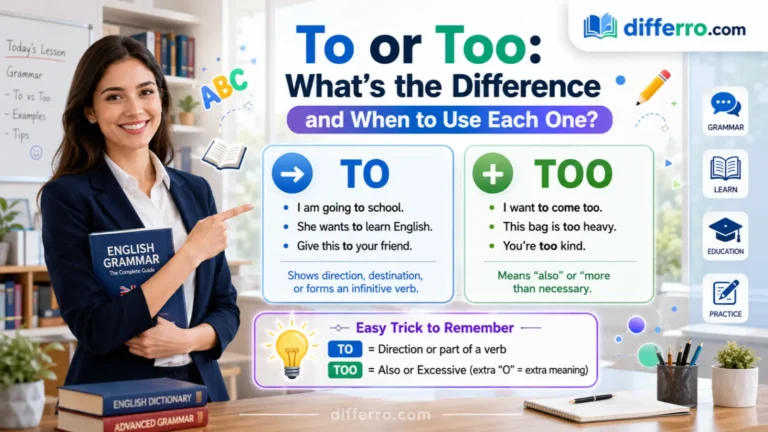
To or Too is one of the most common grammar confusions in English. Many learners and even native speakers mix these words because they sound exactly the same. However, their meanings and uses are very different.
Using the wrong word can change the meaning of a sentence and make your writing look unprofessional. The good news is that understanding the difference between to and too is simple.
In this guide, you’ll learn the meaning of each word, when to use them, common mistakes, memory tricks, examples, and usage trends. By the end, you’ll know exactly which word to choose in every situation.
⭐ Quick Answer
To is usually used as a preposition or as part of an infinitive verb.
Too means “also” or “more than enough.”
Example:
- I want to learn English.
- I want ice cream too.
Meaning of To
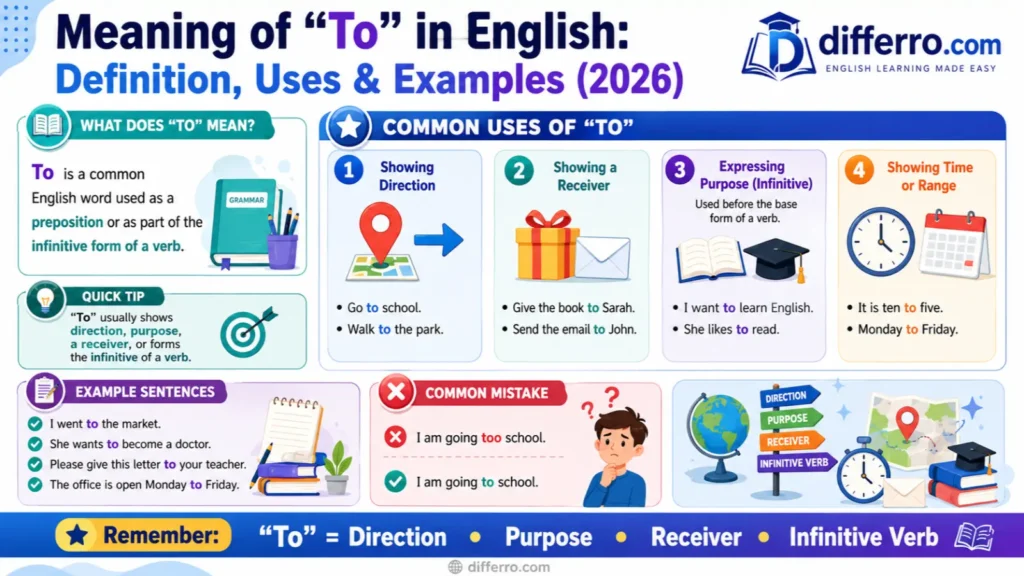
To is a preposition or part of an infinitive verb.
It often shows direction, destination, purpose, or relationship.
Examples
- She went to the market.
- I want to study tonight.
Meaning of Too
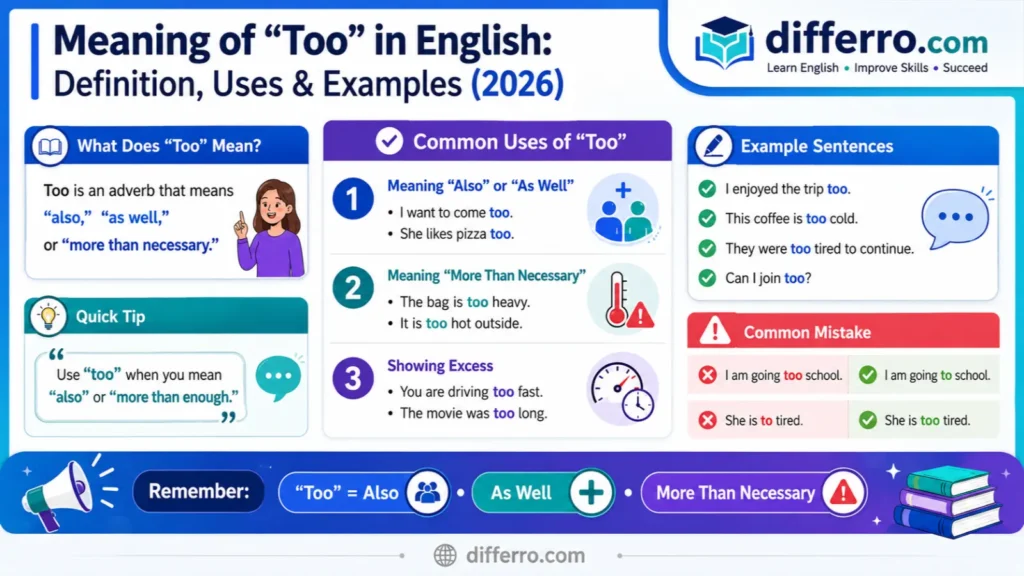
Too means “also” or “excessively.”
It is used when something is more than needed or when adding information.
Examples
- I want to come too.
- The coffee is too hot.
Key Differences Between To and Too
| Feature | To | Too |
|---|---|---|
| Meaning | Shows direction, purpose, or part of a verb | Means also or excessively |
| Tone | Neutral and grammatical | Adds emphasis |
| Usage | Very common in sentences | Used for addition or excess |
| Popularity | Much more common | Less common but important |
Origin & History
The word to comes from Old English and has been used for centuries to indicate direction and purpose.
The word too developed from an older form meaning “in addition” or “beyond what is needed.”
Similar Word Examples
- Their vs There
- Your vs You’re
- Then vs Than
- Affect vs Effect
British English vs American English Spelling
Unlike many English words, to and too have the same spelling and meaning in both British and American English.
There is no spelling difference between the two versions of English.
Only usage mistakes create confusion.
Comparison Table: British vs American English
| Feature | British English | American English |
|---|---|---|
| To | To | To |
| Too | Too | Too |
| Meaning Difference | None | None |
| Spelling Difference | None | None |
When to Use To
Use to when showing:
Direction
- We walked to school.
Destination
- She traveled to London.
Purpose
- I need to work.
Relationship
- This gift belongs to Sarah.
When to Use Too
Use too when meaning:
Also
- I want pizza too.
More Than Needed
- The bag is too heavy.
Extra Emphasis
- It’s too good to miss.
Common Mistakes
Mistake 1
❌ I want too go home.
✅ I want to go home.
Mistake 2
❌ She likes coffee to.
✅ She likes coffee too.
Mistake 3
❌ The soup is to hot.
✅ The soup is too hot.
Mistake 4
❌ I am going too school.
✅ I am going to school.
Easy Trick to Remember
Remember this simple rule:
- Too has an extra “O.”
- The extra “O” means extra or also.
Example:
- Too much
- Too hot
- Me too
If there is no idea of “extra” or “also,” use to.
Write 5 Examples
1. Going to Work
I need to leave early for work.
My colleague is leaving early too.
2. School Conversation
She wants to join the science club.
Her friend wants to join too.
3. Shopping Trip
We went to the mall yesterday.
The mall was too crowded.
4. Family Dinner
I plan to cook dinner tonight.
My sister wants to help too.
5. Vacation Planning
They are traveling to Turkey next month.
The tickets were too expensive at first.
Related Keywords
- to vs too
- difference between to and too
- to or too grammar
- too meaning
- to meaning
- homophones in English
- common English grammar mistakes
Google Trends & Usage Data
USA
Searches for to vs too increase during school semesters and exam periods.
UK
Grammar-related searches remain consistent throughout the year.
Australia
Students frequently search for homophone differences, including to or too.
India
English-learning searches generate strong interest in this topic.
Pakistan
Grammar confusion queries are popular among students and competitive exam candidates.
Insight
Across all five countries, to vs too remains one of the most searched grammar comparisons because both words sound identical but serve different purposes.
Comparison Table: Keyword Variations
| Keyword Variation | Search Intent |
|---|---|
| to vs too | Comparison |
| to or too | Confusion |
| difference between to and too | Educational |
| when to use too | Grammar help |
| when to use to | Grammar help |
| too meaning | Definition |
| to meaning | Definition |
Final Verdict
Neither word is better than the other because they serve different purposes.
- Use to for direction, purpose, destinations, and infinitive verbs.
- Use too when you mean “also” or “more than enough.”
Choosing the correct word depends entirely on the sentence.
FAQs
Is it correct to use “too” instead of “to”?
No. They have different meanings and cannot always replace each other.
What is the difference between to and too?
To shows direction or purpose. Too means also or excessively.
Which is more common?
To is far more common because it appears in many sentence structures.
Is too formal or informal?
Too can be used in both formal and informal writing.
Why does confusion exist?
Because to and too are homophones. They sound the same but have different meanings.
Conclusion
Understanding to or too is easier than many people think. Although these words sound identical, they have completely different functions. To usually shows direction, purpose, or forms part of an infinitive verb. Too means “also” or “more than necessary.” Learning this distinction helps improve grammar, writing clarity, and communication skills.
A simple memory trick is to remember that too contains an extra “O,” which represents something extra. Whenever you’re unsure, check whether the sentence expresses addition or excess. If it does, use too. Otherwise, use to. Mastering this small grammar rule can make your English writing more accurate and professional.

Sara Taylor is a passionate writer and language enthusiast. She specializes in creating simple and easy-to-understand articles about English grammar, spelling differences, and commonly confused words. Her writing style focuses on helping students, writers, and English learners improve their language skills with confidence. Through informative guides and practical examples, Sara makes complex grammar topics easier for everyday readers.