

Many people get confused when they see the words now and laters in conversations, messages, or social media posts.
At first glance, both seem related because they involve time. However, they serve completely different purposes in English.
This confusion often appears among students, English learners, and people who communicate online.
Some assume that “laters” is simply another way to say “later,” while others think it can replace “now” in certain situations. That is not correct.
English contains many informal expressions and slang terms that can make learning the language challenging.
Understanding the difference between these two words helps you avoid mistakes and communicate more naturally.
In this guide, you will learn the meaning of each term, their origins, usage rules, common errors, and simple examples that make the distinction clear.
⭐ Quick Answer
Now refers to the present moment or an immediate action. Laters is an informal slang expression used to say goodbye or “see you later.”
Examples
- I need your answer now.
- I’m leaving. Laters!
Meaning of Now
The word now means at the present time or immediately.
It is one of the most common words in English and appears in both formal and informal communication.
Examples
- We should start the meeting now.
- She is busy right now.
Meaning of Laters
Laters is a casual slang term that means “see you later” or “goodbye for now.”
People mainly use it in text messages, chats, and friendly conversations.
Examples
- Thanks for your help. Laters!
- I have to go. Laters, everyone.
📊 Key Differences Table
| Feature | Now | Laters |
|---|---|---|
| Meaning | Present moment | Casual goodbye |
| Tone | Neutral | Informal |
| Usage | Formal and informal | Mostly informal |
| Popularity | Very common | Less common |
| Grammar Status | Standard English | Slang expression |
📜 Origin & History
The word now comes from Old English nu, meaning the present time. It has existed for centuries and remains a core part of modern English.
The slang term laters developed from the phrase “see you later.” Over time, speakers shortened the expression into a quick farewell used among friends.
Similar Expressions
- See ya
- Catch you later
- Talk soon
- Bye for now
British English vs American English Spelling
British and American English use the same spelling for both words. There is no regional spelling difference. The main distinction is that “laters” is considered slang and appears mostly in casual communication.
Comparison Table: British vs American English
| Usage Type | British English | American English |
|---|---|---|
| Present-time word | Now | Now |
| Informal farewell | Laters | Laters |
| Formal Writing | Preferred | Preferred |
| Casual Texting | Common | Common |
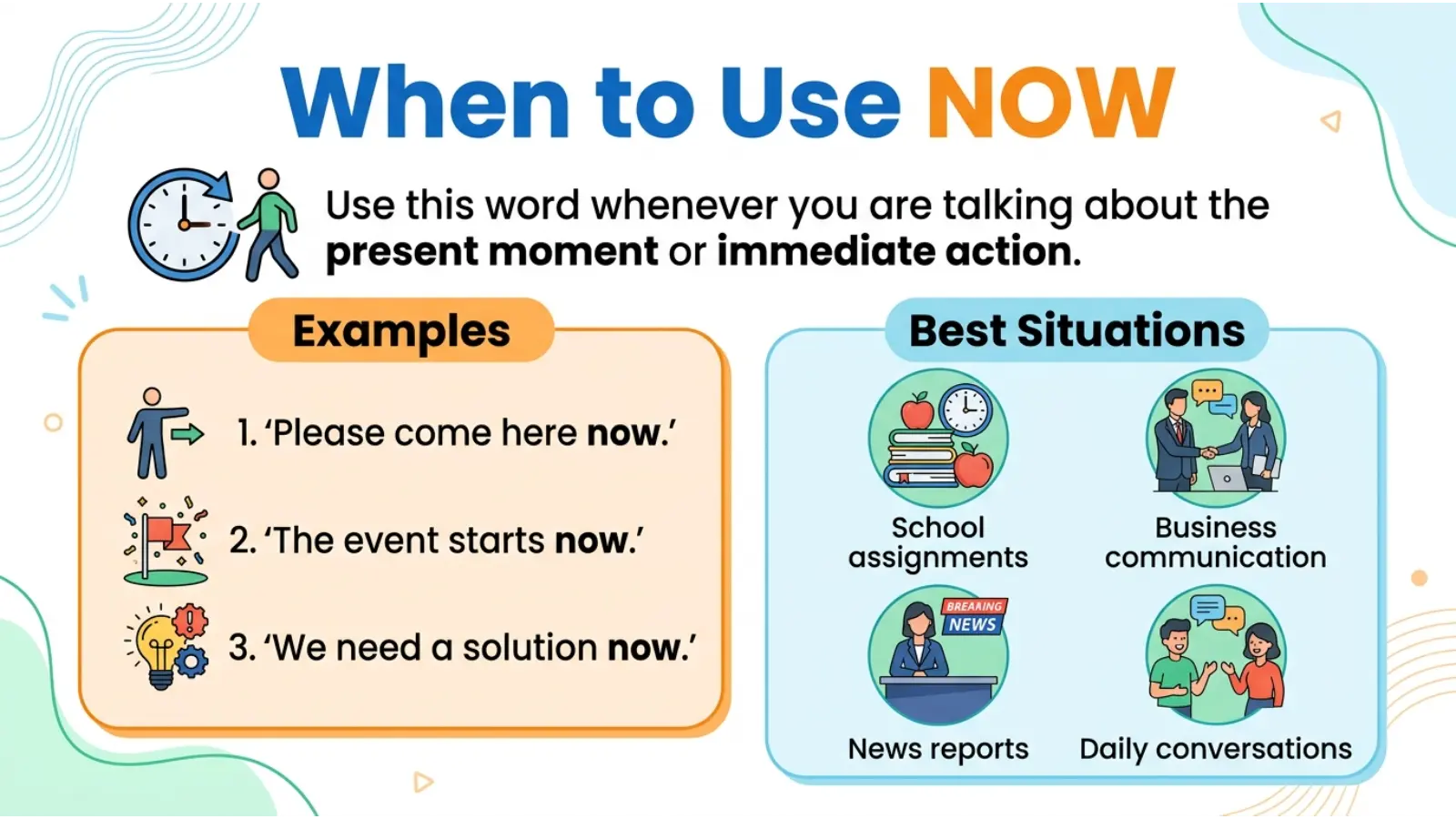
When to Use Now
Use this word whenever you are talking about the present moment or immediate action.
Examples
- Please come here now.
- The event starts now.
- We need a solution now.
Best Situations
- School assignments
- Business communication
- News reports
- Daily conversations
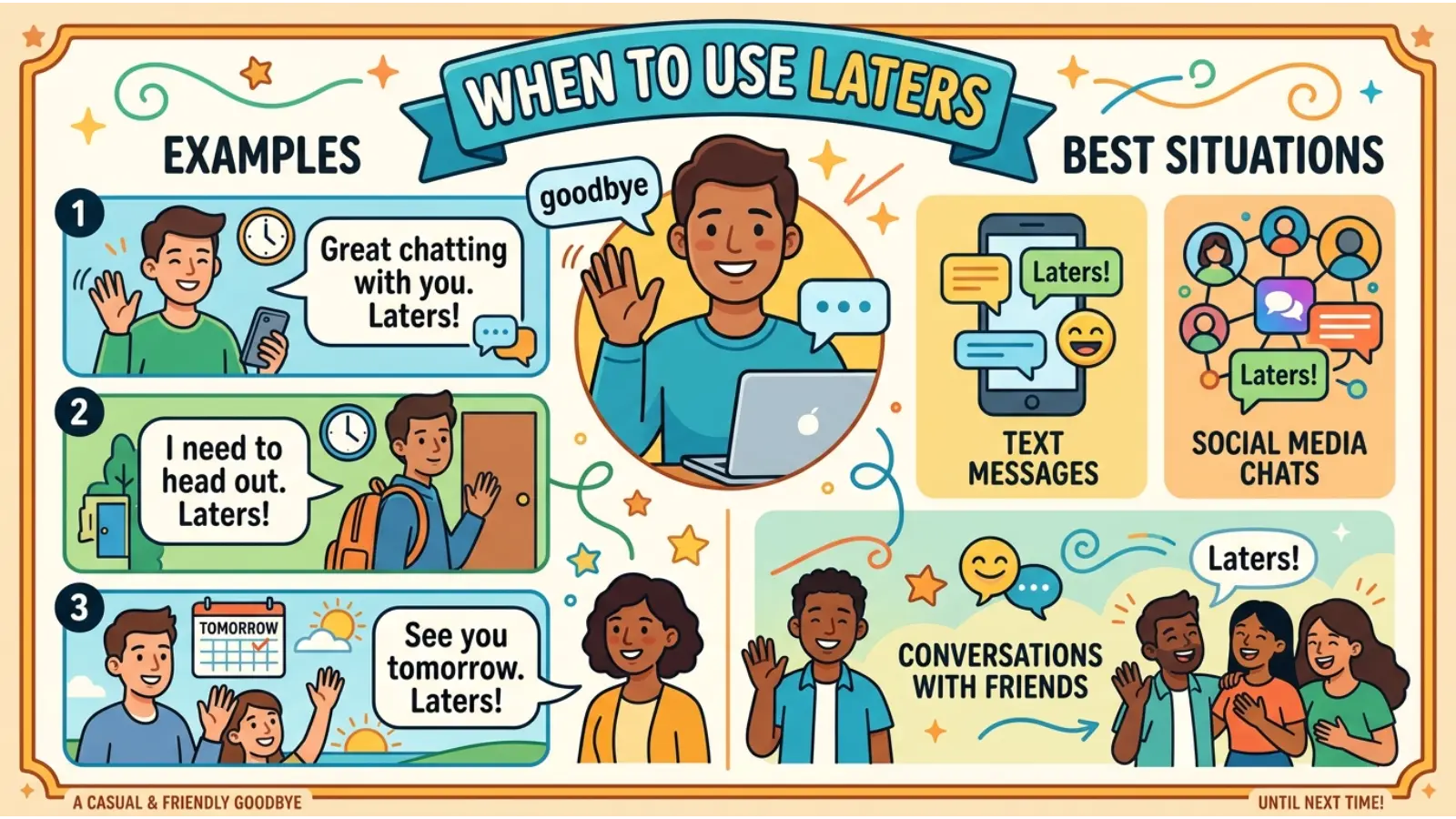
When to Use Laters
Use this expression when ending a friendly conversation.
Examples
- Great chatting with you. Laters!
- I need to head out. Laters!
- See you tomorrow. Laters!
Best Situations
- Text messages
- Social media chats
- Conversations with friends
❌ Common Mistakes
Mistake 1
Incorrect: I need to finish my homework laters.
Correct: I need to finish my homework later.
Mistake 2
Incorrect: The meeting starts laters.
Correct: The meeting starts later.
Mistake 3
Incorrect: Laters everyone, the show begins.
Correct: Now everyone, the show begins.
Mistake 4
Incorrect: I am busy laters.
Correct: I am busy now.
🧠 Easy Trick to Remember
Use this simple memory tip:
Now = Present Time
Laters = Goodbye Time
If you are talking about something happening immediately, choose “now.”
If you are ending a conversation, choose “laters.”
✨ Write 5 Examples
1. School Example
The teacher wants the assignment now.
2. Office Example
We need approval now to continue the project.
3. Text Message Example
I have to leave. Laters!
4. Social Media Example
Thanks for watching the stream. Laters everyone!
5. Family Example
Dinner is ready now. Come downstairs.
🌍 Google Trends & Usage Data
Search behavior shows that “now” receives significantly more searches than “laters” across major English-speaking countries. This happens because “now” is used in everyday communication, news, business, and education.
The slang term appears mainly in casual online conversations and messaging platforms.
Country Insights
- USA: Strong preference for “now.”
- UK: Slightly higher slang usage.
- Australia: Informal expressions remain popular.
- India: Standard English dominates searches.
- Pakistan: Formal word usage is far more common.
Comparison Table: Keyword Variations
| Variation | Search Intent |
|---|---|
| now meaning | Definition |
| what does now mean | Explanation |
| laters meaning | Slang definition |
| what does laters mean | Informal usage |
| now vs later | Comparison |
| casual goodbye words | Related search |
❓ FAQ Section
Is “laters” a correct word?
Yes. It is a recognized informal slang expression.
What is the difference between these two terms?
One refers to the present moment, while the other serves as a casual farewell.
Which word is more common?
Now is much more common in everyday English.
Can I use laters in formal writing?
No. It is best reserved for casual communication.
Why does the confusion exist?
Both words relate to time, causing some people to compare them incorrectly.
✅ Final Verdict
These two terms are not interchangeable. One describes the present moment, while the other functions as a friendly goodbye. For formal, academic, and professional writing, use now whenever discussing current actions or events. Use laters only in casual conversations and online chats.
Conclusion
The confusion between these expressions is common because both relate to time in some way. However, their meanings are very different. One refers to the current moment and appears in all forms of English communication. The other is a slang farewell used mainly among friends and online communities.
When writing essays, emails, reports, or professional content, stick with standard English usage. Reserve informal expressions for casual conversations and text messages. Remember the simple rule: if something is happening at the present moment, use “now.” If you are saying goodbye in a relaxed way, use “laters.” Following this guideline will help you communicate clearly and avoid common mistakes.

Sara Taylor is a passionate writer and language enthusiast. She specializes in creating simple and easy-to-understand articles about English grammar, spelling differences, and commonly confused words. Her writing style focuses on helping students, writers, and English learners improve their language skills with confidence. Through informative guides and practical examples, Sara makes complex grammar topics easier for everyday readers.
1 thought on “Now Or Laters: Which One Is Correct and When to Use It?”