
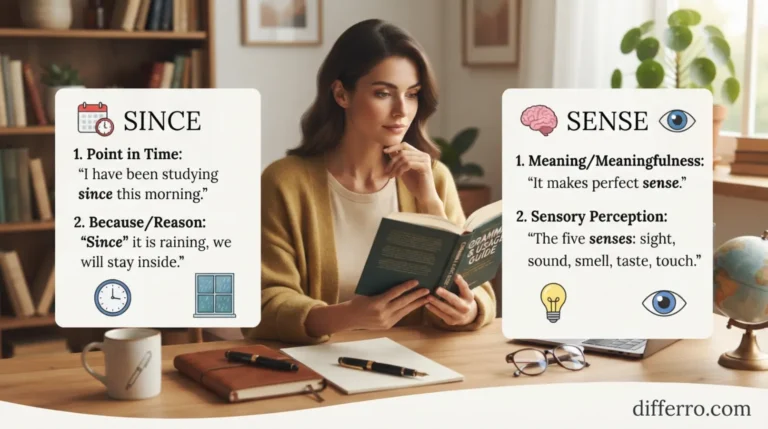
Since or sense can confuse English learners because both words sound alike but have different meanings. However, each word serves a distinct purpose in a sentence. Since usually refers to time or gives a reason for something. Sense refers to understanding, awareness, feelings, or one of the five senses.
For example, you might say, “I have lived here since 2020.” You might also say, “That decision makes sense.” Both sentences use the correct word for a different purpose.
Understanding the difference between since and sense helps you write clearly and avoid common spelling mistakes. These words appear frequently in everyday conversations, school assignments, emails, and professional writing. This guide explains their meanings, grammatical uses, origins, and common mistakes. You will also learn simple memory tricks and practical examples to choose the right word confidently.
⭐ Quick Answer
Since refers to a starting point in time or explains a reason. Sense means understanding, awareness, a feeling, or the ability to recognize something.
Example: “I have worked here since Monday” refers to time. “Your idea makes sense” refers to understanding.
📘 Meaning of Since
Since is a word that refers to a starting point in time or explains why something happens. It can function as a preposition, conjunction, or adverb.
Use since when discussing something that started in the past and continues now. You can also use it to introduce a reason.
Examples of Since
- I have studied English since 2022.
- Since it was raining, we stayed indoors.
In the first example, since identifies when the activity began. In the second, it explains why the people stayed indoors.
Common Uses of Since
- Time: She has worked here since January.
- Reason: Since you are ready, we can begin.
- Past starting point: I have known him since childhood.
- Time-related adverb: I saw her last week but have not spoken to her since.
📗 Meaning of Sense
Sense is a noun or verb that relates to understanding, awareness, perception, or judgment.
As a noun, senses can describe a physical ability, such as sight or hearing. It can also describe practical judgment or the meaning of something.
As a verb, senses means to notice, feel, or recognize something.
Examples of Sense
- Your explanation makes sense to me.
- Dogs have a strong sense of smell.
In the first example, sense means understanding. In the second, it describes the ability to detect smells.
Common Uses of Sense
- Understanding: I understand the sense of your message.
- Good judgment: She has a strong sense of responsibility.
- Physical perception: My sense of hearing is excellent.
- Emotional awareness: He sensed that something was wrong.
- Meaning: The word has several different senses.
🔍 Since or Sense: Key Differences
| Feature | Since | Sense |
|---|---|---|
| Meaning | Refers to time or gives a reason | Refers to understanding, perception, or judgment |
| Part of speech | Preposition, conjunction, or adverb | Noun or verb |
| Tone | Neutral and factual | Neutral and descriptive |
| Usage | Time expressions and explanations | Feelings, awareness, meaning, and judgment |
| Common phrases | Since yesterday, since 2020, since you asked | Make sense, common sense, sense of humor |
| Popularity | Common in everyday English | Common in everyday English |
| Example | I have lived here since 2020. | This plan makes sense. |
Remember: Since and sense are not interchangeable. Choose the word that matches your intended meaning.
🕰️ Origin and History of Since and Sense
The words since and sense have different historical origins.
Since developed from older English forms related to time and sequence. English speakers use it today to describe when something began or why something happened.
Sense comes through Old French from Latin sensus, meaning feeling, perception, or understanding. Its modern meanings include physical perception, awareness, and good judgment.
Although the words sound similar, their meanings and grammatical roles remain different.
Similar Word Examples
English contains many words that sound alike but have different meanings.
- Since vs. sense: Time or reason vs. understanding or perception.
- There vs. their: A place or position vs. belonging to them.
- Hear vs. here: Perceive sound vs. a location.
- Right vs. write: Correct or a direction vs. forming words.
- Weather vs. whether: Atmospheric conditions vs. expressing a choice or possibility.
Learning these differences can improve spelling, reading, and everyday communication.
🇬🇧 British English vs. American English Spelling
Both British and American English use the standard spellings since and sense.
Neither word changes its spelling based on the English variety you use.
The meanings and grammatical rules also remain the same in British, American, Australian, Indian, and Pakistani English.
British vs. American English Comparison
| Feature | British English | American English |
|---|---|---|
| Correct spelling | Since, sense | Since, sense |
| Time usage | Since Monday | Since Monday |
| Meaning usage | Makes sense | Makes sense |
| Spelling variation | None | None |
| Grammar | Same general rules | Same general rules |
✍️ When to Use Since
Use since when you refer to a starting point in time or explain a reason.
1. To Describe a Starting Point in Time
Use since with a specific time, date, event, or past starting point.
Examples:
- I have lived in Lahore since 2020.
- She has worked at this school since January.
- We have been friends since childhood.
- He has not called me since Monday.
Grammar tip: When an action started in the past and continues now, the present perfect often works with since.
Example: “I have known her since 2018.”
2. To Give a Reason
Use since to introduce a reason for an action or situation.
Examples:
- Since you are busy, I will return later.
- Since everyone agrees, we can start the meeting.
- Since the shop was closed, we went home.
- Since you asked, I will explain the answer.
In these sentences, since has a meaning similar to because.
3. To Refer to a Past Event
You can use since to describe the time after an earlier event.
Examples:
- I last visited him in June and have not seen him since.
- She moved away last year and has not returned since.
- We met once and have stayed in touch ever since.
These examples connect a past event with a later period.
🧠 When to Use Sense
Use sense when you discuss understanding, feelings, perception, or judgment.
1. To Describe Understanding
Use sense when something seems logical or understandable.
Examples:
- Your explanation makes senses.
- His answer does not make sense.
- The instructions make perfect sense to me.
- Does this sentence make sense?
The phrase make sense is especially common in everyday English.
2. To Describe Physical Perception
Use sense when referring to the body’s ability to detect things.
Examples:
- Sight is one of the five senses.
- Dogs have an excellent sense of smell.
- Loud music affected my sense of hearing.
- Taste helps us recognize different flavors.
The five traditional senses are sight, hearing, smell, taste, and touch.
3. To Describe Judgment or Awareness
Use sense when discussing practical judgment, responsibility, or awareness.
Examples:
- Use your common sense before making a decision.
- She has a strong sense of responsibility.
- He has a good sense of humor.
- I sensed that something was wrong.
In the final example, sensed is the past tense of the verb sense.
⚠️ Common Mistakes With Since and Sense
Mistake 1: Using Sense for Time
Incorrect: I have lived here sense 2020.
Correct: I have lived here since 2020.
Use since to identify when an ongoing situation began.
Mistake 2: Using Since for Understanding
Incorrect: Your explanation makes since.
Correct: Your explanation makes sense.
Use sense when something is logical or understandable.
Mistake 3: Confusing Since With Because
Incorrect: I stayed home sense I felt sick.
Correct: I stayed home since I felt sick.
Here, since introduces the reason for staying home.
You could also write, “I stayed home because I felt sick.”
Mistake 4: Using Sense in a Time Expression
Incorrect: She has worked here sense Monday.
Correct: She has worked here since Monday.
The word since identifies the starting point of her employment.
Mistake 5: Using Since in a Common Expression
Incorrect: You should use your since.
Correct: You should use your sense.
The correct expression is use your sense or, more commonly, use your common sense.
Mistake 6: Confusing Since With Sense in Questions
Incorrect: Does that since to you?
Correct: Does that make sense to you?
The phrase make sense asks whether something is understandable.
💡 Easy Trick to Remember Since or Senses
Use this simple memory trick to choose the correct word.
- Since = Starting time or reason. Think of “since Sunday” or “since it rained.”
- Sense = Smell, sight, or understanding. Think of “sense of smell” or “makes sense.”
Ask yourself one quick question before writing:
Am I talking about time or a reason? Choose since.
Am I talking about understanding, perception, or judgment? Choose sense.
Examples:
- I have been here since breakfast.
- That answer makes sense.
This trick works for most everyday situations.

🌟 Everyday-Life Examples of Since or Sense
1. At School
A teacher explains a difficult math problem. A student finally understands the steps and says, “Now it makes sense.”
Later, the student tells a friend, “I have studied this topic since Monday.”
The first sentence uses sense for understanding. The second uses since for time.
2. At Work
A manager says, “Your suggestion makes sense, so we should consider it.”
An employee replies, “I have worked on this project since last month.”
The first sentence describes logical thinking. The second identifies a starting point.
3. In Everyday Conversations
A friend asks why you stayed home. You answer, “Since I felt tired, I decided to rest.”
Later, you tell another friend, “That decision makes senses.”
Here, since introduces a reason, while sense describes understanding.
4. While Discussing Health
Someone says, “My sense of smell became weaker after I caught a cold.”
Another person asks, “Have you felt better since yesterday?”
The first sentence describes physical perception. The second refers to a period beginning yesterday.
5. While Writing Emails
You write, “Since the meeting starts at nine, please arrive early.”
Later, you review your message and ask, “Does this sentence make sense?”
The first sentence introduces a reason. The second asks whether the message is understandable.
🌍 Google Trends and Usage Insights: Five Countries
Google Trends reports relative search interest, not exact search volumes. A verified country-by-country comparison requires checking the terms and date range directly.
- USA: Both words appear in general English usage, while spelling questions may reflect learner confusion.
- UK: Both spellings and meanings remain the same in British English.
- Australia: The words follow the same standard spelling and grammar rules.
- India: English learners may search for examples and explanations of commonly confused words.
- Pakistan: Educational searches may focus on sentence examples, meanings, and spelling differences.
SEO insight: These points describe likely educational search needs, not verified Google Trends rankings. Compare “since or sense” and “since vs sense” separately to examine relative interest.
Comparison Table: Keyword Variations
| Keyword variation | Search intent | Recommended use |
|---|---|---|
| Since or sense | Spelling and meaning confusion | Main title and introduction |
| Since vs sense | Direct comparison | Key differences section |
| Since or sense meaning | Definition search | Meaning sections |
| Since and sense examples | Learning through examples | Everyday examples section |
| Difference between since and sense | Informational search | Comparison section |
| How to use since and sense | Grammar guidance | Usage sections |
| Since vs sense in a sentence | Practical learning | FAQ and examples |
❓ Frequently Asked Questions
1. Is “since or senses ” a correct phrase?
Yes. “Since or sense” is a useful phrase when asking which word fits a particular sentence. However, the words have different meanings and cannot replace each other.
2. What is the difference between since and sense?
Since refers to a starting point in time or introduces a reason. Sense refers to understanding, perception, awareness, or judgment.
Example: “I have lived here since 2020.” “Your idea makes sense.”
3. Which word is more common, since or senses ?
Both words are common in everyday English, but they serve different purposes. Their relative frequency depends on the text and context. Neither word is universally more appropriate than the other.
4. Can I use since and sense in formal writing?
Yes. Both words are standard in formal and informal English. Use since for time or reasons, and use sense for understanding, perception, or judgment.
5. Why do people confuse since and senses ?
The words sound alike in many English accents, but their spellings and meanings differ. People may confuse them when writing quickly or relying on pronunciation instead of context.
🏆 Final Verdict: Since or Sense?
Neither since nor sense is better than the other. The correct choice depends on what you want to communicate.
Use since when you refer to a starting point in time or explain a reason. For example, “I have known her since 2020” identifies when the relationship began.
Use sense when you describe understanding, awareness, perception, or judgment. For example, “Your explanation makes sense” means the explanation is understandable.
Both words appear frequently in everyday conversations, schoolwork, emails, and professional writing. Their spellings remain the same in British and American English.
Remember the simple rule: since connects with time or reasons, while sense connects with understanding or perception. Check the meaning of your sentence before choosing either word. This habit will help you avoid spelling mistakes and communicate more clearly.
Conclusion
Understanding the difference between since or sense helps you write accurate, natural English. Although these words sound alike, they have different meanings and grammatical functions.
Use since to describe a starting point in time or introduce a reason. For example, “I have worked here since Monday” identifies when the work began. Use sense to describe understanding, perception, or judgment. For example, “Your explanation makes sense” expresses understanding.
Both words are correct, common, and useful in everyday communication. Neither spelling changes between British and American English. Remember the simple rule: since connects with time or reasons, while sense connects with understanding and perception. With regular practice, you can choose the right word confidently in conversations, emails, assignments, and professional writing.

Imran Lodhra is a comparison-focused content writer at Differro.com.
He specializes in creating clear, simple, and informative comparison articles.
His work helps readers understand key differences, pros and cons, and important details.
Imran focuses on accurate, practical, and easy-to-read content for everyday readers.
1 thought on “Since or Senses Differences ,Meaning and Correct Usage”