
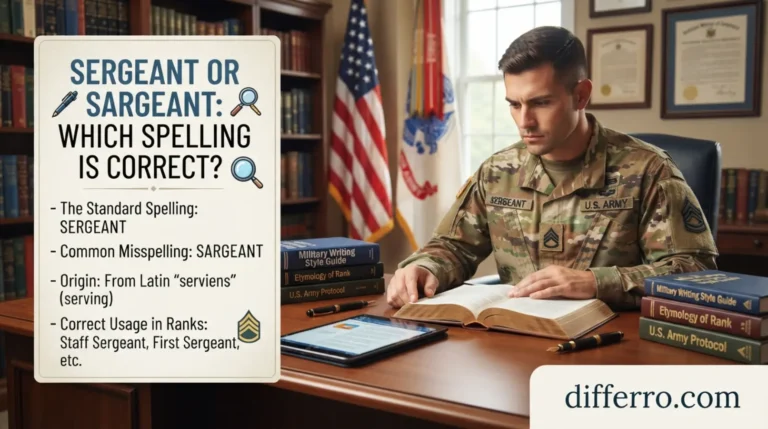
Sergeant or sargeant is a common spelling confusion among English learners, writers, and students. Both spellings look similar, but only one is correct in standard English. Sergeant is the correct spelling for a military or police rank. Sargeant is a misspelling that people often create by writing the word as it sounds.
The confusion happens because the word sergeant has an unusual spelling and pronunciation. Many people pronounce it like “SAR-jent,” which makes the incorrect spelling seem reasonable. However, English spelling does not always match pronunciation. Learning the correct form helps you write accurately in school assignments, professional documents, news articles, and everyday conversations.
This guide explains the meaning of sergeant, why sargeant is incorrect, and how to remember the right spelling. You will also find examples, common mistakes, spelling differences, and frequently asked questions.
⭐ Quick Answer
Sergeant is the correct spelling. Sargeant is a misspelling and should not replace the standard word in formal or informal writing.
Example: The sergeant instructed the soldiers to prepare for inspection.
🔎 Meaning of Sergeant
A sergeant is a rank used in military forces and some police organizations. The exact duties and position depend on the organization and country.
In many military forces, sergeants supervise personnel, provide instructions, and help maintain discipline. In police departments, a sergeant may supervise officers and coordinate daily operations.
Examples of Sergeant
- The sergeant checked the soldiers’ equipment before the exercise.
- The police sergeant assigned officers to different patrol areas.
Both examples use sergeant correctly to describe a rank or position.
❌ Meaning of Sargeant
Sargeant is generally an incorrect spelling of sergeant. It does not serve as the standard English spelling for the military or police rank.
People often write sargeant because the correct word sounds like “SAR-jent.” However, pronunciation does not change its accepted spelling.
Examples of the Incorrect Spelling
- Incorrect: The sargeant addressed the new recruits.
Correct: The sergeant addressed the new recruits. - Incorrect: My uncle works as a police sargeant.
Correct: My uncle works as a police sergeant.
Use sergeant in essays, emails, reports, applications, and other standard writing.
📊 Sergeant or Sargeant: Key Differences
| Feature | Sergeant | Sargeant |
|---|---|---|
| Meaning | A military or police rank | No standard meaning as a rank |
| Tone | Neutral and professional | Incorrect in standard writing |
| Usage | Correct in formal and informal contexts | Usually a spelling mistake |
| Popularity | Standard spelling | Nonstandard misspelling |
| Grammar | Correct noun | Incorrect substitute for the rank |
| Example | The sergeant led the team. | The sargeant led the team. |
Remember: Use sergeant whenever you mean the military or police rank.
🕰️ Origin and History of Sergeant
The word sergeant entered English through Old French sergent, which came from Latin serviens, meaning “serving” or “servant.” Over time, the word developed into a title for people who held particular duties or ranks.
Today, military forces and police organizations use the term in different ways. Its spelling reflects its historical development rather than a simple letter-for-sound pattern.
The unusual spelling explains why people sometimes write sargeant. However, the standard form remains sergeant.
Similar Words With Tricky Spellings
English contains several words whose spelling differs from what learners might expect.
- Lieutenant: A military or police rank with pronunciation that varies by region.
- Colonel: A military rank pronounced differently from its spelling.
- Corporal: A military or police rank that can confuse new learners.
- Sergeant: A rank pronounced roughly like “SAR-jent.”
- February: A month whose pronunciation often differs from careful spelling.
Learning these words individually can improve spelling accuracy.
🇬🇧 British English vs American English Spelling
Both British and American English use sergeant as the correct spelling.
Neither variety accepts sargeant as the standard spelling for the rank.
Pronunciation and military or police structures may vary between countries, but the spelling remains the same.
British vs American English Comparison
| Feature | British English | American English |
|---|---|---|
| Correct spelling | Sergeant | Sergeant |
| Incorrect variant | Sargeant | Sargeant |
| Meaning | Military or police rank | Military or police rank |
| Pronunciation | Generally “SAR-jent” | Generally “SAR-jent” |
| Usage | Official and everyday writing | Official and everyday writing |
The main distinction is not British versus American spelling. It is the difference between the correct word and a misspelling.
✍️ When to Use Sergeant
Use sergeant whenever you refer to the relevant military or police rank.
The word works in formal documents, news reports, school assignments, and everyday communication.
Examples of Correct Usage
- The sergeant supervised the training session.
- A sergeant spoke to the recruits about discipline.
- The police sergeant reviewed the incident report.
- She earned promotion to sergeant after years of service.
- The sergeant asked everyone to follow safety instructions.
Always retain the standard spelling, even when the word appears in dialogue or informal writing.
🚫 When to Avoid Sargeant
Avoid sargeant when you intend to write the standard rank. It is not an accepted British or American spelling of sergeant.
If you see sargeant in an essay, article, report, or official document, correct it to sergeant.
Incorrect and Correct Examples
- Incorrect: The sargeant called the meeting to order.
- Correct: The sergeant called the meeting to order.
- Incorrect: He wants to become an army sargeant.
- Correct: He wants to become an army sergeant.
- Incorrect: The sargeant spoke with the officers.
- Correct: The sergeant spoke with the officers.
Writing tip: Do not use sargeant simply because it seems closer to the word’s pronunciation.
⚠️ Common Mistakes With Sergeant or Sargeant
Mistake 1: Spelling the Word as It Sounds
Incorrect: The sargeant inspected the equipment.
Correct: The sergeant inspected the equipment.
The pronunciation can mislead writers, but the standard spelling includes e after the initial s.
Mistake 2: Assuming Both Spellings Are Accepted
Incorrect: Both sergeant and sargeant are correct spellings.
Correct: Sergeant is the standard spelling for the rank.
The second form is generally a spelling error.
Mistake 3: Using the Wrong Form in Formal Documents
Incorrect: The sargeant signed the report.
Correct: The sergeant signed the report.
Official writing requires the standard spelling, especially when describing someone’s rank.
Mistake 4: Confusing Pronunciation With Spelling
Incorrect: I wrote sargeant because that is how the word sounds.
Correct: I wrote sergeant because that is the accepted spelling.
English contains many words whose spellings do not closely match their pronunciations.
Mistake 5: Changing the Spelling Between Sentences
Incorrect: The sergeant arrived early. Later, the sargeant addressed the team.
Correct: The sergeant arrived early. Later, the sergeant addressed the team.
Use the same correct spelling throughout your writing.
🧠 Easy Trick to Remember Sergeant
Use this simple memory trick:
Sergeant has “ser” at the beginning, not “sar.”
Remember the spelling pattern:
- Correct: S-E-R-G-E-A-N-T
- Incorrect: S-A-R-G-E-A-N-T
You can also connect the correct spelling with the phrase “Sergeant starts with SER.”
Repeat the correct spelling when studying or proofreading your writing. This habit can help you recognize the word more quickly.

🌟 Everyday-Life Examples: Sergeant or Sargeant
1. In a Military Report
The sergeant checked the unit’s equipment before the scheduled exercise.
Why it is correct: The sentence uses sergeant to identify a military rank.
2. In a Police News Story
The police sergeant explained how officers responded to the incident.
Why it is correct: The sentence uses the standard spelling for a police supervisory rank.
3. In a School Assignment
My history teacher explained the role of a sergeant in the army.
Why it is correct: The word correctly identifies a military rank.
4. In an Email
Dear Sergeant Williams, thank you for arranging the training session.
Why it is correct: The standard spelling appears in a respectful form of address.
5. During Proofreading
Incorrect: The sargeant organized the team.
Correct: The sergeant organized the team.
Why it matters: Correcting sargeant improves spelling accuracy and keeps the writing professional
These variations address readers who want to check the spelling, understand the meaning, or learn the correct form.
🌍 Google Trends and Usage Insights: Five Countries
Google Trends reports relative search interest rather than exact search volumes. Without live comparison data, country-specific rankings for these spellings cannot be confirmed.
- USA: Searchers may look up the correct spelling when writing about military or police ranks.
- UK: Readers may search for sergeant spelling and pronunciation in British English.
- Australia: Learners may compare the written form with its spoken pronunciation.
- India: Students and competitive-exam candidates may search for correct spelling and word meaning.
- Pakistan: English learners may look for spelling clarification and examples for academic writing.
SEO insight: These are reasonable audience-intent possibilities, not verified Google Trends results. Compare both spellings in Google Trends using the same date range and country settings before reporting popularity figures.
Comparison Table: Keyword Variations
| Keyword variation | Search intent | Suggested use |
|---|---|---|
| Sergeant or sargeant | Spelling comparison | Main title and introduction |
| Sergeant vs sargeant | Correct spelling | Key differences section |
| Correct spelling of sergeant | Spelling help | Quick Answer section |
| Is sargeant a word? | Word validation | FAQ section |
| Sergeant meaning | Definition | Meaning section |
| How to spell sergeant | Learning and spelling | Memory trick section |
| Sergeant pronunciation | Pronunciation help | Origin and history section |
❓ Frequently Asked Questions
1. Is sergeant or sargeant correct?
Sergeant is correct. Sargeant is generally a misspelling when referring to a military or police rank.
2. What is the difference between sergeant and sargeant?
Sergeant is the standard English word for a rank used in military forces and some police organizations. Sargeant is an incorrect spelling of that word.
3. Which spelling is more common?
Sergeant is the standard spelling used in dictionaries, official documents, and professional writing. Sargeant is a nonstandard misspelling.
4. Should I use sergeant in formal writing?
Yes. Use sergeant in academic assignments, professional emails, military reports, police documents, and other formal writing.
5. Why do people confuse sergeant and sargeant?
The word’s pronunciation sounds roughly like “SAR-jent.” People may spell it with a because they follow the sound instead of remembering the standard spelling.
✅ Final Verdict: Sergeant or Sargeant?
Sergeant is the correct spelling, while sargeant is generally incorrect. Use sergeant whenever you refer to a military or police rank. The correct spelling remains the same in British and American English.
The confusion mainly comes from the word’s unusual relationship between spelling and pronunciation. Although sargeant may look reasonable, it does not replace the standard form.
Remember the spelling pattern S-E-R-G-E-A-N-T to avoid mistakes in essays, reports, emails, and everyday writing. If you encounter the incorrect version, correct it before publishing or submitting your work.
Learning this distinction will strengthen your spelling accuracy and help you communicate more professionally.
Conclusion
Understanding the difference between sergeant or sargeant helps you avoid a common English spelling mistake. Sergeant is the correct word for a military or police rank. Sargeant is a nonstandard misspelling that you should avoid in standard writing.
The confusion arises because sergeant sounds roughly like “SAR-jent.” However, English spelling does not always follow pronunciation. Both British and American English use the same correct spelling.
Remember the letters S-E-R-G-E-A-N-T whenever you write the word. Use it in school assignments, professional emails, reports, and everyday communication. With regular practice and careful proofreading, you can recognize the correct form and prevent this mistake from appearing in your writing.

Imran Lodhra is a comparison-focused content writer at Differro.com.
He specializes in creating clear, simple, and informative comparison articles.
His work helps readers understand key differences, pros and cons, and important details.
Imran focuses on accurate, practical, and easy-to-read content for everyday readers.
2 thoughts on “Sergeant or Sargeant: Which Spelling Is Correct?”