

Planning vs planing can confuse writers because both words are correct but have different meanings. Planning means deciding what to do before taking action. Planing usually means smoothing wood with a tool or gliding across water on a boat. The correct spelling depends on the situation and the message you want to communicate.
Many people accidentally leave out one “n” when writing about future arrangements, goals, or projects. This mistake can change the meaning of a sentence. For example, “I am planning a trip” describes preparation for travel. However, “I am planing the wood” describes a woodworking task.
Understanding the difference helps you avoid spelling mistakes in schoolwork, emails, professional documents, and everyday conversations. This guide explains both words, their meanings, correct usage, common mistakes, and simple examples. You will also learn an easy trick to remember which spelling fits your sentence.
⭐ Quick Answer
Planning is the correct spelling when you mean preparing for something or deciding what to do. Planing refers mainly to smoothing wood with a plane or making a boat glide across water.
Example: “We are planning a wedding” is correct for organizing an event. “He is planing the wooden surface” is correct for woodworking.
📘 Meaning of Planning
Planning is the process of deciding what to do, how to do it, and when to do it. It involves organizing activities, setting goals, and preparing for future events.
Planning is the present participle of plan. It also works as a gerund, which means it can function as a noun.
Examples of Planning
- We are planning a family vacation for December. The family is organizing a future trip.
- Careful planning helps businesses manage their budgets. Preparation helps businesses use their money wisely.
Other common examples include planning a wedding, planning a project, planning a lesson, and planning a career.
📘 Meaning of Planing
Planing has two main uses. In woodworking, it means smoothing or shaping a surface with a tool called a plane. In boating, it describes a boat moving fast enough to rise partly above the water’s surface.
Planing is the present participle of plane. It does not normally mean organizing future activities.
Examples of Planing
- The carpenter is planing the wooden door. The carpenter is smoothing the wood with a plane.
- The speedboat is planing across the water. The boat is moving quickly across the water’s surface.
These examples show why context matters when choosing between planning and planing.
🔎 Planning vs Planing: Key Differences
| Feature | Planning | Planing |
|---|---|---|
| Meaning | Preparing and organizing future actions | Smoothing wood or gliding across water |
| Word origin | Plan | Plane |
| Grammar | Present participle or gerund of plan | Present participle of plane |
| Common usage | Goals, events, projects, and schedules | Woodworking and boating |
| Tone | Everyday, professional, and academic | Technical or specialized |
| Popularity | Much more common in general English | Less common in everyday writing |
| Example | She is planning a meeting. | He is planing a wooden board. |
Remember: Both spellings are correct. Choose the word that matches your intended meaning.
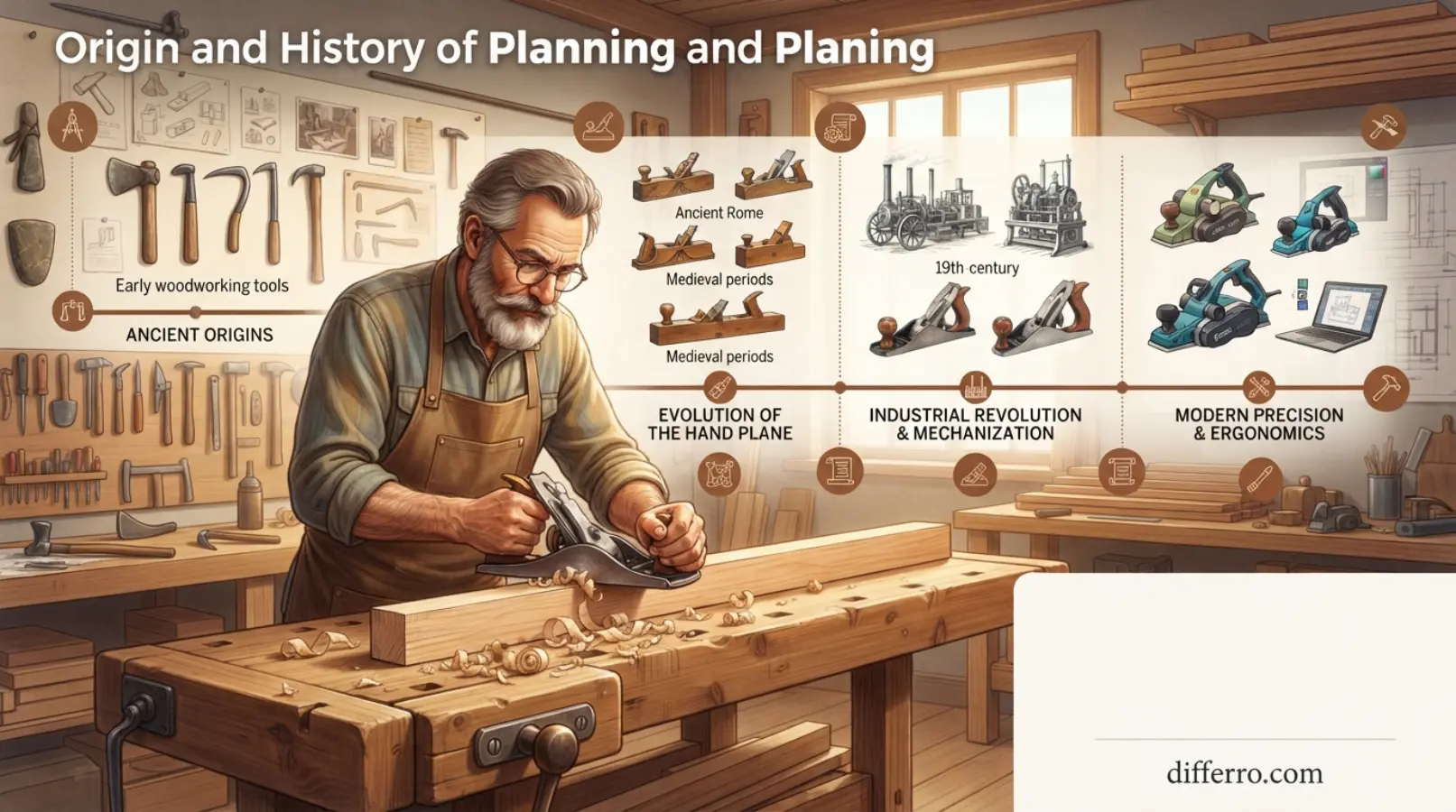
🕰️ Origin and History of Planning and Planing
The word plan entered English through French, with earlier roots connected to a flat surface or a drawing. Its meaning developed to include a proposed method or arrangement for achieving something.
The word plane has roots in Latin planus, meaning flat or level. English uses plane for a tool that smooths wood and for several other objects or concepts.
Their different meanings explain their spelling patterns. When plan takes the suffix -ing, the final consonant doubles. When plane takes the suffix, the silent “e” drops.
Similar Word Examples
- Plan → Planning
- Plan → Planned
- Plane → Planing
- Plane → Planed
- Hope → Hoping
- Hop → Hopping
These examples show how English spelling changes when words take certain endings.
🇬🇧 British English vs American English Spelling
Planning vs planing have the same spelling and meaning in British and American English.
Neither variety uses a different spelling for these two words.
The main difference is their meaning in context, not their regional spelling.
British vs American English Comparison
| Word or phrase | British English | American English |
|---|---|---|
| Planning a trip | Planning a trip | Planning a trip |
| Planing wood | Planing wood | Planing wood |
| Planning a project | Planning a project | Planning a project |
| Planing a boat | Planing a boat | Planing a boat |
✍️ When to Use Planning
Use planning when discussing preparation, organization, goals, or future activities. It is the correct choice for most sentences about making arrangements.
1. Planning an Event
Use planning when organizing a wedding, birthday party, meeting, or celebration.
Example: We are planning a surprise party for our mother.
2. Planning a Project
Use planning when deciding how to complete work or reach a goal.
Example: The team is planning a new website.
3. Planning for the Future
Use planning when preparing for upcoming needs or opportunities.
Example: She is planning to study abroad next year.
4. Planning a Schedule
Use planning when arranging activities or deciding when to complete tasks.
Example: I spend Sunday evening planning my weekly schedule.
🪵 When to Use Planing
Use planing when describing woodworking or a boat moving across the water at speed.
1. Planing Wood
Carpenters use a plane to remove thin layers of wood and create a smooth surface.
Example: The carpenter is planing the table legs.
2. Planing a Door
A carpenter may plane a door to help it fit its frame.
Example: He is planing the edge of the door because it sticks.
3. Planing a Wooden Board
Woodworkers may plane boards before building furniture.
Example: The craftsman is planing the board before assembling the cabinet.
4. Planing Across Water
A speedboat may rise partly above the water as its speed increases.
Example: The boat is planing smoothly across the lake.
⚠️ Common Mistakes With Planning vs Planing
Mistake 1: Writing “Planing a Trip”
Incorrect: We are planing a trip to London.
Correct: We are planning a trip to London.
Why: The sentence describes organizing a trip, so planning needs two “n” letters.
Mistake 2: Writing “Planning the Wood”
Incorrect: The carpenter is planning the wooden surface.
Correct: The carpenter is planing the wooden surface.
Why: The carpenter is smoothing wood with a plane, so planing is correct.
Mistake 3: Adding an Extra “N” to Planing
Incorrect: The speedboat is planning across the lake.
Correct: The speedboat is planing across the lake.
Why: The sentence describes a boat moving at speed, not making arrangements.
Mistake 4: Assuming Planing Is Always Incorrect
Incorrect: “Planing” is never a correct English word.
Correct: “Planing” is correct when describing woodworking or a boat moving across water.
Why: Both words exist, but they serve different purposes.
Mistake 5: Confusing Planning With Planned
Incorrect: We are planned a school event.
Correct: We are planning a school event.
Why: The present continuous tense uses are planning. You can also write, “We planned a school event.”
🧠 Easy Trick to Remember
Use this simple rule:
- Planning = preparing. Remember the extra “n” in planning when organizing something.
- Planing = smoothing. Remember the word plane, the tool used to smooth wood.
Try this quick test:
- Organizing a birthday party? Use planning.
- Smoothing a wooden table? Use planing.
- Preparing a school timetable? Use planning.
- Describing a speedboat gliding across water? Use planing.
This memory trick makes the spelling difference easier to recognize.
🌟 Everyday-Life Examples: Planning vs Planing
1. Planning a Family Vacation
Sentence: We are planning our summer vacation with the whole family.
Explanation: Planning is correct because the family is organizing a future trip.
Keyword usage: Planning or planing depends on whether you mean preparation or a physical action.
2. Planning a School Event
Sentence: The teachers are planning an annual sports day for students.
Explanation: Planning describes arranging an upcoming school event.
Keyword usage: Use planning when writing about school event planning, schedules, or activities.
3. Planing a Wooden Table
Sentence: The carpenter is planing the wooden table before applying varnish.
Explanation: Planing is correct because the carpenter is smoothing the surface.
Keyword usage: Planing is a woodworking term, unlike planning a project.
4. Planning a Business
Sentence: The entrepreneur is planning a small business in his hometown.
Explanation: Planning describes preparing business goals, budgets, and activities.
Keyword usage: Business planning requires the double “n” because it comes from plan.
5. Planing a Speedboat
Sentence: The speedboat is planing across the river at high speed.
Explanation: Planing describes the boat’s movement across the water.
Keyword usage: This specialized meaning makes planing correct in boating contexts.
🌍 Google Trends and Usage Insights
Google Trends compares relative search interest, not the total number of searches. Exact country rankings require checking current data for each term.
- USA: Planning may attract broad interest because people use it for work, education, and everyday organization.
- UK: Both spellings remain standard, although planning serves more general writing needs.
- Australia: Planning commonly appears in searches about schedules, events, and projects.
- India: Students and English learners may search for the spelling difference and sentence examples.
- Pakistan: Searchers may focus on correct spelling, word meanings, and English grammar explanations.
SEO insight: These observations describe likely search intent, not verified Google Trends rankings. Compare both terms by country and date range before publishing numerical claims. Because planning has a broader everyday meaning, it is likely to attract more general-language interest than planing.
Comparison Table: Keyword Variations
| Keyword variation | Search intent | Recommended use |
|---|---|---|
| Planning or planing | Spelling and meaning comparison | Main title and introduction |
| Planning vs planing | Direct comparison | Key differences section |
| Planning meaning | Definition | Planning section |
| Planing meaning | Definition and specialist usage | Planing section |
| How to spell planning | Spelling help | Common mistakes section |
| Planning spelling rules | Grammar learning | Easy memory trick |
| Planing wood meaning | Technical definition | Woodworking examples |
❓ Frequently Asked Questions
1. Is planning or planing correct?
Both words are correct. Use planning for organizing or preparing something. Use planing for smoothing wood or describing a boat moving quickly across water.
2. What is the difference between planning and planing?
Planning comes from plan and means preparing for an activity. Planing comes from plane and usually describes smoothing a surface or gliding across water.
3. Which word is more common, planning or planing?
Planning is much more common in everyday English because people frequently discuss schedules, events, and future goals. Planing appears mainly in specialized woodworking and boating contexts.
4. Is planning or planing more suitable for formal writing?
Both words work in formal writing when used correctly. Use planning for business reports, academic work, and project documents. Use planing when discussing woodworking or boating.
5. Why do people confuse planning and planing?
Both words come from similar-looking base words and use the ending -ing. However, their meanings and spelling rules differ. Remember that plan becomes planning, while plane becomes planing.
✅ Final Verdict: Planning vs Planing?
Planning is the correct choice when you mean preparing, organizing, or deciding what to do. It appears in everyday conversations, business documents, school assignments, and professional writing.
Planing is also correct, but it has a more specialized meaning. It describes smoothing wood with a plane or a boat gliding across water at speed.
The best way to choose is to check the action in your sentence. If someone organizes a trip, they are planning it. If a carpenter smooths a board, the carpenter is planing it.
Remember the base words: plan becomes planning, while plane becomes planing. This simple rule will help you choose the correct spelling with confidence.
Conclusion
Planning vs planing can be confusing because both spellings are correct. However, their meanings differ clearly. Planning means preparing, Organizing, or deciding how to complete an activity. Planing usually means smoothing wood with a special tool or describing a speedboat moving across water.
Use planning when discussing trips, projects, business goals, school events, or future arrangements. Choose planing when describing woodworking or a boat’s movement across water. Both words have the same spelling in British and American English.
Remember that plan doubles its final “n” before adding -ing. Meanwhile, plane drops its silent “e” before adding the same ending. Understanding this spelling rule will help you write clearly and avoid common mistakes.

Imran Lodhra is a comparison-focused content writer at Differro.com.
He specializes in creating clear, simple, and informative comparison articles.
His work helps readers understand key differences, pros and cons, and important details.
Imran focuses on accurate, practical, and easy-to-read content for everyday readers.
1 thought on “Planning vs Planing: Which Spelling Is Correct?”