
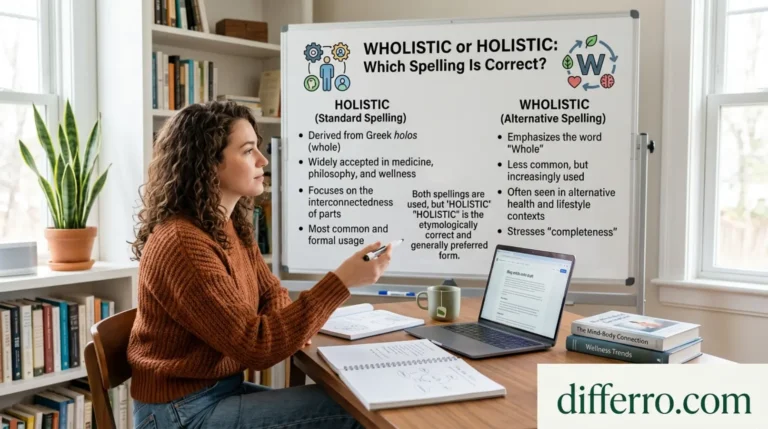
Wholistic or Holistic is a common spelling question in modern English. Both forms relate to considering something as a complete whole. However, holistic is the standard and much more common spelling. Wholistic also appears in English as a recognized variant.
The confusion comes from the word whole. Since holistic describes a complete or whole approach, many writers naturally add a “w.” However, the standard form is holistic, which comes from holism. The word holistic was first recorded in English in 1926.
This guide explains the meaning, spelling, history, usage, and differences between wholistic and holistic. It also gives simple examples to help you choose the right word.
⭐ Quick Answer
Holistic is the standard and more widely used spelling. Wholistic is a recognized variant with the same basic meaning, but it is much less common.
Example:
✅ The doctor recommended a holistic approach to health.
⚠️ The doctor recommended a wholistic approach to health.
Meaning of Holistic
Holistic is an adjective that describes an approach that considers something as a whole. It does not focus only on separate parts.
The word commonly appears in healthcare, education, psychology, business, wellness, and personal development. Dictionaries define it around the idea of understanding the whole rather than isolated parts.
Examples of Holistic
- The school takes a holistic approach to student development.
- She follows a holistic plan for improving her overall well-being.
Meaning of Wholistic
Wholistic is a variant spelling of holistic. It carries essentially the same basic meaning.
Some writers use the spelling to emphasize the idea of considering the whole person or system. Collins lists wholistic as a variant spelling of holistic.
Examples of Wholistic
- The program provides wholistic support for families.
- The organization uses a wholistic approach to community development.
The spelling can also have special meaning in some communities. For example, some Indigenous health and education sources deliberately use wholistic to emphasize interconnected aspects of well-being.
🔎 Key Differences Between Wholistic and Holistic
| Feature | Holistic | Wholistic |
|---|---|---|
| Meaning | Considering the whole | Considering the whole |
| Tone | Standard and professional | Alternative or specialized |
| Usage | Very common | Less common |
| Popularity | Much higher | Much lower |
| Formal writing | Usually preferred | Use when a style specifically requires it |
| Healthcare | Very common | Also used in some settings |
| Education | Common | Less common |
| Business | Common | Less common |
The main difference is usage and spelling, not meaning. Both words can describe an approach that considers the whole rather than isolated parts.
📚 Origin and History
The history of holistic explains why it does not contain a “w.”
Holistic comes from holism and was first recorded in 1926. The related word holism describes the idea that a whole can be understood differently from its separate parts.
Wholistic developed later through influence from the English word whole. Etymonline dates the variant to around 1941.
Similar related words include:
- Holism
- Holistically
- Whole
- Wholeness
- Comprehensive
- Integrated
- Complete
🇬🇧 British English vs American English Spelling
British and American English generally use holistic as the standard spelling. Neither variety requires a different spelling for this word.
Wholistic exists as a variant, but it remains less common in both forms of English.
| English Variety | Standard Spelling | Alternative |
|---|---|---|
| American English | Holistic | Wholistic |
| British English | Holistic | Wholistic |
| Australian English | Holistic | Wholistic |
| Indian English | Holistic | Wholistic |
| Pakistani English | Holistic | Wholistic |
✍️ When to Use Holistic
Use holistic when you want the standard spelling for general or professional writing.
It works well in:
- Academic writing
- Business writing
- Healthcare content
- Education
- Psychology
- Wellness articles
- News writing
- Websites
- Everyday communication
Examples
Healthcare:
The clinic uses a holistic approach to patient care.
Education:
Teachers should support the holistic development of students.
Business:
The company needs a holistic strategy for long-term growth.
Personal development:
She takes a holistic view of her career and personal life.
✍️ When to Use Wholistic
Use wholistic when a person, organization, publication, or community intentionally uses that spelling.
This can happen in specialized contexts. Some Indigenous frameworks, for example, deliberately use wholistic to highlight interconnected areas of life and well-being.
Examples
- The organization promotes a wholistic approach to community care.
- The program follows a wholistic model of personal development.
For ordinary professional writing, however, holistic will usually be the clearer choice.
⚠️ Common Mistakes
1. Treating Wholistic as the Only Correct Spelling
❌ The correct spelling is always wholistic.
✅ Holistic is the standard spelling, while wholistic is a recognized variant.
2. Adding a W Because of Whole
❌ We need a wholistic approach because the word comes from whole.
✅ We need a holistic approach because the standard word comes from holism.
The spelling wholistic exists, but its history differs from the standard form.
3. Using Both Spellings in One Article
❌ The article uses both holistic and wholistic randomly.
✅ Choose holistic unless a specific source requires wholistic.
Consistency makes professional writing easier to read.
4. Assuming Wholistic Is Always Wrong
❌ Wholistic is never a real English word.
✅ Wholistic is recognized as a variant spelling by dictionaries such as Collins.
5. Writing Holistic as Holystic
❌ The company offers a holystic service.
✅ The company offers a holistic service.
The correct spelling contains holistic, not holystic.
🧠 Easy Trick to Remember
Use this simple rule:
Holistic = standard spelling.
Think:
HOLISM → HOLISTIC
Do not add the “w” just because the meaning relates to a whole.
You can remember it this way:
Holistic is the standard whole-picture word.
If you are unsure, holistic is normally the safest choice.
🌱 5 Everyday Life Examples
1. Holistic Approach to Health
A doctor may take a holistic approach by considering several aspects of a patient’s well-being.
This can include physical, emotional, social, and psychological factors.
Primary keyword: holistic
Secondary keyword: holistic approach
2. Wholistic Family Support
A community organization may describe its services as wholistic family support.
The spelling can emphasize support for the complete family.
Primary keyword: wholistic
Secondary keyword: wholistic support
3. Holistic Education
A school may use holistic education to describe broader student development.
This approach can consider academic, social, emotional, and personal growth.
Primary keyword: holistic
Secondary keyword: holistic education
4. Holistic Business Planning
A company can take a holistic approach to business planning.
Managers may consider employees, customers, finances, and long-term goals.
Primary keyword: holistic
Secondary keyword: holistic approach
5. Wholistic View of Life
Some writers use wholistic to stress the idea of complete personal development.
The spelling appears in some specialized philosophical, cultural, and health contexts.
Primary keyword: wholistic
Secondary keyword: wholistic approach
📊 Google Trends and Usage Insight
Google Trends does not provide a fixed worldwide popularity number for these spellings. Search interest also changes by country and time period. Current dictionary and usage sources consistently show holistic as the more common form.
| Country | More Common Form | Usage Insight |
|---|---|---|
| 🇺🇸 USA | Holistic | Strong preference for holistic |
| 🇬🇧 UK | Holistic | Holistic is the standard form |
| 🇦🇺 Australia | Holistic | Wholistic appears in some specialized contexts |
| 🇮🇳 India | Holistic | Holistic is widely used in health and education |
| 🇵🇰 Pakistan | Holistic | Holistic is the clearer standard choice |
Australian and Indigenous health literature provides documented examples of deliberate wholistic usage.
For SEO, holistic should normally be the primary keyword. Wholistic works well as a secondary variation because people still search and write the alternative spelling.
Comparison Table: Keyword Variations
| Keyword Variation | Meaning | Recommended Use |
|---|---|---|
| Holistic | Considering the whole | Primary |
| Wholistic | Considering the whole | Alternative |
| Holistically | In a holistic manner | Standard adverb |
| Wholistically | In a wholistic manner | Rare variant |
| Holism | Theory of considering wholes | Related noun |
| Holistic approach | Whole-picture method | Common phrase |
| Wholistic approach | Whole-picture method | Specialized variation |
🏁 Final Verdict: Wholistic or Holistic?
Holistic is the better choice for most modern English writing.
It is the standard spelling and appears far more often in professional, academic, healthcare, education, and general content.
Wholistic is not simply meaningless. It is a recognized variant and has legitimate specialized uses.
Use wholistic when a particular organization, community, framework, or publication intentionally uses that spelling.
For general SEO content, formal writing, and everyday communication, choose holistic.
❓ Frequently Asked Questions
Is wholistic a correct word?
Yes. Wholistic is recognized as a variant spelling of holistic by some dictionaries. Collins, for example, lists it as a variant.
What is the difference between holistic and wholistic?
The basic meaning is the same. Both describe an approach that considers the whole instead of focusing only on separate parts. The main difference is spelling and frequency.
Which is more common, holistic or wholistic?
Holistic is much more common. Major usage references and style guidance generally prefer holistic for standard writing.
Is holistic more formal than wholistic?
Generally, yes. Holistic is the standard form used across professional and academic contexts. Wholistic may appear in specialized contexts where the spelling has a particular purpose.
Why does the confusion between holistic and wholistic exist?
The confusion comes mainly from the meaning. Holistic relates to considering something as a whole, so adding the “w” seems natural. The alternative spelling developed under the influence of whole.
Conclusion
Wholistic or Holistic can confuse writers because both forms refer to considering something as a whole. Holistic is the standard and more widely used spelling in modern English. Wholistic is a recognized variant that appears in some specialized contexts.
For general writing, academic work, business content, healthcare articles, and SEO, holistic is usually the best spelling to choose. Use wholistic when a specific organization, community, or publication intentionally follows that form. Remember the simple rule: holism leads to holistic. When you are unsure, choose holistic. This spelling is familiar to more readers and works naturally across American, British, Australian, Indian, and Pakistani English.

Imran Lodhra is a comparison-focused content writer at Differro.com.
He specializes in creating clear, simple, and informative comparison articles.
His work helps readers understand key differences, pros and cons, and important details.
Imran focuses on accurate, practical, and easy-to-read content for everyday readers.