

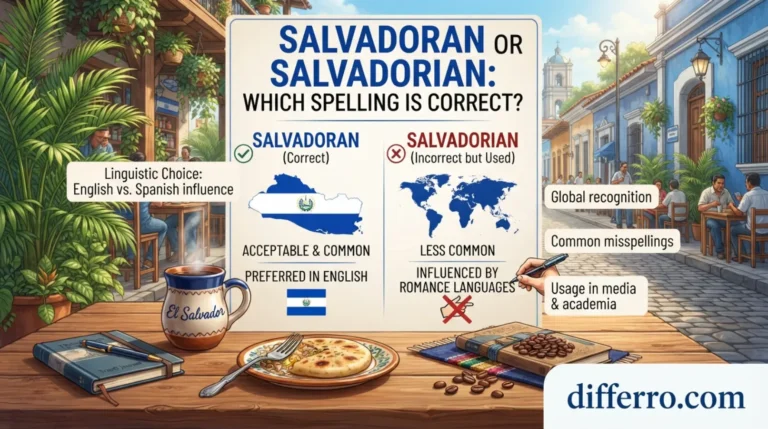
Salvadoran or Salvadorian? Both terms describe people, culture, and things connected to El Salvador. However, one spelling has stronger support in standard English usage. Many writers feel confused because both forms look correct and appear in different contexts.
Salvadoran is the standard and widely preferred term for someone or something from El Salvador. Salvadorian also appears in English, but it is less common. You may encounter both spellings in articles, conversations, and online searches.
Choosing the right word matters when writing about nationality, history, food, traditions, or culture. This guide explains their meanings, differences, origins, and correct usage. You will also learn which spelling works best in formal writing and everyday conversations.
⭐ Quick Answer
Salvadoran is the preferred and most widely accepted English spelling for someone or something from El Salvador. Salvadorian is also used, but it is less common.
Example: She is Salvadoran, and her family celebrates Salvadoran traditions.
📖 Meaning of Salvadoran
Salvadoran is an adjective and noun that refers to El Salvador, its people, or its culture.
As a noun, it describes a person from El Salvador or someone of Salvadoran nationality. As an adjective, it describes the country’s culture, traditions, food, or other connections.
Examples include:
- Salvadoran people
- Salvadoran culture
- Salvadoran food
- Salvadoran history
- Salvadoran traditions
Examples of Salvadoran
Example 1: My new neighbor is Salvadoran and speaks Spanish with her family.
Example 2: Pupusas are a popular part of Salvadoran cuisine.
Both sentences use Salvadoran correctly to describe nationality and cultural identity.
📖 Meaning of Salvadorian
Salvadorian is an alternative English term for a person or something connected to El Salvador.
It carries essentially the same meaning as Salvadoran. However, Salvadorian appears less frequently in standard English usage.
Some writers use it because they find the ending familiar or prefer its pronunciation. Nevertheless, Salvadoran remains the safer choice for formal writing and general communication.
Examples of Salvadorian
Example 1: He is Salvadorian and enjoys sharing stories about his family’s homeland.
Example 2: The restaurant serves traditional Salvadorian dishes.
Both examples communicate the intended meaning. However, many editors would prefer Salvadoran in these sentences.
🔍 Salvadoran or Salvadorian: Key Differences
The main difference involves spelling and usage, not meaning. Both words refer to the same country and cultural identity.
| Feature | Salvadoran | Salvadorian |
|---|---|---|
| Meaning | From or related to El Salvador | From or related to El Salvador |
| Tone | Standard and widely preferred | Less common alternative |
| Usage | Formal and informal English | Mostly alternative usage |
| Popularity | More widely used | Less widely used |
| Part of speech | Noun and adjective | Noun and adjective |
| Nationality | Salvadoran | Salvadorian |
| Cultural reference | Salvadoran culture | Salvadorian culture |
| Recommendation | Preferred spelling | Acceptable but less common |
Key point: Use Salvadoran when you want the most widely recognized and standard English form.
🕰️ Origin and History of Salvadoran and Salvadorian
Both terms derive from the name El Salvador, a country in Central America. The country’s name means “The Savior” in Spanish.
English adopted Salvadoran as the established demonym and adjective. The ending “-an” appears in many English nationality words.
Salvadorian developed as an alternative form with the familiar “-ian” ending. English sometimes uses this ending for nationalities and cultural identities.
However, Salvadoran became the more established form in dictionaries, journalism, and general English writing.
Similar Nationality Words
English uses different endings to describe people from different countries.
- American: A person from the United States.
- Mexican: A person from Mexico.
- Guatemalan: A person from Guatemala.
- Honduran: A person from Honduras.
- Canadian: A person from Canada.
- Colombian: A person from Colombia.
- Salvadoran: A person from El Salvador.
These examples show that English does not follow one universal rule for nationality endings.
🇬🇧 British English vs American English Spelling
Salvadoran is the preferred spelling in both British and American English. Salvadorian also appears as an alternative in both varieties.
Unlike words such as colour and color, this comparison does not involve a standard regional spelling difference.
British vs American English Comparison
| Feature | British English | American English |
|---|---|---|
| Preferred spelling | Salvadoran | Salvadoran |
| Alternative spelling | Salvadorian | Salvadorian |
| Nationality meaning | Same | Same |
| Cultural usage | Salvadoran culture | Salvadoran culture |
| Formal writing | Salvadoran | Salvadoran |
| Regional spelling difference | No major difference | No major difference |
✍️ When to Use Salvadoran
Use Salvadoran when describing people, nationality, language communities, food, traditions, or anything connected to El Salvador.
It is the strongest choice for academic writing, journalism, business communication, and everyday English.
1. Describing Nationality
Use Salvadoran when identifying someone’s nationality.
Example: My colleague is Salvadoran and grew up in San Salvador.
2. Describing Food and Culture
Use Salvadoran when discussing traditional dishes, customs, and cultural practices.
Example: Salvadoran pupusas are popular among locals and international visitors.
3. Writing News and Educational Content
Use Salvadoran in articles, reports, research, and educational materials.
Example: The article explores Salvadoran history and its cultural influences.
4. Discussing Communities
Use Salvadoran when describing people with connections to El Salvador.
Example: The city has a growing Salvadoran community.
✍️ When to Use Salvadorian
Use Salvadorian when quoting a source, preserving someone’s preferred wording, or discussing an existing text that uses this alternative.
The spelling communicates the same general meaning. However, Salvadoran remains preferable when you have no specific reason to choose the alternative.
1. Quoting Someone
You can preserve Salvadorian when someone uses it in a direct quotation.
Example: The speaker described herself as Salvadorian during the interview.
2. Discussing Alternative Usage
Use Salvadorian when explaining the spelling variation itself.
Example: Salvadorian is an alternative form of Salvadoran.
3. Preserving Original Text
You may retain Salvadorian in a historical document or source title.
Example: The old publication uses the term Salvadorian throughout its article.
4. Reflecting Personal Preference
Some individuals may prefer Salvadorian when describing their background.
Example: She personally identifies as Salvadorian and uses that spelling in her biography.
Respect an individual’s preferred description when discussing their identity.
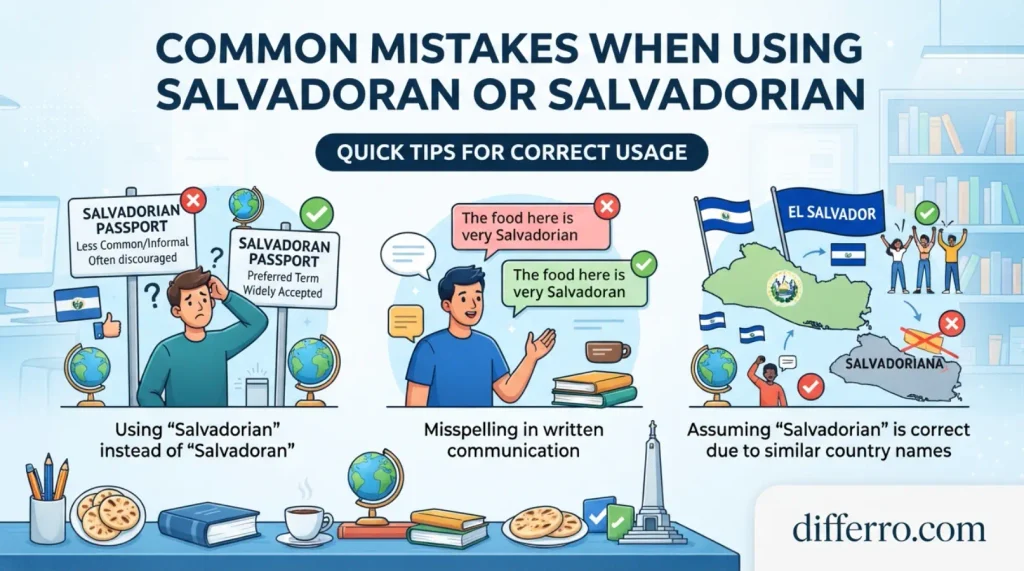
⚠️ Common Mistakes When Using Salvadoran or Salvadorian
Mistake 1: Treating Both Spellings as Equally Common
Incorrect: Salvadoran and Salvadorian have exactly the same popularity.
Correct: Salvadoran is the more widely preferred form in standard English.
Mistake 2: Thinking Salvadorian Refers to a Different Nationality
Incorrect: Salvadorian describes someone from a different country.
Correct: Both terms refer to El Salvador and its people.
Mistake 3: Using Salvadoran as the Country’s Name
Incorrect: I am planning a vacation to Salvadoran.
Correct: I am planning a vacation to El Salvador.
Salvadoran describes nationality or cultural connections, not the country’s official name.
Mistake 4: Confusing Salvadoran With Spanish
Incorrect: Every Salvadoran person is from Spain.
Correct: Salvadoran refers to El Salvador, a country in Central America.
Spanish is widely spoken in El Salvador, but the nationality is Salvadoran.
Mistake 5: Changing Someone’s Preferred Identity Label
Incorrect: Everyone must use Salvadoran, even when someone prefers Salvadorian.
Correct: Salvadoran is the standard recommendation, but respect personal preferences.
Mistake 6: Mixing Both Spellings in One Article
Incorrect: The Salvadoran community celebrates Salvadorian traditions.
Correct: The Salvadoran community celebrates Salvadoran traditions.
Choose one spelling for consistent editorial style unless discussing the alternative.
🧠 Easy Trick to Remember
Remember this simple spelling tip:
Salvadoran = Standard choice.
The word ends with “-an,” like Guatemalan and Honduran.
Use Salvadoran for most writing situations. Remember Salvadorian as a less common alternative.
This small memory trick can help you avoid spelling confusion.
🌎 Everyday-Life Examples: Salvadoran or Salvadorian
1. Introducing Someone
Correct: Maria is Salvadoran, and she lives in Los Angeles.
Alternative: Maria is Salvadorian, and she lives in Los Angeles.
Both sentences communicate the same nationality. Salvadoran is the preferred spelling.
2. Talking About Traditional Food
Correct: My friend introduced me to delicious Salvadoran food.
Alternative: My friend introduced me to delicious Salvadorian food.
Both forms describe food connected to El Salvador.
3. Discussing Family Background
Correct: His parents have Salvadoran roots.
Alternative: His parents have Salvadorian roots.
Both expressions describe a family connection to El Salvador.
4. Writing a School Assignment
Correct: Salvadoran culture includes distinctive traditions, music, and cuisine.
Alternative: Salvadorian culture includes distinctive traditions, music, and cuisine.
The first sentence is the stronger choice for standard academic writing.
5. Writing a News Article
Correct: The report highlights the experiences of Salvadoran immigrants.
Alternative: The report highlights the experiences of Salvadorian immigrants.
Use Salvadoran for consistency with common editorial conventions.
🌍 Google Trends and Usage Insights: Five Countries
Google Trends measures relative search interest, not exact search volume. The following observations are general expectations, not verified live rankings.
- USA: Both spellings may appear in searches about nationality, immigration, and Central American culture.
- UK: Salvadoran is the preferred editorial form for general English writing.
- Australia: Writers may encounter both variations when researching El Salvador and its people.
- India: Searchers may use both forms when learning nationality words and English spelling.
- Pakistan: Users may search for the correct spelling when writing about El Salvador or its culture.
SEO insight: Compare both exact phrases in Google Trends using the same date range and country filters. Include related searches to understand user intent. Do not assume search popularity from spelling preference alone.
Comparison Table: Keyword Variations
| Keyword variation | Search intent | Suggested usage |
|---|---|---|
| Salvadoran or Salvadorian | Spelling comparison | Main title |
| Salvadoran vs Salvadorian | Direct comparison | Key differences |
| Salvadoran meaning | Definition | Meaning section |
| Salvadorian meaning | Alternative spelling | Meaning section |
| Is Salvadorian correct? | Spelling question | FAQ |
| Salvadoran nationality | Informational | Nationality examples |
| Correct spelling of Salvadoran | Spelling clarification | Conclusion |
❓ Frequently Asked Questions
1. Is Salvadorian a correct spelling?
Yes. Salvadorian is an alternative English spelling for someone or something connected to El Salvador. However, Salvadoran is the more widely preferred form.
2. What is the difference between Salvadoran and Salvadorian?
Both words have essentially the same meaning. Salvadoran is the standard and more common spelling, while Salvadorian is a less common alternative.
3. Which is more common, Salvadoran or Salvadorian?
Salvadoran is more common in standard English usage. It appears more frequently in general writing, journalism, and references to nationality.
4. Which spelling should I use in formal writing?
Use Salvadoran in academic papers, professional documents, news articles, and general publications. It is the safer and more widely recognized choice.
5. Why do people confuse Salvadoran and Salvadorian?
Both spellings come from the name El Salvador and describe the same nationality. The different endings create confusion because English uses both “-an” and “-ian” in nationality words.
🏆 Final Verdict: Salvadoran or Salvadorian?
Salvadoran is the better choice for standard English writing. It is the more widely accepted and commonly used term for people and things connected to El Salvador.
Salvadorian is also understandable and appears as an alternative spelling. However, most writers should choose Salvadoran for clarity and consistency.
Use Salvadoran when describing nationality, food, culture, history, traditions, and communities. Use Salvadorian when quoting an original source or respecting someone’s preferred identity label.
Both spellings communicate the same general meaning. The main difference involves popularity and editorial preference, not nationality or definition.
If you are unsure, choose Salvadoran. It is the safest option for everyday communication, academic writing, and SEO content.
Conclusion
Salvadoran or Salvadorian is a common spelling question for English writers. Both terms describe people, culture, and things connected to El Salvador. However, Salvadoran is the standard and more widely preferred spelling.
Salvadorian remains an alternative form, but writers use it less frequently. Both words communicate essentially the same meaning and do not represent different nationalities. For professional articles, academic work, and everyday communication, Salvadoran offers the clearest choice. You can use Salvadorian when quoting original material or respecting someone’s personal preference. Remember that Salvadoran is the safest option when you want consistent and widely recognized English usage.


1 thought on “Salvadoran or Salvadorian: Which Spelling Is Correct?”