
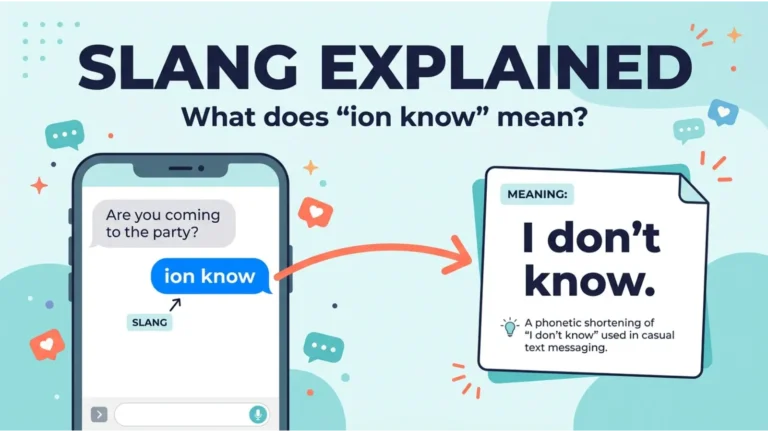
Ion meaning slang is a common search for people who see this short expression in text messages, TikTok comments, Snapchat conversations, or social media posts.
If someone sends you a message like “ion know” or “ion wanna go,” you might wonder whether it is a new abbreviation, a typing mistake, or a completely different word. The good news is that its meaning is simple once you understand how people use it in everyday conversations.
Internet slang often changes the way people write familiar English phrases. Instead of typing complete sentences, users shorten words to make messages feel quicker, more relaxed, and more natural. Ion is one example of this informal writing style, especially in casual online conversations.
Quick Answer:
In texting and slang, ion usually means “I don’t” and is a casual, phonetic spelling of the phrase. For example, “ion know” means “I don’t know.”
What Does Ion Mean in Text?
The slang term ion usually means “I don’t” in text messages and online conversations. It is commonly used in informal digital communication, particularly in some varieties of African American English and internet slang.
People use ion because it represents how the phrase “I don’t” may sound when spoken casually. It is not a formal English contraction, but it is widely recognizable in certain online communities.
Here are a few simple examples:
- Ion know: I don’t know.
- Ion care: I don’t care.
- Ion want it: I don’t want it.
- Ion think so: I don’t think so.
The exact meaning depends on the rest of the sentence. When you see ion before a verb, try replacing it with “I don’t” to understand the message.
Ion Meaning Slang: Full Form and Definition
People sometimes search for the ion full form because they assume the term is an abbreviation made from several words.
In texting slang, however, ion generally does not have a fixed letter-by-letter full form. It is an informal spelling representing the pronunciation of “I don’t.”
For example:
| Slang expression | Standard English meaning |
|---|---|
| Ion know | I don’t know |
| Ion feel like it | I don’t feel like it |
| Ion understand | I don’t understand |
| Ion need that | I don’t need that |
| Ion believe you | I don’t believe you |
Remember that ION also has other meanings. In chemistry, an ion is an electrically charged atom or molecule. In some technical contexts, ION may also be an acronym.
The surrounding words help you determine which meaning is intended.
Ion Meaning in Different Contexts
The expression can communicate different feelings depending on the sentence, situation, and relationship between the people talking.
1. Ion Meaning in Text Messages
In everyday texting, ion usually replaces “I don’t.”
Example:
“Are you coming tonight?”
“Ion know yet.”
The person means they are not sure whether they will come.
2. Ion Meaning on TikTok
On TikTok, ion often appears in captions, comments, memes, and videos featuring casual speech.
For example:
“Ion even know why this is so funny.”
This means “I don’t even know why this is so funny.”
The expression helps the text match the creator’s conversational style.
3. Ion Meaning on Snapchat
On Snapchat, people may use ion to communicate quickly with friends.
Example:
“Ion got your snap.”
This means “I don’t have your Snap” or, depending on context, “I didn’t get your Snap.”
The intended meaning can vary slightly with the situation.
4. Ion Meaning on Instagram
Instagram users may write ion in comments, captions, or direct messages.
Example:
“Ion care what anyone says.”
This means “I don’t care what anyone says.”
Depending on the context, the sentence may sound confident, playful, dismissive, or confrontational.
Is Ion Rude, Offensive, or Neutral?
Ion is generally informal rather than offensive. The word itself is not usually a swear word or insult.
However, the sentence containing it can sound rude.
Consider these examples:
- “Ion know lol” — casual and friendly.
- “Ion care 😂” — potentially playful, depending on the relationship.
- “Ion care what you think” — potentially dismissive or confrontational.
The difference comes from the message’s meaning and tone, not simply from the slang term.
For professional emails, academic assignments, job applications, or formal conversations, it is better to use standard English such as “I don’t know.”
Where Is Ion Commonly Used?
Ion appears in several types of informal communication:
- Text messages between friends.
- TikTok captions and comments.
- Snapchat messages.
- Instagram comments and direct messages.
- Memes and online jokes.
- Informal conversations represented in writing.
The expression is associated with certain spoken varieties of English, including African American English, and has spread through social media and internet culture.
Its use is not limited to one location or demographic. However, not everyone uses or interprets the term in the same way.
Real-Life Conversation Examples of Ion
The best way to understand ion meaning slang is to see how it works in different conversations.
Friendly Examples
Example 1
Person A: “Do you want some pizza?”
Person B: “Ion want any rn, but thanks!”
Meaning: “I don’t want any right now, but thanks!”
Example 2
Person A: “You coming to my birthday party?”
Person B: “Ion know yet 😂”
Meaning: “I don’t know yet.”
Casual Examples
Example 3
Person A: “Did you watch the new episode?”
Person B: “Ion watch that show anymore.”
Meaning: “I don’t watch that show anymore.”
Example 4
Person A: “Why didn’t you reply?”
Person B: “Ion see your message.”
Meaning: “I didn’t see your message” or “I don’t see your message,” depending on the context.
Argumentative Examples
Example 5
Person A: “You have to agree with me.”
Person B: “Ion have to do anything.”
Meaning: “I don’t have to do anything.”
Example 6
Person A: “Everyone thinks you’re wrong.”
Person B: “Ion care what everyone thinks.”
Meaning: “I don’t care what everyone thinks.”
These examples show that ion can fit different situations. The tone depends on the complete sentence and the relationship between the speakers.
Emotional and Psychological Meaning of Ion
Ion does not have one specific psychological meaning. Instead, it can help communicate a person’s attitude or emotion.
Depending on the context, it may express:
- Uncertainty: “Ion know what happened.”
- Disinterest: “Ion feel like going out.”
- Confidence: “Ion need anyone’s approval.”
- Frustration: “Ion understand why you did that.”
- Humor: “Ion know why I’m laughing so hard.”
People often choose informal spellings because they feel more natural or reflect their everyday speech. However, you should not assume that someone is angry, sad, or disrespectful simply because they use ion.
Look at the whole conversation before interpreting the emotion.
Origin and Background of Ion Slang
Ion is generally understood as a phonetic representation of “I don’t” in informal speech and writing.
The pronunciation of “I don’t” can become compressed in casual conversation. Ion represents one way speakers write that pronunciation, particularly in some varieties of African American English and related online language styles.
Social media has helped make the expression more visible. TikTok videos, memes, music, and messaging culture allow informal expressions to spread between communities.
There is no single verified date when ion first appeared as slang, so it is best not to assign it an exact origin without reliable historical evidence.
It is also important to distinguish the slang use from the established scientific meaning of ion.
Ion vs. Similar Slang Terms
Ion is not the only informal expression people use in digital conversations. Other terms may look similar or communicate related ideas.
| Slang term | Meaning | Example |
|---|---|---|
| Ion | I don’t | Ion know |
| IDK | I don’t know | IDK what happened |
| IDC | I don’t care | IDC about the result |
| IDGAF | I don’t give a f*** | IDGAF what they say |
| IMO | In my opinion | IMO, it’s a good idea |
| I ain’t | Informal form expressing negation | I ain’t going |
The main difference is that ion substitutes for “I don’t,” while IDK and IDC abbreviate complete phrases. IDGAF is much stronger and includes profanity, so it should be used more carefully.
When Should You Use Ion and When Should You Avoid It?
Ion works best when the conversation is casual and the other person understands internet slang.
When to use ion
- Chatting with friends.
- Writing casual social media comments.
- Sharing memes or jokes.
- Matching an informal conversational style.
- Communicating in communities where the expression is familiar.
When to avoid ion
- Writing professional emails.
- Applying for jobs.
- Completing academic assignments.
- Communicating with clients or supervisors.
- Speaking with people who may not understand the slang.
In formal settings, use the standard phrase “I don’t.” It is clearer, more widely understood, and appropriate for nearly every audience.
Polite Alternatives to Ion
Because ion is not inherently offensive, it does not always need a polite replacement. Still, standard English can make your message sound clearer or more respectful.
| Informal expression | Clear or polite alternative |
|---|---|
| Ion know | I’m not sure. |
| Ion care | I don’t have a strong preference. |
| Ion want to go | I’d rather not go. |
| Ion understand | Could you explain that again? |
| Ion agree | I see it differently. |
| Ion feel like it | I don’t feel up to it right now. |
For example, instead of saying “Ion care,” you could write “I’m okay with either option” if you want to express flexibility rather than disinterest.
Why Do People Use Ion?
People use ion for several practical and social reasons.
1. It is quick to type. Informal spellings can make messages feel faster and less structured.
2. It reflects spoken language. Some people write the way they naturally speak.
3. It creates a casual tone. Ion can make a message sound relaxed among people who regularly use it.
4. It fits internet culture. Short expressions work well in comments, captions, memes, and quick replies.
5. It communicates identity and community. Language can reflect a person’s background, social environment, and online communities. Ion should not be treated as evidence of any one person’s identity, though.
Impact of Using Ion in Communication
Slang can make digital conversations feel natural and expressive, but it can also create misunderstandings.
When both people recognize ion, the message is usually easy to understand. When one person is unfamiliar with the term, they may mistake it for a typo or the scientific word.
Using slang in a formal setting can also make a message seem less professional than intended.
A useful rule is to adjust your language to your audience. Casual expressions are fine among friends, while standard English is often more effective in professional and academic communication.
Is Ion Safe to Use on Social Media?
Yes. Ion itself is generally safe to use on social media. It is an informal expression rather than inherently harmful or abusive language.
However, the content surrounding it matters. A sentence such as “Ion care about that trend” is usually harmless, while a message attacking another person can still be hurtful regardless of the slang used.
For public posts, consider whether your audience will understand the expression. For private messages, follow the communication style that feels natural and respectful to both people.
Common Misunderstandings About Ion
People sometimes misunderstand ion for several reasons.
- Thinking it always means a scientific ion: In a casual text, it usually means “I don’t” when used before a verb.
- Assuming it is an acronym: The slang use is generally a phonetic spelling, not a fixed abbreviation.
- Believing it is always rude: Its tone depends on the complete sentence.
- Confusing it with IDK: Ion means “I don’t,” while IDK means “I don’t know.”
- Assuming everyone uses it the same way: Slang varies between communities, regions, and individuals.
The best way to interpret the expression is to read the surrounding words and consider the conversation.
Variations and Types of Ion Usage
Ion is flexible and may appear in different sentence patterns.
- Ion know: Expresses uncertainty.
- Ion care: Expresses a lack of concern or interest.
- Ion want: Expresses a lack of desire.
- Ion think: Introduces an opinion or belief.
- Ion even: Adds emphasis, as in “Ion even understand.”
These are informal writing patterns, not separate official definitions. The basic idea usually remains “I don’t,” although the intended meaning depends on the sentence.
How to Respond When Someone Uses Ion
Your response should depend on what the person is saying.
- If they say “Ion know,” you can reply, “No worries” or “That’s okay.”
- If they say “Ion care,” you can ask, “Do you mean you’re okay with either option?”
- If they say “Ion understand,” you can explain the situation more clearly.
- If you cannot understand the message, simply ask, “What do you mean by ion?”
There is no need to correct someone’s spelling during a casual conversation unless clarification is necessary.
Regional and Cultural Usage of Ion
Ion is associated with informal speech patterns, including African American English, and is now recognizable in wider online slang communities.
Its popularity on social media has exposed more people to the expression, but its frequency and interpretation can vary by community.
In some conversations, ion may feel completely ordinary. In others, readers may not recognize it immediately. Understanding this variation helps people interpret slang without making assumptions about the person using it.
FAQs About Ion Meaning Slang
1. What does ion mean in texting?
Ion usually means “I don’t” in texting. For example, “ion know” means “I don’t know.”
2. What does ion stand for?
In slang, ion is generally a phonetic spelling of “I don’t,” rather than an abbreviation with a fixed full form.
3. What does ion mean on TikTok?
On TikTok, ion usually means “I don’t.” It appears in captions, comments, memes, and casual conversations.
4. Is ion the same as IDK?
No. Ion means “I don’t,” while IDK means “I don’t know.” For example, “ion care” means “I don’t care.”
5. Is ion rude?
Not by itself. Ion is informal, but the sentence and tone can make a message sound rude, playful, or neutral.
6. Can I use ion in formal writing?
It is best to avoid ion in formal writing. Use “I don’t” instead, especially in academic work, professional emails, and official documents.
Conclusion
Understanding ion meaning slang is simple once you know that it usually represents “I don’t” in informal digital communication. Expressions such as “ion know,” “ion care,” and “ion want to go” are common examples of how the term appears in texting and social media.
Although ion is generally neutral, the meaning and emotional tone of a message depend on the surrounding words and situation. It is useful for casual conversations with people who understand the expression, but standard English is a better choice for professional and academic writing.
The most important thing is to consider context. When you see ion in a message, read the full sentence before deciding what the person means.

Ali Raza is an M.Phil. scholar and English language expert specializing in English grammar, slang meanings, vocabulary, and everyday expressions. He writes clear, practical, and easy-to-understand content that helps readers master confusing English words, phrases, spelling, and modern slang. His goal is to make English learning simple, useful, and accessible for students, beginners, and everyday readers.
1 thought on “Ion Meaning Slang Full Form and Usage”