
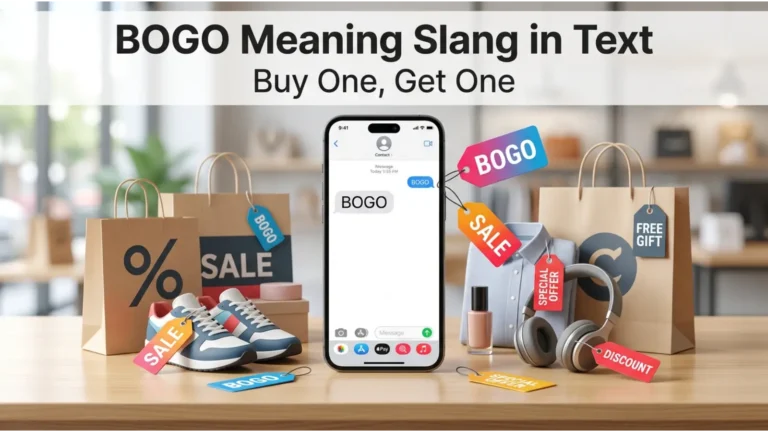
If you have seen “bogo meaning slang” in a search, text, social media post, or shopping message, you may be wondering what these four letters actually mean.
BOGO is especially common in conversations about sales, food, clothing, beauty products, and online shopping. You may also see it in captions such as “BOGO today” or “There’s a BOGO deal on pizza.”
Although some people call it slang, BOGO is more accurately an abbreviation used in retail and casual communication. Major dictionaries define it as an abbreviation for “buy one, get one.”
Quick Answer:
BOGO means “Buy One, Get One.” It usually describes a promotion where you buy one item and receive another free or at a reduced price.
What Does BOGO Mean in Text?
The most common BOGO meaning in text is “Buy One, Get One.”
People use BOGO when talking about special offers, discounts, coupons, restaurants, stores, and online shopping.
For example:
“The pizza place has a BOGO deal tonight.”
This means the restaurant has a buy-one-get-one promotion. The exact offer can vary, so the second item may be free or discounted. Cambridge Dictionary specifically defines BOGO as an abbreviation for “buy one get one.”
BOGO is therefore better understood as a shopping abbreviation than traditional slang like LOL or OMG.
BOGO Full Form
The BOGO full form is:
B = Buy
O = One
G = Get
O = One
So:
BOGO = Buy One, Get One
You may also see BOGOF, which means “Buy One, Get One Free.” Cambridge lists BOGOF as the UK form commonly used for a buy-one-get-one-free offer.
What Does BOGO Stand For?
When someone asks, “What does BOGO stand for?”, the usual answer is Buy One, Get One.
The phrase is mainly connected with sales and promotional offers. For example:
- BOGO shoes
- BOGO pizza
- BOGO coffee
- BOGO skincare
- BOGO shirts
- BOGO groceries
- BOGO tickets
The important point is that BOGO does not automatically mean the second item is completely free. Some businesses use BOGO for promotions where the second product is discounted.
Always check the details of the particular promotion.
Meaning Of BOGO in Different Contexts
BOGO can appear in several everyday situations.
BOGO in Text Messages
Friends may use BOGO when sharing a deal.
Example:
“There’s a BOGO deal on burgers tonight!”
The sender is telling the other person about a buy-one-get-one promotion.
BOGO on Social Media
You may see BOGO in Instagram captions, Facebook posts, TikTok shopping content, or promotional posts.
Example:
“BOGO sale starts today! 🛍️”
Here, BOGO is being used to make the promotion short and easy to notice.
BOGO in Shopping
Retailers commonly use BOGO to advertise special offers.
Example:
“These shirts are BOGO this weekend.”
The exact terms depend on the store’s promotion.
BOGO at Restaurants
Restaurants may use BOGO for food and drinks.
Example:
“Pizza is BOGO after 6 PM.”
This tells customers that the restaurant has a buy-one-get-one promotion.
Is BOGO Rude, Offensive, or Neutral?
In its standard meaning, BOGO is neutral.
It is not normally a rude or offensive expression. It is simply an abbreviation associated with shopping and promotions.
For example:
“I found a BOGO deal on shampoo.”
There is nothing offensive about this sentence.
However, context matters because BOGO can have unusual meanings in some user-generated slang sources. Those meanings are much less common than the standard “Buy One, Get One” meaning. If you see BOGO in an unfamiliar context, look at the surrounding conversation before assuming what it means.
Where Is BOGO Commonly Used?
BOGO is particularly common in:
- Retail stores
- Grocery shopping
- Restaurants
- Online stores
- Coupons
- Advertising
- Text messages
- Social media
- Promotional emails
- Shopping apps
The term is especially associated with American English. Collins describes BOGO as an American abbreviation and notes that the UK equivalent is often BOGOF.
How Do You Pronounce BOGO?
BOGO is generally pronounced as one word:
BOH-go
It is not normally pronounced by saying each letter separately.
Collins gives the pronunciation as approximately /ˈboʊˌgoʊ/ in American English.
For example:
“They have a BOGO sale.”
You would say it naturally as “BOH-go sale.”
Real-Life BOGO Conversation Examples
Here are some examples showing how people might use BOGO naturally.
Friendly
A: “Want to get some coffee?”
B: “Sure! There’s a BOGO offer at the café.”
Casual
A: “Did you see the shoe sale?”
B: “Yeah, they’re doing BOGO this weekend.”
Shopping
A: “Why did you buy two shampoos?”
B: “They were BOGO, so I got the second one free.”
Restaurant
A: “What should we order tonight?”
B: “Pizza. There’s a BOGO promotion.”
Social Media
“Found a great BOGO deal on my favorite snacks!”
Promotional Message
“BOGO weekend starts Friday. Check the store for details.”
Emotional and Psychological Meaning of BOGO
BOGO does not have a special emotional or psychological meaning by itself.
However, people may use it because promotional language creates a sense of value or urgency.
For example:
“Hurry! BOGO ends tonight!”
The word BOGO can make an offer sound attractive because customers immediately associate it with getting more than one item for their money.
That does not mean every BOGO promotion provides the same level of savings. The actual terms matter.
Origin and Background of BOGO
BOGO comes from the phrase “Buy One, Get One.” It developed from retail and promotional language as businesses looked for short ways to describe sales offers.
Today, dictionaries recognize BOGO as an established abbreviation. Cambridge lists it as the American form, while BOGOF is commonly associated with British usage.
So although people sometimes search for BOGO meaning slang, its standard meaning comes from advertising and retail rather than from internet slang.
BOGO vs. BOGOF vs. Two for One
These terms are closely related but are not always identical.
| Term | Meaning | Common Use |
|---|---|---|
| BOGO | Buy One, Get One | Retail and online shopping |
| BOGOF | Buy One, Get One Free | Especially common in UK English |
| Two for One | Get two items for the price of one | Retail and promotions |
| 50% Off | Item is sold at half price | General discounts |
A BOGO promotion can have different conditions. Always read the offer details to determine whether the second item is free or discounted.
When Should You Use BOGO?
BOGO is useful when discussing:
- Shopping deals
- Sales
- Coupons
- Restaurant promotions
- Grocery offers
- Online discounts
- Social media promotions
For example:
“I found a BOGO deal on sneakers.”
This sounds natural in a casual conversation.
When Should You Avoid Using BOGO?
You may want to avoid BOGO when your audience does not know the abbreviation.
For formal or professional writing, write the full phrase the first time:
“We are offering a Buy One, Get One promotion this weekend.”
Later, you can introduce BOGO if appropriate.
This is especially useful in business communication where clarity is more important than brevity.
Common Misunderstandings About BOGO
1. BOGO always means free
Not necessarily.
BOGO stands for Buy One, Get One, while the exact promotion can vary. Some offers provide the second item free, while others provide it at a discount.
2. BOGO is always slang
Not exactly.
BOGO is more accurately described as an abbreviation or promotional term.
3. BOGO means two items for half price
Not necessarily.
The savings depend on the specific terms of the promotion.
4. BOGO is pronounced letter by letter
Usually, no. It is commonly pronounced as “BOH-go.”
Variations and Types of BOGO
You may encounter several forms of BOGO offers:
- BOGO Free: Buy one and receive another free.
- BOGO 50% Off: Buy one and get another at half price.
- BOGO Discount: Second item is discounted.
- BOGO Deal: General term for a buy-one-get-one promotion.
- BOGOF: Buy One, Get One Free.
Because businesses can define their promotions differently, check the fine print before purchasing.
How to Respond When Someone Uses BOGO
If someone sends you:
“There’s a BOGO deal at the mall.”
You can respond naturally:
- “Nice! What store?”
- “What does the deal include?”
- “Is the second one free?”
- “Let’s go!”
- “Thanks for letting me know.”
If you’re unsure what they mean, simply ask:
“What does BOGO mean here?”
Regional and Cultural Usage
BOGO is particularly common in American retail English. Cambridge identifies BOGO as the US form, while BOGOF is associated with UK English.
You may still encounter BOGO internationally, especially on websites, social media, and global shopping platforms.
The meaning usually remains connected to Buy One, Get One.
Is BOGO Safe for Social Media?
Yes. The standard meaning of BOGO is generally safe and neutral for social media.
You can use it in posts such as:
“BOGO sale today!”
or:
“Found a BOGO deal on my favorite snacks!”
However, because abbreviations can occasionally have multiple meanings, context is important. If you are creating content for a broad audience, writing “Buy One, Get One” may be clearer.
Why Do People Use BOGO?
People use BOGO because it is:
- Short
- Easy to remember
- Common in shopping
- Convenient for advertisements
- Easy to use in texts
- Useful in social media captions
A short abbreviation can communicate a familiar promotion without requiring the entire phrase.
FAQs About BOGO Meaning Slang
What does BOGO mean in text?
BOGO usually means “Buy One, Get One.” It is commonly used when talking about sales, discounts, and promotional offers.
What does BOGO stand for?
BOGO stands for Buy One, Get One.
Is BOGO slang or an abbreviation?
BOGO is more accurately an abbreviation used in retail and casual communication rather than traditional slang.
Does BOGO mean buy one get one free?
Not always. BOGO means Buy One, Get One, but the second item may be free or discounted depending on the promotion.
Is BOGO rude?
No. The standard meaning of BOGO is neutral and is not considered rude or offensive.
What is the difference between BOGO and BOGOF?
BOGO means Buy One, Get One, while BOGOF specifically means Buy One, Get One Free. BOGOF is particularly associated with UK usage.
Conclusion
The standard BOGO meaning slang is “Buy One, Get One.” It is mainly a retail and shopping abbreviation used in texts, social media, advertisements, coupons, restaurants, and online stores.
BOGO is generally neutral and easy to use in casual conversations. Just remember that BOGO does not always guarantee that the second item is completely free. The specific terms of the offer determine what you actually receive.
If you see BOGO in a shopping message, the simplest interpretation is Buy One, Get One. When the context is unclear, check the surrounding conversation or ask what the person means.

Ali Raza is an M.Phil. scholar and English language expert specializing in English grammar, slang meanings, vocabulary, and everyday expressions. He writes clear, practical, and easy-to-understand content that helps readers master confusing English words, phrases, spelling, and modern slang. His goal is to make English learning simple, useful, and accessible for students, beginners, and everyday readers.
1 thought on “BOGO Meaning Slang in Text: What Does BOGO Mean?”