
Affect vs Effect confuses many English learners and native speakers. The two words sound similar but usually have different grammatical roles.
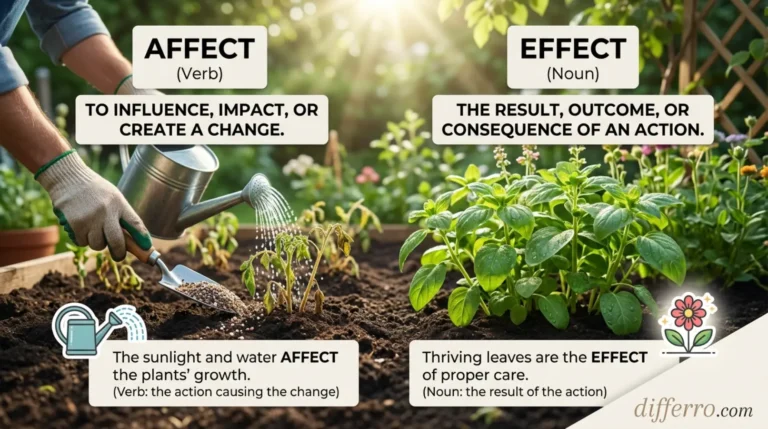
Affect usually works as a verb. It means to influence something or someone. Effect usually works as a noun. It means a result or outcome.
For example, you can say, “Stress can affect your sleep.” You can also say, “Stress can have an effect on your sleep.”
The main difference becomes easier when you focus on their roles. Affect usually describes an action or influence. Effect usually describes the result of that influence.
However, both words have less common uses. Effect can also work as a verb. Affect can also work as a noun in psychology.
This guide explains Affect vs Effect with simple definitions and everyday examples.
⭐ Quick Answer
Affect vs Effect: Affect is usually a verb meaning “to influence.” Effect is usually a noun meaning “a result.”
Example: “The weather affected our plans.” “The weather had an effect on our plans.”
Meaning of Affect
Affect usually means to influence someone or something.
It normally functions as a verb. You use it when one thing changes, influences, or impacts another thing.
Examples of Affect
- Lack of sleep can affect your concentration.
- The rain affected our travel plans.
Think of affect as an action that causes an influence.
For example, loud noise can affect your ability to focus. A teacher’s advice can affect a student’s decision.
Meaning of Effect
Effect usually means the result or outcome of something.
It normally functions as a noun. You use it when discussing what happened because of an action.
Examples of Effect
- The medicine had a positive effect.
- The new rule had little effect on attendance.
Think of effect as the result that follows an action.
For example, exercise can affect your health. Better health can be an effect of regular exercise.

🔍 Affect vs Effect: Key Differences
| Feature | Affect | Effect |
|---|---|---|
| Basic meaning | To influence | A result or outcome |
| Common role | Verb | Noun |
| Typical question | What does it influence? | What result did it produce? |
| Tone | Common and neutral | Common and neutral |
| Usage | Describes influence | Describes consequence |
| Popularity | Very common | Very common |
| Example | Noise can affect sleep. | Noise can have an effect on sleep. |
The easiest distinction is action versus result.
When something affects another thing, it influences it. The resulting change can be called an effect.
📚 Origin and History of Affect vs Effect
Affect and effect come from Latin roots. Their meanings developed through French and Middle English.
Affect comes from the Latin afficere, meaning to influence or act upon. Effect comes from the Latin efficere, meaning to accomplish or bring about.
English later developed several meanings for both words.
This history explains why their forms look and sound so similar. Their different meanings still help distinguish them today.
Similar word pairs can also cause confusion:
- Advice / Advise
- Practice / Practise
- Compliment / Complement
- Principal / Principle
- Accept / Except
These pairs often differ in meaning or grammatical function.
🇬🇧 British English vs 🇺🇸 American English Spelling
Affect and effect have the same spelling in British and American English.
Their pronunciation and grammatical uses also remain largely the same.
Therefore, you do not need different spellings for Affect vs Effect in the UK or US.
British vs American English
| Word | British English | American English |
|---|---|---|
| Affect | Affect | Affect |
| Effect | Effect | Effect |
| Meaning | Same | Same |
| Common usage | Influence/result | Influence/result |
This makes Affect vs Effect different from words such as colour/color or organise/organize.
✍️ When to Use Affect
Use affect when you mean influence.
In most everyday sentences, it acts as a verb.
Examples
- Cold weather can affect your health.
- The news affected her mood.
- Poor planning may affect the project’s success.
- Social media can affect buying decisions.
A useful structure is:
Something + affects + something
For example:
Lack of exercise can affect your energy level.
Here, lack of exercise influences your energy level.
Less Common Noun Use of Affect
In psychology, affect can function as a noun.
It describes the visible expression of someone’s emotional state.
Example:
- The patient showed a flat affect.
This meaning appears mainly in psychology and medical writing. It is less common in everyday English.
📝 When to Use Effect
Use effect when you mean result or outcome.
It usually works as a noun.
Examples
- The medicine had a strong effect.
- The decision had a positive effect.
- Exercise has many health effects.
- The new policy had little effect.
A useful structure is:
Something + has an effect + on something
For example:
Stress can have an effect on your sleep.
Here, effect refers to the result or influence produced by stress.
Effect as a Verb
Effect can also work as a verb in formal English.
As a verb, it means to cause something to happen.
Example:
- The new policy will effect major changes.
This use is less common in everyday conversation.
Do not confuse it with:
- The policy will affect employees.
Here, affect means the policy will influence employees.
⚠️ Common Mistakes with Affect vs Effect
1. Using Effect When You Mean Influence
❌ The weather effected our plans.
✅ The weather affected our plans.
Use affect when something influences something else.
2. Using Affect When You Mean Result
❌ The medicine had a positive affect.
✅ The medicine had a positive effect.
Use effect when you mean a result.
3. Confusing “Affect” With “Effect On”
❌ The noise had a bad affect on my sleep.
✅ The noise had a bad effect on my sleep.
The phrase effect on commonly identifies a result or influence.
4. Using Effect as the Normal Verb for Influence
❌ Loud music effects my concentration.
✅ Loud music affects my concentration.
Use affects when you mean “influences.”
5. Confusing “Effect” With “Affect” in Formal Writing
❌ The changes will affect a complete transformation.
✅ The changes will effect a complete transformation.
Here, effect means “bring about.” This is a formal and less common use.
🧠 Easy Trick to Remember Affect vs Effect
Remember this simple rule:
Affect = Action
Effect = End result
Both Affect and Action begin with A.
Both Effect and End result begin with E.
Think of this sentence:
The rain affected our trip, and the cancellation was the effect.
The rain caused the influence. The cancellation was the result.
Another quick trick:
Affect → influence
Effect → result
When you can replace the word with influence, choose affect.
When you can replace it with result, choose effect.
🌟 Affect vs Effect in Everyday Life
1. Health and Sleep
Poor sleep can affect your mood during the day.
The effect may include tiredness and poor concentration.
This example shows the basic relationship clearly. Sleep influences your mood, while tiredness becomes a result.
2. Weather and Travel
Heavy rain can affect your travel plans.
One possible effect is a delayed or cancelled trip.
Here, affect describes the influence. Effect describes the resulting situation.
3. School and Learning
A supportive teacher can affect a student’s confidence.
Higher confidence can have a positive effect on learning.
This example uses both words naturally. The teacher influences confidence. Improved confidence produces a result.
4. Work and Business
A price increase can affect customer behavior.
One effect may be lower sales.
Businesses often study how changes affect customers. They also measure the effects of those changes.
5. Daily Decisions
Your choices can affect your future.
Every decision may have an effect on your goals.
This example shows why both words matter. Your choices create influences, while their consequences become effects.
📈 Google Trends and Usage Data
Affect and effect are both widely searched English confusion terms in major English-learning markets.
The United States generally represents the largest search market among the five countries. The UK also shows strong interest because both words are common in formal writing.
Australia follows similar English usage patterns. India and Pakistan show strong educational interest in spelling and grammar comparisons.
Search demand can change by season and location. Educational searches often increase around school and examination periods.
Usage Insight by Country
| Country | Common Search Interest | Main Search Intent |
|---|---|---|
| USA | Very high | Grammar and writing |
| UK | High | English usage |
| Australia | Moderate to high | Grammar confusion |
| India | High | Learning and exams |
| Pakistan | High | English learning |
The strongest content opportunity is not choosing one word as “better.” The real search intent is understanding when to use each word.
Keyword Variations Comparison
| Keyword Variation | Main Intent | Best Content Angle |
|---|---|---|
| Affect vs Effect | Comparison | Difference and examples |
| Affect or Effect | Spelling confusion | Correct choice |
| Affect and Effect | Learning | Meaning and usage |
| Difference Between Affect and Effect | Informational | Detailed comparison |
| Affect Meaning | Definition | Simple meaning |
| Effect Meaning | Definition | Simple meaning |
| How to Use Affect and Effect | Educational | Rules and examples |
⚖️ Final Verdict: Affect vs Effect
Neither word is better than the other.
Use affect when you mean influence.
Use effect when you mean result.
For example:
The stress affected his health.
The stress had a negative effect on his health.
Remember Affect = Action or influence and Effect = End result.
This simple rule works for most everyday writing.
Only remember the less common uses when you encounter formal, psychological, or technical writing.
❓ FAQ About Affect vs Effect
Is “affect” or “effect” correct?
Both words are correct. They have different meanings and grammatical uses. Affect usually means influence, while effect usually means result.
What is the main difference between affect and effect?
Affect usually functions as a verb and means “to influence.” Effect usually functions as a noun and means “a result.”
Which is more common, affect or effect?
Both are extremely common English words. Their frequency depends on context because they perform different grammatical roles.
Are affect and effect used in formal writing?
Yes. Both words are standard in formal writing. Correct usage matters more than choosing one word over the other.
Why do people confuse affect and effect?
They look and sound similar. Their meanings also relate to cause and result. This makes them easy to mix up.
🔗 3 Internal Linking Ideas
- Principal vs Principle: Explain another commonly confused English word pair.
- Advice vs Advise: Compare a noun and verb that learners often mix up.
- Practice vs Practise: Explain the spelling and usage differences across English varieties.
🏆 Conclusion
Affect vs Effect becomes much easier when you remember their basic roles. Affect usually means to influence and works as a verb. Effect usually means a result and works as a noun. For example, stress can affect your sleep. Poor sleep can then have an effect on your health.
The two words have other meanings too. However, their common everyday uses cover most writing situations. Use affect when describing an influence or action. Use effect when describing the resulting change or outcome.
Remember the simple trick: Affect = Action or influence. Effect = End result. With regular practice, you can quickly choose the correct word. This distinction will also make your emails, essays, and everyday writing clearer.
🎯 SEO Bonus
5 SEO-Optimized Titles
- Affect vs Effect: Meaning, Difference and Examples
- Affect vs Effect: How to Use Each Word Correctly
- Affect or Effect? Simple Rules, Meanings and Examples
- Affect vs Effect: Easy Grammar Guide With Examples
- Affect vs Effect Difference: Meaning and Correct Usage
URL Slug
affect-vs-effect
Meta Description
Affect vs Effect explained simply. Learn the difference, meanings, grammar rules, common mistakes, and easy examples for correct usage.

Imran Lodhra is a comparison-focused content writer at Differro.com.
He specializes in creating clear, simple, and informative comparison articles.
His work helps readers understand key differences, pros and cons, and important details.
Imran focuses on accurate, practical, and easy-to-read content for everyday readers.
2 thoughts on “Affect vs Effect: Meaning, Difference and Examples”