
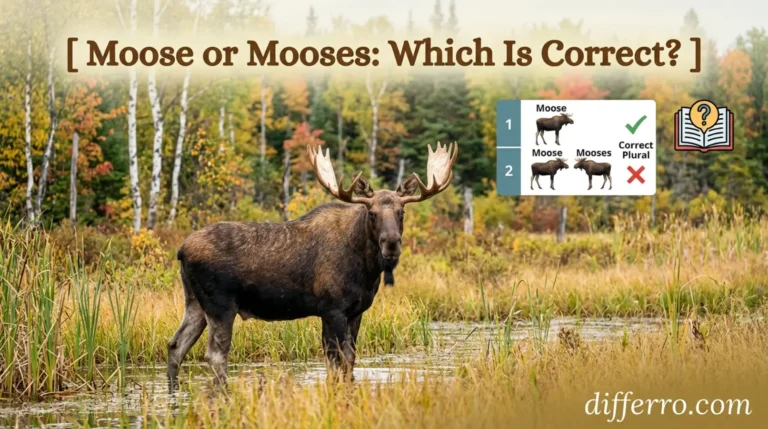
Moose or Mooses is a common English grammar and spelling confusion. Many people wonder how to make moose plural. The correct plural form is moose, not mooses in standard English. The word stays the same for one animal and several animals. For example, you can say “one moose” and “five moose.” This pattern can seem unusual because most English nouns take -s or -es in the plural. Words such as goose, however, change their spelling completely. That difference can make moose or mooses confusing for English learners. The word moose describes a large deer with broad antlers. It is common in North American English and also appears in British English. Learning the correct plural form helps you write clearly in school, work, and everyday communication.
⭐ Quick Answer
The correct plural of moose is moose. Mooses is generally not used as the standard plural form.
Example: We saw three moose near the lake.
Meaning of Moose
Moose is a noun that names a very large deer with broad, flat antlers. It can describe one animal or several animals.
The singular and plural forms are identical.
Examples:
- We saw a moose near the forest.
- Several moose crossed the road.
When referring to one animal, use a singular verb.
Example: A moose was standing beside the lake.
When referring to several animals, use a plural verb.
Example: Several moose were moving through the forest.
Meaning of Mooses
Mooses adds -s to the word moose. Some speakers may use this form informally, humorously, or rarely. However, moose is the standard plural form in modern English.
Major English dictionaries list moose as both the singular and plural form.
Examples:
- Nonstandard: We saw five mooses in the park.
- Standard: We saw five moose in the park.
For formal writing, schoolwork, professional content, and SEO articles, choose moose.
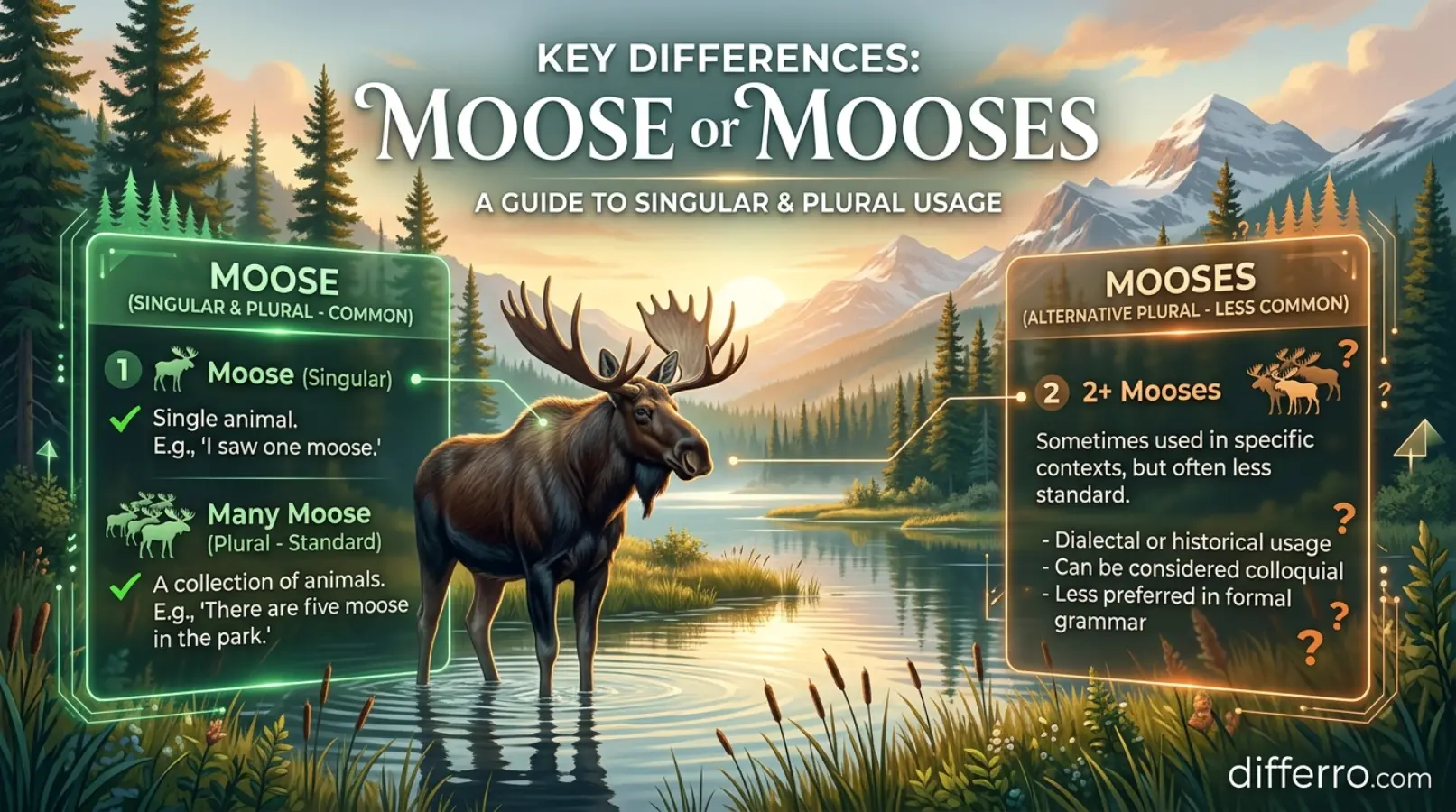
📊 Key Differences: Moose or Mooses
| Feature | Moose | Mooses |
|---|---|---|
| Meaning | Large deer; singular and plural | Nonstandard or rare plural form |
| Tone | Standard and natural | Informal, unusual, or humorous |
| Usage | Correct standard usage | Generally avoided |
| Popularity | Far more common | Much less common |
| Formal writing | Recommended | Not recommended |
| Plural use | Standard plural | Usually considered incorrect |
The important point is simple: moose works for both one and more than one animal. Oxford, Cambridge, and Collins all identify moose as the plural form.
📚 Origin & History
The word moose entered English from an Algonquian language. Dictionaries trace it to forms such as Eastern Abenaki mos. The word appeared in English around the late sixteenth or early seventeenth century.
Its unusual plural does not follow the pattern of words like goose → geese.
The words moose and goose have different histories. Therefore, their plural forms developed differently.
Similar unchanged plural examples include:
- deer → deer
- sheep → sheep
- fish → fish
- moose → moose
The unchanged form makes moose an important example for English learners.
🇬🇧 British English vs American English Spelling
British and American English both normally use moose as the plural form. Neither variety normally requires mooses in standard writing. British English may also use elk for this animal in some contexts, especially outside North America.
| Feature | British English | American English |
|---|---|---|
| Singular | moose | moose |
| Plural | moose | moose |
| Common alternative | elk in some contexts | elk can mean a different animal |
| Mooses | Generally avoided | Generally avoided |
🦌 When to Use Moose
Use moose when talking about one animal.
Example:
A moose appeared near our campsite.
Also use moose when talking about two or more animals.
Examples:
- We saw two moose near the river.
- Several moose live in this region.
- The park protects many moose.
The surrounding words usually show whether moose is singular or plural.
Look at the verb and number words.
One moose was walking through the trees.
Several moose were walking through the trees.
⚠️ When to Use Mooses
In standard English, avoid mooses when you mean more than one moose.
You may encounter mooses in informal, playful, or rare usage. Wiktionary records it as a rare or nonstandard plural.
For normal writing, use moose instead.
Avoid:
We photographed several mooses.
Better:
We photographed several moose.
This rule is especially important in formal writing, education, journalism, and professional content.
❌ Common Mistakes
1. Adding -s automatically
Incorrect: We saw three mooses.
Correct: We saw three moose.
Do not add -s simply because the noun is plural.
2. Using meese
Some people copy the pattern goose → geese and create meese.
Incorrect: We saw two meese.
Correct: We saw two moose.
Meese is not the standard plural of moose.
3. Using a singular verb with several moose
Incorrect: Several moose was near the road.
Correct: Several moose were near the road.
The noun stays unchanged, but the verb becomes plural.
4. Treating moose as a regular plural noun
Incorrect: Five mooses were feeding nearby.
Correct: Five moose were feeding nearby.
The number five already shows that the noun is plural.
5. Changing moose in formal writing
Incorrect: The researchers recorded several mooses.
Correct: The researchers recorded several moose.
Use the standard form in academic and professional writing.
🧠 Easy Trick to Remember
Remember this simple rule:
One moose, two moose, many moose.
The word moose does not change when you make it plural.
You can also remember:
One deer → two deer
One sheep → two sheep
One moose → two moose
Think of moose as an unchanged plural noun.
🌲 Everyday Life Examples
1. Wildlife Photography
A photographer captured pictures of a moose in the forest.
Later, the photographer saw several moose near the water.
Here, moose works for both singular and plural use.
2. Road Safety
Drivers should slow down when a moose approaches the road.
Drivers may encounter several moose in rural areas.
The context shows the number.
3. National Parks
The park has a healthy population of moose.
Visitors sometimes spot one moose near the trails.
The primary keyword remains moose or mooses.
4. School Writing
Students may learn that moose has the same singular and plural form.
A good example is, “We saw four moose.”
This secondary usage helps learners understand irregular plurals.
5. Travel Stories
We were excited when we saw a moose during our trip.
The next morning, we noticed several moose across the valley.
This natural context makes the grammar rule easy to remember.
🔎 Related Keywords
- moose or mooses
- plural of moose
- plural form of moose
- is mooses a word
- is moose plural
- moose singular and plural
- moose plural grammar
📈 Google Trends & Usage Data
Google Trends can compare search interest by country and region. It treats spelling variations and misspellings separately unless users combine them.
Across the USA, searches for moose are strongly tied to wildlife and regional usage.
In the UK and Australia, learners may encounter the word through wildlife, dictionaries, and English-learning searches.
In India and Pakistan, searches are more likely to reflect English grammar and plural-form questions.
The main SEO insight is clear: moose has genuine vocabulary value, while mooses mainly appears because people question the correct plural.
Keyword Variation Comparison
| Keyword Variation | Standard Usage | Search Intent | Best Use |
|---|---|---|---|
| moose | Yes | Animal or plural form | Primary keyword |
| mooses | Generally no | Spelling confusion | Comparison keyword |
| plural of moose | Yes | Grammar question | SEO support |
| plural form of moose | Yes | Educational | SEO support |
| is mooses correct | No | Grammar confusion | FAQ keyword |
| moose plural | Yes | Direct grammar search | Supporting keyword |
| moose or mooses | Comparison | Spelling confusion | Main comparison keyword |
⚖️ Final Verdict
Moose is the correct standard choice for both singular and plural use.
Use a moose for one animal.
Use moose after numbers or plural expressions.
Correct:
- one moose
- two moose
- many moose
- several moose
Mooses is not the normal plural form in standard English. Although rare informal usage exists, it should be avoided in formal writing.
The easiest rule is:
One moose, two moose, many moose.
❓ FAQ
Is “mooses” correct?
Mooses is generally not the standard plural form. Use moose for more than one animal.
What is the difference between moose and mooses?
Moose is the standard singular and plural form. Mooses is a rare or nonstandard plural form.
Which is more common, moose or mooses?
Moose is much more common and is the standard form used by major English dictionaries.
Is “moose” formal English?
Yes. Moose is fully acceptable in formal, academic, professional, and everyday English.
Why does confusion about moose and mooses exist?
Many English nouns form plurals by adding -s. Learners may therefore expect mooses. However, moose keeps the same form in both numbers.
📝 Conclusion
The moose or mooses confusion is easy to solve once you learn the standard plural rule. Moose is both the singular and plural form in standard English. You can say “one moose” for a single animal and “several moose” for multiple animals. You should normally avoid mooses in formal writing. The word has an interesting Algonquian origin, which helps explain why it does not follow the pattern of goose → geese. Remember the simple phrase: one moose, two moose, many moose. This rule works in American and British English. Using moose correctly will make your writing clearer, more natural, and grammatically accurate.

Imran Lodhra is a comparison-focused content writer at Differro.com.
He specializes in creating clear, simple, and informative comparison articles.
His work helps readers understand key differences, pros and cons, and important details.
Imran focuses on accurate, practical, and easy-to-read content for everyday readers.
1 thought on “Moose or Mooses: Which Is Correct?”