
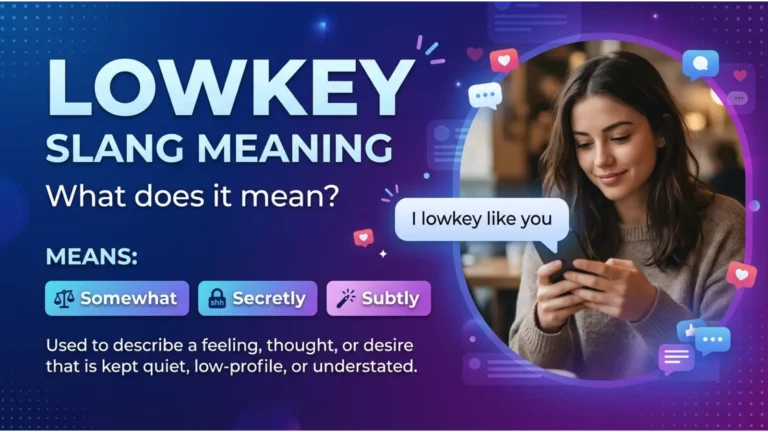
Lowkey meaning slang is a common search for people who see the word in text messages, TikTok comments, Instagram captions, or everyday conversations.
If someone texts you, “I lowkey miss you,” you might wonder whether they are hiding their feelings or simply speaking casually.
The word is popular among younger internet users because it helps express feelings, opinions, and preferences without making them sound too strong or serious.
In simple English, lowkey can mean a little, secretly, somewhat, or without drawing too much attention, depending on the context.
It is often used to make a statement sound softer, more casual, or less dramatic. Understanding this slang can help you follow online conversations and respond naturally to friends.
Quick Answer:
Lowkey means “somewhat,” “secretly,” or “quietly,” depending on the context. People commonly use it in texting and social media to express a feeling or opinion in a subtle, casual way.
What Does Lowkey Mean in Text?
The phrase lowkey meaning in text usually refers to expressing something in a relaxed, understated, or slightly secretive way.
For example:
- “I lowkey like him.” — I like him, but I may not want to make a big deal about it.
- “That movie was lowkey amazing.” — The movie was surprisingly or genuinely very good.
- “Let’s keep it lowkey.” — Let’s keep things quiet, private, or simple.
The exact meaning depends on the sentence. Sometimes lowkey means “a little,” while in other situations, it suggests that someone does not want much attention.
Lowkey Full Form and Definition
Lowkey does not have a full form because it is not an abbreviation or acronym. It is an informal English word that has developed additional meanings in modern slang.
The traditional word low-key can describe something quiet, restrained, understated, or not very noticeable. In online slang, people also use lowkey as an adverb to describe feelings, reactions, and opinions.
What does lowkey stand for? It does not stand for separate words. Instead, it communicates subtlety, understatement, or a feeling that someone is expressing casually.
Lowkey Meaning Slang in Different Contexts
Lowkey can communicate several ideas depending on how it is used.
1. Lowkey Means Somewhat or A Little
People often use lowkey to make an opinion sound less intense.
Example: “I’m lowkey tired.”
Meaning: I’m a little tired, or I’m feeling tired but not making a big deal about it.
2. Lowkey Means Secretly
Lowkey can suggest that someone has a feeling they do not openly share.
Example: “She lowkey has a crush on him.”
Meaning: She probably likes him but may not want everyone to know.
This meaning is common in conversations about crushes, friendships, and personal feelings.
3. Lowkey Means Surprisingly or Actually
Sometimes lowkey emphasizes a positive or negative reaction.
Example: “This restaurant is lowkey the best place in town.”
Meaning: The restaurant is genuinely excellent, perhaps better than expected.
Here, lowkey does not necessarily mean that the opinion is secret.
4. Lowkey Means Quiet or Private
The word can also describe an event, plan, or lifestyle that avoids unnecessary attention.
Example: “We’re having a lowkey birthday party.”
Meaning: The party will be simple, relaxed, or small rather than elaborate.
Is Lowkey Rude, Offensive, or Neutral?
Lowkey is generally neutral and informal. It is not normally considered rude or offensive.
Friends may use it to discuss their feelings, share opinions, or make jokes. However, the tone and situation can change how a sentence sounds.
For example:
- Friendly: “I’m lowkey proud of you.”
- Casual: “I’m lowkey hungry.”
- Sarcastic: “That was lowkey the worst idea ever.”
The final example may sound critical, but the negative tone comes from the message rather than the word itself.
Lowkey is appropriate in most casual conversations, but formal reports, professional emails, and academic writing usually call for more precise language.
Where Is Lowkey Commonly Used?
Lowkey appears in several everyday communication settings.
- Text messages: “I lowkey want to go home.”
- TikTok: “This song is lowkey addictive.”
- Instagram: “Lowkey obsessed with this outfit.”
- Snapchat: “I lowkey forgot about the assignment.”
- Online gaming: “That was a lowkey impressive move.”
- Face-to-face conversations: “I’m lowkey nervous about tomorrow.”
It is especially recognizable in internet slang and informal conversations among younger English speakers. However, people of different ages may use or understand it.
Real-Life Conversation Examples
These examples show how lowkey works in different tones.
Friendly Examples
Example 1
A: “Did you like the gift?”
B: “I lowkey love it!”
Meaning: The speaker genuinely loves the gift and expresses enthusiasm casually.
Example 2
A: “How are you feeling about your new job?”
B: “I’m lowkey excited.”
Meaning: The speaker feels excited but is expressing it in an understated way.
Casual Examples
Example 3
A: “Want to get some food?”
B: “Yes, I’m lowkey starving.”
Meaning: The speaker is very hungry, expressed casually.
Example 4
A: “Have you listened to her new song?”
B: “It’s lowkey my favorite.”
Meaning: The song is one of the speaker’s favorites, possibly more than others might expect.
Argumentative Examples
Example 5
A: “You didn’t even listen to my idea.”
B: “You’re lowkey making this a bigger problem than it is.”
Meaning: The speaker thinks the other person is exaggerating the issue. This may sound dismissive.
Example 6
A: “That was a terrible decision.”
B: “You’re lowkey being unfair right now.”
Meaning: The speaker believes the other person’s judgment is unfair.
In arguments, lowkey can soften a statement, but it does not automatically make criticism polite.
Emotional and Psychological Meaning of Lowkey
Lowkey is useful because people do not always want to express their emotions directly or dramatically.
For instance, someone might say, “I lowkey miss my old friends,” rather than openly describing how lonely they feel. The word can make a personal statement feel less intense.
People may use lowkey to:
- Express embarrassment about their feelings.
- Share an opinion without sounding overly serious.
- Reduce the intensity of a statement.
- Test how another person reacts to an idea.
- Add humor or a relaxed tone to a conversation.
However, you should not assume that someone is hiding a deep emotion simply because they use lowkey. Sometimes it is just a conversational habit.
Origin and Background of Lowkey Slang
The expression comes from the older English term low-key, which has long been associated with something restrained, subdued, or not attention-seeking.
The modern slang usage developed through informal speech and popular culture, including music, youth language, and online communication. Social media helped spread its use in captions, memes, comments, and direct messages.
Today, people often write lowkey as one word in casual digital communication, although low-key remains a standard spelling in many traditional uses.
The modern slang meaning is broader than the original idea of keeping something quiet. It can now express mild feelings, understated enthusiasm, or even strong opinions presented casually.
Lowkey vs. Similar Slang Terms
Several slang words have meanings similar to lowkey, but they are not always interchangeable.
| Slang term | Meaning | Example |
|---|---|---|
| Lowkey | Somewhat, subtly, or secretly | “I lowkey like this song.” |
| Highkey | Openly, strongly, or obviously | “I highkey love this song.” |
| Kinda | Somewhat or to a degree | “I’m kinda tired.” |
| Secretly | Without others knowing | “I secretly admire her.” |
| Honestly | Sincerely or truthfully | “Honestly, this song is great.” |
| Fr | For real; genuinely or in agreement | “This song is good, fr.” |
Lowkey vs. Highkey
Lowkey and highkey are often treated as opposites in internet slang.
- “I lowkey want to leave.” — I somewhat want to leave, or I am admitting the feeling casually.
- “I highkey want to leave.” — I really want to leave, and I am expressing it more strongly.
These meanings are flexible, so the difference is not always about the strength of the emotion alone.
When to Use Lowkey and When to Avoid It
Use lowkey when talking casually with friends, chatting online, writing social media captions, or sharing an opinion in a relaxed way.
Avoid it when writing formal documents, academic assignments, business proposals, or professional messages that require clear and precise wording.
For example:
Informal: “I’m lowkey worried about the test.”
Formal: “I am somewhat concerned about the examination.”
Lowkey is not offensive, so you generally do not need to replace it for politeness. Instead, choose wording that fits your audience and purpose.
Polite Alternatives to Lowkey
If you want to sound clearer or more professional, you can replace lowkey with:
- Somewhat: “I’m somewhat concerned.”
- A little: “I’m a little nervous.”
- Quietly: “She quietly supported the idea.”
- Privately: “I’d prefer to discuss this privately.”
- Honestly: “Honestly, I really enjoyed it.”
- Understated: “It was an understated celebration.”
Remember that these words have different meanings. Choose the one that best matches what you want to say.
Why Do People Use Lowkey?
People use lowkey because it makes conversations sound natural, relaxed, and less dramatic.
It can communicate a feeling without making the speaker seem overly serious. It can also create a playful tone or make an opinion sound like a casual admission.
For example, “I lowkey want another slice of cake” sounds relaxed and humorous. The speaker is expressing a desire without making it sound like a major announcement.
The word also works well in short messages because it communicates tone with just one word.
Impact of Lowkey on Communication
Lowkey can make informal communication feel more expressive and relatable. It helps people show uncertainty, enthusiasm, embarrassment, or mild frustration.
However, slang can also create misunderstandings when people interpret it differently. One person might understand “I lowkey like you” as a romantic admission, while another might take it as a casual comment.
To avoid confusion, consider the context, your relationship with the other person, and the tone of the conversation. When the meaning matters, direct language is usually more effective.
Is Lowkey Safe for Social Media?
Yes. Lowkey is generally safe to use on social media because it is not inherently vulgar, hateful, or offensive.
You can use it in captions, comments, messages, and videos. For example:
- “Lowkey loving this weather.”
- “This outfit is lowkey perfect.”
- “Lowkey need a vacation.”
- “I’m lowkey excited for the weekend.”
As with any expression, the rest of your message matters. A sentence can still be insulting or inappropriate even when it includes harmless slang.
Lowkey Usage in Different Contexts
The meaning of lowkey can shift slightly depending on the situation.
In relationships: “I lowkey miss you” may express affection without sounding too direct.
At school: “I’m lowkey worried about my grades” communicates concern casually.
At work: “That presentation was lowkey impressive” expresses approval informally.
In friendships: “I’m lowkey annoyed with him” shares frustration without making a dramatic statement.
In social media captions: “Lowkey living my best life” communicates enjoyment in a playful, understated style.
Each example, the surrounding words help reveal the intended meaning.
Common Misunderstandings About Lowkey
Here are a few mistakes to avoid when interpreting this slang.
1. Thinking lowkey always means secretly.
It can mean somewhat, subtly, or surprisingly. For example, “This food is lowkey amazing” does not necessarily describe a secret.
2. Assuming it always means a small amount.
In some sentences, lowkey adds emphasis rather than reducing it. “I’m lowkey obsessed with this show” can express strong enthusiasm.
3. Treating lowkey as an acronym.
It has no official full form.
4. Thinking lowkey is always romantic.
It can describe almost any feeling, opinion, preference, or situation.
5. Assuming it is rude.
The word itself is generally neutral. The message and tone determine whether a sentence sounds respectful or dismissive.
Variations and Types of Lowkey
Lowkey appears in several common forms.
- Lowkey: “I lowkey want to go.”
- Low-key: “We’re planning a low-key evening.”
- Lowkeying: An informal, less common form used to describe playing down or concealing something, as in “He’s lowkeying his excitement.”
- Highkey: A related slang term that expresses something openly or strongly.
The most natural form depends on the sentence. Use lowkey for common slang expressions and low-key when following a style guide that prefers the hyphenated spelling.
How to Respond When Someone Uses Lowkey
Your response should depend on what the person means.
If they express a feeling:
Person: “I lowkey miss our old school.”
You: “Same! Those days were fun.”
If they give a compliment:
Person: “Your new haircut is lowkey amazing.”
You: “Thank you! I’m glad you like it.”
If they admit a crush:
Person: “I lowkey like her.”
You: “Oh really? Are you going to tell her?”
If they make a complaint:
Person: “I’m lowkey annoyed about what happened.”
You: “I understand. What bothered you the most?”
You do not need to use slang in your response if it does not feel natural to you.
Regional and Cultural Usage
Lowkey is widely recognizable in informal English, particularly in online conversations and youth culture. Its meaning generally stays similar across English-speaking communities, although individual speakers may use it differently.
In the United States, it is common in casual speech, texting, and social media. It is also used in the United Kingdom, Canada, Australia, and other English-speaking communities.
People in Pakistan, India, and other countries where English is used alongside local languages may encounter it through social media, music, films, and online friendships.
The exact frequency of use varies by community and individual. It is best understood as informal internet slang rather than a word that everyone uses in the same way.
Frequently Asked Questions
1. What does lowkey mean in texting?
Lowkey usually means somewhat, secretly, or casually expressing a feeling. For example, “I lowkey like him” means the speaker likes him but may not want to make a big deal about it.
2. What does lowkey stand for?
Lowkey does not stand for a phrase or set of initials. It is an informal word with meanings related to subtlety, understatement, and restrained expression.
3. Does lowkey mean secretly?
Sometimes. It can suggest that someone is not openly sharing a feeling, but it can also mean somewhat or surprisingly, depending on the context.
4. What is the opposite of lowkey?
Highkey is a common slang opposite. It usually means openly, strongly, or obviously expressing something.
5. Is lowkey a bad word?
No. Lowkey is generally a harmless, informal expression. However, the sentence in which it appears can still be rude, critical, or inappropriate.
6. Should I write lowkey or low-key?
Both forms are used. Lowkey is common in internet slang, while low-key is widely used as the standard hyphenated form in conventional writing.
Conclusion
Understanding lowkey meaning slang makes it easier to follow text messages, social media comments, and everyday conversations. The word generally means somewhat, secretly, quietly, or in an understated way, but its exact meaning depends on context.
People use lowkey to express feelings, soften opinions, show casual enthusiasm, and avoid sounding overly dramatic. It is usually harmless and appropriate for informal conversations, though more precise language is better for professional or academic writing.
The most important tip is to look at the complete sentence rather than assuming lowkey always means secretly. Once you understand the context and tone, you can interpret the word naturally and use it confidently in everyday English.
Ali Raza is an M.Phil. scholar and English language expert specializing in English grammar, slang meanings, vocabulary, and everyday expressions. He writes clear, practical, and easy-to-understand content that helps readers master confusing English words, phrases, spelling, and modern slang. His goal is to make English learning simple, useful, and accessible for students, beginners, and everyday readers.
1 thought on “Lowkey Meaning Slang in Text With Examples”