
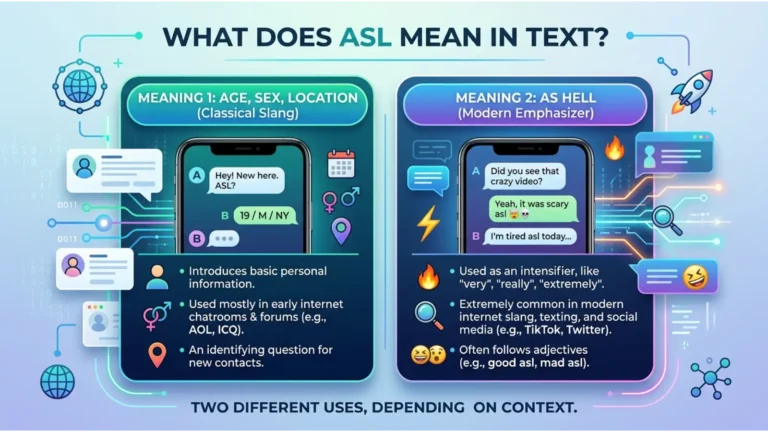
ASL meaning slang is a common search for people who see “ASL” in a text, chat, comment, or social media post and are unsure what the person means. The abbreviation can have different meanings depending on the conversation, which makes it easy to misunderstand.
In older online chat culture, ASL commonly meant “age, sex, location.” People used it when asking someone for basic personal information, especially in chat rooms. However, modern internet users may also use asl to mean “as hell,” usually to add emphasis to an adjective or statement.
The surrounding words and tone are important. Knowing the context can help you understand which meaning the sender intended.
Quick Answer:
In slang and texting, ASL can mean “age, sex, location” or “as hell.” The correct meaning depends on the context.
What Does ASL Mean in Text?
The most common slang meanings of ASL are:
- Age, Sex, Location — an older chat abbreviation used to ask about someone’s age, gender, and location.
- As Hell — modern informal slang used to emphasize something.
For example:
- “ASL?” → “Age, sex, location?”
- “That movie was funny asl.” → “That movie was extremely funny.”
Because these meanings are very different, context matters.
ASL Full Form and Definition
ASL = Age, Sex, Location
The older meaning of ASL comes from online chat rooms and messaging culture. A person might simply write:
“ASL?”
They are asking for your age, sex, and location.
This abbreviation was particularly associated with internet chatrooms and early instant messaging.
ASL = As Hell
In contemporary slang, asl can also mean “as hell.” Here, it works as an intensifier.
Examples include:
- “I’m tired asl.”
- “That test was hard asl.”
- “She is funny asl.”
In these examples, “asl” adds emphasis to the word before it.
ASL Meaning in Different Contexts
The meaning changes according to how it appears.
| Example | Likely Meaning |
|---|---|
| “ASL?” | Age, sex, location |
| “Where are you from? ASL?” | Age, sex, location |
| “I’m tired asl.” | As hell |
| “That was crazy asl.” | As hell |
| “Do you remember ASL chat rooms?” | Age, sex, location |
A useful rule is to look at what comes immediately before and after ASL.
If it appears by itself as a question, “age, sex, location” is more likely. If it follows an adjective such as “funny,” “tired,” or “crazy,” it usually means “as hell.”
Is ASL Rude, Offensive, or Neutral?
ASL is not automatically rude or offensive. Its tone depends on the meaning and situation.
When ASL means “age, sex, location,” it can feel intrusive because it asks for personal information. This is especially important when talking to strangers online.
When ASL means “as hell,” it is informal slang. It can be perfectly normal among friends but may not fit professional or formal communication.
For example:
- Casual: “That game was fun asl.”
- Professional: “That game was extremely enjoyable.”
The second version is more appropriate for formal writing.
Where Is ASL Commonly Used?
The two slang meanings appear in different environments.
“Age, sex, location” is strongly associated with:
- Online chat rooms
- Older internet culture
- Dating or social chats
- Informal messaging
“As hell” is more likely to appear in:
- Text messages
- TikTok comments
- Instagram posts
- X or other social platforms
- Gaming chats
- Discord conversations
- Memes
- Casual conversations
Capitalization is not always meaningful. You may see ASL, asl, or Asl.
Real-Life Conversation Examples
Friendly Example
Person A: “That restaurant was good asl.”
Person B: “I know! I want to go again.”
Here, asl = as hell, meaning very good.
Casual Example
Person A: “You awake?”
Person B: “Yeah, bored asl.”
Again, ASL means as hell.
Older Chat Example
Person A: “Hey, ASL?”
Person B: “21, male, Toronto.”
Here, ASL means age, sex, location.
Argumentative Example
Person A: “Why are you angry asl?”
Person B: “Because you ignored my messages.”
Here, ASL means as hell and emphasizes “angry.”
Emotional and Psychological Meaning
When asl means “as hell,” it often strengthens an emotion or reaction.
For example:
- “I’m nervous asl.”
- “I’m happy asl.”
- “I’m annoyed asl.”
- “I’m excited asl.”
The abbreviation does not create the emotion. Instead, it makes the statement sound stronger and more expressive.
The emotional effect also depends on punctuation, surrounding words, and the relationship between the people communicating.
Origin and Background of ASL Slang
The “age, sex, location” meaning became popular during the early internet chat era. Users wanted a quick way to ask basic information about people they met online.
As online communication evolved, slang and abbreviations changed. ASL eventually developed another informal use: “as hell.”
This newer usage fits a broader internet trend in which people shorten common phrases to communicate quickly.
It is important not to confuse this slang with ASL, the standard abbreviation for American Sign Language. In discussions about language, education, or deaf communities, ASL usually refers to American Sign Language rather than slang.
ASL vs Similar Slang Terms
| Slang | Meaning | Typical Use |
|---|---|---|
| ASL | As hell | Strong emphasis |
| AF | As f*** | Strong emphasis, more vulgar |
| OMG | Oh my God | Surprise or excitement |
| FR | For real | Agreement or emphasis |
| TBH | To be honest | Giving an honest opinion |
| IDK | I don’t know | Uncertainty |
For example, “That was funny asl” and “That was funny AF” can communicate a similar idea, but the second expression is more vulgar.
When Should You Avoid Using ASL?
Avoid slang when the situation requires formal or professional language.
This includes:
- Job applications
- Business emails
- Academic assignments
- Formal reports
- Official messages
- Professional presentations
Also be careful with the “age, sex, location” meaning when speaking to strangers. Sharing personal information online can create privacy and safety concerns.
Instead of answering an unexpected personal question, you can simply say:
“I prefer not to share personal information.”
When Is It Appropriate to Use ASL?
Using asl to mean “as hell” is generally suited to relaxed conversations with people who understand internet slang.
It can work in:
- Friendly texts
- Casual group chats
- Gaming conversations
- Social media comments
- Informal online conversations
Before using it, consider your audience, the platform, and the tone you want to create.
Polite Alternatives to ASL
If you want to replace “as hell” with more neutral language, try:
- Very
- Extremely
- Really
- Incredibly
- Quite
- Seriously
For example:
Slang: “That was difficult asl.”
Neutral: “That was extremely difficult.”
Slang: “I’m tired asl.”
Neutral: “I’m really tired.”
Why Do People Use ASL?
People use slang abbreviations because they make communication short, quick, expressive, and conversational.
Typing “asl” instead of “as hell” can save space and match the informal style of online conversations.
Internet slang also creates a sense of familiarity. Friends and online communities often develop shared vocabulary that feels natural within their group.
However, slang can cause confusion when different communities use the same abbreviation differently.
Impact of ASL on Communication
ASL can make a message sound relaxed and expressive, but it can also create misunderstandings.
For example, someone unfamiliar with internet slang may read:
“That was amazing asl.”
and wonder what ASL means.
Another issue is that ASL has multiple established meanings. Someone discussing sign language may use ASL to mean American Sign Language, while someone texting “tired asl” means “tired as hell.”
Always consider the topic before deciding what the abbreviation means.
Is ASL Safe for Social Media?
The slang use of “as hell” is generally just an informal expression. However, the older “age, sex, location” use deserves more caution.
If someone online asks you for your age, gender, and location, you do not have to provide that information. Avoid sharing sensitive personal details with strangers.
Parents and younger internet users should be particularly careful with unexpected requests for personal information in chats.
Common Misunderstandings About ASL
One major misunderstanding is assuming that ASL always means “age, sex, location.” That was a well-known older internet meaning, but modern slang frequently uses ASL as “as hell.”
Another misunderstanding occurs when people confuse slang ASL with American Sign Language.
For example:
- “I’m tired asl.” → as hell
- “I am learning ASL.” → American Sign Language
- “ASL?” → potentially age, sex, location
The sentence provides the clue.
Variations and Types of ASL
You may see the abbreviation written in several ways:
- ASL
- asl
- Asl
The lowercase form asl is especially common in casual texting and social media.
The meaning generally comes from the sentence rather than capitalization.
How to Respond When Someone Uses ASL
Your response depends on what they mean.
If someone asks:
“ASL?”
and you understand it as “age, sex, location,” you can choose whether you want to answer. You can also decline.
If someone writes:
“That was funny asl.”
you can respond naturally:
- “For real!”
- “Right?”
- “I know 😂”
- “It really was.”
If you’re unsure what the person means, simply ask:
“What do you mean by ASL?”
That is often the easiest way to avoid confusion.
Regional and Cultural Usage
Internet slang does not always have one universal meaning. Different age groups, online communities, and regions can use abbreviations differently.
The “age, sex, location” meaning is strongly connected with older internet chat culture, while “as hell” is common in contemporary informal online communication.
The safest approach is to look at the surrounding sentence instead of assuming that every use of ASL has the same meaning.
FAQs About ASL Meaning Slang
What does ASL mean in slang?
In slang, ASL can mean “age, sex, location” or “as hell.” Context determines the intended meaning.
What does ASL stand for in texting?
In older texting and chat culture, ASL commonly stands for age, sex, location. In modern slang, it can also mean as hell.
What does “funny asl” mean?
“Funny asl” means “funny as hell.” It emphasizes that something is extremely funny.
Is ASL a bad word?
No. ASL itself is not necessarily a bad word. However, “as hell” is informal, and the phrase may not be suitable for professional communication.
Does ASL mean American Sign Language?
Yes. ASL is also the standard abbreviation for American Sign Language. This is different from its internet slang meanings.
Should I answer someone who asks “ASL?”
You do not have to. If a stranger asks for your age, gender, or location, you can protect your privacy and choose not to share personal information.
Conclusion
Understanding asl meaning slang requires paying attention to context. In older internet chat culture, ASL commonly meant “age, sex, location.” In modern informal texting and social media, asl can also mean “as hell,” adding strong emphasis to a statement.
The best way to identify the intended meaning is to look at the surrounding words. Remember that ASL can also mean American Sign Language, so the topic of the conversation matters.
Use slang like asl mainly in casual settings, and choose clearer, more formal wording for school, work, and professional communication.

Ali Raza is an M.Phil. scholar and English language expert specializing in English grammar, slang meanings, vocabulary, and everyday expressions. He writes clear, practical, and easy-to-understand content that helps readers master confusing English words, phrases, spelling, and modern slang. His goal is to make English learning simple, useful, and accessible for students, beginners, and everyday readers.
1 thought on “ASL Meaning Slang What Does ASL Mean in Text”