
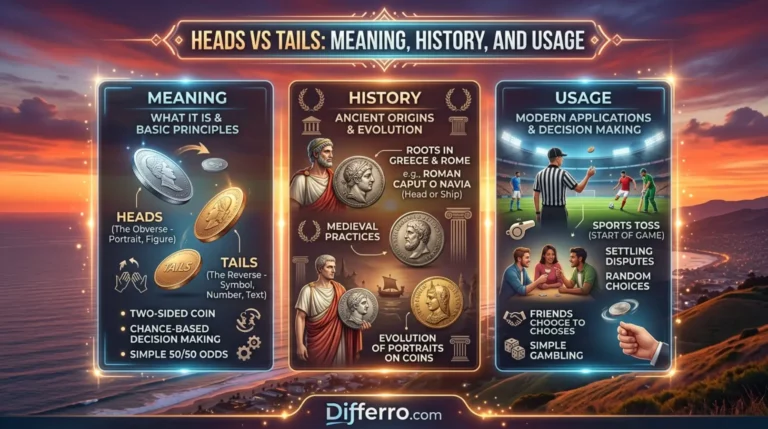
Head Or Tails is a common phrase used when flipping a coin to make a decision. People often say it before starting a game, choosing turns, or settling a simple debate. The phrase may look simple, but many people still get confused about its correct usage and meaning.
Some users search for “head or tails” because they want to know whether it is singular or plural. Others want to understand where the phrase came from and how it is used in daily English.
In simple terms, “heads” and “tails” are the two sides of a coin. “Heads” usually shows a person’s face, while “tails” shows a symbol, number, or design. The phrase is popular in both spoken and written English across the world.
This guide explains the meaning, usage, history, and differences in a simple and easy way.
⭐ Quick Answer
Head Or Tails refers to the two sides of a coin used in a coin toss. “Heads” usually shows a person’s image, while “tails” shows the opposite side.
Example:
- “Let’s flip a coin. Heads or tails?”
- “She picked tails and won the toss.”
Meaning of Heads
“Heads” refers to the side of a coin that usually shows a person’s face or portrait.
Examples:
- The coin landed on heads.
- He always chooses heads first.
Meaning of Tails
“Tails” refers to the opposite side of the coin. It usually shows a symbol, number, or design.
Examples:
- The toss ended on tails.
- She guessed tails correctly.
Key Differences Between Heads and Tails 🪙
| Feature | Heads | Tails |
|---|---|---|
| Meaning | Side with a face | Opposite side |
| Appearance | Portrait or image | Symbol or design |
| Usage | Coin toss choices | Coin toss choices |
| Tone | Neutral | Neutral |
| Popularity | Very common | Very common |
Origin & History 📜
The phrase “heads or tails” comes from old coin designs. Ancient coins often had a ruler’s head on one side and a symbol on the other side. Over time, people started calling the sides “heads” and “tails.”
The phrase became popular in games, sports, and decision-making activities.
Similar examples:
- Black or white
- Yes or no
- Win or lose
British English vs American English Spelling 🌍
Both British and American English use the phrase “heads or tails” in the same way. There is no spelling difference between the two forms.
The phrase is widely accepted in sports, games, and casual conversations in both regions.
Comparison Table: British vs American English
| British English | American English |
|---|---|
| Heads or tails | Heads or tails |
| No spelling change | No spelling change |
| Same pronunciation | Same pronunciation |

When to Use Heads
Use “heads” when referring to the face side of a coin.
Examples:
- The referee called heads.
- Heads appeared after the flip.

When to Use Tails
Use “tails” when referring to the opposite side of the coin.
Examples:
- I guessed tails correctly.
- The coin landed on tails twice.
Common Mistakes ❌
| Incorrect Usage | Correct Usage |
|---|---|
| Head or tail | Heads or tails |
| The coin showed head | The coin showed heads |
| I pick tail | I pick tails |
| Heads and tail | Heads and tails |
Easy Trick to Remember 💡
Remember this simple tip:
- Heads = Human face
- Tails = The other side
If you see a portrait, think “heads.”
write 5 examples ✍️
1. Coin Toss in Sports
The captain selected heads before the match started.
2. Making Quick Decisions
We used heads or tails to decide who would go first.
3. Classroom Games
The teacher flipped a coin and it landed on tails.
4. Friendly Challenges
My friend always picks heads during games.
5. Everyday Conversations
People often use heads or tails for simple choices.
Related Keywords 🔍
- Heads or tails meaning
- Coin toss meaning
- Heads vs tails
- Coin flip phrases
- Toss a coin
- Heads and tails usage
- Coin toss examples
Final Verdict ✅
“Heads or tails” is the correct and complete phrase used in coin tossing. Both words are equally important because they represent the two sides of a coin.
Use:
- Heads for the portrait side
- Tails for the opposite side
The phrase is correct in both formal and informal English.
Google Trends & Usage Data 🌎
In the USA, searches for “heads or tails” are very common during sports events and games.
People in the UK and Australia often use the phrase in casual conversation and school activities.
Across India and Pakistan, many searches come from students learning English phrases and coin toss meanings.
Globally, “heads or tails” remains a highly searched phrase because it is simple, practical, and widely used.
Comparison Table: Keyword Variations
| Keyword Variation | Popularity |
|---|---|
| Heads or tails | Very High |
| Head or tails | Medium |
| Heads and tails | High |
| Coin toss | Very High |
| Toss a coin | High |
FAQs ;
Is “heads or tails” correct?
Yes, it is the correct phrase used for coin tossing.
What is the difference between heads and tails?
Heads shows the face side of a coin. Tails shows the opposite side.
Which is more common?
Both are equally common because they are used together.
Is “heads or tails” formal?
Yes. It is acceptable in both formal and informal English.
Why does confusion exist?
Some people confuse singular and plural forms like “head or tail.”
Conclusion 📝
Head Or Tails is a simple but important English phrase used worldwide. It describes the two sides of a coin during a coin toss. “Heads” usually shows a face, while “tails” shows the opposite design. The phrase is common in games, sports, classrooms, and daily conversations.
There is no difference between British and American English spelling for this phrase. Using “heads or tails” correctly helps improve both spoken and written English. Many learners confuse singular and plural forms, but the correct expression is always “heads or tails.”
Understanding this phrase is easy once you remember that coins always have two sides. It remains one of the most popular expressions connected to games and decision-making.
Discover More Post ;
Bolder Or Boulder : What’s the Difference?
Crawfish Or Crayfish : Which Word Is Correct?
Cancelation vs Cancellations Explained Simply

Sara Taylor is a passionate writer and language enthusiast. She specializes in creating simple and easy-to-understand articles about English grammar, spelling differences, and commonly confused words. Her writing style focuses on helping students, writers, and English learners improve their language skills with confidence. Through informative guides and practical examples, Sara makes complex grammar topics easier for everyday readers.