
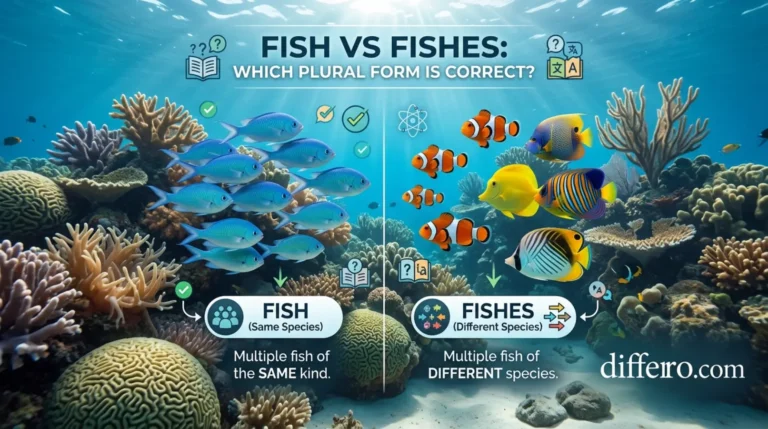
Fish vs Fishes is a common English grammar question about the plural form of “fish.” Both forms are correct, but they have different uses. Fish is the normal plural when you mean several individual fish. Fishes can describe different species or types of fish, especially in scientific writing. This small difference often confuses English learners and writers. You might wonder whether “two fish” or “two fishes” is correct. In most everyday situations, two fish is the better choice. However, “fishes” has a useful role when different species are the focus. Understanding this difference helps you write clearer English. It also prevents common plural mistakes in school, work, and everyday conversation.
⭐ Quick Answer
Fish is the usual plural of “fish” when referring to several individual fish. Fishes is also correct when discussing different species or types of fish.
Example: I caught five fish. The scientist studied several fishes from different species.
🐟 Meaning of Fish
Fish can refer to one fish or several fish. Its singular and common plural forms are the same.
Use fish when you are counting individual fish or talking about fish generally.
Examples:
- I saw a large fish in the river.
- We caught six fish during the trip.
The word “fish” can also refer to fish as food.
Example:
- We had grilled fish for dinner.
The usual plural form is fish in normal English. Major grammar references also recognize “fish” as the common plural form.
🐠 Meaning of Fishes
Fishes is a correct plural form of “fish.” It usually emphasizes different species, kinds, or groups of fish.
The word appears more often in scientific, biological, and technical contexts.
Examples:
- Marine scientists studied several fishes from different regions.
- The book describes the fishes of the Pacific Ocean.
You should not assume that “fishes” is wrong. It has a specific and established use. However, fish remains much more natural in ordinary conversation.
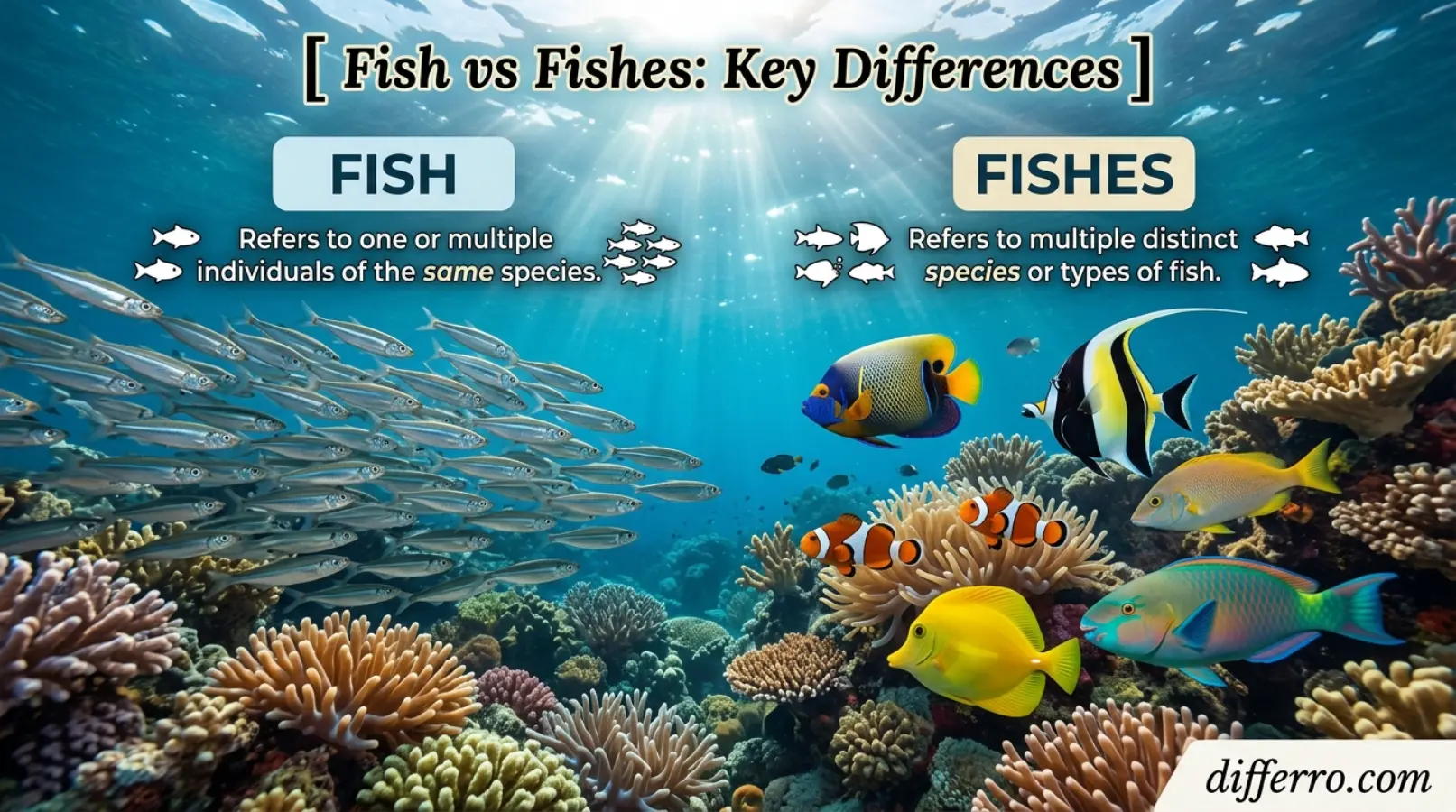
📊 Fish vs Fishes: Key Differences
| Feature | Fish | Fishes |
|---|---|---|
| Meaning | One fish or several individual fish | Different species or types |
| Tone | Natural and everyday | More specialized |
| Usage | Common conversation and writing | Scientific and technical contexts |
| Popularity | Much more common | Less common |
| Example | I caught three fish. | Scientists studied several fishes. |
The main difference is not simply the number of fish. Context determines the better choice.
If you mean several individual animals, use fish.
If you emphasize different species, fishes can be appropriate.
📜 Origin & History
The word fish has a long history in English. Its older forms developed into the modern word used today. English also kept the same form for singular and plural in many animal names.
Examples include:
- one fish → two fish
- one deer → two deer
- one sheep → two sheep
- one trout → two trout
“Fishes” developed as another plural form. Modern English uses it less often than “fish.” It became especially useful when writers needed to distinguish different kinds or species.
This explains why both forms exist today.
🇬🇧 British English vs American English
British and American English generally follow the same rule for Fish vs Fishes. Both varieties commonly use fish as the plural. Fishes can appear when writers emphasize different species. The difference is mainly about context, not national spelling.
| Usage | British English | American English |
|---|---|---|
| One animal | fish | fish |
| Several fish | fish | fish |
| Different species | fishes | fishes |
| Scientific context | fishes can occur | fishes can occur |
| Everyday use | fish preferred | fish preferred |
So there is no major British-American spelling conflict here.
🎣 When to Use Fish
★Use fish when you mean one individual fish.
- I saw one fish near the boat.
- A fish jumped out of the water.
Use fish when you mean several individual fish.
- We caught five fish.
- There are ten fish in the aquarium.
Use fish when speaking about fish generally.
- Fish live in many aquatic environments.
- Many people enjoy eating fish.
★Use fish when the species does not matter.
- The lake contains thousands of fish.
- We watched the fish swimming near the reef.
For most everyday sentences, fish is the safest and most natural choice.
🐡 When to Use Fishes
Use fishes when different species or types are important.
- The researcher studied several fishes.
- The guide describes the fishes of the Indian Ocean.
Here, the writer focuses on variety rather than simply counting individual animals.
For example, imagine an aquarium containing goldfish, guppies, and angelfish.
You could say:
- The aquarium contains many fish.
If you want to emphasize the different species, you could say:
- The aquarium contains several fishes.
However, everyday writers often choose “species of fish” instead.
- The aquarium contains several species of fish.
This wording sounds natural and avoids unnecessary confusion.
❌ Common Mistakes
1. Using Fishes for Every Plural
Incorrect for normal everyday usage:
- I caught three fishes yesterday.
Better:
- I caught three fish yesterday.
Use “fishes” only when the sentence focuses on different species or types.
2. Thinking Fishes Is Always Wrong
Incorrect idea:
- “Fishes” is never grammatically correct.
Correct explanation:
- “Fishes” is a valid plural form.
It can describe different species or types of fish.
3. Adding Fishes After a Number
Usually unnatural:
- I bought five fishes for my aquarium.
Natural:
- I bought five fish for my aquarium.
The first sentence could work in a specialized context, but ordinary English favors “fish.”
4. Confusing Fish With Fish Species
Less natural:
- Scientists studied five fishes.
Clearer:
- Scientists studied five species of fish.
Use “species of fish” when you want maximum clarity.
🧠 Easy Trick to Remember
Use this simple rule:
Fish = individual fish.
Fishes = different species or types.
Think of the word species whenever you see fishes.
If you can replace “fishes” with different species of fish, the usage probably works.
Easy examples:
- Two fish = two individual animals.
- Two fishes = two types or species.
- Many fish = many individual animals.
- Many fishes = many different species.
When you are unsure, choose fish. It is the normal plural in everyday English.
🌊 Everyday Life Examples
1. At the Aquarium
You might see many individual fish swimming together.
Example:
- We saw dozens of fish at the aquarium.
Primary keyword: fish
Secondary keyword: fish plural
2. During Fishing
When someone catches several individual animals, use “fish.”
Example:
- My brother caught four fish at the lake.
Primary keyword: fish
Secondary keyword: plural of fish
3. At a Seafood Restaurant
“Fish” can describe food rather than individual animals.
Example:
- We ordered grilled fish for dinner.
Primary keyword: fish
Secondary keyword: fish meaning
4. In a Science Class
“Fishes” can appear when students study different species.
Example:
- The class learned about freshwater fishes.
Primary keyword: fishes
Secondary keyword: fish species
5. In a Marine Biology Book
Scientific writing may use “fishes” to emphasize biological diversity.
Example:
- The book examines tropical fishes from several regions.
Primary keyword: fishes
Secondary keyword: fishes meaning
📈 Google Trends & Usage Data
Google Trends uses relative search interest rather than fixed search-volume numbers. The broader term fish has far wider everyday usage than fishes. Across English-speaking and English-learning markets, fish is the safer general-use form. Search interest for the exact grammar comparison can vary by country and time. The strongest SEO opportunity comes from combining “fish or fishes” with related queries like “plural of fish” and “is fishes correct.”
| Country | Likely Search Intent | Stronger Keyword Variation | SEO Insight |
|---|---|---|---|
| USA | Grammar and correct usage | fish or fishes | Target comparison questions |
| UK | Grammar and English usage | plural of fish | Add British English context |
| Australia | English learning and grammar | fish or fishes | Include practical examples |
| India | English learning | fish vs fishes | Target simple grammar explanations |
| Pakistan | English learning and exams | plural of fish | Use clear rules and examples |
Available grammar references consistently identify fish as the common plural, while fishes has a more specialized role.
Keyword Variations Comparison
| Keyword Variation | Search Intent | Best Content Angle |
|---|---|---|
| Fish or fishes | Comparison | Main target keyword |
| Fish vs fishes | Comparison | Difference and examples |
| Plural of fish | Grammar | Direct answer |
| Is fishes correct? | Question | Grammar clarification |
| Fishes meaning | Definition | Meaning and usage |
| Fish plural | Grammar | Beginner explanation |
| When to use fishes | Usage | Species-based explanation |
⚖️ Final Verdict
Both fish and fishes are correct plural forms.
However, fish is the better choice for most situations.
Use fish when you mean several individual fish or fish generally.
Use fishes when you want to emphasize different species, types, or biological groups.
For example:
- I caught three fish.
- The scientist studied several fishes.
The first sentence counts individual animals.
The second highlights different types or species.
So, if you are unsure, choose fish. It is the standard and natural plural in everyday English. “Fishes” is not wrong, but its meaning is more specialized.
❓ FAQ
Is “fish” the correct plural of fish?
Yes. Fish is the usual plural form when referring to several individual fish.
Example: We saw ten fish in the lake.
What is the difference between fish and fishes?
Fish normally refers to individual fish or fish generally. Fishes can emphasize different species or types of fish.
Which is more common, fish or fishes?
Fish is much more common in everyday English. “Fishes” appears less often and has a more specialized use.
Is “fishes” formal English?
“Fishes” is correct English, but it is not simply a formal version of “fish.” It is often used in scientific or biological contexts when species diversity matters.
Why does the confusion between fish and fishes exist?
The confusion exists because English accepts both forms. Fish works as both singular and plural, while fishes provides another plural form with a more specialized meaning.
📝 Conclusion
The difference between Fish or Fishes depends mainly on context. Fish is the normal plural for several individual fish. It is also common when talking about fish generally or as food. Fishes is also correct, but it often highlights different species, types, or biological groups. For everyday English, “fish” is usually the best choice. For scientific writing, “fishes” can provide useful precision. Remember the simple rule: fish means individual fish, while fishes can mean different species. When you are unsure, choose “fish.” This choice sounds natural in most conversations, articles, school assignments, and everyday writing.

Imran Lodhra is a comparison-focused content writer at Differro.com.
He specializes in creating clear, simple, and informative comparison articles.
His work helps readers understand key differences, pros and cons, and important details.
Imran focuses on accurate, practical, and easy-to-read content for everyday readers.