
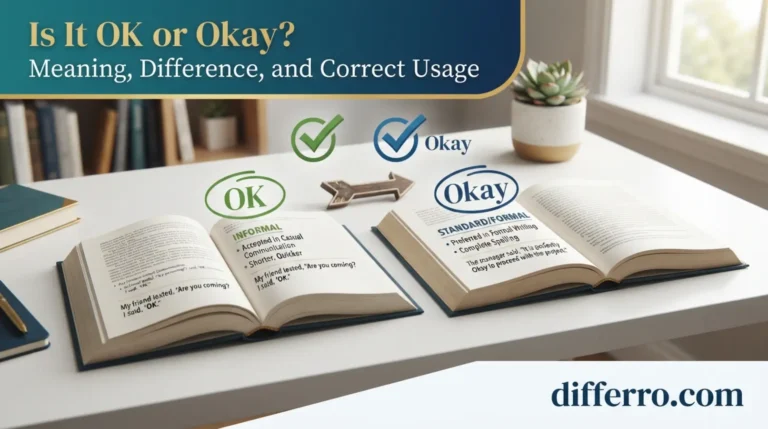
Is it OK or okay? Both spellings are correct, and both express agreement, approval, or acceptance. However, many English learners wonder which version they should use in everyday writing.
The word OK often appears in text messages, emails, and short responses. The spelling okay also works in casual conversations, professional emails, and formal writing. Neither spelling changes the basic meaning of the word.
Your choice usually depends on your writing style, audience, and personal preference. Some people prefer OK because it looks short and direct. Others choose okay because it looks more like a conventional English word.
This guide explains the meaning of OK and okay, their origins, and their differences. You will also find common mistakes, everyday examples, and simple tips for choosing the correct spelling.
⭐ Quick Answer
Both OK and okay are correct English spellings. They mean acceptable, satisfactory, or all right. Use either spelling in everyday writing, but follow your organization’s style guide in formal documents.
Example: Is it OK if I arrive late?
Example: Is it okay if I arrive late?
Both sentences are correct.
📖 Meaning of OK
OK means acceptable, satisfactory, agreed, or in a satisfactory condition. People use it to express approval, confirm information, or describe how something feels.
OK often appears in messages because it is short and easy to recognize.
Examples:
- Your homework is OK, but you can improve it.
- OK, I will meet you at the library.
📖 Meaning of Okay
Okay has the same meaning as OK. It can express agreement, approval, acceptance, or a satisfactory condition.
Writers often choose okay when they want the word to look more like a fully written word. It works in conversations, emails, stories, and many professional documents.
Examples:
- Your presentation looks okay to me.
- Okay, let’s begin the meeting.
🔍 Key Differences Between OK and Okay
OK and okay do not have a meaningful difference in definition. Their main difference involves spelling, appearance, and writing style.
| Feature | OK | Okay |
|---|---|---|
| Meaning | Acceptable or agreed | Acceptable or agreed |
| Tone | Short and direct | Natural and conversational |
| Usage | Texts, notes, emails, and general writing | Conversations, emails, articles, and general writing |
| Popularity | Widely recognized | Widely recognized |
| Formal writing | Acceptable when the style guide allows it | Acceptable when the style guide allows it |
| Grammar | Can function as an adjective, adverb, verb, or response | Can function as an adjective, adverb, verb, or response |
| Example | The plan is OK. | The plan is okay. |
Key takeaway: Neither spelling is universally better. Choose the form that suits your sentence and follow any required style rules.
📚 Origin and History of OK and Okay
The word OK became popular in the United States during the 1830s. It emerged from a humorous abbreviation of “oll korrect,” an intentionally misspelled version of “all correct.”
The expression gained wider attention in 1840 during the US presidential campaign of Martin Van Buren. His supporters used “OK” as a political slogan connected with his nickname, “Old Kinderhook.”
Over time, people adopted OK as a common expression of agreement and approval. The spelling okay developed as a written form that represents the same expression.
Today, both spellings are standard in English. You can use either one without changing the meaning.
Similar Words and Expressions
English has several expressions that communicate ideas similar to OK and okay.
- All right: Everything is satisfactory or acceptable.
- Fine: Something is acceptable or in good condition.
- Acceptable: Something meets the required standard.
- Agreed: Someone accepts a suggestion or proposal.
- Approved: Someone has given permission or consent.
- Sure: Someone agrees to a request or suggestion.
Examples:
- Your answer is all right.
- The quality is acceptable.
- Sure, I can help you tomorrow.
These expressions can sometimes replace OK or okay, but their meanings and tones may differ slightly.
🇬🇧 British English vs American English Spelling
Both OK and okay are accepted in British and American English.
American English commonly uses both forms in everyday communication and published writing.
British English also accepts both spellings, although individual publications may prefer one form.
| Feature | British English | American English |
|---|---|---|
| Accepted spelling | OK and okay | OK and okay |
| Everyday use | Both forms | Both forms |
| Formal documents | Follow the relevant style guide | Follow the relevant style guide |
| Meaning | Acceptable or agreed | Acceptable or agreed |
| Example | The arrangements are okay. | The arrangements are OK. |
Neither country has an exclusive claim to either spelling. Your choice depends more on context and editorial preference than on nationality.
✍️ When to Use OK
Use OK when you want a short, direct, and familiar expression. It works particularly well in brief responses, notes, messages, and informal communication.
1. In Text Messages
OK keeps your response short and clear.
Example: OK, I’ll call you tonight.
2. When Confirming a Plan
Use OK to acknowledge arrangements or show agreement.
Example: Is 10 a.m. OK for our meeting?
3. In Brief Notes
OK works well when space matters or you need a quick status update.
Example: The report is OK to send.
4. In Everyday Questions
Use OK to ask whether something is acceptable.
Example: Is it OK to park here?
5. In Professional Communication
OK can work in workplace messages when your organization’s style allows it.
Example: The revised schedule is OK with me.
Remember that OK is not automatically too informal for professional writing. Context and the document’s purpose matter.
✍️ When to Use Okay
Use okay when you prefer the fully spelled-out form. It often reads naturally in sentences, dialogue, explanatory articles, and conversational writing.
1. In Everyday Conversations
Okay works naturally when you respond to someone.
Example: Okay, I understand your point.
2. In Emails
Use okay when it suits the tone of your message.
Example: Your proposed changes look okay to me.
3. In Articles and Stories
Okay can fit naturally into explanations and dialogue.
Example: She asked whether everything was okay.
4. When Describing a Condition
Use okay to describe someone’s health, feelings, or circumstances.
Example: I’m feeling okay after a good night’s sleep.
5. In Professional Documents
Okay is acceptable in many professional contexts, but formal reports may require a more precise word.
Example: The initial results were okay, but further testing is necessary.
For a more precise or formal tone, consider words such as satisfactory, acceptable, or approved.
⚠️ Common Mistakes When Using OK or Okay
Although both spellings are correct, writers sometimes use them incorrectly or misunderstand their meaning.
Mistake 1: Thinking OK Is Incorrect
Incorrect claim: OK is always a misspelling of okay.
Correct explanation: OK is a standard English spelling. You can use it instead of okay.
Example: Your suggestion is OK.
Mistake 2: Thinking Okay Is Only Informal
Incorrect claim: You can use okay only in casual conversations.
Correct explanation: Okay appears in many types of writing, although formal documents may require more precise wording.
Example: The patient reported feeling okay after resting.
Mistake 3: Using Both Forms Inconsistently
Problem: A document switches between OK and okay without a clear reason.
Better approach: Choose one spelling for consistency unless your style guide says otherwise.
Example: The equipment is okay. The results are okay. The final check is okay.
Mistake 4: Using OK When You Need a Precise Word
Problem: A formal report says a product is OK without explaining its actual condition.
Better approach: Use a more specific term when accuracy matters.
Example: The product meets all safety requirements.
This sentence communicates more information than “The product is OK.”
Mistake 5: Confusing Agreement With Quality
OK and okay can express agreement or describe something acceptable. However, they do not always mean excellent.
Example: The meal was okay, but it was not outstanding.
Use words such as excellent, outstanding, or exceptional when you want to express stronger approval.
🧠 Easy Trick to Remember
Remember this simple rule:
OK = short spelling. Okay = fully spelled-out form.
Both spellings have the same basic meaning. Neither is inherently more correct than the other.
Use these quick reminders:
- Choose OK for short replies and brief messages.
- Choose okay when you prefer a word-like appearance in sentences.
- Follow your style guide when writing for a company, school, or publication.
- Use a more precise word when the context requires clear details.
Memory tip: If you can replace OK with okay without changing the sentence’s meaning, both spellings will usually work.
💬 Everyday Life Examples: OK or Okay
Here are five everyday situations that show how to use OK and okay naturally.
Example 1: Asking for Permission
Using OK: Is it OK if I borrow your pen?
Using okay: Is it okay if I borrow your pen?
Both questions politely ask for permission.
Example 2: Confirming a Meeting
Using OK: Is 3 p.m. OK for our meeting?
Using okay: Is 3 p.m. okay for our meeting?
Both sentences ask whether the proposed time suits the other person.
Example 3: Checking on a Friend
Using OK: Are you OK after the accident?
Using okay: Are you okay after the accident?
Both sentences ask about someone’s condition. In serious situations, ask more specific questions when necessary.
Example 4: Agreeing With a Suggestion
Using OK: OK, let’s take the earlier bus.
Using okay: Okay, let’s take the earlier bus.
Both responses show agreement with the suggestion.
Example 5: Describing Work Quality
Using OK: Your first draft is OK, but it needs editing.
Using okay: Your first draft is okay, but it needs editing.
Both sentences describe work that meets a basic standard but needs improvement.
Use these phrases where they genuinely help answer readers’ questions. Avoid repeating them unnaturally throughout the article.
🌎 Google Trends and Usage Data: USA, UK, Australia, India, and Pakistan
OK and okay are familiar expressions across English-speaking communities, including the USA, UK, Australia, India, and Pakistan.
Their relative search interest may change by country, period, and search wording.
Google Trends reports normalized search interest rather than exact search volumes, so it cannot establish a universal winner without a defined comparison.
For reliable country-level SEO decisions, compare the exact search terms over the same period and inspect each country’s results separately.
Comparison Table: Keyword Variations
| Keyword variation | Search intent | Best content angle |
|---|---|---|
| Is it OK or okay | Spelling clarification | Explain that both are correct |
| OK vs okay | Direct comparison | Compare spelling and usage |
| Is OK correct English | Grammar question | Confirm standard usage |
| Is okay formal | Formality question | Explain context and style |
| Okay or OK in British English | Regional usage | Explain that both forms work |
| OK or okay in American English | Regional usage | Explain accepted spellings |
| Is it okay to say OK | Everyday usage | Give natural examples |
SEO insight: The exact phrase “is it OK or okay” targets readers who want a quick spelling decision. Answer that question immediately, then support it with examples, usage guidance, and related questions. Do not invent country-specific search figures without checking live data.

⚖️ Final Verdict: Is It OK or Okay?
Both OK and okay are correct. They share the same basic meaning, and neither spelling is universally better.
Choose OK when you want a short, direct expression. Choose okay when you prefer the fully spelled-out form. Both work in everyday conversations, text messages, and many professional situations.
For formal writing, follow your organization’s style guide. When precision matters, consider replacing either spelling with a clearer word, such as acceptable, satisfactory, or approved.
The most important rule is simple: use the spelling that fits your context and remain consistent throughout your writing.
❓ Frequently Asked Questions
1. Is it correct to write OK or okay?
Yes. Both OK and okay are standard English spellings. They express agreement, acceptance, or a satisfactory condition. You can use either form in most everyday situations.
2. What is the difference between OK and okay?
The main difference is spelling and style. OK is shorter, while okay spells out the expression. Both generally have the same meaning and grammatical uses.
3. Which is more common, OK or okay?
Both forms are widely used. Their relative popularity varies across contexts, publications, and search queries. A specific answer requires a defined source and time period.
4. Should I use OK or okay in formal writing?
Both can appear in professional writing. However, formal reports and academic documents may benefit from precise alternatives, such as acceptable or satisfactory. Always follow the required style guide.
5. Why do people confuse OK and okay?
People confuse them because the spellings look different but mean essentially the same thing. The unusual origin of OK also makes some writers assume that okay is the only correct form.
Conclusion
The choice between OK and okay is simple because both spellings are correct. They express agreement, acceptance, or a satisfactory condition. The main difference lies in their appearance, not their meaning.
Use OK when you want a short and direct response. Choose okay when you prefer the fully spelled-out form. Both spellings work in everyday conversations, messages, and many professional documents.
For formal writing, follow your organization’s style guide and choose precise words when the situation requires them. You do not need to worry about using one spelling over the other in ordinary communication.
Remember: OK and okay are both acceptable English. Choose the form that suits your writing style, audience, and purpose.

Imran Lodhra is a comparison-focused content writer at Differro.com.
He specializes in creating clear, simple, and informative comparison articles.
His work helps readers understand key differences, pros and cons, and important details.
Imran focuses on accurate, practical, and easy-to-read content for everyday readers.
1 thought on “Is It OK or Okay? Meaning, Difference, and Correct Usage”