
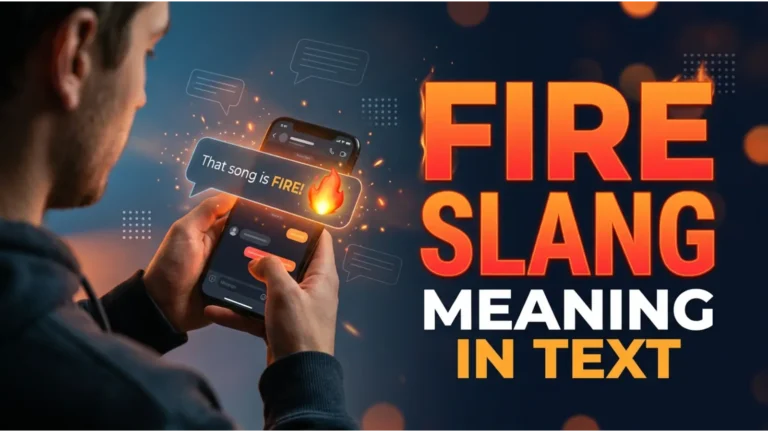
Fire slang meaning refers to something excellent, exciting, attractive, or impressive. If you have seen someone comment “That outfit is fire” or “This song is fire” on Instagram, TikTok, Snapchat, or in a text message, they are probably giving a compliment.
In modern internet slang, the word fire usually expresses strong approval or excitement rather than referring to actual flames.
People search for this expression because slang often changes the meaning of familiar English words. Understanding it can help you follow online conversations, respond naturally to friends, and understand comments on trending posts.
Although fire is generally positive, its meaning can depend on the situation, tone, and surrounding words. It can describe music, fashion, food, skills, achievements, and even a person’s overall style.
Quick Answer:
Fire means amazing, excellent, impressive, or really good in slang. It is commonly used to compliment something or show excitement in text messages and on social media.
What Does Fire Mean in Text?
In texting, fire is an informal slang term used to describe something outstanding, stylish, exciting, or highly enjoyable. It is similar to saying “awesome,” “fantastic,” or “incredible.”
For example:
- “Your new shoes are fire!” means your shoes look amazing.
- “This playlist is fire” means the music is excellent.
- “That performance was straight fire” means the performance was extremely impressive.
The expression is popular among younger internet users, music fans, gamers, and people who communicate through social media.
Unlike the literal meaning of fire, which refers to combustion or flames, the slang meaning communicates enthusiasm and approval.
Fire Slang Full Form
People sometimes search for the fire slang full form, but fire is not an acronym and has no official full form in this usage. It is an ordinary English word that developed a figurative meaning.
When someone calls something fire, they generally mean it is exceptionally good or exciting.
Fire Meaning in Different Contexts
The meaning of fire can change slightly depending on what someone is describing.
1. Fire in Text Messages
In text messages, fire is usually a quick way to express excitement or admiration.
Examples:
- “Your new haircut is fire!”
- “That idea is fire.”
- “Bro, this movie is fire.”
It helps people communicate enthusiasm without writing a long explanation.
2. Fire on Instagram and TikTok
On Instagram and TikTok, fire frequently appears in comments, captions, and direct messages.
For example:
- “Fire fit!” means the outfit looks fantastic.
- “Your latest reel is fire” means the video is impressive.
- “This trend is fire” means the trend is exciting or appealing.
The 🔥 emoji often communicates the same meaning. A comment containing only this emoji can be a compliment, although the precise intention depends on the post and relationship between the users.
3. Fire in Music and Entertainment
The term is especially common when discussing songs, performances, and creative work.
Examples:
- “The new album is fire.”
- “Her vocals are absolutely fire.”
- “That DJ set was fire last night.”
In these examples, fire means the music or performance is exceptionally good.
4. Fire in Fashion and Appearance
People also use fire to compliment clothing, hairstyles, makeup, and personal style.
For example, “Your outfit is fire” means the outfit looks stylish and attractive.
Depending on the situation, the compliment may refer to the person’s appearance, the clothes themselves, or the overall look.
Is Fire Slang Rude, Offensive, or Neutral?
Fire is generally positive, informal, and non-offensive. It is commonly used as a compliment among friends and in casual online conversations.
However, the appropriateness of the word depends on the setting.
- With friends: Perfectly normal in casual conversation.
- On social media: Common in comments and captions.
- At school: Usually fine in informal conversations, depending on school rules.
- At work: Acceptable in relaxed environments, but more formal language may be better in professional emails.
- During serious conversations: It may sound inappropriate if someone expects sympathy or a serious response.
For example, telling a friend “Your presentation was fire” is a positive compliment. However, using the same expression during a serious discussion about an emergency could seem insensitive.
The word itself is not offensive, but the context determines whether it is appropriate.
Where Is Fire Slang Commonly Used?
Fire is widely recognized in online communication, particularly in informal English.
Common places include:
- TikTok: Complimenting videos, dances, and trends.
- Instagram: Praising outfits, photographs, and reels.
- Snapchat: Reacting to friends’ pictures and stories.
- WhatsApp: Sharing excitement about music, food, or experiences.
- Discord: Praising gaming skills, artwork, or creative ideas.
- YouTube: Commenting on songs, videos, and performances.
- Everyday conversations: Expressing admiration for something impressive.
Although it is especially visible on social media, people also use fire in spoken conversations.
Real-Life Conversation Examples of Fire Slang
Here are realistic examples showing how people use fire in different situations.
Friendly Examples
Example 1
Alex: “I bought a new jacket yesterday.”
Sam: “That jacket is fire!”
Meaning: Sam thinks the jacket looks excellent.
Example 2
Mia: “Listen to this song I found.”
Ella: “Wow, this track is fire!”
Meaning: Ella really likes the song.
Casual Examples
Example 3
Friend 1: “How was the restaurant?”
Friend 2: “The food was fire. We should go again.”
Meaning: The food was delicious.
Example 4
Friend 1: “Did you watch the final match?”
Friend 2: “Yeah, that last goal was fire!”
Meaning: The goal was exciting and impressive.
Argumentative Examples
Fire is usually positive, but it can appear in sarcastic or argumentative conversations.
Example 5
Alex: “You said my presentation was boring.”
Jordan: “I never said that. I actually thought it was fire.”
Meaning: Jordan clarifies that the presentation was excellent.
Example 6
Chris: “You keep saying that song is fire, but I don’t like it.”
Taylor: “That’s fine. Everyone has different tastes.”
Meaning: The speakers disagree about the song’s quality. The word fire itself remains positive.
Usage in Different Contexts
| Context | Example | Meaning |
|---|---|---|
| Fashion | “Those sneakers are fire.” | Stylish or attractive |
| Music | “This beat is fire.” | Excellent or exciting |
| Food | “That burger is fire.” | Delicious |
| Gaming | “Your gameplay is fire.” | Very impressive |
| Photography | “Your pictures are fire.” | Excellent or beautiful |
| Achievements | “Your performance was fire.” | Outstanding |
| Social media | “That post is fire.” | Appealing or impressive |
Emotional and Psychological Meaning of Fire
Fire communicates more than simple approval. It can express excitement, admiration, enthusiasm, and a sense of shared enjoyment.
When someone says “That’s fire,” they may be expressing:
- Excitement: They find something thrilling or entertaining.
- Admiration: They appreciate someone’s talent or appearance.
- Approval: They believe something is excellent.
- Connection: They share enthusiasm with friends or an online community.
- Confidence: They want to give a strong, memorable compliment.
The word is also useful because it communicates a strong reaction in just one or two words.
However, not everyone uses slang in the same way. Some people use fire frequently, while others prefer expressions such as “amazing” or “excellent.”
Origin and Background of Fire Slang
The figurative use of fire has roots in African American English and Black cultural expression, with strong associations with music, particularly hip-hop and related popular culture.
Fire has long been used metaphorically to describe something powerful, exciting, or impressive. The expression became especially visible through music, entertainment, and youth culture before spreading widely across online communities.
Social media platforms helped popularize phrases such as “that’s fire,” “straight fire,” and “on fire.”
Today, the term is used internationally by people who communicate in English online. Its popularity reflects a broader pattern in which ordinary words develop new meanings through music, culture, and internet trends.
There is no single universally agreed date when the slang meaning began, and its development predates modern social media.
Fire vs. Similar Slang Terms
Several slang expressions have meanings similar to fire, but they are not always interchangeable.
| Slang term | Meaning | Example |
|---|---|---|
| Fire | Excellent or impressive | “This song is fire.” |
| Lit | Exciting, fun, or lively | “The party was lit.” |
| Dope | Cool or impressive | “Those shoes are dope.” |
| Sick | Extremely good or impressive | “That trick was sick.” |
| Banger | An exceptionally good song or track | “This song is a banger.” |
| Heat | Something excellent, especially music or creative work | “The artist dropped some heat.” |
| GOAT | Greatest of all time | “She’s the GOAT.” |
Fire vs. lit: Fire often describes the quality of something, while lit frequently describes an exciting event or atmosphere. Both words can overlap.
Fire vs. dope: Both are compliments. Dope can sound more closely associated with coolness or style, while fire often expresses strong enthusiasm.
Fire vs. banger: Fire can describe almost anything impressive, whereas banger is most commonly used for an excellent song or track.
Common Misunderstandings About Fire Slang
People unfamiliar with internet slang can misunderstand this expression.
Here are some common mistakes:
- Taking it literally: “Your outfit is fire” usually does not mean the clothes are burning.
- Thinking it is an acronym: Fire does not have an official slang full form.
- Assuming it always describes appearance: It can also describe food, music, skills, and ideas.
- Confusing it with anger: In slang, fire usually expresses approval rather than anger.
- Assuming every use is sincere: Someone can use the word sarcastically, depending on their tone.
- Thinking it is only used online: People also say fire in everyday conversations.
Understanding the complete message makes it easier to identify the intended meaning.
Variations and Types of Fire Slang
Fire appears in several common expressions.
That’s Fire
A simple way to say that something is excellent.
Example: “Your new design is fire.”
Straight Fire
A stronger expression used to emphasize quality.
Example: “The entire album is straight fire.”
On Fire
This expression can mean performing exceptionally well or experiencing a series of successes.
Example: “She’s scored three goals today. She’s on fire!”
Unlike “that song is fire,” which describes quality, “on fire” often describes a person or team performing exceptionally well.
Fire Emoji 🔥
The fire emoji can express excitement, approval, attractiveness, or enthusiasm.
Example: “Your new profile picture 🔥”
Depending on the relationship and situation, it may also communicate flirtation or attraction.
Drop Fire
This can mean releasing something excellent, especially music or creative content.
Example: “The producer keeps dropping fire tracks.”
When to Use Fire Slang and When to Avoid It
Fire works best in informal situations where the other person understands contemporary slang.
Use it when:
- Complimenting a friend’s outfit or hairstyle.
- Praising music, videos, artwork, or creative projects.
- Reacting to an exciting performance.
- Sharing enthusiasm in group chats.
- Commenting casually on social media.
Avoid it when:
- Writing a formal business report.
- Communicating with someone who may not understand slang.
- Writing academic assignments that require formal language.
- Responding to a serious or sensitive situation where casual enthusiasm may seem disrespectful.
For professional communication, alternatives such as “excellent,” “impressive,” “outstanding,” and “well done” can sound more appropriate.
Polite Alternatives to Fire
Fire is not offensive, so you generally do not need a polite substitute. However, other expressions may fit particular audiences or situations better.
| Alternative | Best use |
|---|---|
| Excellent | Professional and academic settings |
| Amazing | Everyday compliments |
| Impressive | Praising someone’s skills |
| Fantastic | Friendly or professional communication |
| Outstanding | Recognizing exceptional performance |
| Stylish | Complimenting clothing or appearance |
| Delicious | Praising food |
| Well done | Recognizing an achievement |
For example, instead of writing “Your presentation is fire” in a formal email, you could say, “Your presentation was excellent and very engaging.”
How to Respond When Someone Says Fire
Your response depends on what the other person is complimenting.
Here are some natural replies:
- “Thank you!” — A simple response to a compliment.
- “Glad you like it!” — Friendly and casual.
- “Appreciate it!” — Relaxed and informal.
- “Right? This song is amazing!” — When you share the same opinion.
- “Thanks, I worked hard on it.” — When someone praises your work.
- “Haha, you’re too kind!” — A playful response.
If someone comments with only a 🔥 emoji, you can respond with a thank-you, a smile, or another suitable emoji.
You do not need to use slang in return if it does not feel natural to you.
Regional and Cultural Usage of Fire Slang
Fire is widely understood in many English-speaking online communities, including the United States, the United Kingdom, Canada, and Australia.
Its use is particularly visible in music, youth culture, gaming, and social media. People in other countries also encounter the expression through international entertainment and online content.
However, familiarity varies by age, social group, and language background. Someone who regularly watches English-language videos may understand the slang immediately, while another person may interpret it literally.
The word can also carry different associations across communities. Understanding the surrounding conversation is more reliable than assuming everyone uses it in exactly the same way.
Why Do People Use Fire Slang?
People use fire because it is short, expressive, and easy to understand in casual settings.
The expression offers several benefits:
- It communicates strong approval quickly.
- It makes compliments sound enthusiastic.
- It fits naturally into text messages and social media comments.
- It helps people participate in online trends and shared cultural conversations.
- It adds an informal, energetic tone to everyday communication.
For many people, saying “That is fire” feels more expressive than simply saying “That is good.”
However, slang should support communication rather than make messages confusing. Using familiar language for the audience is always a sensible choice.
Is Fire Slang Safe for Social Media?
Yes. Fire is generally safe for ordinary social media use and is not inherently offensive or inappropriate.
You can normally use it in captions, comments, messages, and posts to express admiration or excitement.
For example:
- “New song is fire 🔥”
- “Your artwork is absolutely fire.”
- “This recipe looks fire!”
Still, context matters. The fire emoji can sometimes be interpreted as flirtatious when directed at someone’s appearance, and a literal fire reference can be inappropriate in conversations about actual emergencies.
As with other slang, consider your audience and the subject before posting.
Frequently Asked Questions
1. What is the fire slang meaning in text?
Fire means amazing, excellent, impressive, or exciting. People use it to compliment something they really like.
2. What does fire stand for in slang?
Fire does not stand for a specific phrase. It is an ordinary English word used figuratively to describe something outstanding or appealing.
3. What does 🔥 mean in a text message?
The 🔥 emoji often means something is excellent, attractive, exciting, or impressive. Its exact meaning depends on the conversation.
4. Is calling someone fire a compliment?
Usually, yes. It can compliment someone’s appearance, clothing, talent, or performance. In some situations, it may also sound flirtatious.
5. Is fire slang still popular in 2026?
Yes. Fire remains a recognizable slang expression in online conversations, music culture, and social media. However, individual usage and popularity vary between communities.
6. What is the difference between fire and lit?
Fire often describes something excellent, while lit frequently describes an exciting or energetic experience. Both can be used positively, and their meanings sometimes overlap.
Conclusion
The fire slang meaning is simple: it describes something amazing, impressive, exciting, or exceptionally good. Whether someone says “That song is fire,” “Your outfit is fire,” or leaves a 🔥 emoji under your picture, they are usually expressing enthusiasm or giving a compliment.
Fire is an informal expression commonly used in text messages, social media comments, music discussions, and everyday conversations. It is not an acronym, does not have an official full form, and is generally not offensive.
The most important thing is to understand the context. Use fire with friends and in relaxed online conversations, and choose more formal alternatives when writing professional or academic content. Once you understand the meaning and tone, you can recognize the expression and use it naturally in everyday English.
Ali Raza is an M.Phil. scholar and English language expert specializing in English grammar, slang meanings, vocabulary, and everyday expressions. He writes clear, practical, and easy-to-understand content that helps readers master confusing English words, phrases, spelling, and modern slang. His goal is to make English learning simple, useful, and accessible for students, beginners, and everyday readers.
3 thoughts on “Fire Slang Meaning in Text and Social Media Explained”